

Feminist uprisings in a maelstrom of war
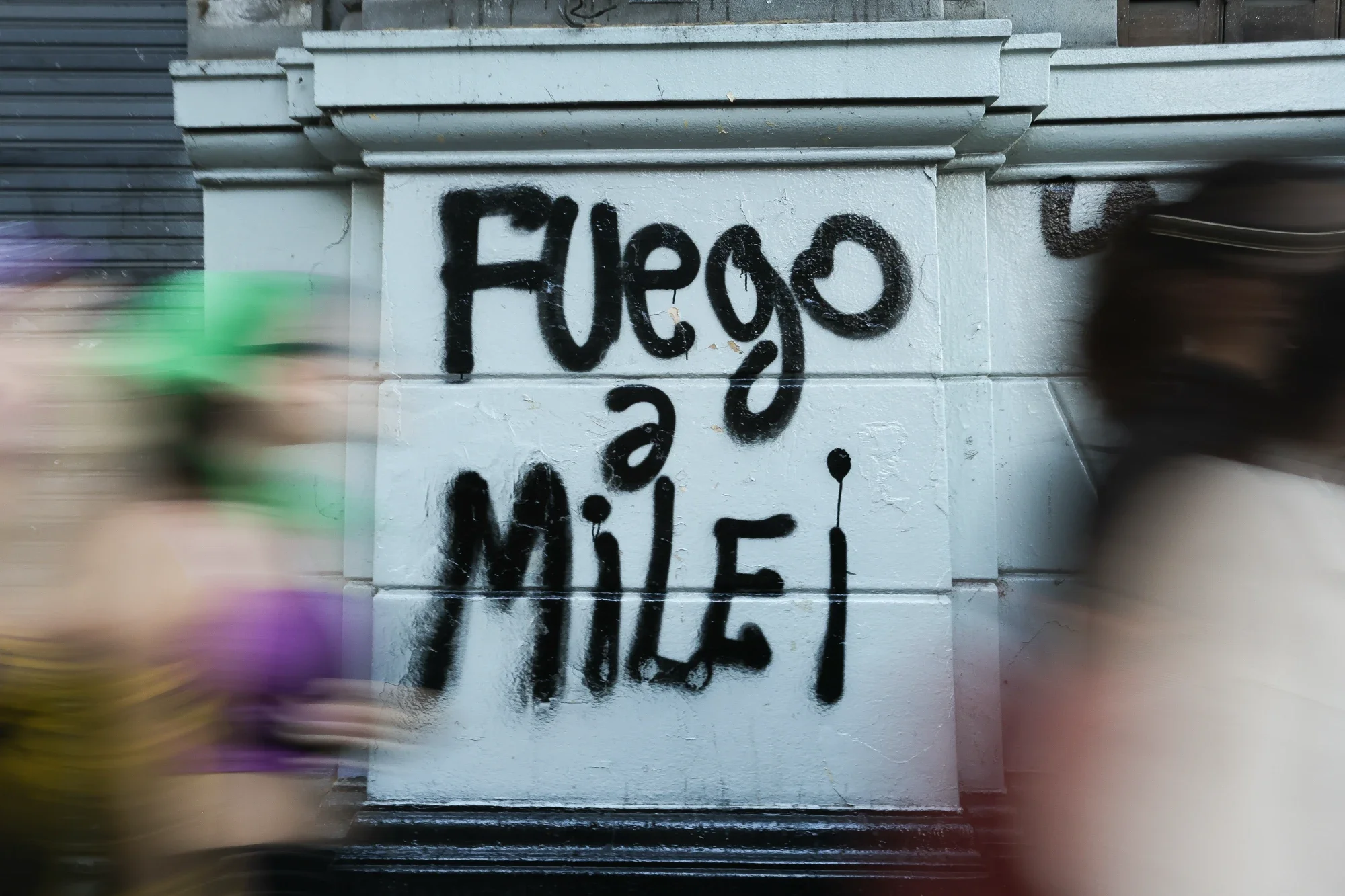
Graffiti reading “Set fire to Milei” during the International Women’s Day march held on March 9, 2026, in Buenos Aires, Argentina. Photo © Susi Maresca.
Opinion • Raquel Gutiérrez Aguilar • April 10, 2026 • Leer en castellano
The International Working Women’s Day protests across Abya Yala this year again showcased our ability to come together and fight shoulder to shoulder. They demonstrated our ability to build mutual support and create safe havens amid the hurricane of devastation unleashed by the loudest and most irresponsible forces of patriarchy.
March 8 is a sweeping and powerful day of struggle that lays bare many tears in the fabric of life, which are aggravated by violent and reckless acts of war. The connection between militarization, extractivism, looting, exploitation, and threats to the reproduction of life is becoming clearer around the world. In turn, hundreds of thousands of women and gender dissidents are mobilizing to affirm and support one another.
A year of war and struggle
This year's colorful and vibrant masses of women, trans people, and non-binary individuals in the streets stood in even sharper contrast, even more so than previous years, to the grim future promised by traditional patriarchal, capitalist, and colonial policies, which have left a trail of death, disappearances, open warfare, impunity, and plunder throughout the region.
This year began with the underhanded attack on Venezuela, when, in addition to seeking control of the country’s oil wealth, United States military forces kidnapped Nicolas Maduro and Cilia Flores and reinforced the power of the sitting government.
There has also been a series of brazen assassinations of working-class people whom the Trump administration labeled with the loose term “narco-terrorists.” This is the excuse used to justify an increase in systematic extrajudicial executions, endorsed by right-wing administrations in the region, which are shrouded in impunity.
Later, the US tightened the long-standing blockade against Cuba, condemning its population to even harsher conditions of deprivation.
Then, on the last day of February, alongside the Zionist regime, the powers controlling extractive industries, finance, and military forces chose to renew their war against Iran and expand it deep into Lebanon. These are the same genocidal forces that, in 2025, destroyed all the infrastructure essential to life in Gaza.
And so we arrived on March 8, with the threat of widespread war growing ever fiercer.
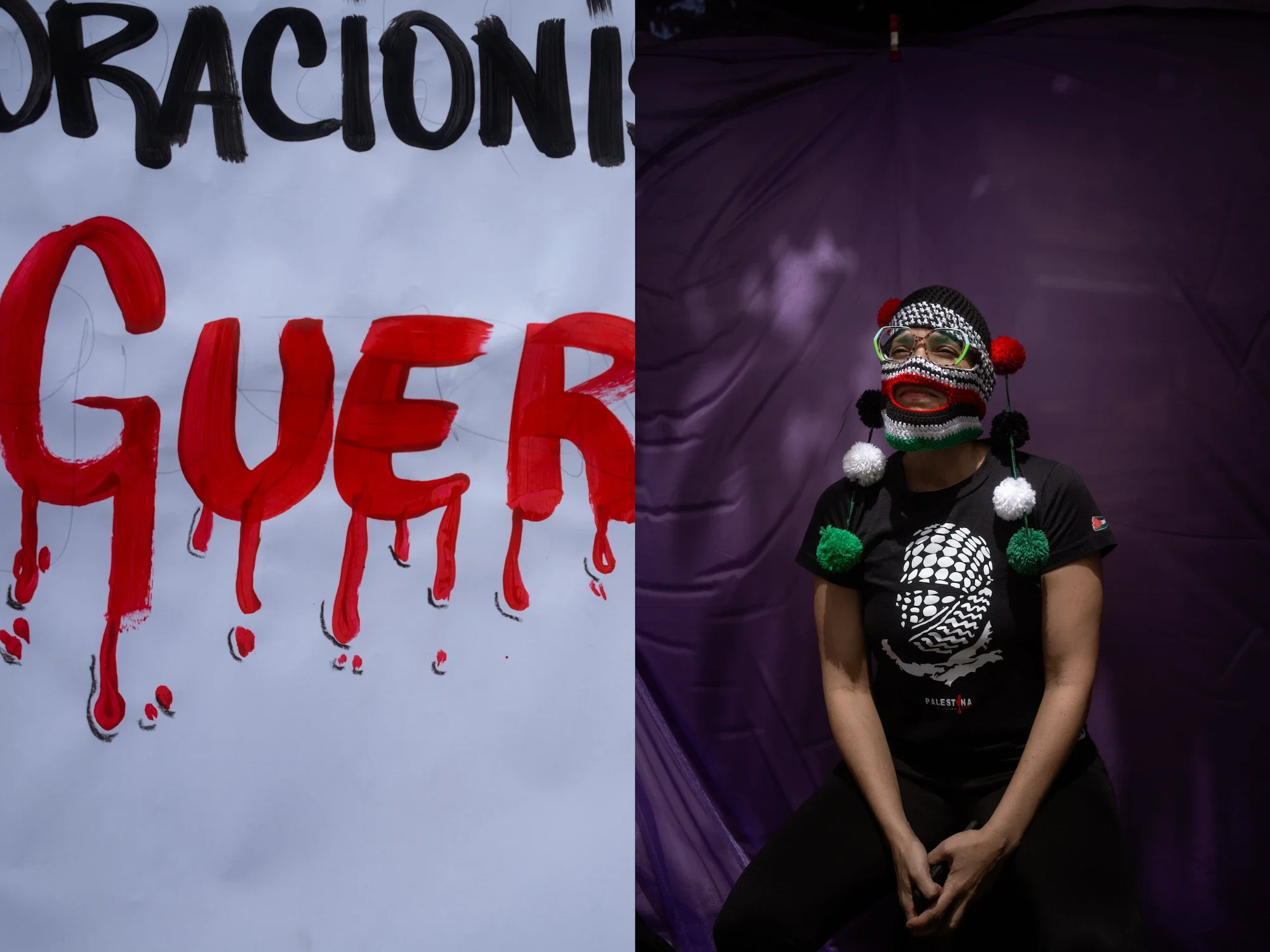
Left: A sign protesting war at the International Women's Day demonstration. Right: A protester at the International Women’s Day demonstration in Brión Square in Caracas, Venezuela, on March 8, 2026. Photo © Andrea Hernández Briceño.
IWD from South to North
In Argentina, rallying under the motto “We must work to unite our struggles,” a massive wave of protesters once again took to the streets on March 8 to condemn the economic policies of Javier Milei’s fraudulent and ridiculous government. Their demonstration brought together condemnations of femicides, demands for justice, and consolidated ongoing resistance against the onslaught promoted by the current administration.
These efforts resonate with the joyful mobilization of Puerto Rican compañeres who turned out for IWD in a display of dignity against the gentrifying and abusive colonialism that continues to hold the island captive. They took to the streets with music and joy at the center, calling on people to remember the revolutionary history of Lolita Lebrón and placing sex workers at the forefront of their march.
For their part, our compañerxs from Chile are facing a difficult present as Pinochet supporter Antonio Kast begins his term as president. Their energy and presence have fueled an atmosphere of resistance and defiance that spreads through the territories they defend in ongoing struggles.
In Colombia and Uruguay, activists are also keeping their guard up and organizing powerful and broad coalitions to keep their movement going. Their efforts weave memory, rebellion and disobedience.
In Mexico, the population is caught between militarization and paramilitary violence, and there were very strong expressions of condemnation of the exacerbated and widespread violence that shows no sign of stopping. From searching mothers to families of the murdered women and girls demanding justice, folks mobilized across the country to build a collective cry of ¡basta! to halt the killings.
Mexico City saw a massive turnout of women converging to create a vast and diverse sea of purple that Sunday. I was struck by how many participated with their families, as several generations of women from the same family walked side by side: young girls and teenagers alongside their mothers, aunts, and grandmothers. Laughing and eating sweets, it was a Sunday unlike any other: we felt united with so many others fighting against death and impunity.
What will this feminist and intergenerational street presence contribute to a profound redefinition of what we imagine family to be—a concept so central to the patriarchal order?
Across the continent, from capital cities to small towns, the March 8 protests are a barometer measuring collective organizing, and the development of skills that have been honed, nurtured, and expanded over time. We must strengthen these skills throughout this year as we weather the onslaught of impending calamities.
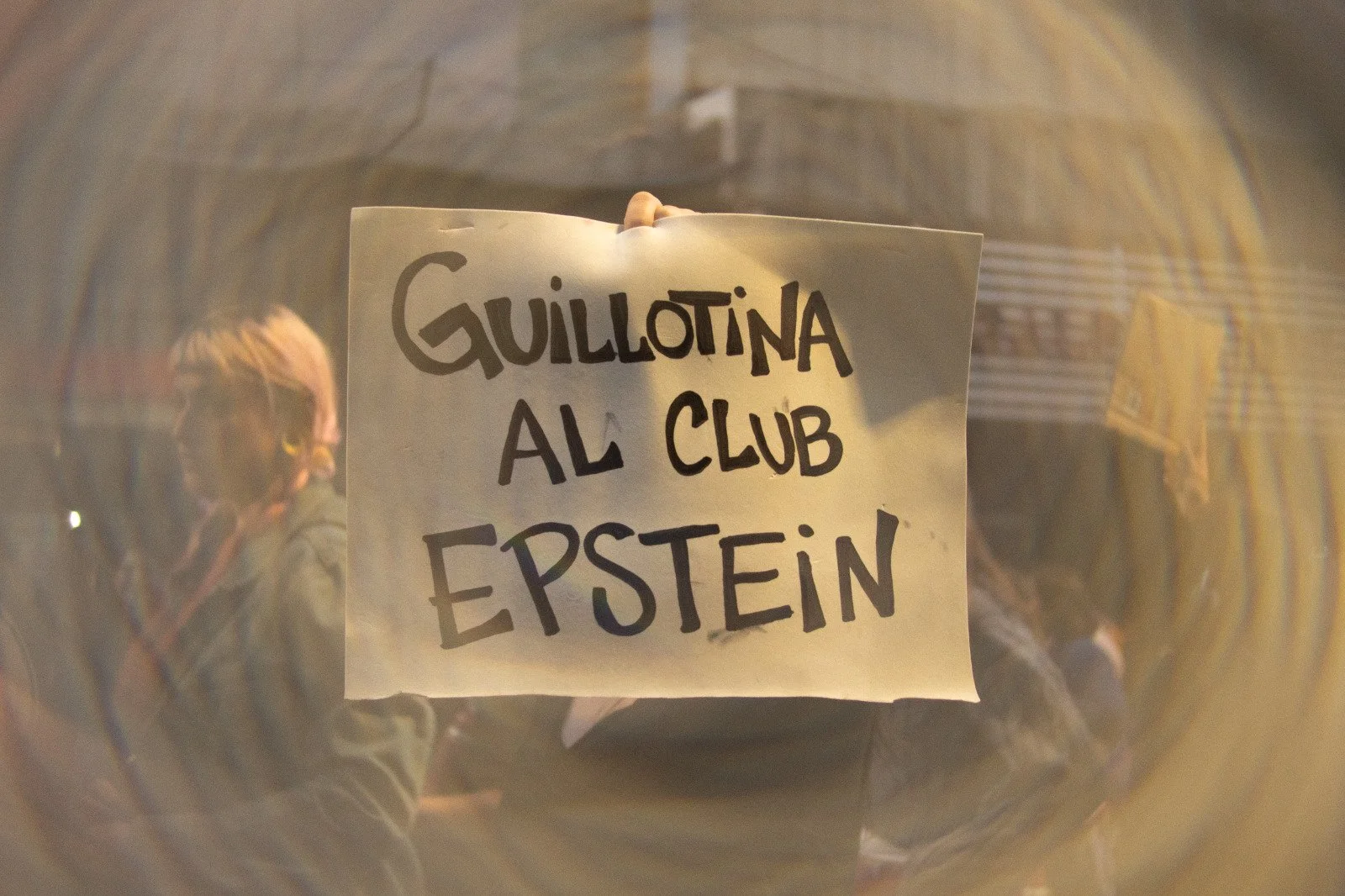
A protester holding a sign that reads “Guillotine the Epstein Club” on March 8, 2026, in Montevideo, Uruguay. Photo © Bettina Franco.
The assault on everyday life
War is spreading around the world, giving rise to unpredictable scenarios. The ensuing tensions are already noticed and felt. War reorganizes alliances and rivalries between patriarchs and armies, but it also deeply impacts the conditions that guarantee social reproduction.
Public budgets are being redirected to ensure the existence and expansion of armies, the production of weapons, and the excessive growth of surveillance technologies and artificial intelligence for military purposes. All of this leads to cuts in already insufficient budgets destined to health, education, housing, access to drinking water, and food production.
These changes are playing out differently in each country, though we will all face rising fuel prices that will once again accelerate inflation in the price of basic goods. The daily struggle to sustain life will become even more difficult due to the labor precarity we already experience.
Unless we rebuild social weavings of reciprocity and mutual support, debt looms as a means of putting food on the table. This means surveillance and armed control of territories—by official and paramilitary forces—will become even more oppressive, amid hostile foreign interventions aimed at ensuring the plunder of resources necessary for survival.
We must continue to be organized and vigilant in the months ahead.
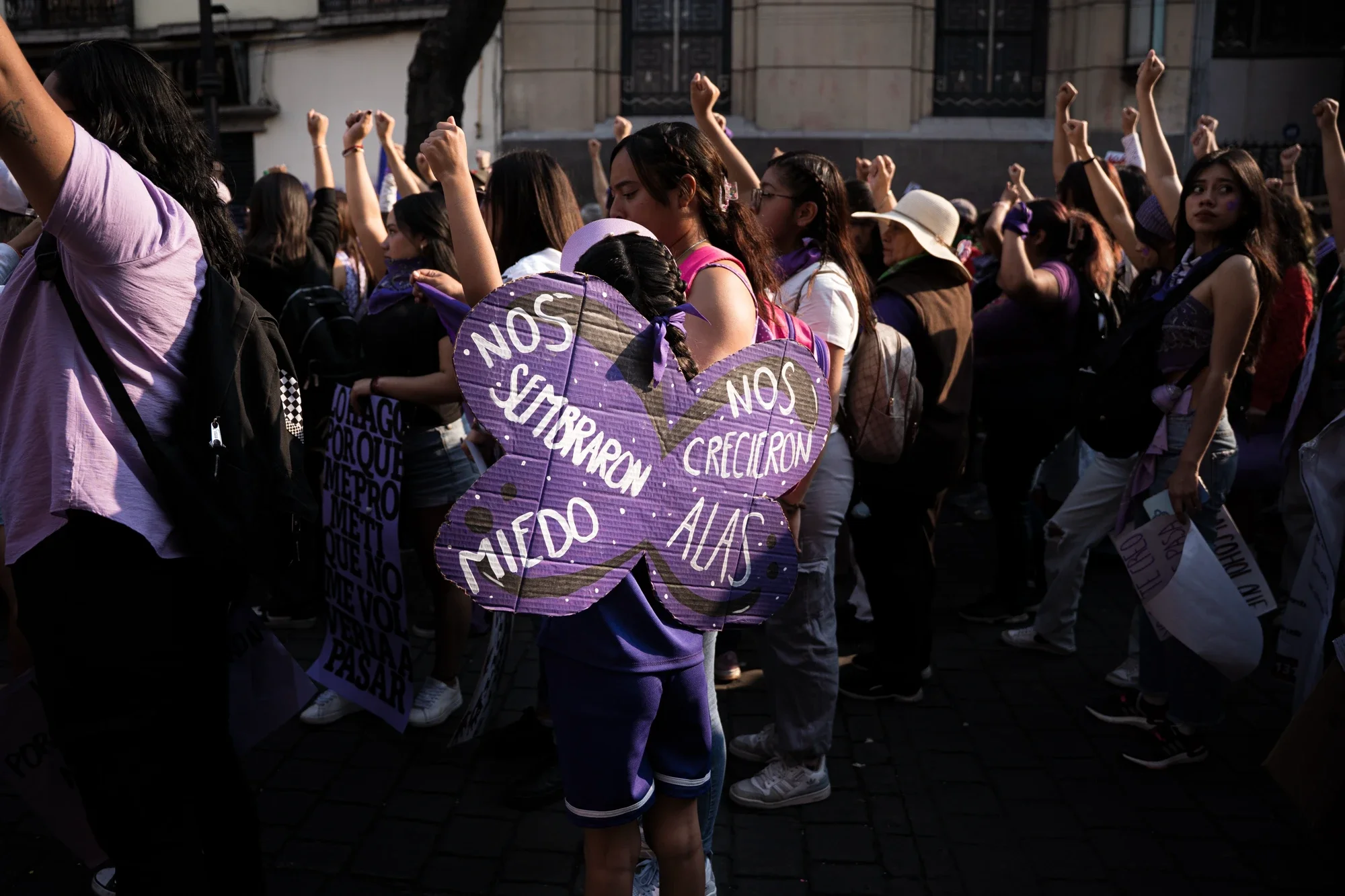
A child with wings bearing the words “They sowed fear in us, but we grew wings” surrounded by protesters raising their fists during the International Women’s Day march on March 8, 2026, in Mexico City. Photo © Aurea del Rosario.
Common sense anti-militarism
We insist on the urgent need to articulate a clear anti-militarist stance that organizes and amplifies resistance to war, to all wars, those taking place in other parts of the world and those spreading like a plague across this continent.
These are wars against the bodies of women and gender dissidents that are imposed on peoples and territories.
Rejecting militarism and overlapping, expanding wars against the fabric of life does not signal passivity, or resignation. On the contrary, it requires active mobilization—the collective cultivation of a common sense of dissidence that rejects the senseless destruction currently underway.
It also demands organization and support from the movement infrastructures transfeminists have been building over the past years. Our struggles against all forms of violence will require a deepening of their political content.
For now, we must continue to link our understanding of femicide to the damage wrought by policies of plunder and expropriation of material goods. The demand to end the impunity of femicides and perpetrators of all kinds of aggression must be woven together with economic justice in ways that are reflected at the dinner table and in our homes.
At Ojalá, we believe we are at a critical moment in the dispute over the conditions and horizons of social reproduction, in a world that’s crumbling under wars and threats of every kind.
Following this year's 8M demonstrations, which renewed our energy and filled us with hope, we want to contribute to broadening reflection and debate from the perspective of the diverse transfeminisms we practice. These are the perspectives that guide us as we struggle for social reproduction and the preservation of life.
As we begin our fourth year of reporting, analysis, outreach and translation at Ojalá, we reaffirm our commitment to engage, patiently but persistently, in the struggles to defend life.