

Rejection of violence drives March 8 actions in Monterrey
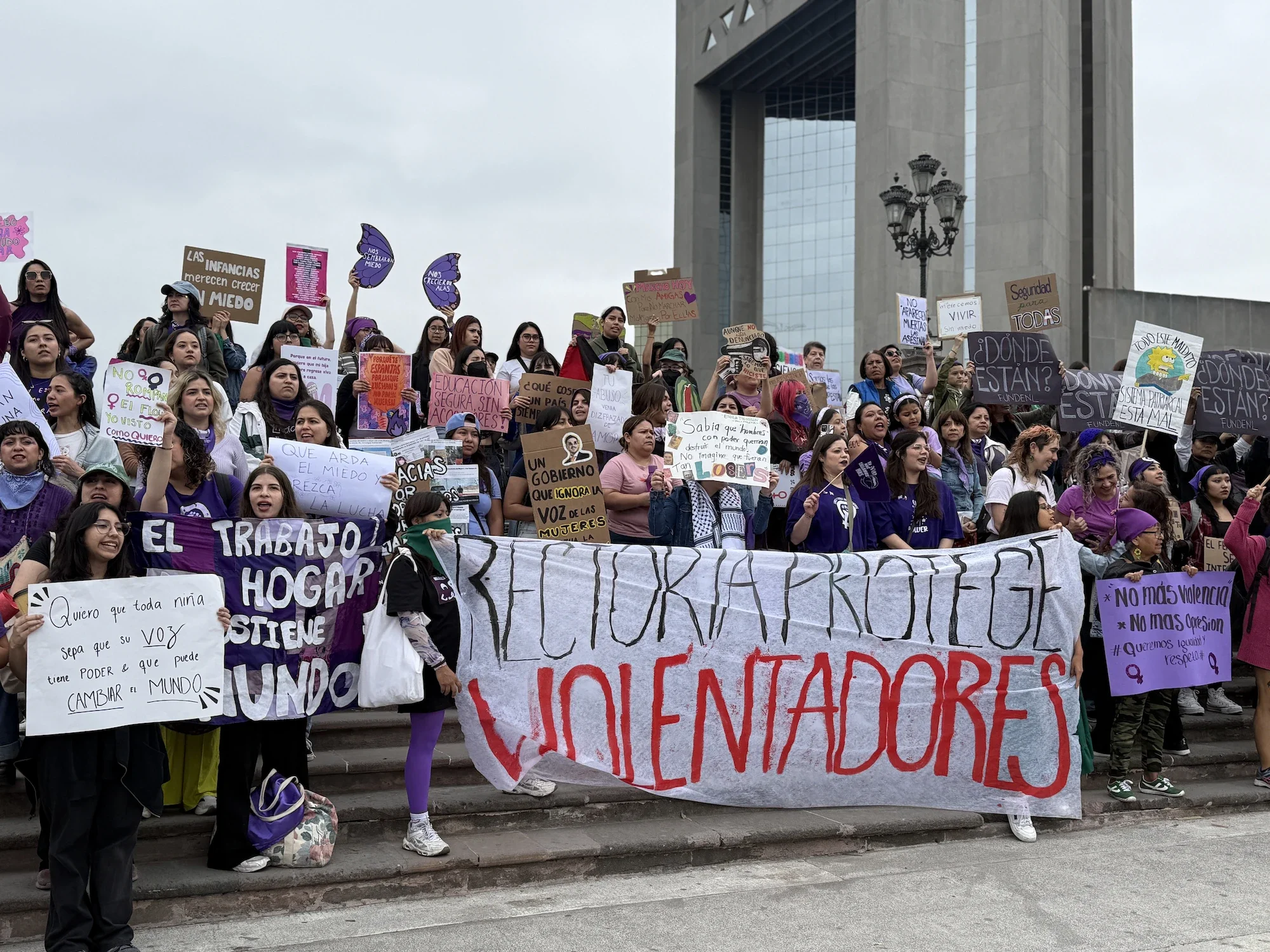
The diverse and inclusive International Women's Day march in Monterrey, Mexico ended with speeches in front of the Government Palace. Photo © Chantal Flores
Reportage • Chantal Flores • March 19, 2026 • Leer en castellano
Pamela Martínez and two of her friends hold up a banner that reads “Justice for Blanca Liliana López” in front of the Government Palace in Monterrey, Nuevo León, on International Women’s Day. López was killed at her home in January by a man who is a US citizen, and who remains on the run.
“We’re tired of watching this happen over and over. If you don’t have money in Nuevo León, nothing gets done, if you’re not the daughter of a governor, no one comes looking for you,” said Martínez, who said considered López a second mother. “Everything goes unpunished. Why should we stay silent when anyone can take my life and carry on with their own?”
The two 8M marches in Monterrey reflect a divided movement filled with tensions around the inclusion of transgender people. Both were marked by calls for the state government to address structural violence affecting women in Nuevo León. In the morning, the inclusive march condemned a lack of accountability as it made its way to the Government Palace, which is where the second march kicked off later that afternoon.
While Governor Samuel García promotes a “new Nuevo León” focused on innovation, social development, and security, feminists highlighted the devastating impact femicides and enforced disappearances have on families and communities, as well as the psychological and economic violence that harms women in the northern Mexican state.
From October to December 2025, 90 cases of femicide, including attempted femicide, were reported in Nuevo León. Amid raised fists and glitter-covered signs, the faces of murdered and disappeared women shone through the crowds that took the streets of downtown to demand the state and federal governments end gender-based violence.
Just before five in the afternoon, women from various organizations shouted in unison: “They took them alive, we want them back alive.” Among them was Mirna Covarrubias, who carried a small wooden cross painted purple with the letters DANY JMZ.
“They killed my daughter in 2016. I’m marching so what happened to me doesn’t happen to others,” said Covarrubias, Daniela’s mother and founder of the I Want To Live Without Violence Dany Jiménez association.
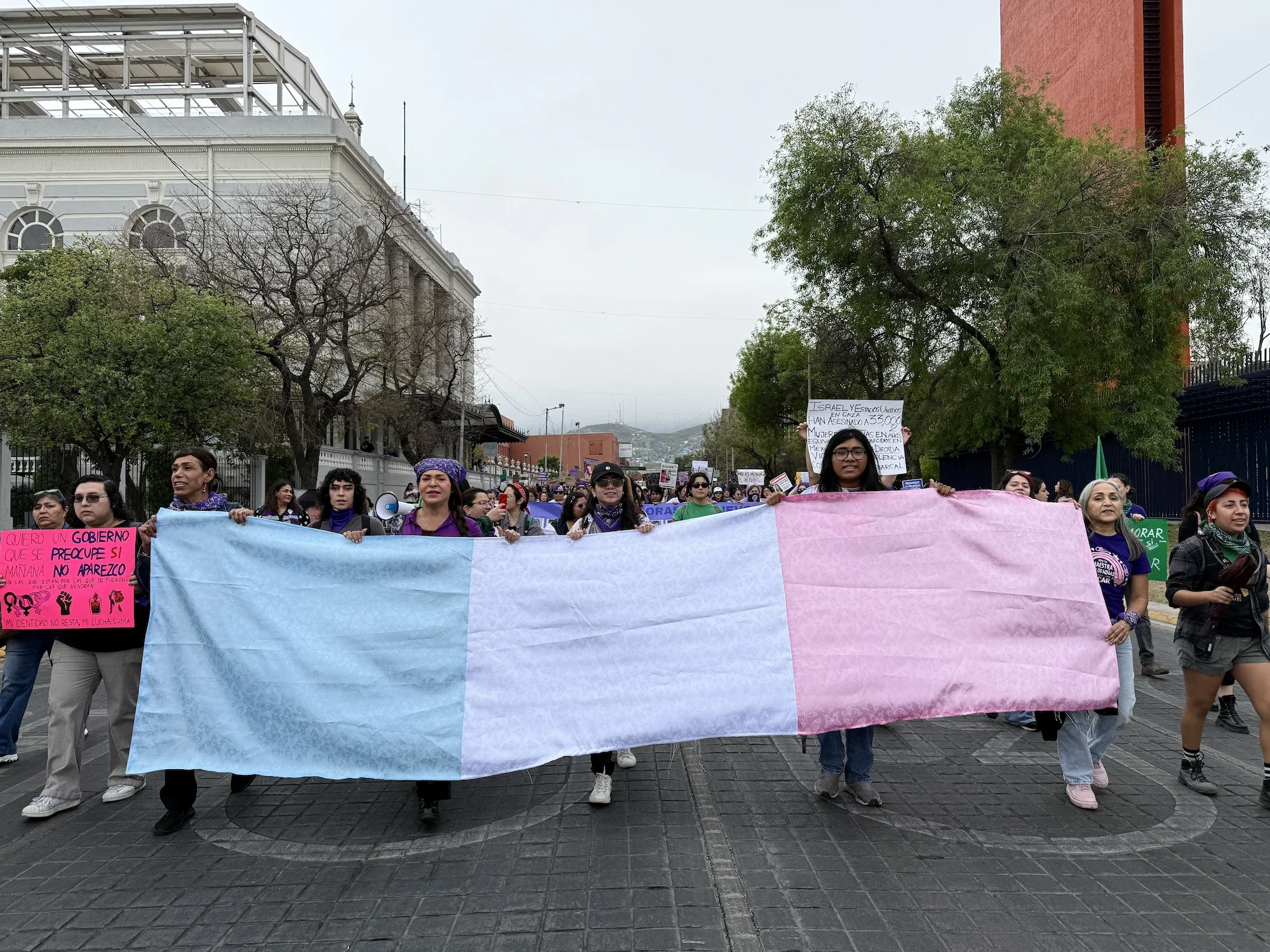
Activists and trans women demand rights and justice in the face of transfeminicides. March 8, 2026, Monterrey, Mexico. Photo © Chantal Flores
IWD, divided
Although Nuevo León has a decades-long history of activism, a rift emerged during the 2023 IWD march. Morras Feministas—a radical, separatist, trans-exclusionary collective—attempted to take a leadership role, even though they didn’t have a base of support among marchers. This led to physical altercations, the fragmentation of contingents, and changes to the planned route, and led several groups to withdraw from the march.
This year, the inclusive march began at 11 in the morning. Surum D’Lara, one of the organizers, explained that women with disabilities were the first to demand a new space where they could feel safe. They began advocating for an inclusive march, and this year managed to achieve a broader, more horizontal organizing structure.
“We all experience different forms of violence; and though we are all oppressed by patriarchy and by capitalism, our differences—like race and social class—also fragment us,” said D’Lara. “We all have the right to protest, and that is why we created this space collectively so that all voices could be heard.”
María Sánchez, a Zoque lawyer, said she saw this march as another step on the long-standing struggle that Indigenous women have been leading “all their lives,” primarily for the right to live with dignity and free from violence in their territories.
“In 2026, we remain invisible, we keep being disappeared, and we continue to be driven from our territories,” said Sánchez, who is a representative of Mexico’s National Network of Indigenous Women Lawyers.
President Claudia Sheinbaum declared 2025 the Year of the Indigenous Woman, but Sánchez pointed out that didn’t lead to real inclusion of Indigenous women.
“There is only some women who can occupy these spaces. Forced disappearances and femicides continue to rise, meaning that not all women are necessarily represented,” she said.
There were many students and university groups among the protesters. Ana Sofía Flores, from the “GirlUp Política” group at the Autonomous University of Nuevo León, stressed the importance of raising awareness about the struggles of trans feminists and vulnerable groups, and addressing the multiple violences they face.
“People are tired of being in the shadows”, added Flores. “Taking up space matters.”
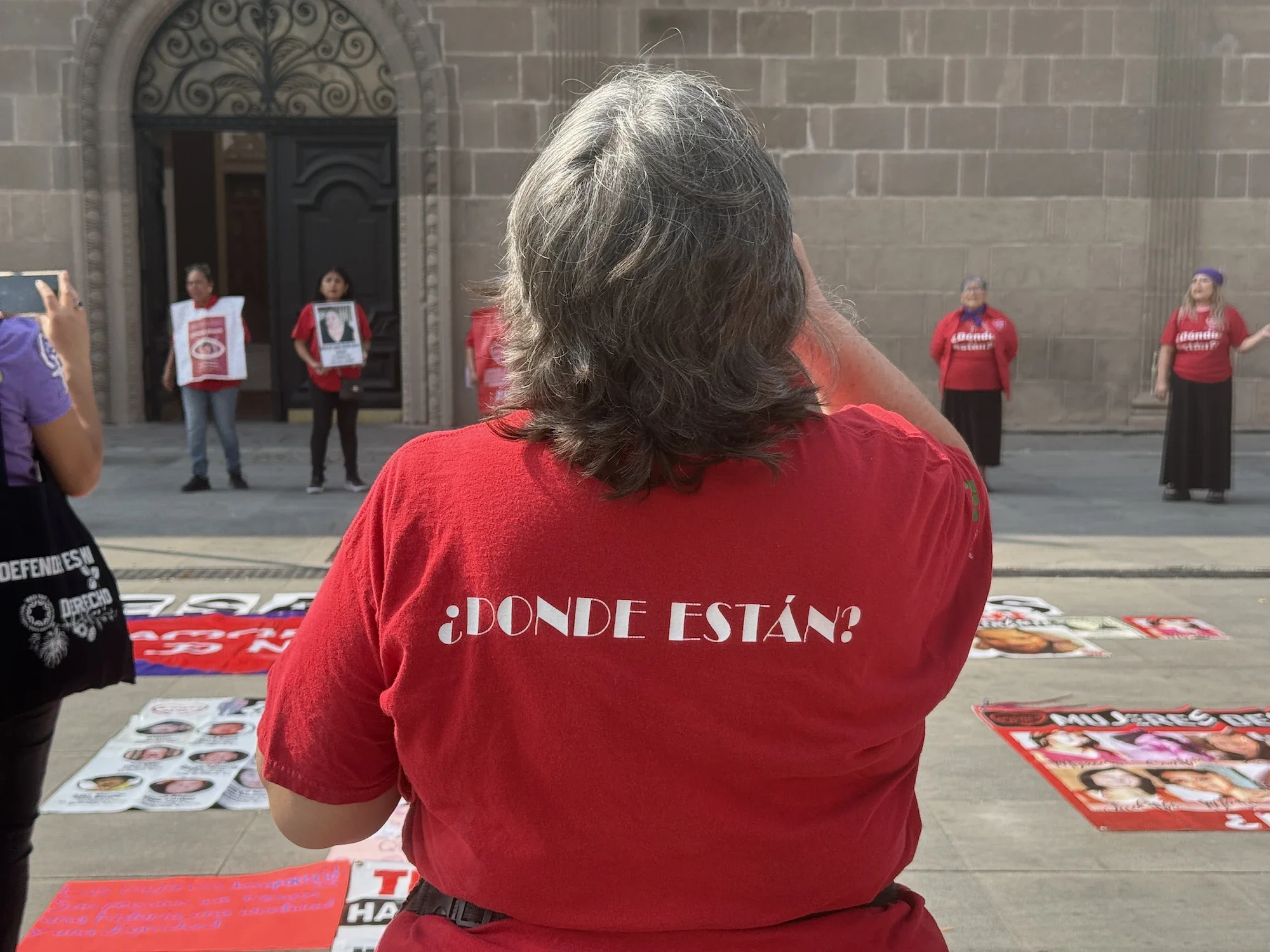
Family members of the disappeared demand action to search for and locate their loved ones. March 7, 2026, Monterrey, Mexico. Photo © Chantal Flores
Searchers and fighters
On March 7, the Association of Women Organized for the Executed, Kidnapped, and Disappeared of Nuevo León and Tamaulipas (AMORES in Spanish) held a protest in front of the Government Palace. The group is one of the first organizations formed by relatives in Nuevo León, it deals with cases that authorities have allowed to drag on for years. AMORES is specifically concerned with the health conditions of some of the mothers of the disappeared.
Sara Torres Carrizales, who has been searching for her son and daughter-in-law since 2010, explains that women have been the driving force behind the struggle and efforts to find the disappeared.
“I have my family, but no one supports me. They’ve lived in fear from the very beginning,” says Torres, 74. Despite the climate of insecurity in which searching mothers have been threatened and murdered, she insists on continuing to shed light on the reality faced by thousands of families in Nuevo León and across Mexico.
Since early 2010 to date, at least 6,708 people have gone missing in Nuevo León, according to the National Registry of Missing Persons.“It’s not fair that this is happening, that they’re being stripped of their right to live with their families,” said Torres.
Azalea Teresa Solís García looks after her 10-year-old granddaughter while fighting for the government to move forward with investigations. Her daughter-in-law, Magaly Yamileth Bernal Barraza was disappeared in September 2019, and her remains were found in early 2020.
“[AMORES] supported me when I was at my lowest,” said Solís.
“My world fell apart, and that’s when they helped me.”In Nuevo León, according to data from a 2025 survey by civic association How We’re Doing Nuevo León, women bear the brunt of caregiving responsibilities. Over half of those who take children to school are women, compared to just 14.6 percent of men. These responsibilities have a direct impact on women’s well-being: 41.0 percent of women in the state reported having experienced mental health issues over the past year, according to the survey.
Solís told Ojalá that, during the early years, she couldn’t finish a sentence without breaking down in tears. Access to counseling through AMORES was crucial in helping her cope with her new role as her granddaughter’s caregiver.“How was I supposed to handle the situation of raising a baby again, and explaining to her: ‘Your mom is missing,’ ‘Your mom was found dead’” she said. “Those are very difficult things to explain to a little girl.”
Police repression
As the evening march came to an end, the violence faced by women in Nuevo León became even more evident in front of the Government Palace, which was surrounded by metal barriers behind which hundreds of riot police were stationed.
Graffiti on the barriers condemned all forms of violence. The crowd chanted: “The new Nuevo León is a femicide state!”—a reference to Governor García’s slogan.
A few minutes before 9 p.m., the government played a recording that echoed across the plaza, congratulating the women on “their good civic behavior” and asking them to leave. When not everyone complied, a group of female police officers began to push those who remained in an attempt to remove them the plaza. They pinned one of the young women to the ground, while family members and protesters demanded her release. She was let go shortly after.
A parade of police cars circled the area with their sirens blaring, and riot police stood on the truck beds holding their shields. It was a warning of what was to come if the protesters did not leave.
The small group that remained stood in front of the line of female police officers cordoning off the palace, shouting over and over: “My friends care for me, not the police.” This continued until rainfall broke up the protest.
