

Chilean feminism rallies in the face of the far-right

“Down with Kast, down with Yankee imperialism.” Thousands of people protest holding an effigy of Donald Trump in Santiago de Chile on March 8, 2026. Photo © Nicole Kramm Caifal.
Reportage • Yasna Mussa • 20 de marzo, 2026 • Leer en castellano
On March 8, women and dissidents turned the streets of Chile purple and green. This year, their call to action was especially urgent. Three days later, on March 11, José Antonio Kast, a member of the far-right, ultra-conservative, anti-reproductive-rights Republican Party, took office as Chile’s president.
Faced with his imminent arrival, a wave of women flooded public spaces, becoming like volcanic lava. “We are furious!” their signs proclaimed. They transformed their anger into art, music, and poetry.
Protests took place in almost every city in the country, where women carryied signs and cutouts and performed pieces that reflected the most pressing issues on the national and international agenda: the Epstein files, the invasion of Iran, the climate crisis, the impunity of Donald Trump, the genocide in Palestine, femicides, and resistance movements in the Global South.
“In times of conflict, women and reproductive rights are pushed aside in the interest of survival,” said Antonia Pérez, an obstetrician of Palestinian descent in Chile, who wore a Palestino soccer team jersey and carrying a Palestinian flag. “They have to survive a situation that has been going on for decades, and everything related to childbirth, the dignity of girls, and rights violations take a back seat, and no one concerns themselves with it.”
Red, green, black, and white, the colors of Palestine, could be seen throughout the march. At the front of the demonstration, protesters carried signs in the same colors bearing the names and ages of women and girls killed by the Israeli army.
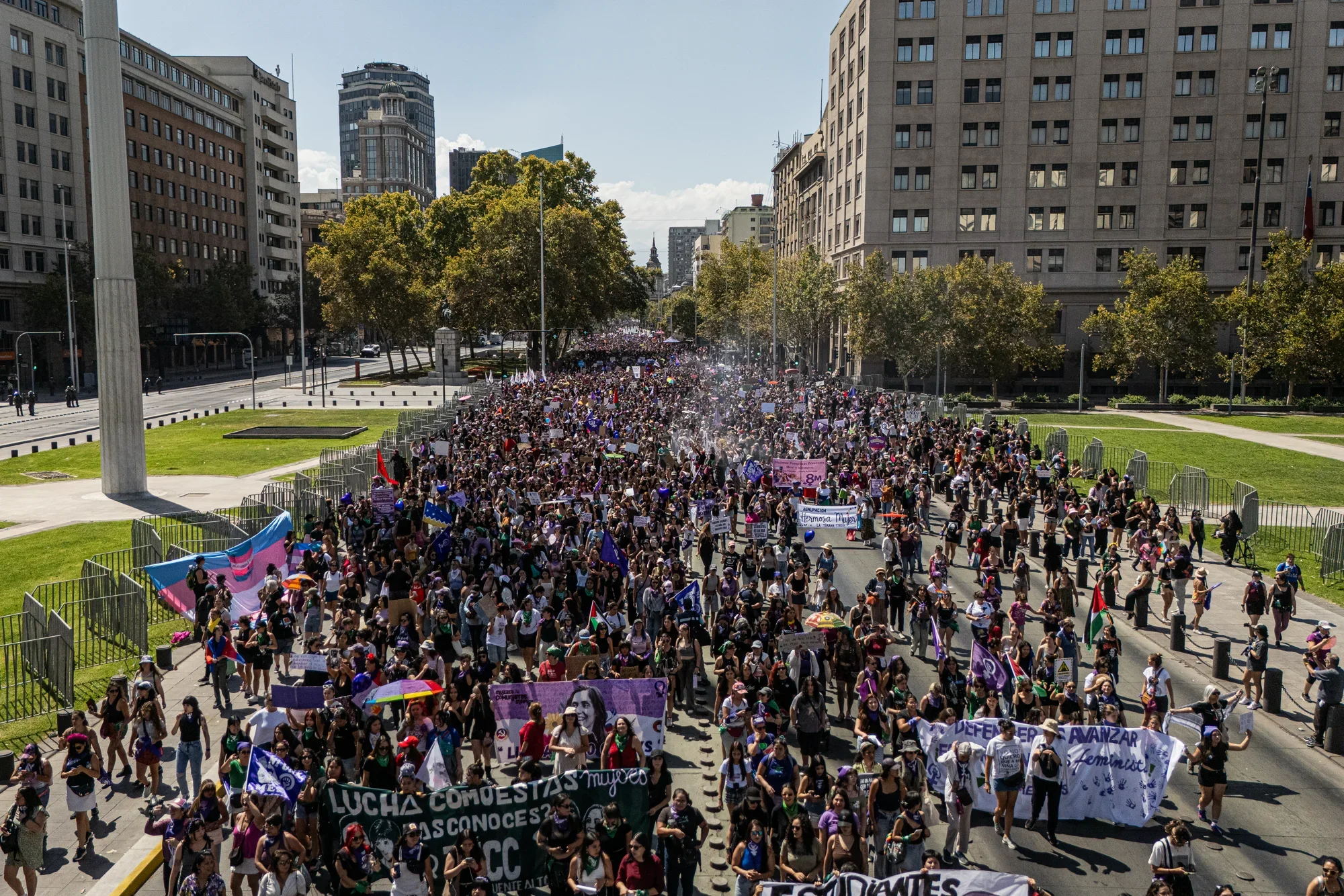
Thousands of people march to commemorate International Women's Day on the main street of Santiago de Chile on March 8, 2026. Photo © Nicole Kramm Caifal
Punta Peuco and patriarchal impunity
The March 8 demonstration in Santiago de Chile began with dance troupes and protesters spilling out onto the sidewalks. Near the Pontifical Catholic University, a banner caught everyone’s attention, and many posed for photos and took selfies. “I wish they hated pedophiles and criminals as much as they hate feminists,” it read.
Martina Cuevas held one of the corner of the sign. She is not part of a group, but told Ojalá she considers herself a staunch feminist and plans to join Chile's Communist Party. She’s 19 years old and has an artistic spirit, and she painted the sign with her sister and her friends.
“I wanted to show that I’ve always noticed there’s more hatred toward feminist women fighting for their rights than toward abusers,” said Cuevas. “It's also about what's happening today with Punta Peuco, where they’re pardoning human rights violators.
”She was referring to a bill that’s colloquially known as the Punta Peuco Law, which would commute sentences for elderly inmates or those with serious illnesses. This could benefit individuals convicted of human rights violations or sex offenders. Kast supports the initiative, which the senate approved days before the march, but which still needs pass in the lower house to become law.
Marianela Chamorro, an activist with the Feminist Front of the Broad Front—a left-wing and center-left political coalition to which Gabriel Boric’s outgoing government belonged—marched alongside them. Chamorro wore a green scarf around her neck, and raised her arms high, holding a sign reading: “Today I march for the 14 girls of Alto Hospicio. For their mothers and their memory. No to impunity! Senate, accomplice to rapists and murderers.”
She was referring to the case of 14 women—most of them teenagers—who were abused, murdered, and disappeared between 1998 and 2001 in the town of Alto Hospicio, near the city of Iquique in Chile’s north. The victims and their families were revictimized by the media and institutions, which blamed the women for being attacked, lobbing sexist and classist accusations without taking action to prevent the crimes from being repeated. If the Punta Peuco law is approved, the killer of the women could walk free.
“I am very concerned, as are many women, that such legislation is being considered today and the process is already well underway,” said Chamorro. “We all know there is an ulterior political motive, to release the prisoners at Punta Peuco, who are human rights violators.”

Crowds gather in front of the Palacio de la Moneda on Alameda, the main street of Santiago, Chile, on March 8, 2026. Photo © Nicole Kramm Caifal
Community care
The 26-degree heat embraced the over 500,000 people who came out to march on that late summer Sunday. Unlike in previous years, the rise of the far right was not a possibility, it was a reality. Slogans and chants called for standing firm and continuing to fight impunity. Although feminist organizations reported turnout numbers similar to previous years, the streets felt more crowded, noisy, and vibrant.
“Avoid fainting. Drink your water. Eat your fruit,” shouted a woman holding a megaphone. At a long table in the middle of the sidewalk, the Huelén Community Kitchen offered ice-cold water, slices of watermelon, blueberries, strawberries, and cantaloupe arranged alongside a box for voluntary donations.
The social and cultural center was founded by local residents during the 2019 social uprising and has been cooking for the community with conviction and love ever since.
While men are involved in the organization, it was women who took part in the 8M march. They shared caregiving responsibilities and complemented each other’s knowledge, which spans generations.
“We’re always fighting for our rights and we stand firm,” said Magaly Valencia, a retired teacher who participates in the community kitchen. “Once a month, we prepare a meal for homeless folks thanks to donations, and we serve it on the streets.”
She highlighted the social and historical role that community kitchens have played in Chile. Self-managed collective food initiatives emerged during the dictatorship and have been replicated in contexts of economic crisis, strikes, or health emergencies, and are almost always led by women from the community.
Valencia, who supported left-wing candidate Jeannette Jara in the last election, said she does not understand why people chose to vote for a president like Kast when he signalled his intention to cut social programs, women’s rights, and public education from the very beginning. To her, this meant people chose to “take a step backward with a far-right government.”
A batucada set the beat for the march as it approached the National Library. Further along the Alameda, a sign read: “I want all girls to know they can be scientists. More women in science, fewer in statistics of violence.” The small hands holding it belonged to 10-year-old Violeta Villarroel, who marches every March 8 alongside her mother, Diana Reyes.
“I believe girls need to have a voice and need to understand from a very young age that these spaces belong to them too, so I’ve been bringing her since she was two,” said Reyes. “She feels like she’s part of it and believes she can do things to change this world and make it a better place.”
“I’m here so that women can be free, our rights are respected, and so we’re heard,” added little Violeta.
Perched atop the bus stop shelter, a group of protesters chanted “You are the rapist,” a phrase that became a feminist anthem during the 2019 social uprising. That’s when the Las Tesis feminist collective staged a performance that went viral and shifted the blame to where it belongs, and pointed the finger squarely at the patriarchy.
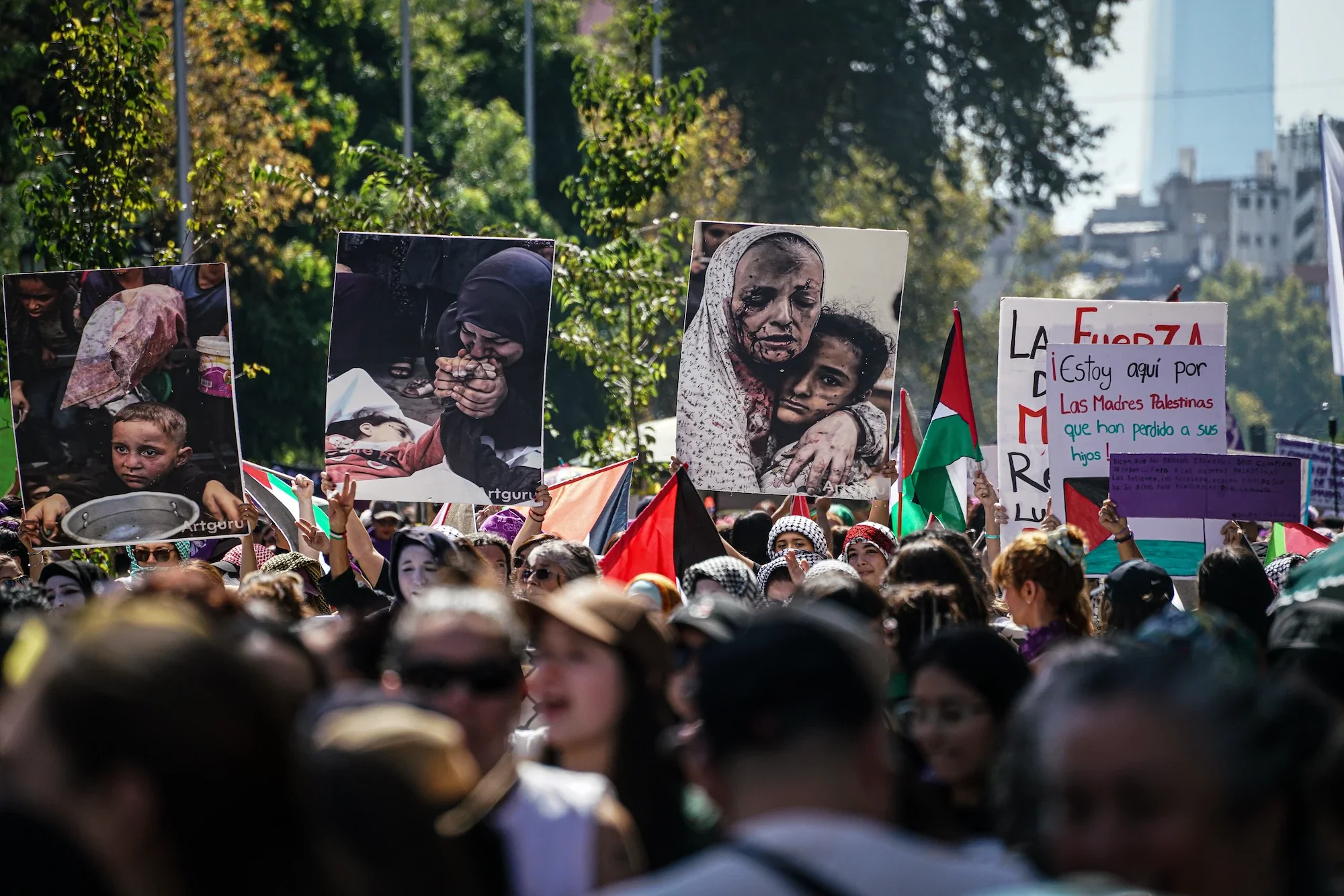
Demonstrators march with photographs of Palestinian women as part of International Women’s Day in Santiago de Chile on March 8, 2026. Photo © Nicole Kramm Caifal
Transfeminist resistance
A group of young people stopped on the sidewalk on Alameda Avenue. They lined up to take photos with a woman they admire: Emilia Schneider, a former student leader, activist, and the first transgender lawmaker in Chilean history. Schneider’s become role model, and her supporters make sure she knows it.
To one side, a cutout bearing the face of President José Antonio Kast passed by bearing a message: “We don’t deserve this Kastigo,” a play on the Spanish word for punishment.
Gender dissident collectives, the LGBTQ+ community, and feminist organizations expressed concern about looming changes in the political landscape. As the march wound through the city, far right leaders who unabashedly express homophobic and transphobic rhetoric were preparing to take power.
A vehicle with loudspeakers and activists chanting feminist slogans made its way through the crowd. It was the la camiona Mónica Briones (the “she-truck”), named in honor of a painter and sculptor who was a victim of femicide during the dictatorship in what was considered the first documented case of a lesbophobic hate crime in Chile.
Trans flags in blue, pink, and white hung from the truck. On one side were portraits of other lesbicide victims, including Nicole Saavedra and Anna Cook. As the vehicle moved slowly forward, an activist, megaphone in hand, demanded: “trans health for Chile.”
Before becoming president, Kast spent years voicing opposition to social rights and feminist causes. He is against access to free abortion, and he’s stated that he intends to roll back progress on sexual and reproductive rights.
In February, shortly after being elected president, Kast travelled to Europe to reaffirm his rejection of what he called “ideological feminism.” He’s also expressed opposition to same-sex adoption, marriage equality, the Gender Identity Law, and the rights of trans children and adolescents.
Walking kilometers with the crowd felt like a process of renewal of an urgent agenda. We’re in a hostile world in which ideas and protests stubbornly emerge with beauty and humor. March 8 is key moment to reflect as tensions come to a head, and as vulnerable groups step forward with greater strength, urgency, and conviction to defend hard-earned rights and keep moving, relentlessly, toward what remains to be won.
