

Anti-fascist feminism takes Bogotá
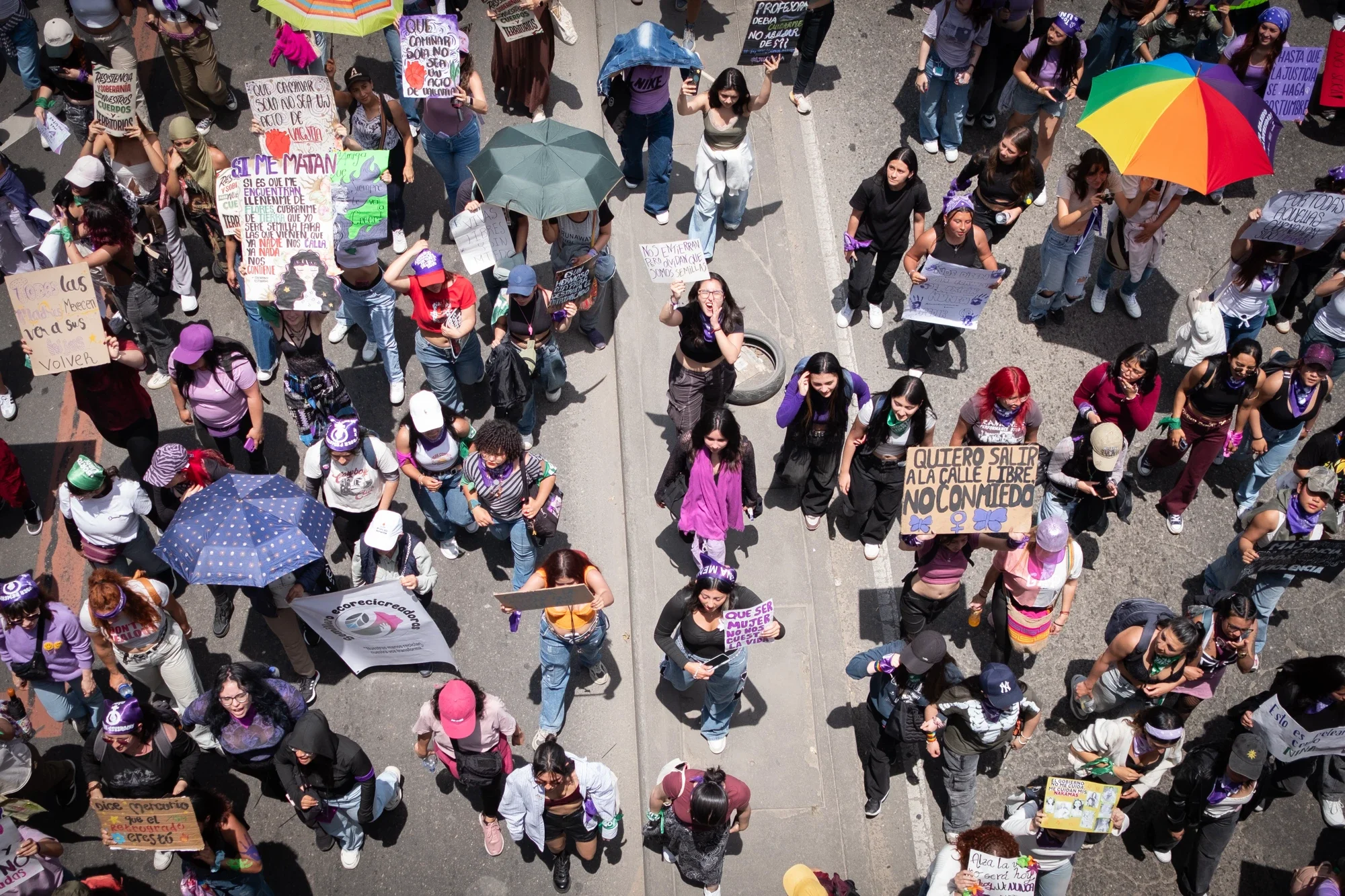
A protester holds a sign reading “They buried us, but they forgot we are seeds” during the International Women’s Day march in Bogotá, Colombia, on March 15, 2026. Photo © Mariana Mora.
Reportage • Mariana Mora • March 26, 2026 • Leer en castellano
In a small park in northwestern Bogotá, Colombia, a crowd gathered under the sun, as women, lesbians, non-binary people, and trans people prepared to march on March 15 for International Working Women’s Day.
This year, the feminist platform Somos un Rostro Colectivo, which has been organizing IWD demonstrations in Bogotá for eight years, chose to postpone the March 8 demonstration after legislative elections and inter-party presidential primaries were called on that date.
The march began at 11:30 a.m. According to the Bogotá Mayor’s Office’s community relations team, around 4,000 people marched, while organizers estimated 7,000. Many of the protest signs, chants, and art spoke out against fascism.
“In Colombia, we had and still have our own anti-fascists who fought against colonialism, including the cimarronas, palenqueras, and campesinas,” said Lety Muñoz Morales of the Colombian Feminist Anti-Fascist Collective. She was referring to women of African descent who, since the 16th century, defied their enslavers, fled, and established palenques—that is, autonomous territories for people who escaped slavery.
Anti-fascist feminism is what unites the group, which has been organizing for 10 years. Their work is especially relevant with resurgence of fascism in Latin America, where women and gender dissidents are the first to lose hard-won rights.
“It’s no secret that the right wing is anti-rights,” said Sara Sofía Parra, a 21-year-old student who joined the demonstration with her partner, Ian Millán, a 25-year-old trans man. Both were concerned by the potential shift in national politics and the possible arrival of a right-wing government and the possibility for levels of violence, which are already alarming, to climb even more.
Last year the Ombudsman’s Office warned that extreme violence against LGBTIQ+ people was on the rise, noting that there were 646 hate crimes in 2025, 30 per cent more than in 2024. The Inter-American Commission on Human Rights also expressed concern at the level of violence targeting the LGBTIQ+ community in Colombia following the transfemicide of Sara Millerey in 2025, which made international headlines due in part to the extreme cruelty involved.
“I feel that the struggle won’t end for us, not now, nor in a thousand years,” said Millán. “And no one who gets into government is going to represent 100 percent of our rights and our ideals,” added Parra.
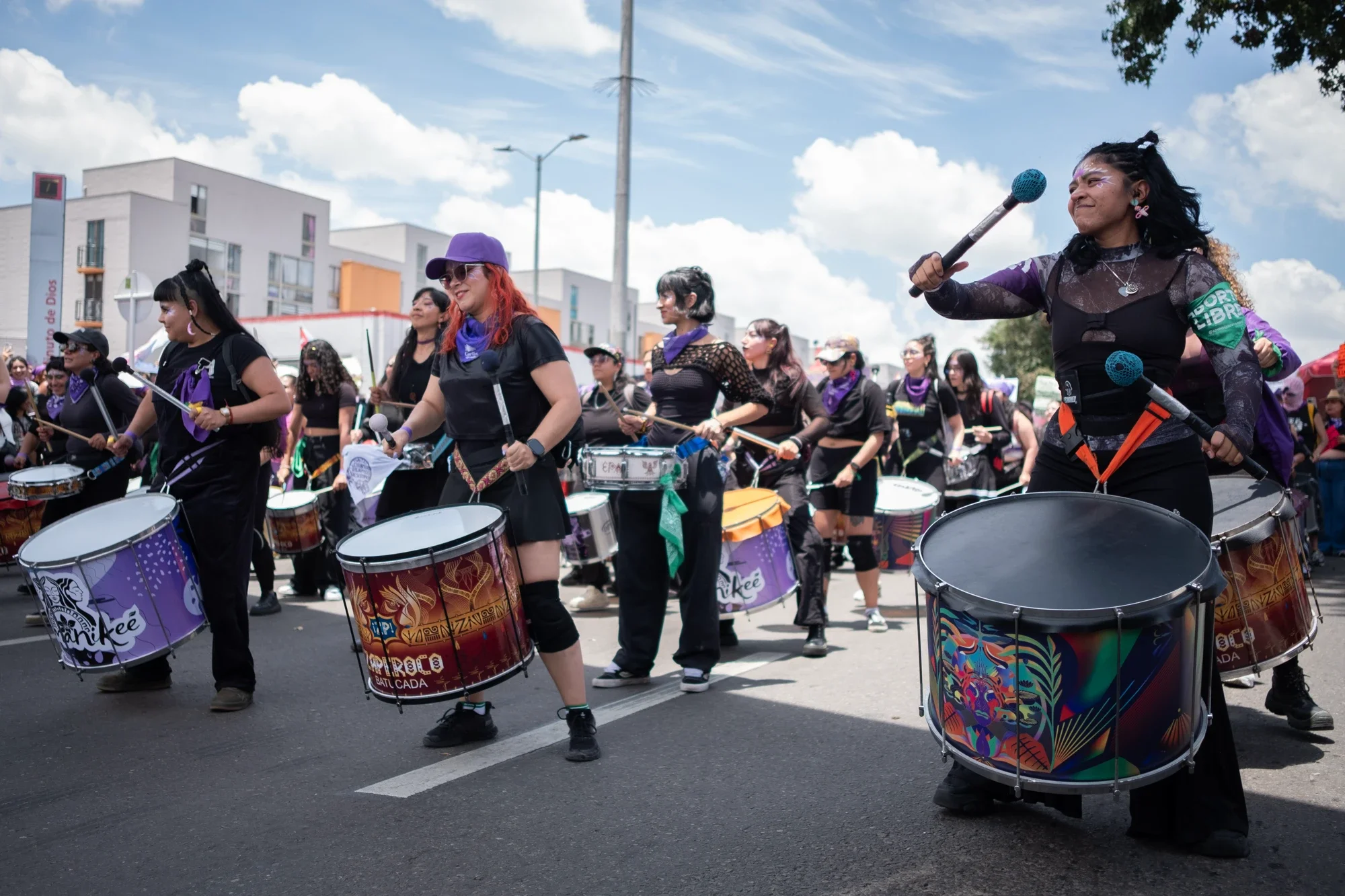
Batucada drummers begin their performance at the International Women's Day march in Bogotá, Colombia, on March 15, 2026. Photo © Mariana Mora.
Elections overlap
“The timing of the elections on March 8 is particularly striking, since it's known that that’s the day we’re in the streets,” said Paulina Góngora, a feminist and community educator who is part of Somos un rostro colectivo. “But we wanted to respect the date to ensure people went out to vote, because our country needs it right now.”
In addition to senators and congressional representatives, three presidential candidates were elected in the first round of elections on March 8: Roy Barreras, of the center-left party La Fuerza de la Paz, Claudia López, a former member of the Partido Alianza Verde and a centrist, and Paloma Valencia, of the Centro Democrático, the right-wing party founded by former President Álvaro Uribe.
There are eleven other presidencial hopefuls in addition to those three candidates, among them Iván Cepeda, who was elected to head the Historic Pact, which is the coalition currently in power. The Historic Pact held their own internal process in October 2025, and Cepeda is currently leading in the polls. The first round in the presidential election will take place on May 31.
“The fact that they’re trying to position a woman as the face of the far right is a way to whitewash her image, as if she were progressive,” said Gabriela Franco Prieto, a member of La Totuma Ecofeminista. “What’s really behind her political project is a model of land grabbing that preserves the current economic model—one of growth for the few.”
For Franco Prieto and her fellow activists, anti-patriarchal struggle is closely linked to land, territory, and protecting the common good, “especially in a country like Colombia, which has been a site of dispute and armed conflict.”
According to an analysis of rural property by the National Administrative Department of Statistics, only 36.3 percent of land titles are held by women, even though women represent over half of the country’s total population. Furthermore, 51.2 percent of women landowners perform domestic work as their primary activity, compared to 6.5 percent of men.
“We see that women, are political allies of the land—as are femme and queer people—have led the fight for community gardens, in defense of wetlands, bogs, and mountains, and are envisioning alternative cities through ecofeminism,” said Franco Prieto.
Barrios rise
Every year, the protest route changes, and this year, demonstrators marched through working- and middle-class neighborhoods in the Engativá district. “We look for places where we feel we need to raise our voices,” said Góngora of Somos un Rostro Colectivo, explaining that in some parts of the city, “there’s a lot of stigma attached to feminism.”
This year, as the march made its way through narrow streets, past houses and crowded shops, it piqued the neighbors' curiosity. Some looked on with serious expressions; others started recording. Still others clapped and danced to the beat of the batucada drums.
“Defending the barrio is feminist,” read a banner held up by a group of marchers. “We’re all women from the south, from the barrios. That's where the struggle begins, and we will always defend it,” said Sofía, one of the women holding the banner, who said she’d rather not give her last name. According to data from the Bogotá Health Observatory, seven of the 10 districts with the highest rates of economic poverty are in the city’s south.
“There is structural violence in these neighborhoods because women are expected to stay at home, to be the ones who raise the children, because of small-scale drug trafficking, and because of gentrification, which has already begun to reach these neighborhoods and makes life even more precarious,” added the 18-year-old protester. “That is the struggle we take up on March 8.”
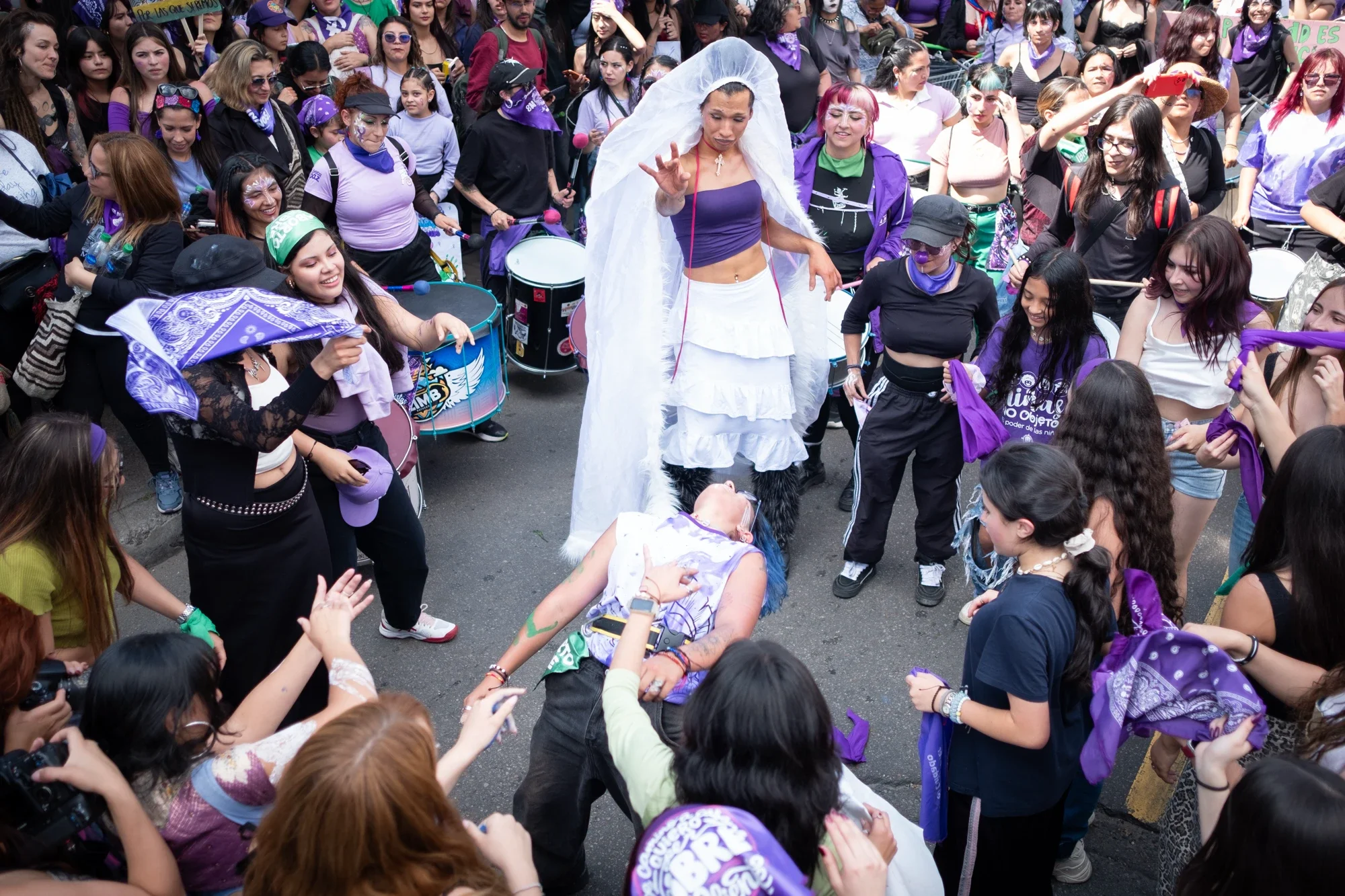
Protesters dance to the beat of the batucada drums at the end of the march in Bogotá, Colombia on March 15, 2026. Photo © Mariana Mora.
Students against violence
Around 2 p.m., the march arrived at Villa de Luz Park, the heart of the neighborhood of the same name and their final destination. I spoke with students from the Bogotá Higher Academy of Arts (ASAB) of the District University about the sit-in they held outside the school days before to demand action against the rise in sexual harassment and abuse due to subway construction in the area.
“Since early February, we’ve been filing complaints through the appropriate channels with the university, the district, and the police,” says Fernanda Meléndez, a student at ASAB. “They’re always stalling and never respond.”
On March 11, around 100 people staged a peaceful protest expressing their views through dance, painting, and performance. The Dialogue and Public Order Unit (UNDMO) arrived later and repressed the demonstration.
Colombia’s Ministry of Education reported 215 cases of gender-based violence at universities between 2022 and September of last year. But the organization Aula Abierta claims that the actual number is much higher, because cases are often underreported.
“We don’t feel safe with the professors or the students, and they’re allowing people from outside the university in, and they are also harming us,” said Sofi, an 18-year-old ASAB student who preferred not to give her last name. One of her classmates spoke of students and faculty members who had complaints against them for harassment and misogyny which have not been addressed by the university.
The students shared their stories with me in a garden behind a sports field, where a group of DJs got the crowd dancing to the rhythm of cumbia. Later, another group joined in with songs celebrating the land and women defenders.
But within minutes of the park turning into a party, the UNDMO police unit arrived with two Buffalo Light Armored Vehicles and barricaded itself at the park's Immediate Response Command Post (CAI), which some protesters targeted with messages like “the police are rapists and rights violators.”
Two years earlier, on March 8, 2024, that same police force stormed Plaza de Bolívar, the march’s final destination. The authorities turned off the lights in the plaza, cordoned off the entrances, and fired tear gas at the crowd. This would not be the first or the last time that Mayor Carlos Fernando Galán sent police to crush demonstrations: that is why the reappearance of the UNDMO two years later set off alarm bells among the protesters.
Even though they were facing a police unit that killed 24 people during the National Strike in 2021, the group stood its ground for over two hours as around 50 officers from the riot squad remained in formation.
Some members of Somos un Rostro Colectivo walked back and forth between the two groups, attempting mediation to prevent a crackdown. The day ended with a lot of tension but without more serious incidents, and women and dissidents left the park secure in the knowledge that they would take to the streets again.