

War off our bodies! 8M in Puerto Rico
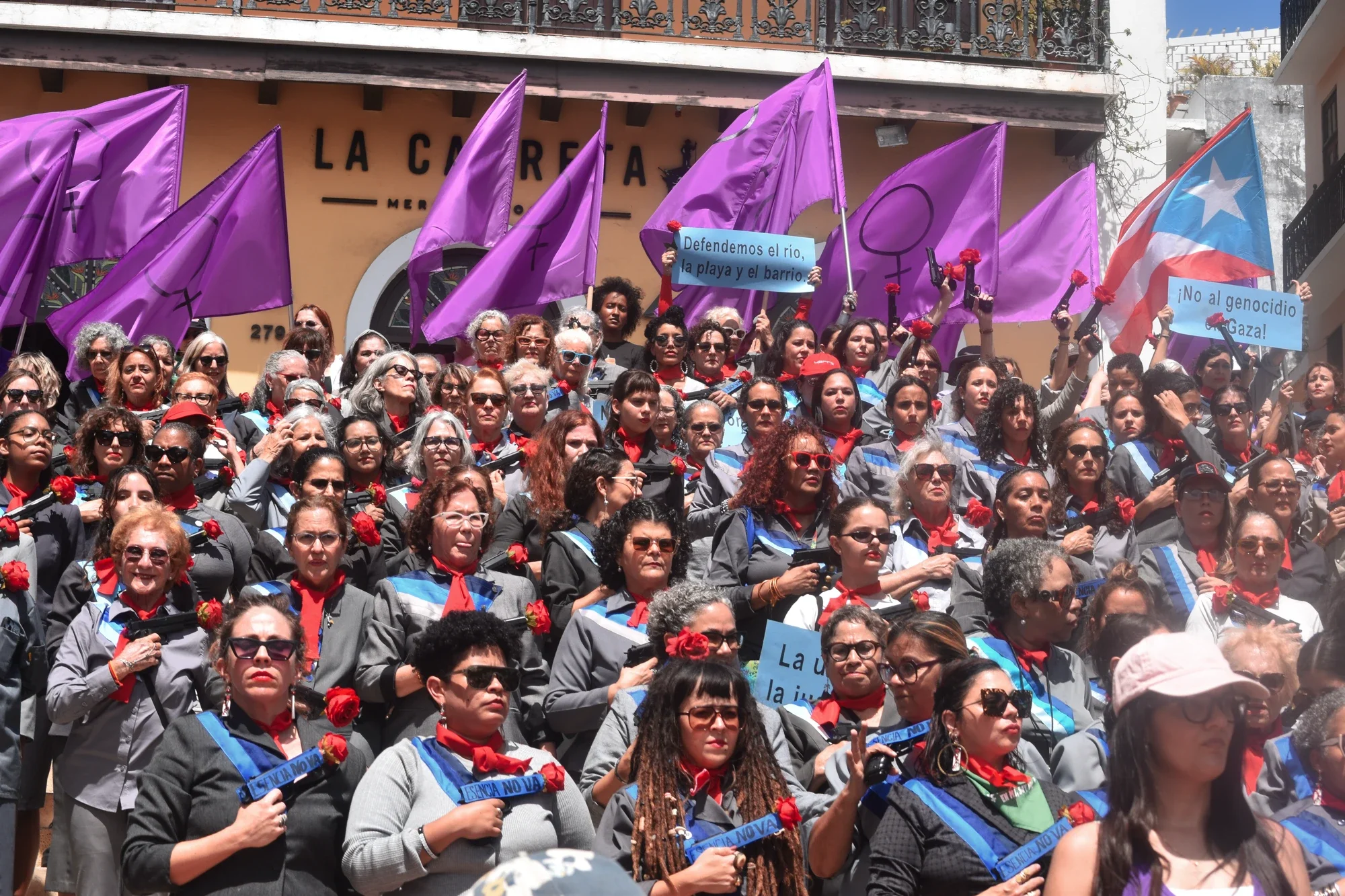
The Army of the Lolitas concludes its participation in the march singing the Puerto Rican anthem, La Borinqueña. They sang the revolutionary version written by Lola Rodríguez de Tió, extolling the fight for the country’s freedom on March 8, 2026, in the Plaza de la Barandilla, in San Juan, Puerto Rico. Photo © Valerie Rodríguez Castro.
Reportage • Belinés Ramos Negrón • March 27, 2026 • Leer en castellano
Women holding guns with roses in the barrels led the International Women's Day in San Juan, Puerto Rico. The Army of the Lolitas was one of many feminist collectives that took to the streets on March 8, protesting violence against women and racialized people in impoverished communities throughout the archipelago.
A key issue raised at the demonstration was the number of femicides this year, which had already reached ten by March. According to the Puerto Rico Gender Equity Observatory, last year ended with 63 femicides. Throughout the march, activists from Comuna Caribe—a political space for Caribbean and Latin American solidarity in Puerto Rico—held handkerchiefs embroidered with victims’ names.
This year’s protest took place against the backdrop of a political offensive against sexual and reproductive rights and ongoing colonial militarization by the United States. A broad network of organizations and activists defended their rights to make decisions about their own bodies and motherhood, demanded environmental justice and highlighted the leadership of trans and sex worker collectives whose contributions to these struggles must not be ignored.
Embodying the collective
The March 8 protests began at 10:30 in the morning in Plaza del Quinto Centenario, in the historic Old San Juan district, opening with an address and a tribute to Mothers Against War Madres Contra la Guerra and the Vieques Women's Alliance Alianza de Mujeres Viequenses.
The March 8 Coalition urged all Puerto Ricans to join the march under the slogan: “War off our bodies” It announced that the march was dedicated to the two groups in recognition their ongoing protests against the genocide in Palestine, the military occupation of Puerto Rico, the structural violence women face in various communities, and their tireless fight for peace and environmental justice.
“Their resistance reminds us that motherhood, territory, and community life are spheres of care, not of war or exploitation,” said the March 8 coalition in a press release.
The coalition is made up of a range of human rights organizations, including the Army of the Lolitas—the group that led the march, with nearly 100 women and dissidents—and initiatives like Taller Salud, Colectivo Orgullo Boquerón, Jornada se acabaron las Promesas, Comuna Caribe, and other student associations and federations.
The Army of the Lolitas commemorated revolutionary leader and independence activist, Lolita Lebrón, who is known as the mother of the motherland. In 1954, Lebrón led a group of nationalists in an attack on the U.S. House of Representatives to protest Puerto Rico’s colonial status under the slogan: I did not come to kill, I came to die for my homeland.
“Lolita taught us that in the face of empire, you don’t ask for permission or face it on your knees. You assert dignity and freedom,” said Edda I. López Serrano, reading from the Army of the Lolitas’ Manifesto as a representative of the group.
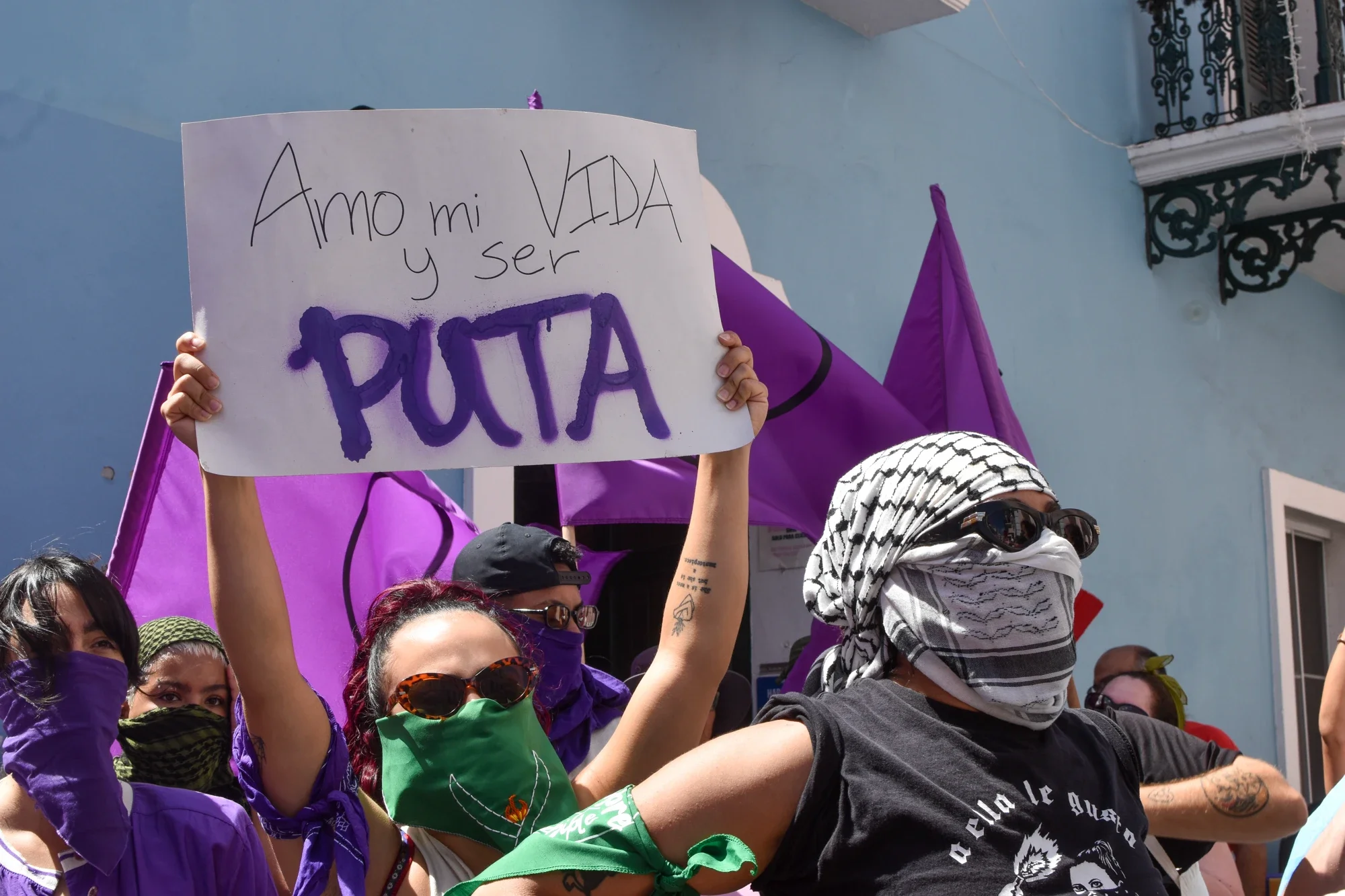
I Love My Life and Being a Slut: The trans community and sex workers defend their rights and bodily autonomy on March 8, 2026 in La Fortaleza, San Juan, Puerto Rico. Photo © Valerie Rodríguez Castro.
Widespread threats, unified resistance
The Lolitas at this march joined the call for environmental justice for communities in the western region, carrying imitation guns with a flower in the barrel along with the message “Esencia OUT!”
This refers to the struggle to stop the Esencia project, a luxury housing and tourism development that would have devastating ecological and financial impacts on communities and increase displacement on the island. The project takes advantage of tax exemptions for real estate developers.
The protest against Esencia was part of a broader movement against the anti-rights political offensive led by the Island’s Governor Jenniffer González. In line with Donald Trump’s fascist measures, the Puerto Rican government increased tax incentives for foreign capitalists at the expense of environmental justice. Over the last year, it has also pushed forward legislative measures that undermine sexual and reproductive rights and target the trans community in the archipelago. Some of these bills have since become law.
Last year, González signed Law 63-2025, which prohibits gender-affirming care for people under 21, establishing prison sentences for those who do not comply and fines of $50,000 for legal entities. In January, she signed Law 18-2026, amending the Penal Code to confer legal personhood on embryos. Along with another new regulation, Law 166-2025, the loss of a fetus resulting from an assault against a pregnant person was classified as murder.
Although some measures allowed public hearings, many were approved through an expedited process that bypassed traditional procedures, which meant they were sent directly to the plenary for a vote without public participation, evaluation, or reports.
The nature of these new laws and the speed with which they were passed raised alarms among feminist movements, queer collectives, and human rights organizations concerned about the growing criminalization of specific populations, which could then be expanded more generally.
Irreverent defiance
Led by trans and queer collectives, protesters stopped twice along the route to perform a “salute to the state,” in which they condemned anti-rights groups and institutions with a combative perreo dance. In the face of a necropatriarchal state, bodies, pleasure, dance, and perreo are used as tools of resistance.
In this case, that meant raising our left hands to symbolize resistance, while turning up the volume of a banging dirty perreo in the background. The first combative perreo of 2026 happened on the steps of San Juan Bautista Cathedral.
“This action was about the need to express and enact irreverence toward the government and the church through our bodies, gestures, and [dirty perreo] music,” said activist Katia Cruz Quintana, who spoke in support of the trans community.
The initiative was a nod to the first combative perreo in 2019, which demanded the resignation of Governor Ricardo Rosselló after his racist, homophobic, and misogynistic text messages were leaked to the media. This year, the perreo was followed by a reading of the Butterfly Manifesto in front of the cathedral.
“They claim to protect children by oppressing and abusing LGBTTQIA+ youth, which begs the question: isn’t it completely contradictory to protect some while stigmatizing others?” read Marielle de León, a San Juan city councilmember for the Movimiento Victoria Ciudadana and Cruz Quintana.
Throughout the march, protesters chanted “Radical transformation, butterfly transformation!”—in reference to demands for social metamorphosis and in solidarity with trans communities and immigrant women.
“What an honor it is to breathe the same air of struggle, sacrifice, and love that women, trans women, and non-binary people,” said Hommy E. Rodriguez, a trans man, about joining the march. “This 8M made me feel that we continue to sustain one another—in every embrace, every fighting spirit—for all those who are still missing, even when the state wants to eliminate us. Love sustains us in unimaginable ways, and there are so many ways to be and to love freely and infinitely.”
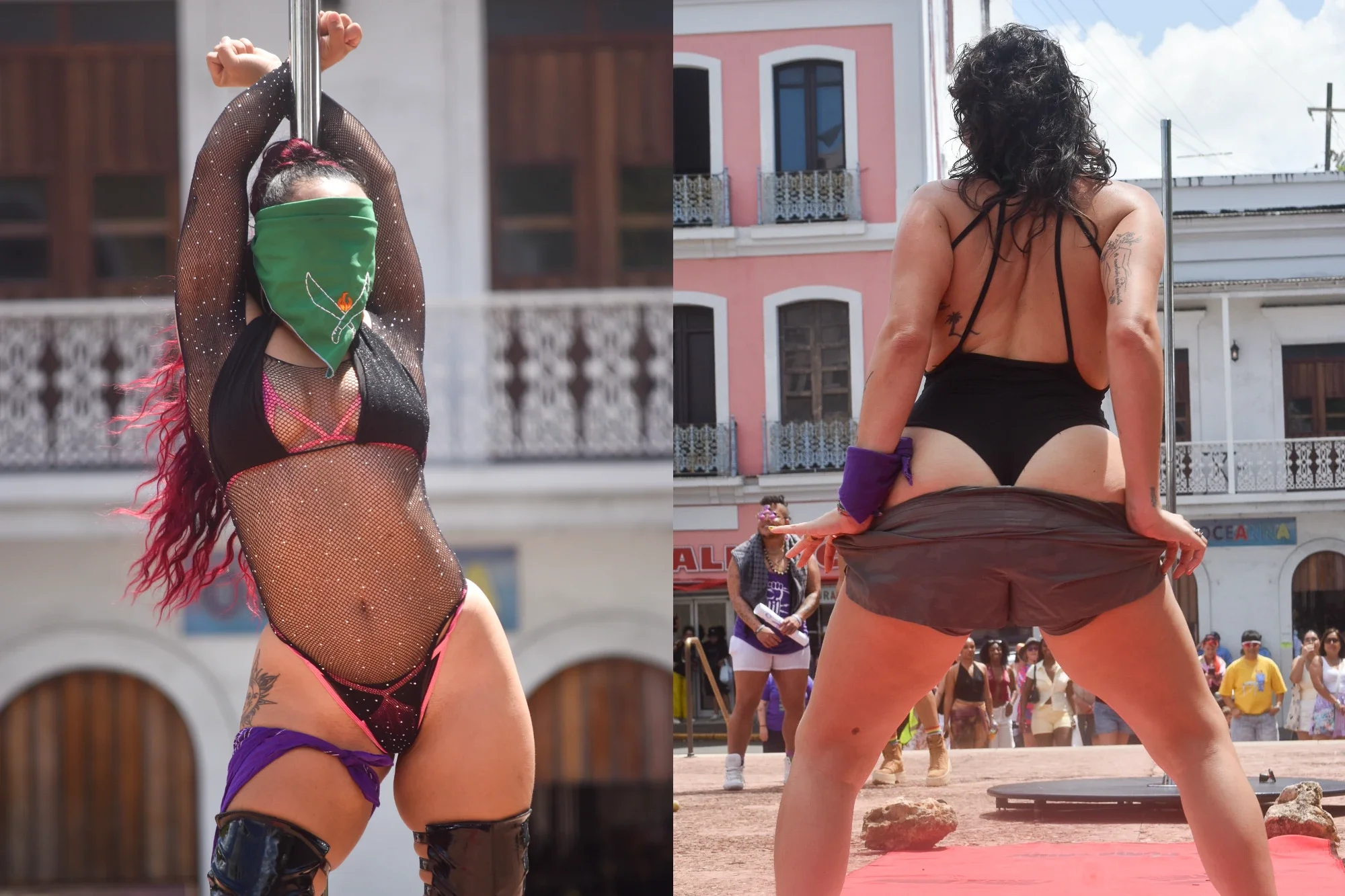
Krystal Isabel is a a sex worker who presented her poem “Slut” (left) and “jayaera” (freedom and happiness) during the Pasarela Combativa organized by Les Realengxs del Slutwalk PR (right) on March 8, 2026, in the Plaza de la Barandilla, San Juan, Puerto Rico. Photo © Valerie Rodríguez Castro.
Reclaiming and resignifying
The march ended at Plaza de la Barandilla, where another Lolita representative took the microphone and shared a final message. “The lives of LGBTQIA+ people, people of color, the impoverished, and those marginalized by the dominant system matter, and they have a place in our struggles.”
The Lolitas closed by singing the Puerto Rican anthem called “La Borinqueña,” in its revolutionary version, which was written by Lola Rodríguez de Tió. “We want freedom, and our machetes will give it to us,” they chanted in place of the official lyrics, which are an ode to colonization. Then the Barrileras del 8M took the stage and opened the dance floor with bomba music, singing, and dancing.
To reaffirm the unity of struggles, members of the sex worker community performed an erotic dance piece and recited a poem by Krystal Isabel “Coqueti$a” Marrero Martin titled “Slut,” honoring the collective’s reclaiming of the word to symbolize strength, power, and the ability to name desires. In an interview with Ojalá, she described the poem as a way to let go, to rage, to heal, and to celebrate herself as the free queer woman and sex worker that she is.
"Putting my body as a slut on the line for resistance, for revolution—that is my calling. I march for myself, for my mom, the first slut I ever knew, for my sisters, even if they don’t know it, for my friends, my brave and beautiful trans siblings, and my queer community,” said Coqueti$a. “Most of all, for all the putas and putxs of this world, because we are resistance, struggle, and courage, and without us, there is no feminist struggle. Including us in these conversations is imperative for real change: without sluts, we are nothing.”
March 8 ended in a Combative Catwalk organized by Les Realengxs of Slutwalk PR. It was an inclusive and diverse catwalk where anyone could jayara—feel free and happy—on the red, rebel carpet.
Organizers, queer collectives, feminists, trans people, and sex workers, as well as members of organizations advocating for sexual and reproductive rights and migrant rights, walked the runway. A jubilant show of solidarity inhabited by adults, youth, and children on an important date, during which we commemorate the struggles of our ancestors, which created space and possibility for our lives.