

Feminist renewal in Uruguay
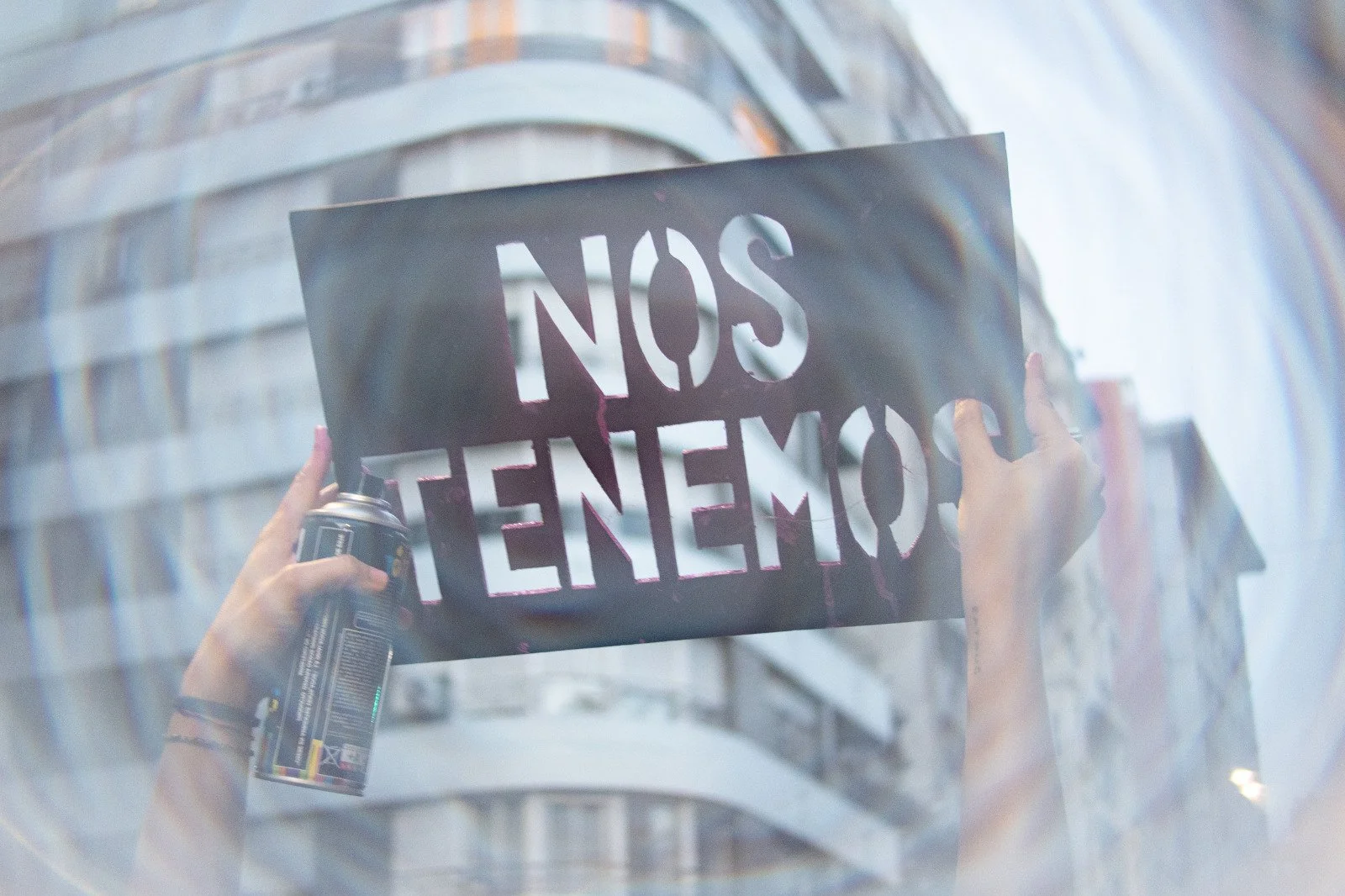
Stencil with the slogan “We hold each other,” on March 8, 2026 in Montevideo, Uruguay. Photo © Bettina Franco.
Opinion • Siboney Moreira Selva and Noel Sosa Gonzalez • April 2, 2026 • Leer en castellano
International Women’s Day in Uruguay once again saw mass demonstrations and rallies held across the country and in different parts of the capital, Montevideo.
Thousands of us gathered to share hugs, knowing glances, chants, laughter, to raise our voices loud and clear, keep pushing forward and remind ourselves that the streets are still ours. It was another 8M that, in its diversity, managed to combine anger, joy, delight, and creativity.
As has been the case for several years, there was a callout to gather at several meeting points along 18 de Julio Avenue in downtown Montevideo at 6 p.m., and march toward the main plaza of the University of the Republic.
The march followed a route that’s become characteristic of feminist mobilization, moving in the opposite direction of the marches organized by traditional social organization.
We don’t march toward the temples of power. Instead, we choose wide-open esplanades, where the air flows freely between us, where we can look each other in the eyes, recognize one another, and take ownership of our words.
This year was also different in terms of who convened the march, as existing networks were reconfigured once again.
Against a backdrop marked by the rise of the far right and a politics of war targeting the bodies of women, children, and gender dissidents, the March 8th march in Montevideo held anti-imperialism at its core.
It centered popular sovereignty, the diverse forms of women's resistance in defense of life, and the critique of patriarchal violence that we feel in our bodies and territories.
A changing organizational landscape
There were two organizing groups that convened the march at different gathering points, each with its own call to action.
The first was On the Road to 8M, a platform that brings together various feminist collectives, feminist nongovernmental organizations, and gender commissions from union social organizations. This year, On the Road to 8M’s rallying cry was: “Anti-imperialist 8M. For popular sovereignty—They shall not pass!”
The other organizing group was the Feminisms Coalition, organized by a collective of women and gender dissidents in Montevideo. They organized under the banner: “8M Anti-Imperialist Feminist Action. For the women of the world in resistance, defending the earth, water, and life. In the face of hatred and patriarchal violence: neither the earth nor our bodies are territories to be conquered!”
The Feminist Intersocial group, which used to be a key organizer of the march, had a smaller role this year. It was founded in 2017 and used to organize the 8M Platform alongside other organizations which became part of On the Road to 8M. Instead, it called for marches in Montevideo and across the country.
In the weeks leading up to the event, the Feminist Intersocial group didn’t hold meetings, instead inviting people to submit ideas for the demonstration's central motto. Eventually, they chose: “Absent State = Poverty and Violence Against Women.”
Absent this year was Tejido Feminista 8M Montevideo, an organization that has brought together collectives, women, and self-organized dissidents since 2021. In recent years, the composition of this coalition has changed, and it did not collectively organize spaces, independent meetups or demands.
This year's march kept the same format of being a mobilization without podiums or speakers, but unlike previous years, it did not feature collective readings of declarations based on discussions leading up to 8M.
Various organizational nodes filled public spaces in different parts of the city with a multitude of demands and grievances.
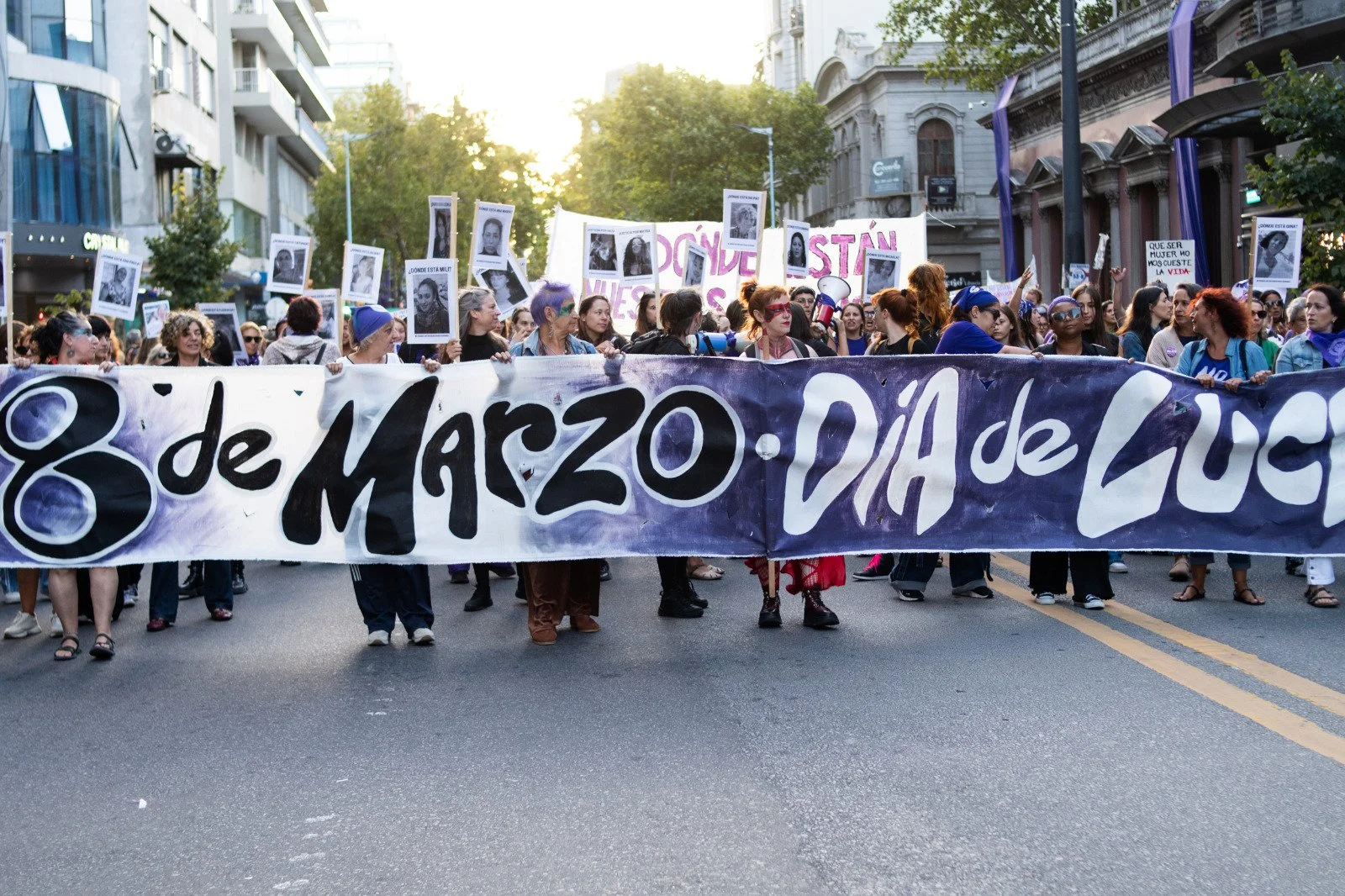
A group holds a banner reading “March 8: Day of Struggle” on March 8, 2026 in Montevideo, Uruguay. Photo © Bettina Franco.
Decentralized demands
This year 8M was named as a women’s work stoppage (paro) rather than a feminist strike, as had been the case since 2019. This meant certain debates from previous years —including strikes in production, reproduction, and spending— were absent, and created a new landscape with its own nuances. The slogan “No war in our name” resonated in the various messages conveyed through posters and conversations.
Feminist Intersocial published a manifesto declaring that with regards to violence against women, children and youth, “...the state looks the other way, and the government and parliament do not care about saving them, about saving us.”
The group pointed out that femicides are preventable, as they are mostly “deaths foretold” in repeated prior complaints, and noted that they were only invited to a single meeting of the new government’s working group on violence against women.
Its statement also addressed the rise of fascism worldwide and the issue of the destruction in Gaza, Iran, and Lebanon, the colonial operation in Haiti, and the devastating blockade against Cuba.
That same manifesto cites the effects of Uruguay's 2020 Urgent Consideration Law, which increased the number of women incarcerated for small-scale drug trafficking from 695 in 2019 to 1,322 in 2024.
Other collectives once again called for an anti-prison 8M rally, echoing chants from previous years—“We’re not all here; the prisoners are missing”—and organizing a gathering at 2 p.m. in front of Penitentiary Unit No. 5, known as the Women’s Prison in the Colón neighborhood.
Several organizations called for participants to bring signs and menstrual care products to the anti-prison 8M march, which has been held for the past three years. The march takes a more anti-punitive and anti-racist stance and highlights prisons as the ultimate expression of patriarchal, colonial, and class-based violence, which punishes an entire social fabric.
Meanwhile, the feminist organization Cotidiano Mujer, part of On the Road to 8M, not only called for a march but also, for the first time, urged people to join the anti-prison 8M event, demanding non-incarceration alternatives and chanting “No more prison time for abortion.”
The IKOVE collective invited people to gather starting at 4 p.m. in Plaza Juan Pedro Fabini (known as Plaza del Entrevero), with the slogan “For lives free from sexual violence. Justice, prevention, and reparation—today and always.”
Ikove means “to survive” in Guaraní, and the members of this collective are survivors of sexual violence who advocate for changes to legislation on the matter. “Justice would be for this not to happen. Justice would be for them to believe us,” reads their statement.
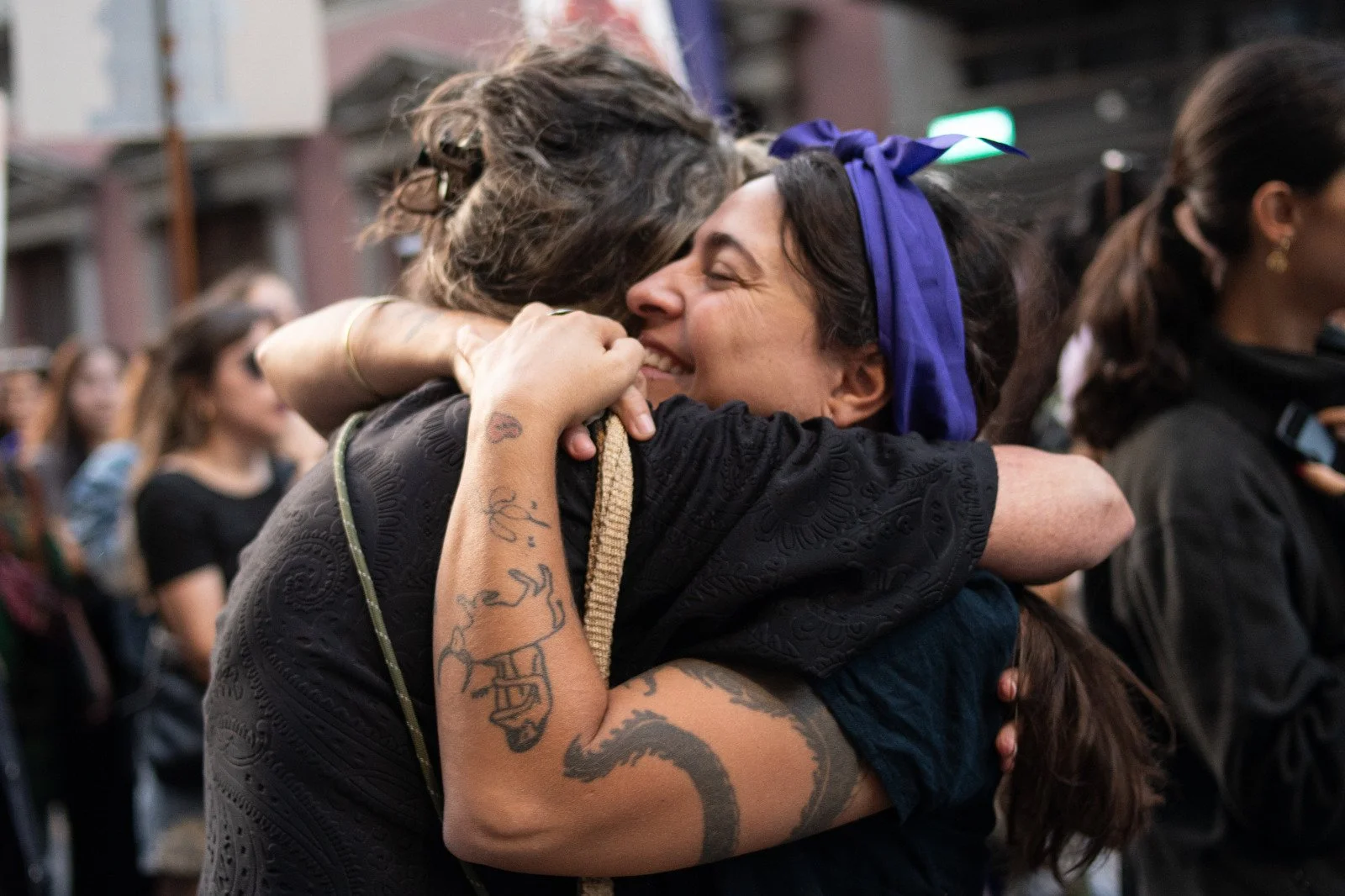
8M protesters embrace on March 8, 2026 in Montevideo, Uruguay. Photo © Bettina Franco.
Playing is part of our fight
One of the activities in the lead up to March 8 was a “pikadito”—a street soccer game—organized for the fourth consecutive year in that same square by Lesbica Futurista and Refuleras.
Soccer players and media workers were there to raise awareness and advocate for soccer with a feminist perspective. Before the march, an impromptu soccer field was set up on the street especially for girls to play, giving us glimpses of women from different generations playing and enjoying themselves, connecting with their bodies in a different way.
Plaza del Entrevero wasn’t a designated gathering point for any specific group, but a contingent did join the march from there. There was a rush of candombe performers at various gathering points along the route, and amid the march’s percussion, the sound of latido.uy also resonated, with its drums and its serene, steadfast chant.
Some of us concluded the march with an impromptu group hug in the form of a spiral: an unplanned gesture that’s imprinted in our bodies and memories, which new generations are now joining.
On March 8, there are those who rally and march individually (as artists, writers, as bodies inhabiting multiple spaces) to speak out and reaffirm that we are not alone. There is a fabric that sustains us and a shared pulse to name and address the violence we must continue to challenge, and to value our shared existence as a source of strength.

