

8M in Caracas, a cry for collective liberation
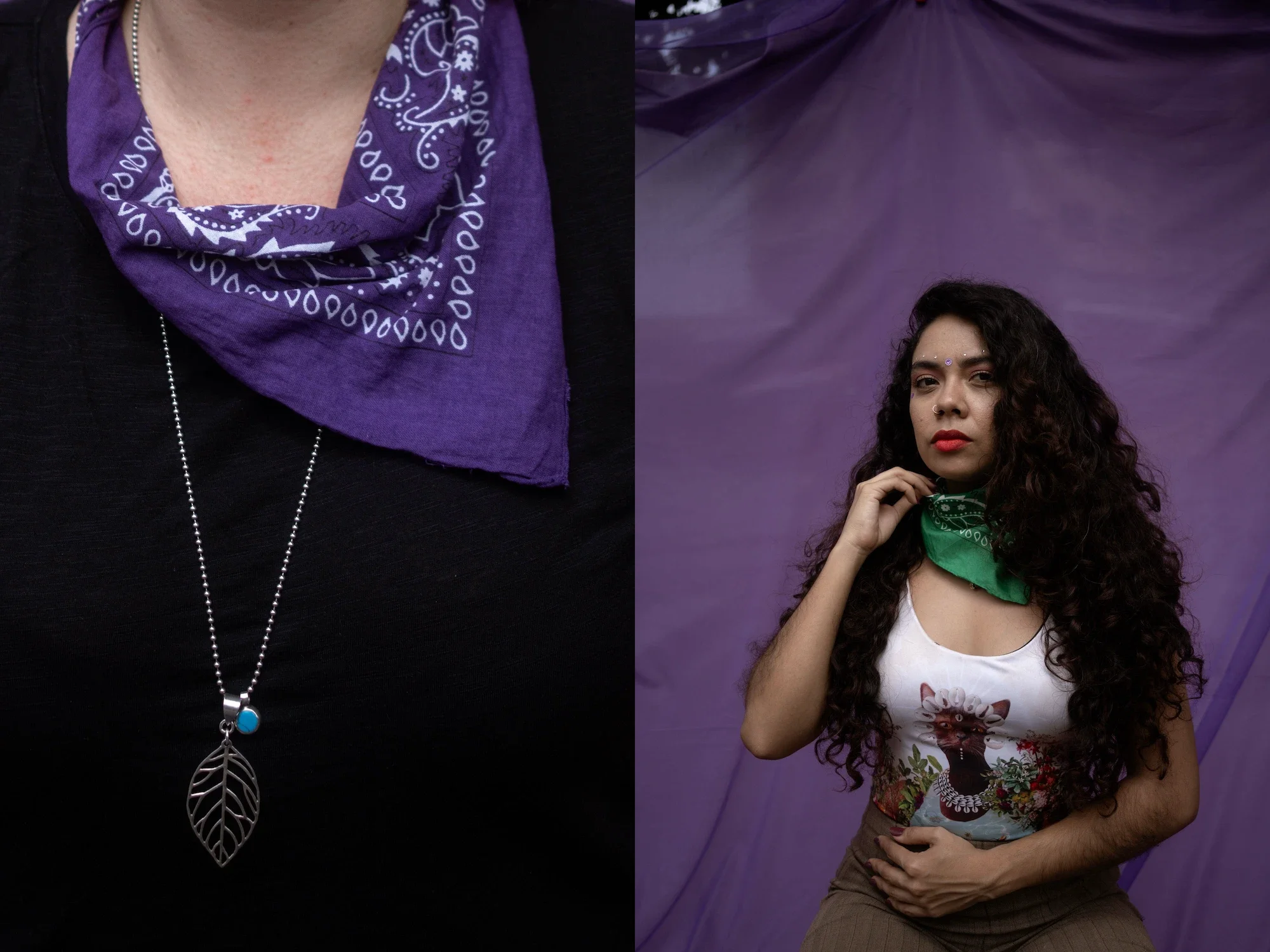
A purple scarf worn by an ecofeminist during the International Women’s Day demonstration. Right: A feminist activist from the Pan Y Rosas organization attends the International Women’s Day demonstration in Brión Square in Caracas, Venezuela, on March 8, 2026. Photo © Andrea Hernández Briceño.
Opinion • Colectiva Mujeres, Cuerpos y Territorios, Venezuela (Mucyt) • Apr, 2026 • Leer en castellano
In Caracas, there are tuqueques—critters known as lagartija tira besos (the lizard that blows kisses) in other parts of Latin America—in our homes. They don’t sing, instead, their vocalizations are rhythmic. Our grandmothers used to tell us that the males make them often when they fall in love. Chuck-chuck-chuck!
The females vocalize less frequently, doing so only when threatened. Female tuqueques are less conspicuous, more delicate and smaller. They hide quickly in crevices, behind picture frames, and between cracks.
They venture out near lights to hunt insects, and their movements are stealthy. They become almost imperceptible to avoid predators. As Venezuelan women, we sometimes feel like tuquecas, needing to hide and be stealthy to go unnoticed. Yet our voices remain: rhythmic, constant, and indignant. We are angry. We have rights.
In the heart of a wounded Venezuela, where life can feel like a puzzle in which sadness and joy resonate together, women have moved beyond our traditional supportive role to become the architects of our own destiny.
Autonomy is not something one seeks permission for, instead, it is a territory that is lived through body and memory. Self-determination is a word that calls to us in our dreams, dreams in which we collectively recall our shared history of popular emancipation.
Reconnecting amid the pain
It’s been a year since we last gathered for our annual March 8 protest on International Women’s Day in the streets of Caracas. This year, we came together to look each other in the eyes once more and embrace each other, celebrating the freedom of our compañera after she was persecuted and kidnapped by the repressive forces unleashed in recent years.
We embraced those who had been threatened on social media, and those who came for the first time to Plaza Brión in the city’s downtown, enticed by the array of banners and street art. Many of us were the same who participated from last year, but there were also new faces.
This year, the streets were ours—instead of convening an 8M march, the government chose to hold a popular referendum to decide on communal projects.
The 8M march in Caracas began at Plaza Altamira. A river of protesters marched and chanted slogans for freedom, rights, and the return of democracy in a deeply fractured country. Women and gender dissidents wearing different colors and fighting for many different causes walked together along Francisco de Miranda Avenue.
Feminist organizations and collectives also held a rally and an assembly in Plaza Brión in Chacaito. The call out drew a broad range of women—working women, party members, feminist activists, and mothers of political prisoners.
On January 3, with trembling hands and faces wet with tears, we learned to write the world’s most merciful lie: “Everything is fine.” Others whispered: we are the daughters of a siege that came without warning. We survived a bombing.
Our wounds are different, but our fear is the same. Some of us carry the echoes of war, coups, and looting in our memories—the sound of steel that bites into childhood. Others, however, had never felt the heart-wrenching beat of helicopters desecrating the roofs of the homes of our loved ones.
We’ve never seen the horizon shine so cruelly, we saw flashes that were not stars, but scarring streaks of light tearing through the dawn sky.
At the same time, just like the tuquecas, we crawl out of the cracks behind our facade of smiles and sorrow. Life strikes with an iron fist and the road is hard, but in the middle of the chaos, we find each other and rejoice in our survival.
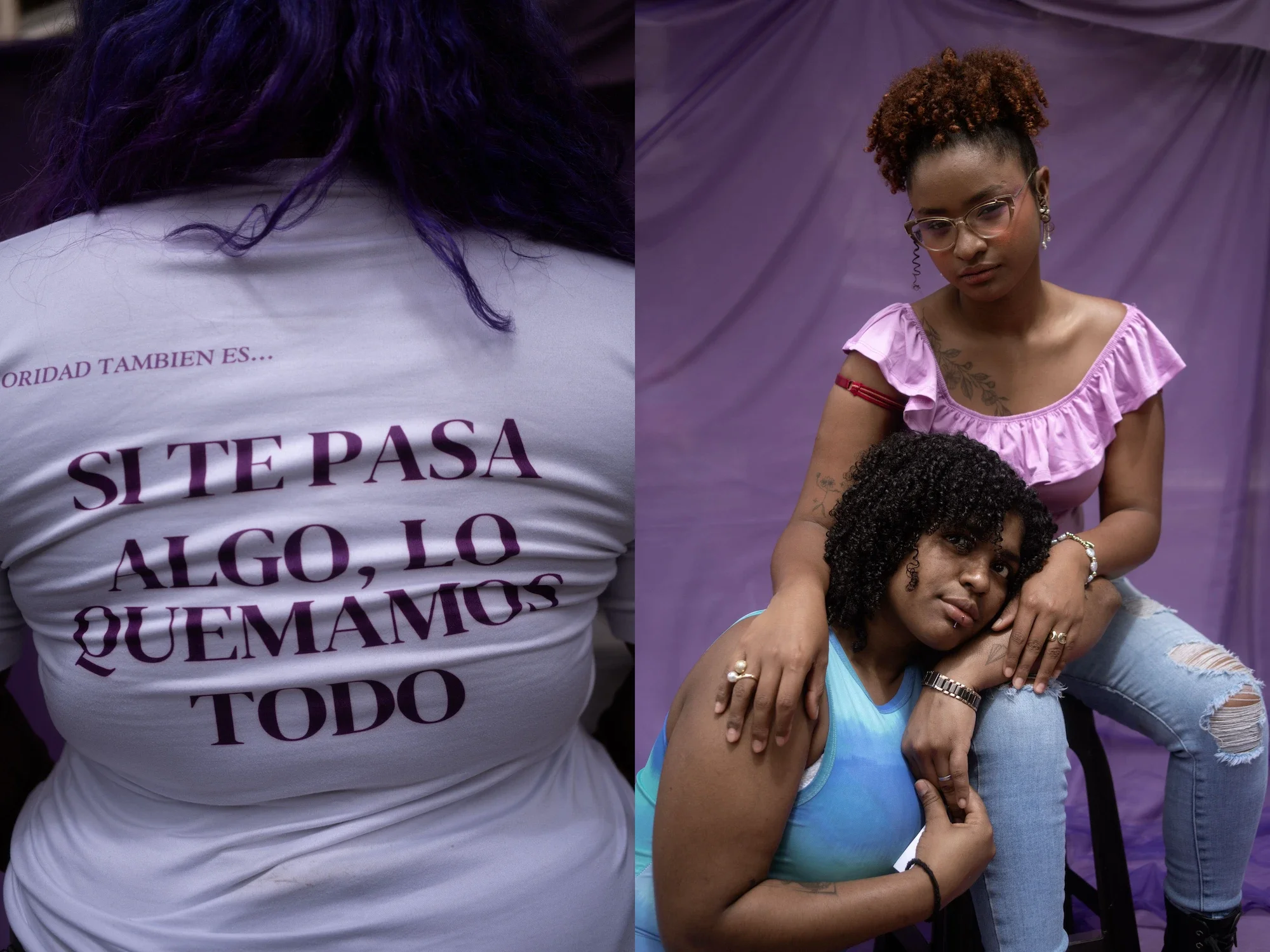
A T-shirt emblazoned with the message “If anything happens to you, we’ll burn it all down” worn during the International Women’s Day demonstration. Right: Two friends attend the International Women’s Day demonstration in Brión Square in Caracas, Venezuela, on March 8, 2026. Photo © Andrea Hernández Briceño.
Feminist anti-extractivism
The prevailing extractivist consensus frightens us. “How are we going to get out of the crisis without oil?” question some. “How can we let the riches of this ‘land of plenty’ go to waste?” ask others.
They argue over whether the money should be used for one thing or another. Money from what? From where? Produced by whom? Our already fragmented sovereignty is divided into pieces of land, and bodies are sacrificed.
Concern hangs in the air, like jam simmering over a flame of anguish.
There are no pay raises. There’s no freedom for our sisters. Nor is there justice or dignity for women in prisons.
Instead, there are mothers everywhere. Mothers of migrants, of the incarcerated, mothers who collect water and worry about drought, Indigenous mothers who cannot bring their crops to the city, who go to bed with malaria.
These mothers are weaving their demands together today, connecting with searchers in Mexico, or with those seeking justice for their murdered children in Colombia. These are moothers who, quietly, set the rhythm for dignity. We march with them.
It was difficult to reach an agreement about this year’s 8M protest: polarization in Venezuelan society enveloped in a deeper silence than ever.
If you step on one side, the other side lifts, like dry leather. Better not say this, better not say that, everything is uncertain. Very few move outside the black-and-white spectrum; a minority who seek to perceive the greys in the smoke of regrouping.
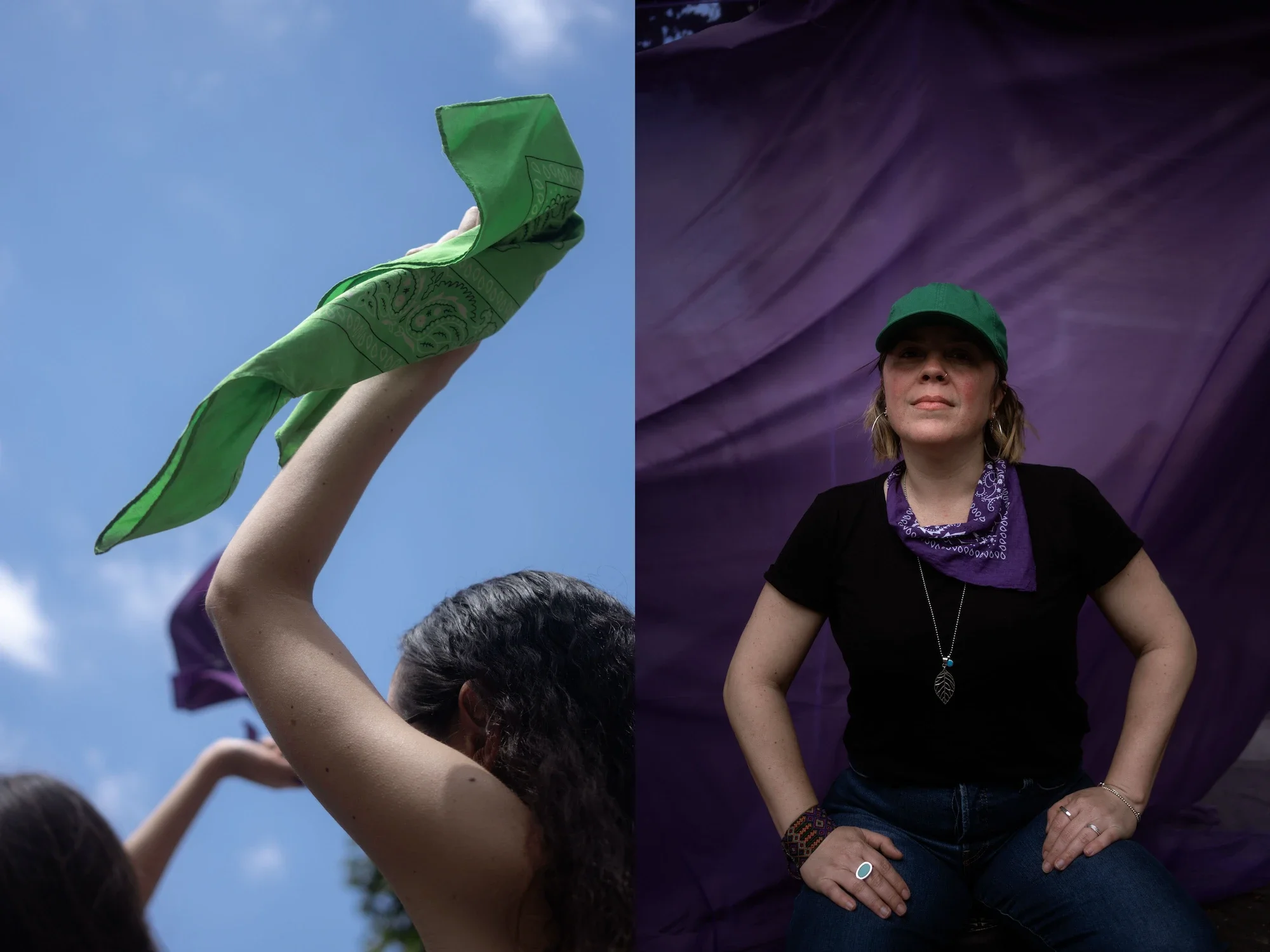
A woman waves a green scarf at the International Women’s Day demonstration. Right: An ecofeminist activist from Mujeres Cuerpos y Territorios organization, during the International Women’s Day demonstration in Brión Square in Caracas, Venezuela, on March 8, 2026. Photo © Andrea Hernández Briceño.
Upholding the protest
Confusion reigns, and everyone wants to see transformation. There are also those who dance on the ruins left by bombs and missiles.
We see how “El Dorado” (the land of oil and gold) is reborn on people’s lips, as elites settle in comfortably, and mothers continue to raise their voices.
Working mothers continued to ask: “When will we get paid?”
Retired grandmothers and pensioners, their hands marked by decades of labor, refuse to let the final chapter of their lives amount to waiting by the phone. They don’t want their years of work to be reduced to the word “remittance.” They demand the right to age in peace.
May 1st is approaching, and the bonus society is running on empty. In Venezuela, a precarious bonus system has replaced wages, effectively eliminating the working class’s benefits and protections.
How will we come back from this? How can we reverse the neoliberal dream of the business elites—the elimination of wages—that has been consummated in Venezuela?
Venezuelan politics has become a chessboard of shadows. Division is no longer a matter of opinion but an abyss that splits and silences at the dinner table.
In this fractured landscape, negotiations with the government and strings pulled from the north feel like a balancing act.
It is not just about deals signed under artificial lights. It’s a constant tug-of-war between sovereignty and urgency, where every agreement carries equal weight in the eyes of those waiting to meet their fate.
Our communities are positioned under the chessboard, our situation is complex and often hard to understand.
We’ve lived through a sustained siege caused by prolonged sanctions and economic blockade, in a context of constant threats of US military invasion. Bombs are presented as means for the “liberation” of the people, but we know that such liberation will never come from the skies. Only the faces of the executioners will change.
Those who drop the bombs, negotiate oil deals, or shake hands with the global far-right, will not free the Venezuelan people from poverty, uncertainty, territorial devastation or state authoritarianism.
A necropolitical logic persists in this war-torn landscape, our country has become a business, and a bargaining chip for those who profit from extractivism, regardless of their ideological affiliation.
It is for all of these reasons that we gathered on March 8 in song and celebration, to center the sovereignty of being—a reminder that even in the darkest times, our freedom is the flame that brings alive the possibility of a different world.
We gathered to insist on imagining that a different future is possible in our country, in our bodies, and in our territories.
