Ten points on the US attack against Venezuela
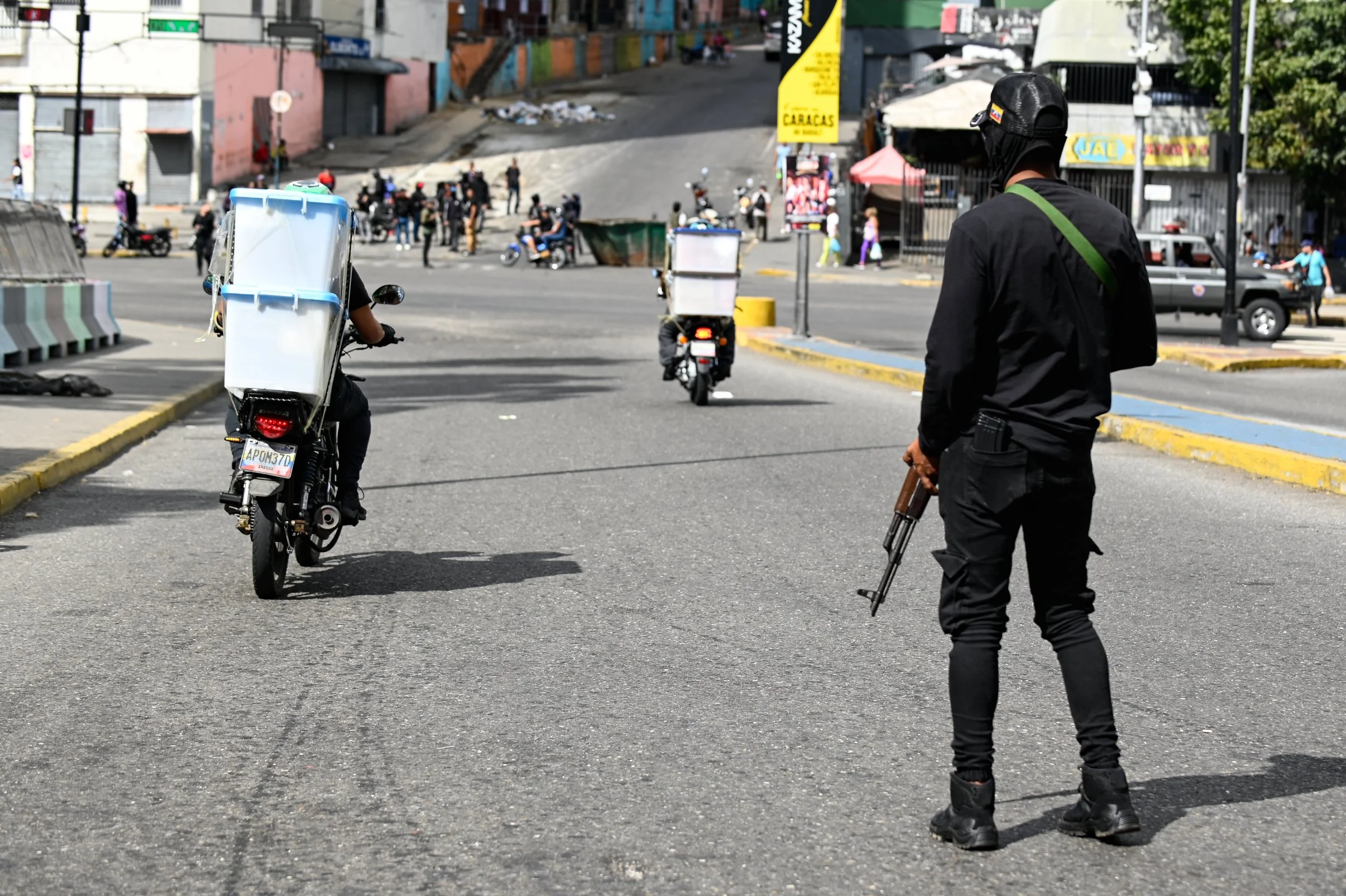
Armed civilian Fuerza Colectivo members set up checkpoints after hearing explosions and low-flying aircraft in the early hours of January 3, 2026, in Caracas, Venezuela. Photo © Maxwell Briceño.
Opinion • Emiliano Teran Mantovani • January 6, 2025 • Leer en castellano
Ojalá condemns the brazen attack by the United States military on Venezuela. We stand in solidarity with the Venezuelan people who sustain daily life with great difficulty amid military aggression and political maneuvering.
Ojalá was born from the conviction that, in the face of the confusion that comes with the urgency of the moment, we can nurture careful, sustained, and profound reflection. We seek to untangle the many layers of confusion and rhetoric surrounding the intervention in Venezuela. This collective practice allows us to understand the fast pace of daily life in a nuanced manner, and to work toward building anti-militarist consensus from below, which are so urgently needed today—Eds.
The bombing and the new scenarios taking shape
The vile and tragic imperial attack on Venezuela on January 3 opens a new scenario nationally and in Latin America. I propose 10 points to analyze what’s taking place and where we could be headed in the interest of fostering collective understanding.
1. First, there’s the humanitarian aspect: as of January 6, there is still little information about the death toll from the vile US attacks. The New York Times reported that at least 80 people died, including civilians. A building in Catia La Mar was bombed, and the death toll could be even higher.
The population has been shaken by these events and is now plunged into further uncertainty about the future, just after the end of another year in which Venezuela experienced the highest inflation in the world.
2. This is a truly traumatic event for a country already traumatized by Nicolás Maduro’s government. It is unsettling to consider the threshold for trauma among Venezuelans, which seems to have multiple layers. Events like those of January 3 are approached with a thick skin.
3. The imperial attack by this powerful conglomerate that despises life is the peak of the Venezuelan tragedy, which began when Maduro's government destroyed democracy, demobilized society through repression, closed the possibility of elections, and chose to hold the entire country hostage.
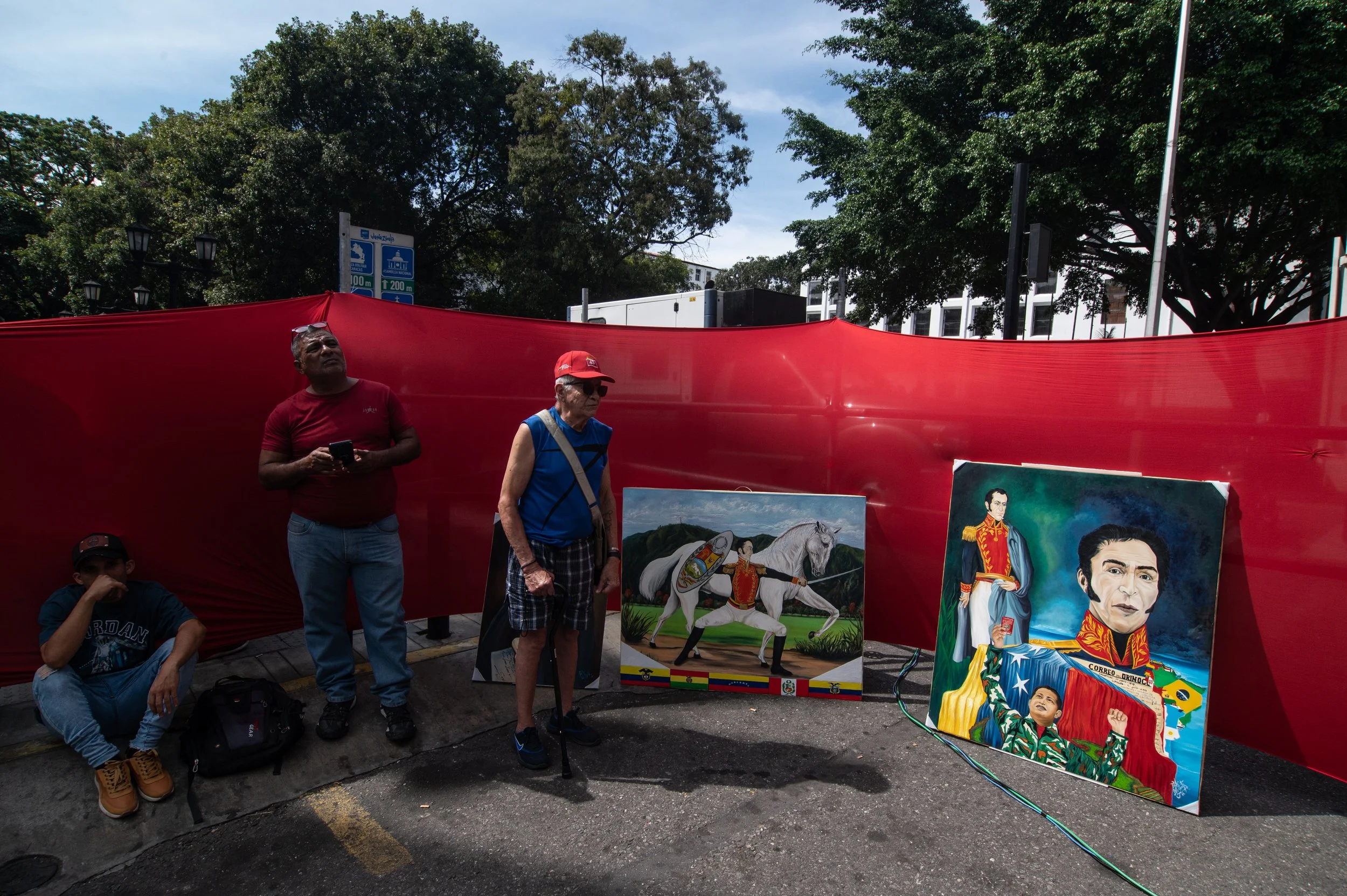
Supporters of President Nicolás Maduro attend a rally near the Miraflores Palace. January 3, 2026, in Caracas, Venezuela. Photo © Maxwell Briceño.
4. Although I am not prone to speculation, it must be said that, given the evidence that continues to surface, the possibility of an imperial attack aided from within is on the table. The virtually non-existent response of the Venezuelan Armed Forces to the removal of Maduro and his partner and congresswoman Cilia Flores; the persistence of the other leaders of the Chavista government; the recognition of Delcy Rodríguez as a key figure in the transition; and the fact that Donald Trump’s administration is distancing itself from María Corina Machado all provide elements that require us to consider the possibility of betrayal, internal fracture, and an agreement toward a change of government.
On January 4, U.S. Secretary of State Marco Rubio said the 2024 presidential election in Venezuela “was an illegitimate election, and that's why [Edmundo González Urrutia] is not a legitimate president.” On the same day, Maduro's son, Nicolás Maduro Guerra, said that “history will reveal who the traitors were.” More puzzle pieces to fit together.
All of the above has enormous implications and significance.
5. January 3 may represent a watershed moment in recent Venezuelan history: a transition has been activated in Venezuela, but instead of a change of government, we are moving toward a change of political regime. A regime that could take us further back then even pre-republican forms of government. It begins with Trump “leading the transition,” announcing co-government, and claiming imperial sovereignty over resources. The rest remains to be seen. There is much to be written in the coming days and weeks.
6. Of course, there is also the question of whether January 3 could represent a watershed moment for Latin America and the Caribbean. It seems likely. Trump announced at his press conference after the attack that “American dominance in the Western hemisphere will never be questioned again.” The logic of dependence and subservience casts a regional spectre and represents an extraordinary threat to Latin America, while also warranting the adoption of new strategies to confront it.
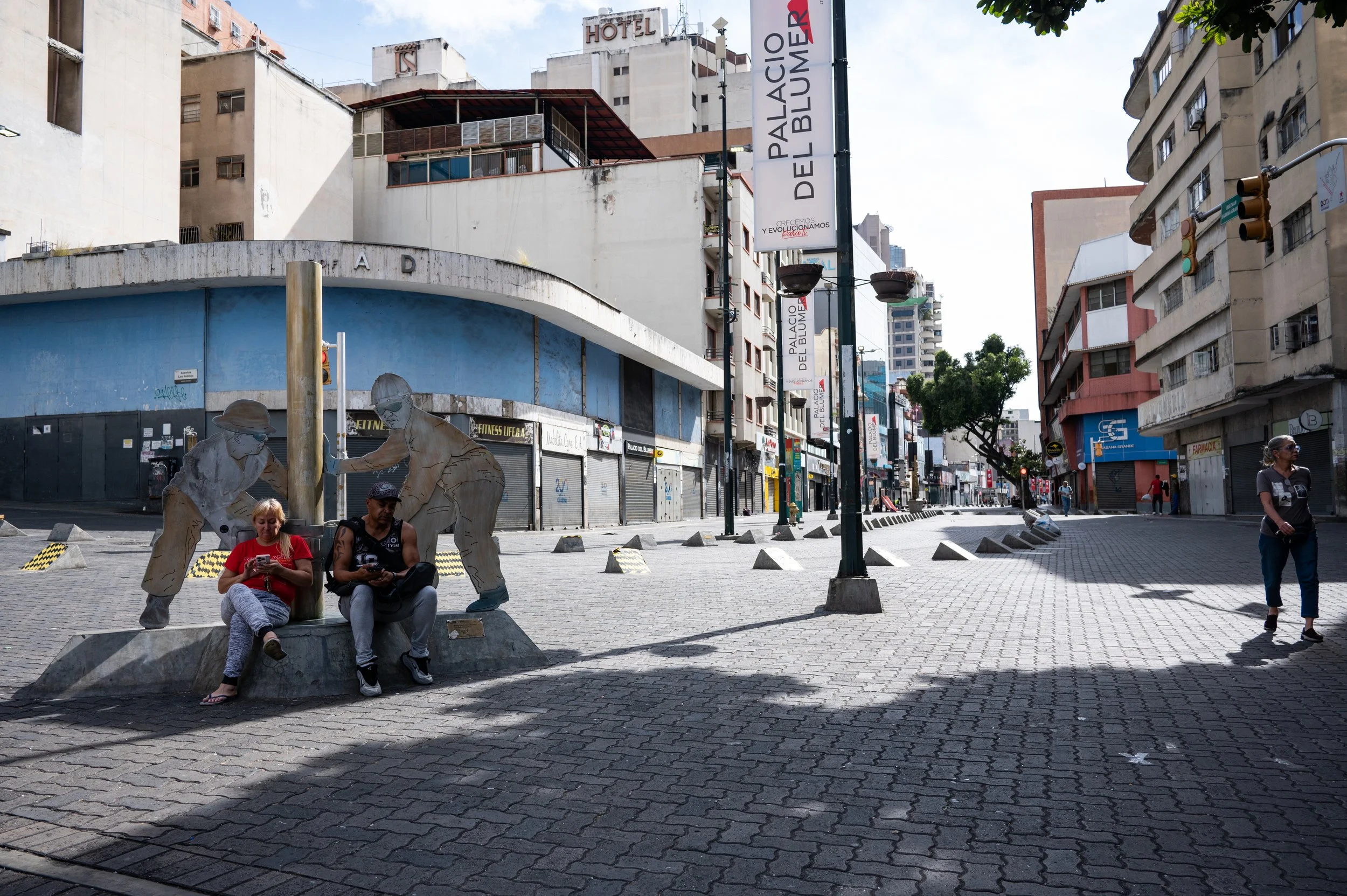
The nearly empty streets of Caracas, Venezuela, on January 3, 2026. Photo © Maxwell Briceño.
7. Presidents Daniel Noboa of Ecuador, Javier Milei of Argentina, and Rodrigo Paz of Bolivia have applauded the attack. The logic of dependence and subservience has historically found national representations. It has also been accepted by part of the population of our region.
That said, it would be an extreme simplification to label all popular discontent as “fascism” and “subservience” without taking into account the mistakes, disenchantment, and disaffection caused by progressive governments in the region. The most conservative sectors in the region have been able to effectively capture this discontent.
8. Latin American history bears the mark of important cycles of social struggle. The last of these cycles with a regional impact was in 2018-2019. I believe that we must carefully trace the features of popular discontent and generational changes and link them to material aspects of sovereignty and Latin Americanism: land, food, wages, and water.
Where are the factors of convergence among social forces? Where are the factors that unite us?
9. We must not forget that Trump faces strong opposition internally. What happens within the United States will be crucial. I would also add a global component: the protests in Morocco, Cameroon, Italy, Madagascar, the Philippines, France, Indonesia, Turkey, Serbia, Mozambique, Kenya, and Iran, to mention only those that occurred in 2025. All of these are factors that play a role in the current moment.
10. National and regional history is being written in the heat of a global civilizational crisis, in which everything is being shaken up. This is a process in which the turbulence and waves that hit our societies seem to emerge almost daily. It has never been more important to cultivate political imagination and new paradigms for interpreting reality.