

Persistence and resistance in 2025
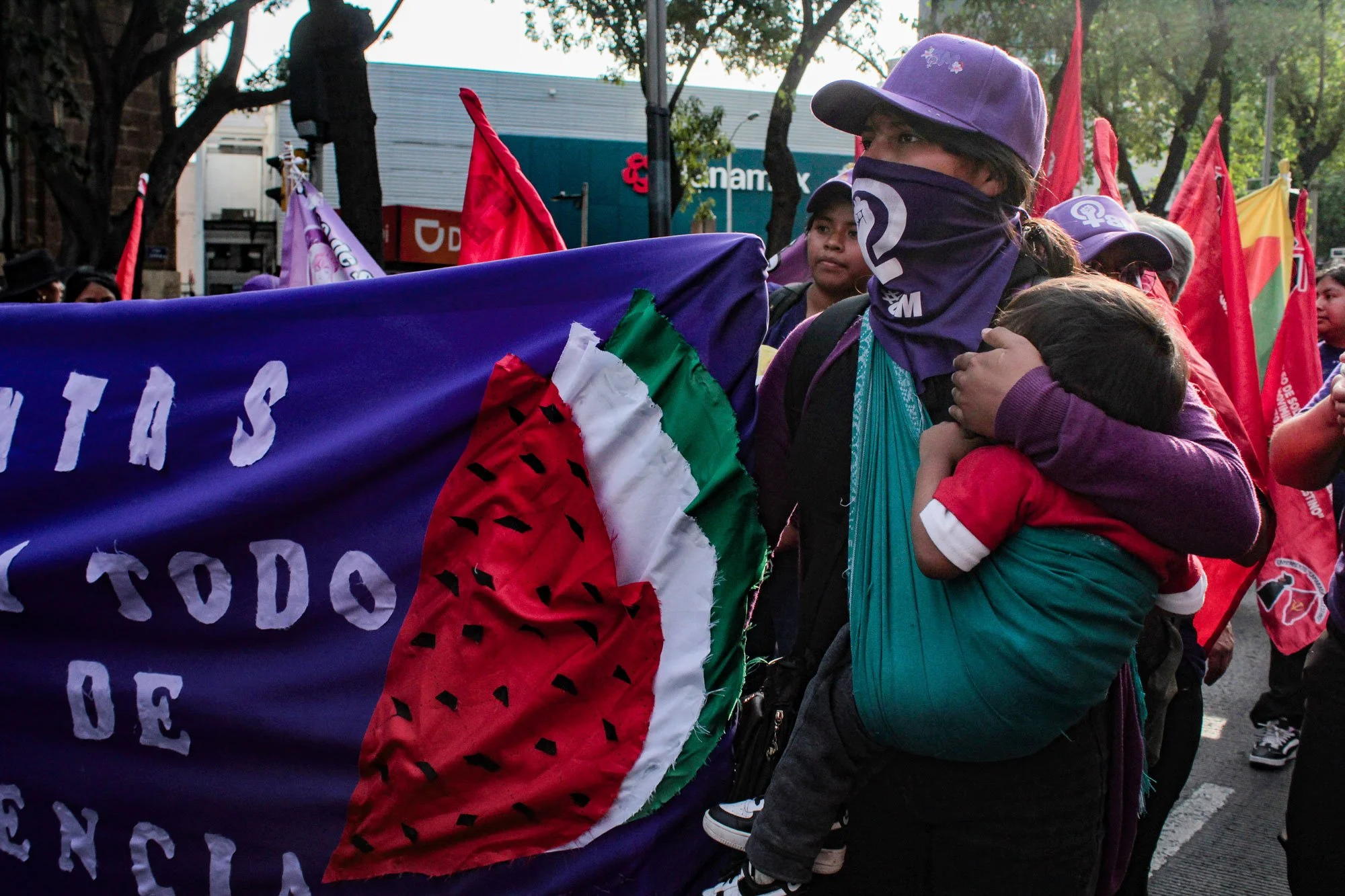
The 25N March on the International Day for the Elimination of Violence against Women. November 25, 2025, Mexico City, Mexico. Photo © Elizabeth Sauno.
Opinion • Ojalá Editorial Collective • December 19, 2025 • Leer en castellano
Ojalá is closing out 2025 with our eyes on a present marked by renewed violence and myriad forms of resistance—both processes that condense long-standing histories.
In July, we published an editorial calling for organized resistance to militarism, in which we drew on a historical arc of social struggles in order to contribute to a collective conversation about today's political challenges.
Since then we’ve continued to deepen our coverage, highlighting everyday forms of community resistance and spaces for critical reflection that nurture a common sense of dissidence that helps propel us forward.
From local community centers to global initiatives for Palestine, we’ve sought to bring political and emotional connections into relief, while offering new perspectives in a moment marked by a reactionary offensive.

Digital art by @Pazconadie for Ojalá.
Global struggle for Gaza
Just as we did in July, we wish to reaffirm our commitment to Palestine. Our coverage has sought to highlight actions of solidarity, the impacts of genocide, and resistance in Latin America, all of which are part of an interconnected global struggle.
In Mexico, professors at various universities organized a content strike, while the Global Sumud Flotilla managed to bring more attention to the genocide. In Chile, home to the largest Palestinian community outside the Arab world, our coverage explored a range of initiatives from communal kitchens to stand-up comedy.
In October, a ceasefire was announced in Gaza, but the war continues. The influence of Israeli companies participating in the apartheid system is real in countries across Abya Yala.
The Mexican state maintains diplomatic relations with Israel despite acknowledging that the war in Gaza is a genocide. In Argentina, Israel's state-owned water company, Mekorot, has signed water management contracts with a dozen provinces. As Nadia Bernal reports, Mekorot has been denounced for violating water rights in Palestine. And in Colombia, Mariana Mora reported on ExpoDefensa, Latin America’s largest military industry fair, where anti-war demonstrators experienced a police crackdown for protesting the presence of Israeli surveillance company Cellebrite.
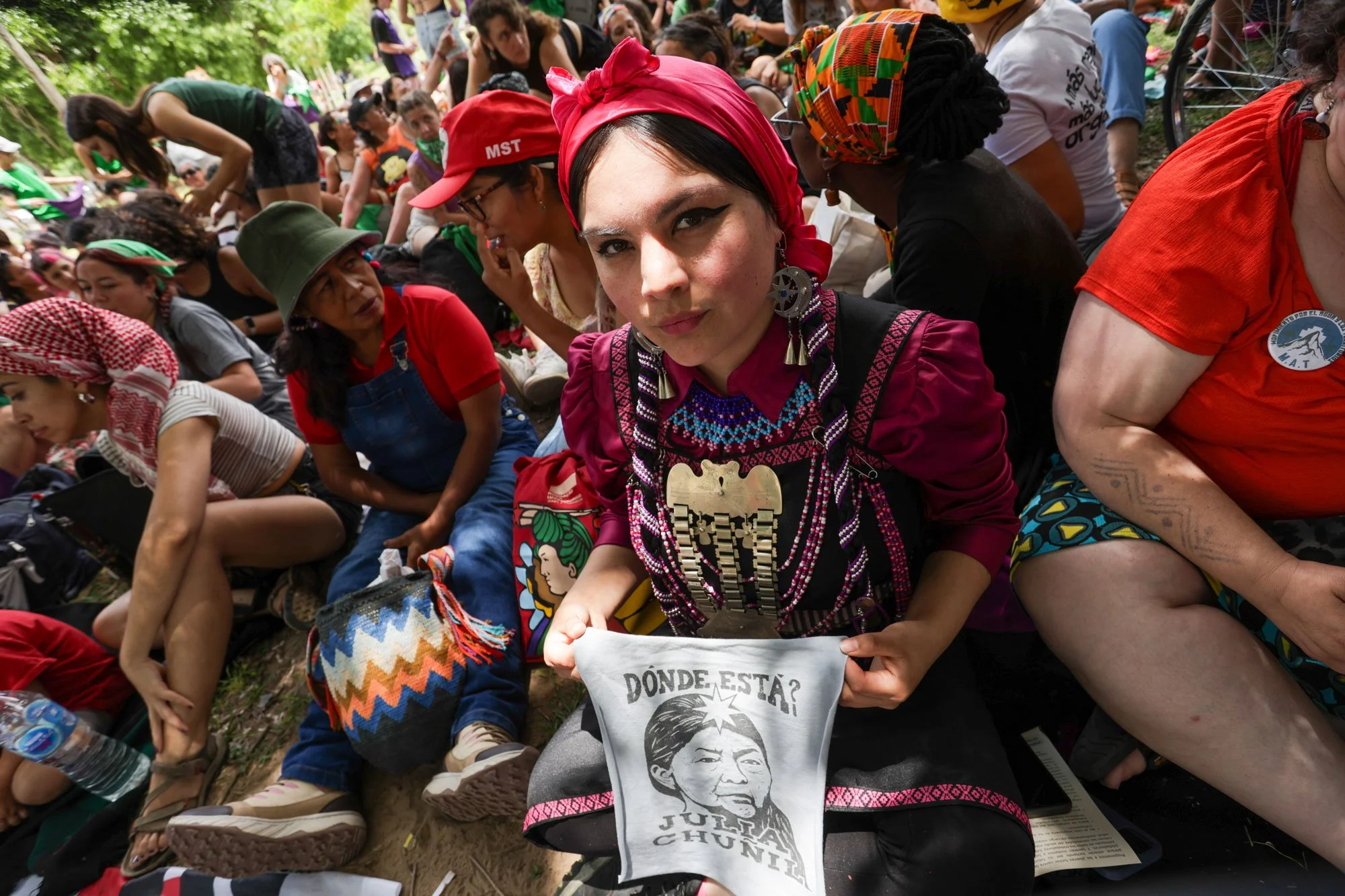
Lyzzette Sanchez Díaz, the Granddaughter of Julia Chuñil from the Gulumapu community in Chile, participates in the Abya Yala feminist assembly in Camba Cuá Park on November 23, 2025 in Corrientes, Argentina. Photo © Susi Maresca.
Transfeminism and LGBTQIA+ rights
This year we published our “Transfeminist Debates” series, made up of articles written in dialogue among activists, researchers, and organizers from different latitudes. These reflections took as a starting point Verónica Gago’s piece on 10 years since the first Ni Una Menos feminist march in Buenos Aires. They included perspectives on ongoing transfeminist movements in Mexico, Chile, Ecuador, Bolivia, Argentina, the United States, and Spain.
We also published articles that delved into key definitions to establish conceptual anchors that allow us to name (and translate) struggles and oppressions from a grounded, Latin American perspective.
Lorena Wolffer shared her reflections on her personal and deeply political process of naming herself a transfeminist in Mexico. Meanwhile, Marbella Quechol intertwined the legacy of the Travesti Museum of Peru with her own experiences to explore what it means to be travesti as an identity, a practice, and an act of resistance.
This need arose in part because these terms are not used as frequently in English or have different meanings. We wanted to begin building our own framework, while acknowledging the subjective experiences that are difficult to translate.
This more contemplative approach was augmented by reporting on the ground.
As is the case every year, we featured coverage of International Women’s Day demonstrations across Abya Yala, showcasing the range of challenges faced by the movement.
In addition, Agustina Ramos covered the Pride March in Argentina, highlighting the mass protest amid the rise of hate speech and setbacks in public policy, while Susi Maresca shared a dispatch from the Plurinational Meeting of Women, Lesbians, Travestis, Transgender, Bisexual, Intersex, and Non-Binary People.
We also shared a two-part interview with activist and thinker Fatima Ouassak, exploring the combative possibilities of motherhood and women’s organizing.

Digital illustration created for Ojalá © Elisa María M.V.
Nurturing and protecting land
This year, continued to cover ongoing community struggles to protect their land.
In Puerto Morelos, México, pressure is mounting on the mangroves and fishing that sustain the community. And in Oaxaca, the struggles of the Mujeres Mazatecas por la Libertad (Mazatec Women for Freedom), who, after years of protest, secured the release of 21 political prisoners who had been jailed for defending their autonomy and territory.
We also published the stories from our Ojalá+Resilience Fund project, which funded reports by five women journalists working across Mexico. The fellows wrote articles about the resistance of communities in Veracruz, Oaxaca, State of Mexico, Nuevo León, and Chihuahua at the intersection of extractivism and organized crime.
We dedicated several articles to covering struggles for land rights in Argentina, where the government hopes to expand the country’s extractive industries: from the salt flats in the north for lithium mining to Patagonia in the south, which has been militarized and opposition repressed to allow for the exploitation of its resources, including land, water, gas, and oil.
Amid the difficulties, we shared news of a key victory in Uruguay, where years of grassroots organizing led to the cancellation of the Neptuno megaproject, which would have privatized 60 percent of the country's drinking water.
No heroes, many teachers
In addition to protests, many of the stories we published reflected the strength of everyday struggles across communities that resist subordination and assert their needs and desires.
We found examples of that strength in initiatives like the Centro Cultural Autónomo iik'naj, a space that seeks to recover traditional knowledge and practices threatened by extractivism in the Yucatan Peninsula. From the mountains of Antioquia, Colombia, we covered a network of cooperatives, based on autonomous community organization, has flourished, establishing itself as an essential food supplier in a territory marked by violence. We learned of the obstinacy of a trans Mapuche youth refusing to abandon her territory in Patagonia, and how trans artists in Puebla are dedicating their lives to what they are most passionate about.
We posted stories of how two friends in Brooklyn, one Haitian and one Dominican, joined forces to fight attempts to divide their countries, combining their cultures through gastronomy. And we learned how folks who consume cannabis in Mexico City challenge stigma and criminalization, through the creation of cafes and tolerant spaces.

Digital illustration in hand drawing style for Ojalá by Karen con K.
A swing rightwards
In recent months, we’ve witnessed a continued swing to the right in Latin American politics. In Bolivia, the promise of “capitalism for all” prevailed over a ruling party embroiled in internal disputes amid an exhausting economic crisis.
On Sunday, a Pinochet supporter who echoes the anti-immigrant rhetoric—in vogue in the global North—won elections in Chile. And in Honduras, the winner of an election shaken by US interventionism has yet to be decided. Both of the leading candidates' platforms promise more neoliberalism.
But rightward momentum has not gone unanswered: in Ecuador, the Confederation of Indigenous Nationalities of Ecuador (CONAIE) called for a national strike to challenge Daniel Noboa's government, which was violently repressed and forced to disband. It was followed by a nationwide plebiscite that firmly rejected militarization and US military presence.

Indigenous women embrace after participating in the popular and plurinational march organized by the Kitu Kara Indigenous people on the 16th day of the national strike called by CONAIE. Quito, Ecuador, October 7, 2025. Photo © Karen Toro.
The worrying advance of war and a new polarizing movement attempting to undermine the many efforts at social organization are undeniable.
Militarization is a spectre that continues to surface in our coverage. Given its regional impact, we’ll continue to examine its impacts, rhetoric, and efforts to mitigate both, in the new year.
Beyond international conflicts, the spread of securitized discourse is cause for concern. In the name of fighting crime, drug trafficking, and “illegal immigration,” this rhetoric is used to expand the influence of the military and law enforcement agencies.
We must continue to explore the harmful effects of militarism on the lives of affected communities, and especially on youth, women and gender dissidents, as explained by the organization Intersecta. It bears repeating that this is a discussion we’re deeply committed to fostering.
We hope 2026 will be a year in which struggles, large and small, immediate and gradual, see successes and provide hope, and continue to push beyond the traps of state-centered thinking and actions.