

Argentina’s Encuentro Plurinacional, a bastion against state anti-feminism
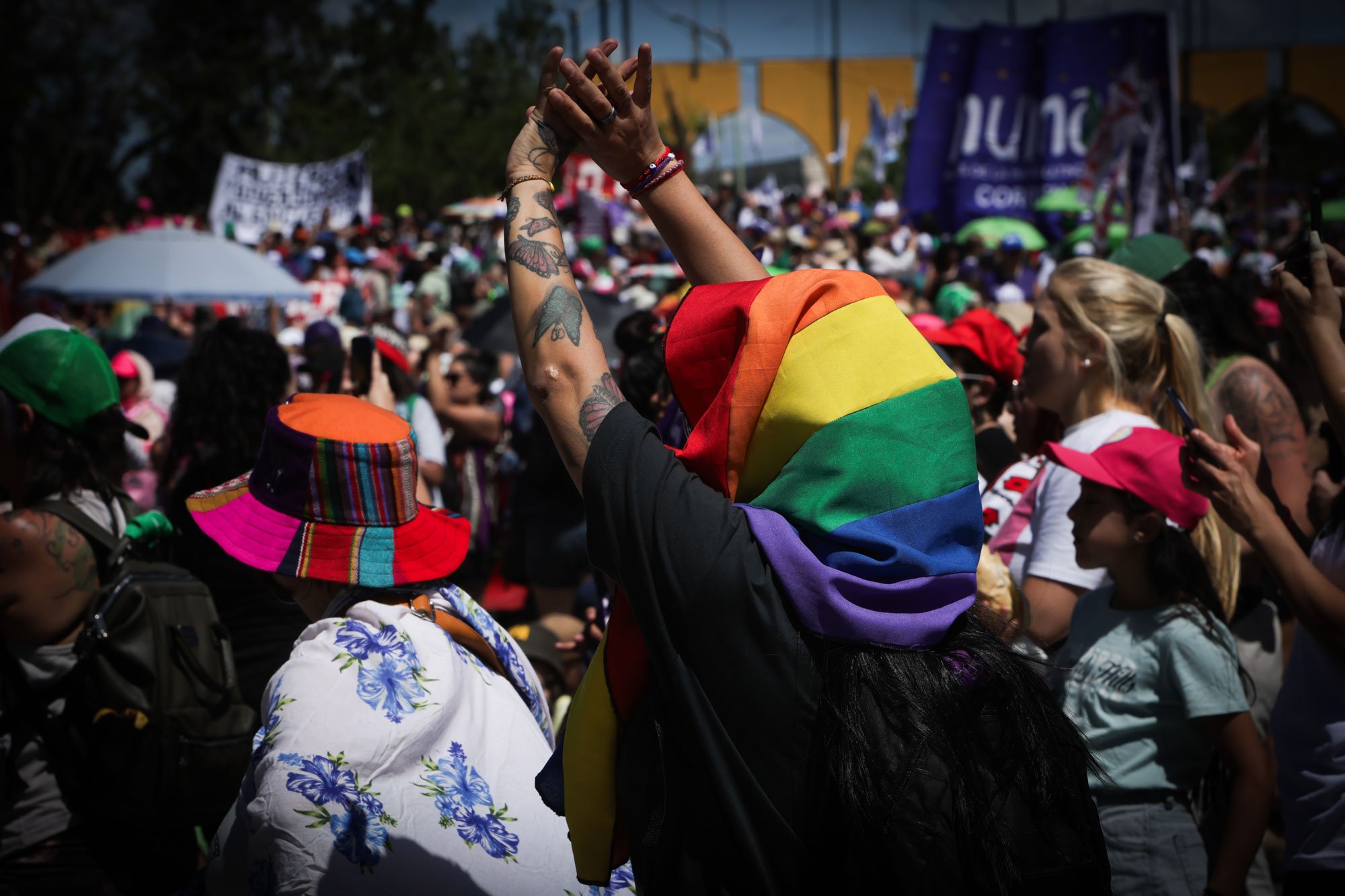
A young woman raises her hands covered by an LGBTQIA+ flag at the Cocomarola Amphitheater during the opening ceremony of the 38th Plurinational Gathering of Women, Lesbians, Travestis, Transgender, Bisexual, Intersex, and Non-Binary People on November 22, 2025 in Corrientes, Argentina. Photo © Susi Maresca.
Opinion • Susi Maresca • 4 de diciembre, 2025 • Leer en castellano
The Plurinational Gathering of Women, Lesbians, Travestis, Transgender, Bisexual, Intersex, and Non-Binary People is the backbone of Argentina's transfeminist movement.
Known as the Encuentro, this year the gathering was held in the northeastern Argentine province of Corrientes from November 22 to the 24. It’s a pluralistic, self-managed, autonomous, horizontal, and federated space that continues to grow.
This year, it featured over one hundred workshops where ideas and debates were shared. Over the three-day period, an estimated 70,000 people participated in collective activities held under a transfeminist framework.
The annual gathering has become even more significant since Javier Milei's far-right government took office, demonstrating a capacity to nurture mobilization and resistance, from emerging anti-fascist marches to the annual 8M and Ni Una Menos demonstrations.
These grassroots encounters can also translate into public policies and formal demands for rights we have already won. They also shape the range of ideas that move us, and help build the power that makes Argentina’s feminist movement among the most well-known in Latin America.
Are there things that could be improved? Of course, there are many.
But what becomes clear to all over the three days of the gatherings is that we are not the same afterward. Power is built here, and it’s part of a legacy we must embrace in order to inhabit the present and design new possible futures.
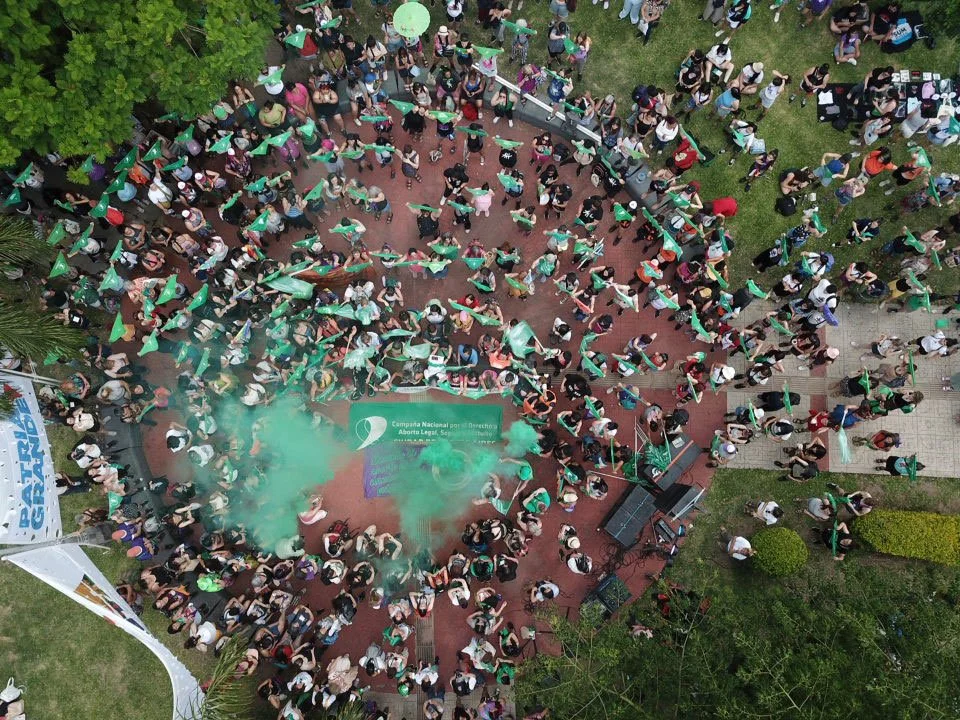
A Pañuelazo (handkerchief protest) is held by the National Campaign for the Right to Legal, Safe, and Free Abortion during the 38th Plurinational Gathering of Women, Lesbians, Travestis, Transgender, Bisexual, Intersex, and Non-Binary People on November 22, 2025 in Corrientes, Argentina. Photo © Susi Maresca.
Naming and existing
In May 1986, a group of women gathered in Buenos Aires for the first Encuentro Nacional de Mujeres (ENM) to discuss advancing the feminist agenda at the dawn of a fledgling democracy in the wake of Argentina's civil-military-ecclesiastical dictatorship. Some of the participants had been part of women's committees in other parts of the world, and decided to replicate them at home. Among the central issues at that time were the right to divorce, abortion, political participation, political prisoners, and foreign debt.
Forty-five women formed the first organizing committee, and together they changed the course of history. They took to the streets to call out gender injustices, which, as a result of the terror of the dictatorship, had been hidden away in the domestic sphere.
Every year since, different provinces of Argentina become venues that host and welcome debates, insights, learning, and calls for justice. Participants set agendas that seek to address fundamental issues in defense of transfeminism in Latin America.
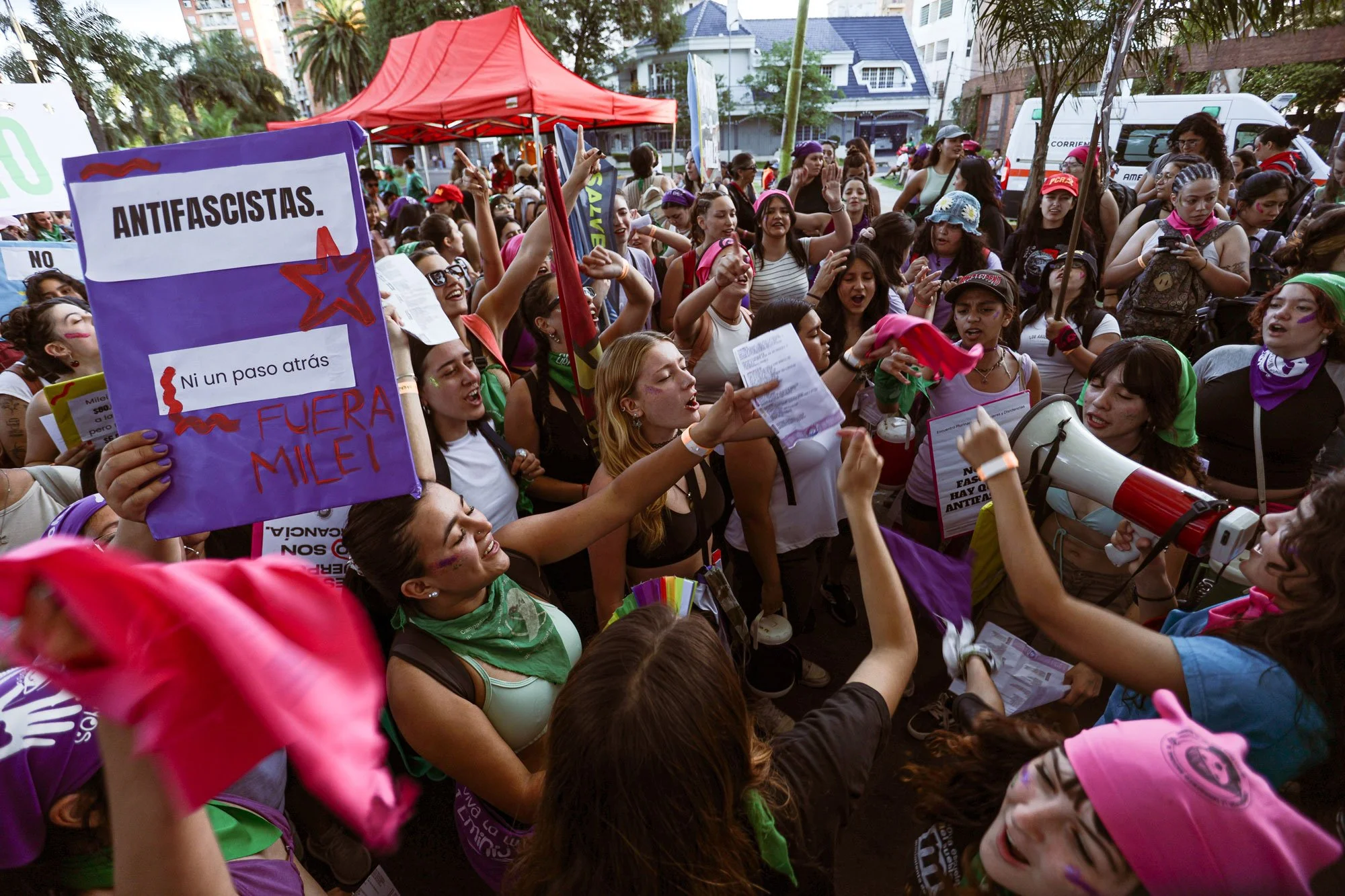
A group of young anti-fascists hold a sign that reads “Not one step back, Milei out” as they sing and jump before the main march of the 38th Plurinational Gathering of Women, Lesbians, Travestis, Transgender, Bisexual, Intersex, and Non-Binary People on November 23, 2025 in Corrientes, Argentina. Photo © Susi Maresca.
This journey has not been without tension. Every single word in the Encuentro’s name has been the subject of lengthy discussions over many years.
A fracture emerged at the 2019 meeting around a handful of key points of disagreement. The main rift was between those who wanted to broaden representation so that the Encuentro was plurinational, inclusive of sexual and gender diversity (lesbians, travestis, trans, bisexuals, intersex, and non-binary people) and Indigenous communities; and those who wanted to keep the gathering “national.”
The following Encuentro didn’t take place until after the pandemic in 2022, in the province of San Luis. It split into two different gatherings for the first and only time in history.
“My sense is the feminist movement does very little to address how heterosexual it is,” said Adriana Guzmán Arroyo, an Aymara, lesbian, feminist, popular educator, and writer. She pointed out that “lesbian feminism has a pre-colonial history.”
Today, the Encuentro's full name is the Plurinational Gathering of Women, Lesbians, Travestis, Transgender, Bisexual, Intersex, and Non-Binary People. Because what we cannot name what does not exist, we’ve learned to construct new debates and meanings—about class, gender, worldviews, territoriality, and solidarity—along our collective journey.

A panoramic view of the opening ceremony at the Cocomarola Amphitheater of the 38th Plurinational Gathering of Women, Lesbians, Travestis, Transgender, Bisexual, Intersex, and Non-Binary People on November 22, 2025 in Corrientes, Argentina. Photo © Susi Maresca.
In Corrientes, we become together
Outside the Cocomarola Amphitheater in the city of Corrientes, dozens of stalls were set up selling artisanal products and food. The economic crisis is hitting hard, and some decided to travel to the Encuentro to sell their goods. On every corner, people embraced and greeted each other.
On November 22, the opening ceremony took place under a blazing sun.
Members of the Guaraní Nation moved through the crowd, opening the way with incense. The province of Corrientes shares a border with Paraguay, Brazil, and Uruguay. It was chosen to host the gathering this year for several reasons, including the case of Loan Peña—a child who was disappeared in 2024, exposing the collusion of the political power with the system of human trafficking. This, year, the slogan for the encounter was “We’re together in Corrientes, against trafficking and in memory of the disappeared.”
At the beginning of the event, the organizing committee read an opening speech that emphasized the fight against patriarchal violence, the cuts to rights and public policies, extractivist advances, and for concrete measures for the LGBTQ+ community. The statement called for justice for the 252 victims of femicides and transfemicides in Argentina so far this year.
“Every day, this government expresses hatred against the working class and against the feminist and transfeminist movement,” organizers read aloud before the cheers of hundreds of people.
According to organizers, the provincial government of Corrientes blocked the use of schools for workshops, lodging, and activities until the last minute. This was despite having declared the event to be of provincial interest months earlier. No statements were made by the government on the matter.
“We endured a boycott because three days before the meeting began, Gustavo Valdés’ government pulled the assigned schools,” said María Mollá, a teacher and activist, in an interview with Ojalá. “The Minister of Education, Práxedes Ytatí López, resigned, and we had to reorganize everything in record time.”
Despite it all, as participants chanted in the streets, the Encuentro proceeded, defying efforts to hold it back.
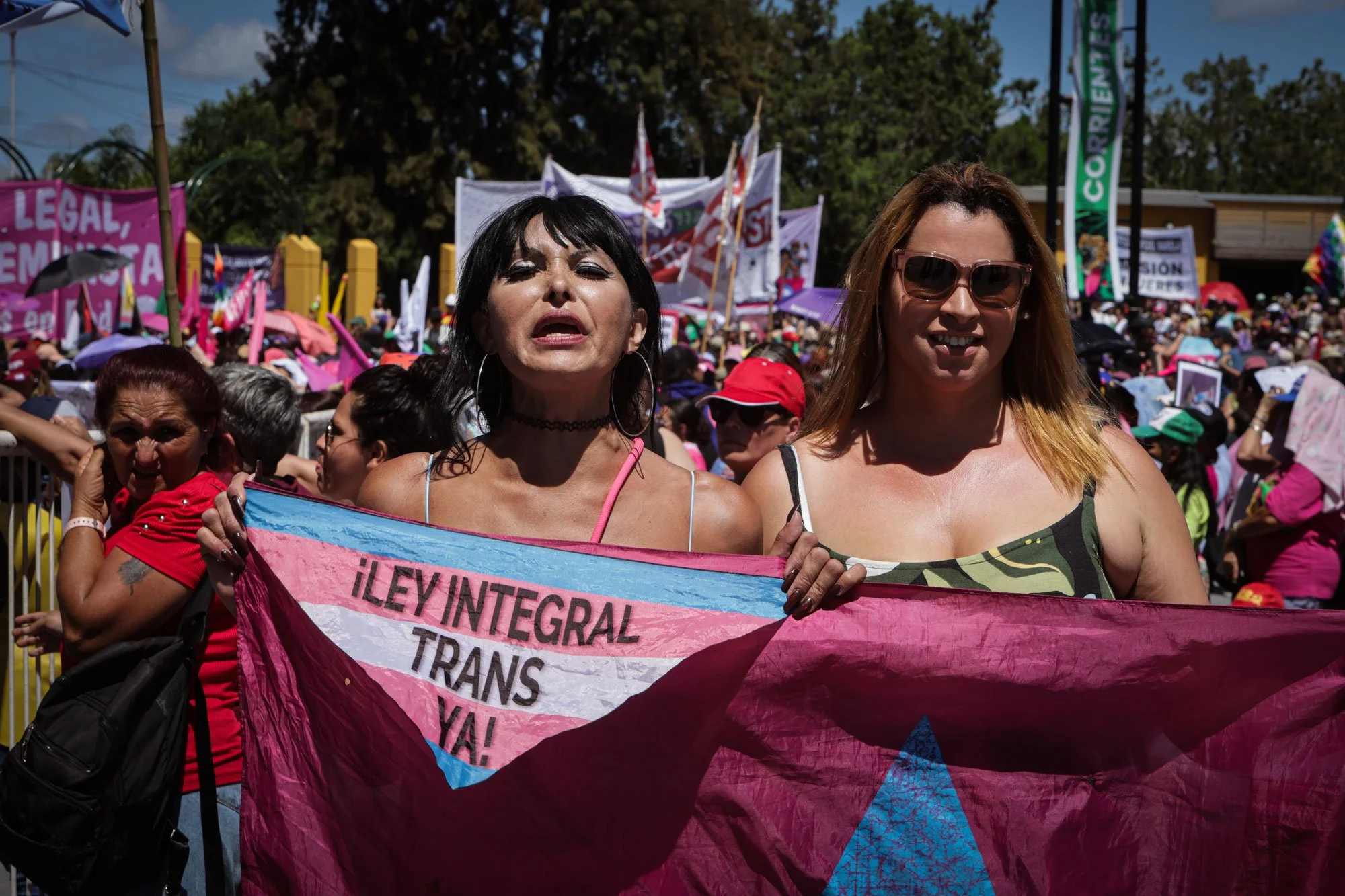
Silvana Sosa, coordinator of the Argentine Association of Travestis, Transsexuals, and Transgender People and her partner Nazarena Fleitas, who is the coordinator of Ate Misiones, hold a banner that reads “Integral Trans Law now!” at the march against travesticides, lesbicides, and trans feminicides at the 38th Plurinational Gathering of Women, Lesbians, Travestis, Transgender, Bisexual, Intersex, and Non-Binary People on November 22, 2025 in Corrientes, Argentina. Photo © Susi Maresca.
The heart of the gathering
Those present at the Encuentro confirmed that the workshops are the heart of the event. For many, it was their first time participating in these kinds of activities.
This year, over 100 workshops were held in public schools across the city. They were divided among 16 issues, including the fight against extractivism in the Paraná River. This year, organizers included two new workshop themes: cyberbullying and the genocide in Palestine, which saw a huge turnout.
The planned demonstrations also drew large crowds. On the afternoon of the first day of the gathering, as the sun set over the river, a massive line of people stretching across seven streets advanced toward the southern waterfront as part of the March Against Travesticides, Lesbicides, and Transfemicides—one of the two most important marches of the Encuentro.
"We've come to show our support, as we do every year. We got 30 percent [of the rights we’re fighting for] with the Gender Identity Law (LIG), we still need the remaining 70 percent," said Silvana Sosa, coordinator of the Association of Travestis, Transsexuals, and Transgender People of Argentina, in an interview with Ojalá.
Sosa explained that the LIG applies to all areas of life, from health to housing. All around her, protesters called for the same, demanding justice for their compañeres murdered out of hatred of trans people. A central demand was for the urgent implementation of a monthly pension as a form of reparations for trans and travesti people over the age of 40, who were victims of extreme institutional violence.
“We demand an Integral Trans Law and historical reparations for everything that is still lacking, for our retired compañeres, for people with disabilities, for all of those with different needs,” said Sosa.
The next day, the Encuentro’s central march snaked over 20 city blocks. “Sir, madam, don't be indifferent, Loan is being disappeared under our noses,” chanted marchers as the column advanced with concentrated and overwhelming force.
I was surprised that the only people recording and documenting this mobilization were my colleagues from autonomous and community media outlets. The mainstream media was conspicuously absent.
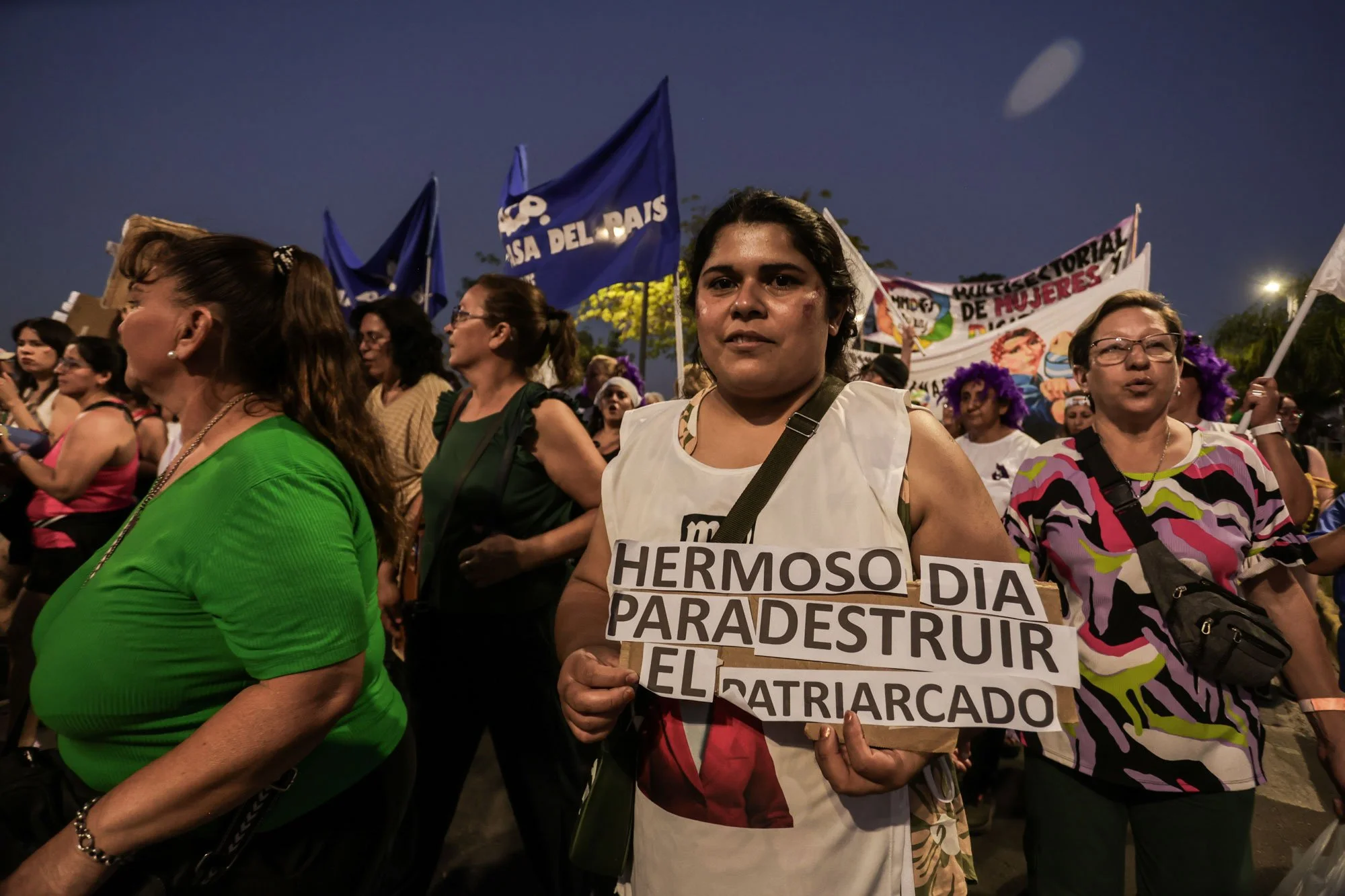
A sign held by a woman from Corrientes reads “A beautiful day to destroy the patriarchy,” during the main march of the 38th Plurinational Gathering of Women, Lesbians, Travestis, Transgender, Bisexual, Intersex, and Non-Binary People on November 23, 2025 in Corrientes, Argentina. Photo © Susi Maresca.
Abya Yala will be totally feminist
Another emblematic moment began under a Lapacho tree in Camba Cuá Park—the Abya Yala (Indigenous term for the Americas) Feminist Assembly opened with what organizers called a multi-spiritual ceremony.
Around 300 people formed a sacred circle, preparing to hear and absorb stories from all over Latin America. Here, speaking out is about more than just talking—it is a form of protest and a way of life.
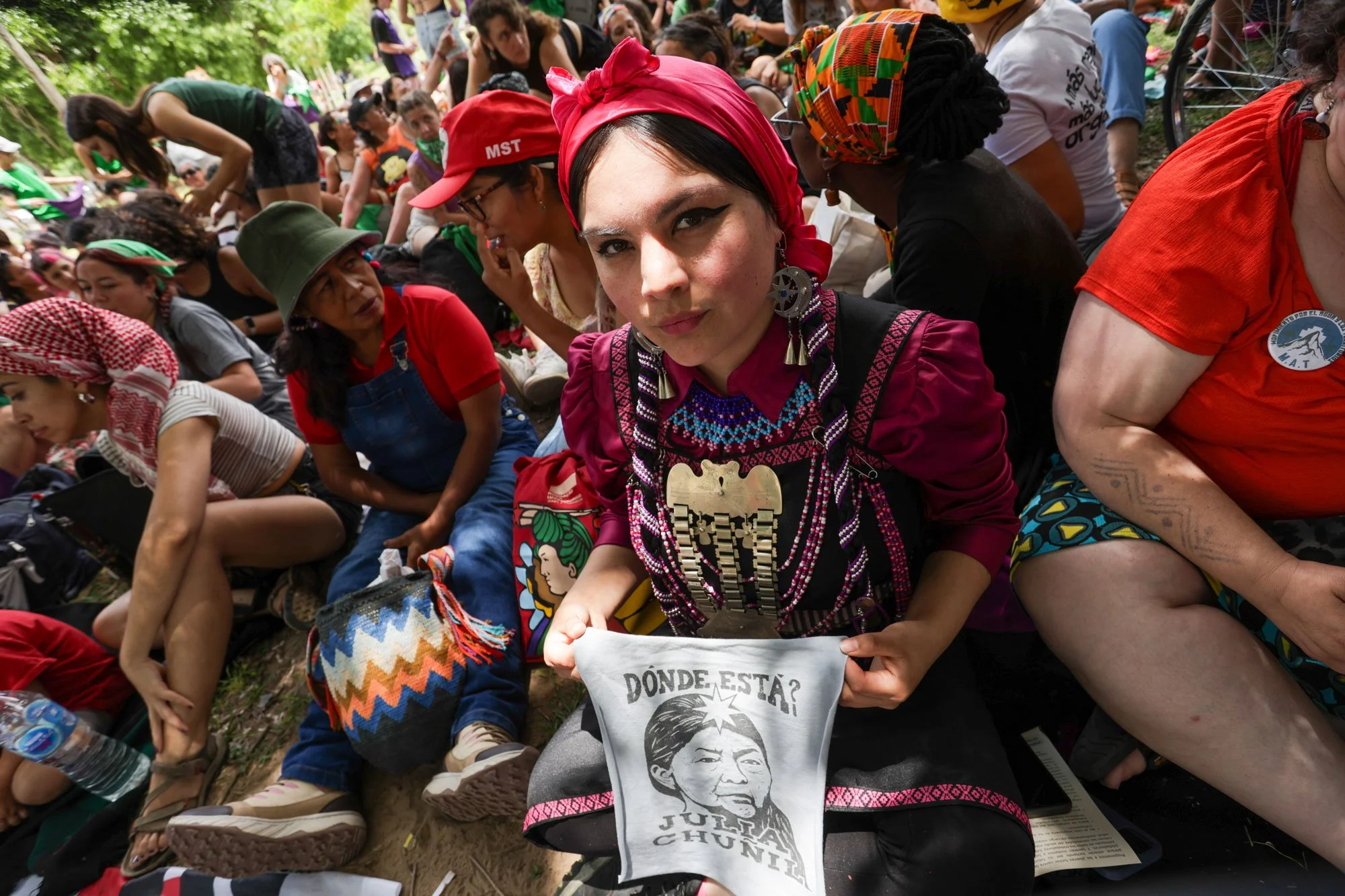
Lyzzette Sanchez Díaz, the Granddaughter of Julia Chuñil from the Gulumapu community in Chile, participates in the Abya Yala feminist assembly in Camba Cuá Park on November 23, 2025 in Corrientes, Argentina. Photo © Susi Maresca.
This assembly has historically centered the plurinationality of the Encuentros. It brings together Aymara, Kolla, Quechua, Mapuche, Qom, Guaraní, Chorote, and Nasa women and gender dissidents, as well as others from Bolivia, Wallmapu in Chile and Argentina, Colombia, Ecuador, Peru, Brazil, and Honduras.
“Women are the ones who have taken on the role of protecting our land,” said Tilda Rabi, 73, who is the president of the Federation of Argentine-Palestinian Entities. “The Palestinian people are an Indigenous people who were colonized; there are many similarities. That is why solidarity with the Palestinian people and with the awakening of all peoples is so important.”
Next year's Encuentro will take place in the province of Córdoba. We will continue to gather until dignity becomes the norm.
