

Dissident Peace in Colombia
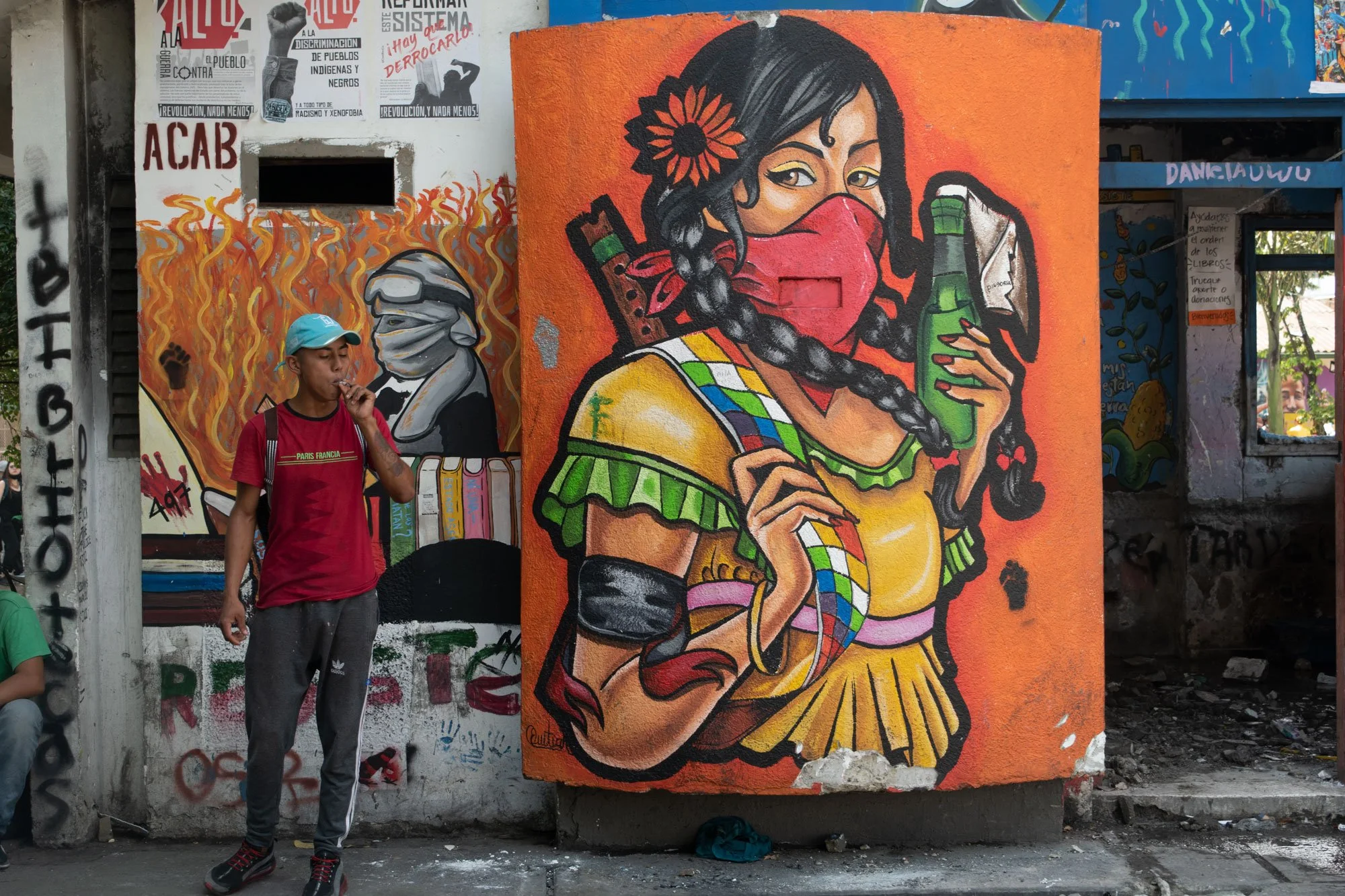
A youth smokes in front of a mural in Puerto Resistencia, Cali, July 2021. Photo © Anthony Dest.
Books • Anthony Dest • November 28, 2025 • Leer en castellano
This week, we’re sharing an excerpt from Anthony Dest’s new book Dissident Peace: Autonomous Struggles and the State in Colombia, published by Stanford University Press earlier this year. The book interrogates the foundations of peace and points to the deeper questions that have—in large part— been left unresolved —Eds.
On October 5, 2017, state forces opened fire on a group of protesters in the small community of El Tandil close to the border with Ecuador. During the 10 days leading up to the massacre, coca growers in El Tandil demanded that the Colombian government implement the 2016 Peace Accords with the FARC-EP. The accords supposedly guaranteed support for coca growers willing to substitute their illicit crops and transition into a legal economy. Instead of providing the coca growers with alternatives, the state killed seven people and injured more than 20.
Although government officials later blamed the violence on so-called FARC-EP dissidents (disidentes), witnesses affirmed that the massacre was unprovoked. More than five years later, the perpetrators of the massacre still have not faced justice, and the coca cultivations in the region around El Tandil continue to produce cocaine for the global market.
José Hernán de la Cruz, one of the survivors of the massacre, told El Espectador:
I think we are dealing with a ruse [engaño]—those of us living amid bullets, amid the armed conflict. What a damn ruse to learn that the military and police arrive and that it’s practically the same as dealing with your worst enemies!
How am I supposed to trust them after what they did to me? They destroyed my arm. All of this arm is reconstructed. [. . .]
It still does not make sense in my mind or for my way of living that I could exercise my rights before this authority and that same authority would start shooting at us, the peasants.
We were demanding something that was just.
The El Tandil Massacre shattered the illusion of peace that the Colombian government tried to project to the world, but it was not a surprise to people familiar with the violent means used to suppress social change in the country. In the immediate aftermath of the Peace Accords, the communities that stood to benefit the most from peace continued to face oppression, and the steady elimination of former FARC-EP combatants who participated in the process had already begun. War continued.
The “ruse” that de la Cruz referred to after the El Tandil Massacre is at the core of the social contract that theoretically holds together the place called Colombia. It is the foundational and ever-present violence of the state and capitalism. The state, like capitalism, is not a transhistorical feature of human history. It is a historically specific form of patriarchal authority whose birth was intertwined with the racist foundations of colonial-capitalist modernity.
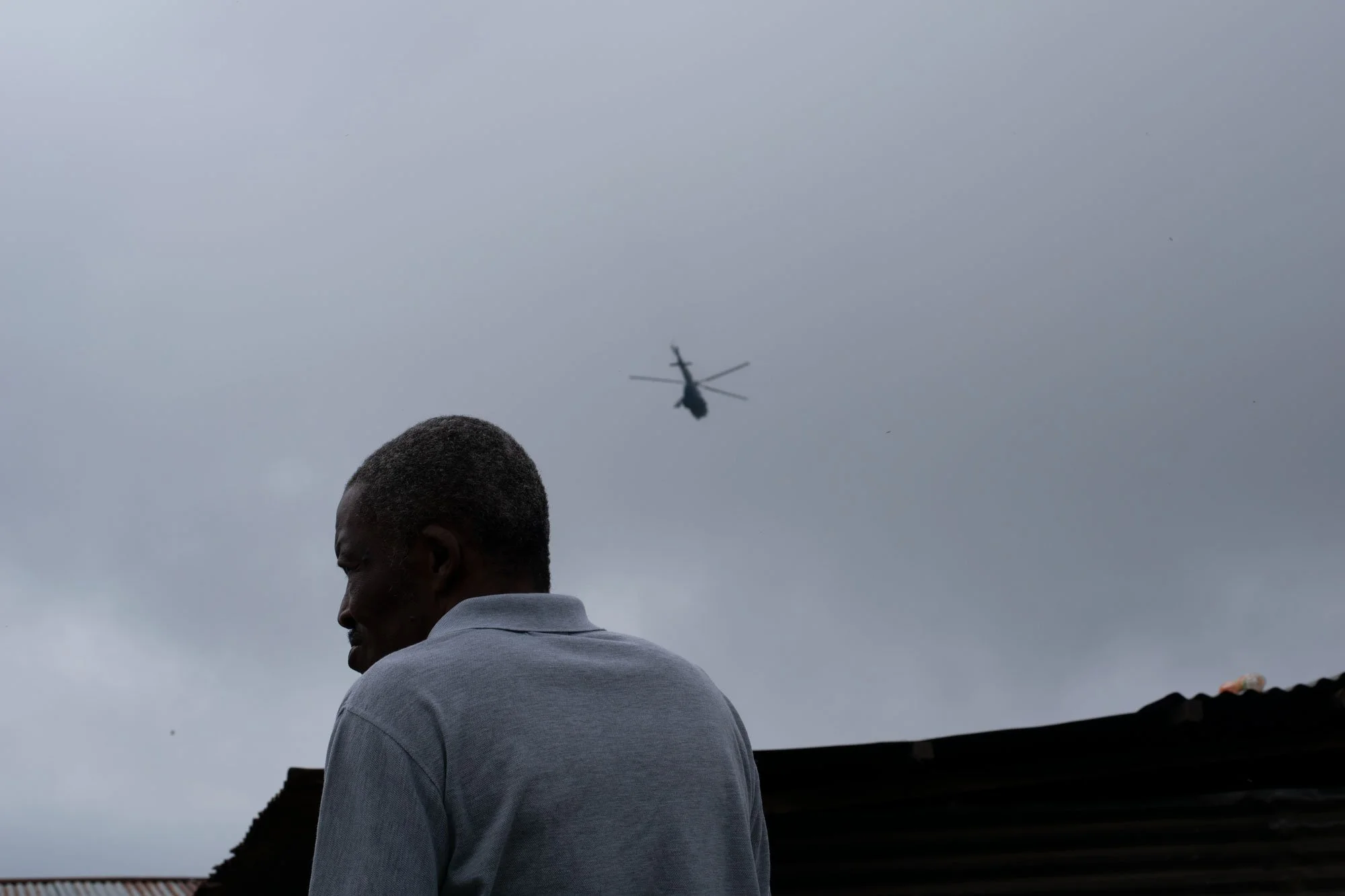
An International Committee of the Red Cross (ICRC) helicopter flies over an Afro-Colombian community council in northern Cauca, August 2016. Photo © Anthony Dest.
A violent state-centric model
Colombia, as one such instantiation of a state, gained its independence from Spain in 1819, and its rulers set out to establish dominion within its perennially changing borders through violence and the rule of law. With Christopher Columbus as its namesake, Colombia forged a citizenry and national identity over the course of centuries. As a state in search of subjects, the discourse of national belonging hinged on forms of racialized and gendered dominance with creole whiteness as its idealized form.
This established Indigenous peoples and the descendants of enslaved Africans— along with their diverse and at times contradictory relationships to the territory—as an obstacle to Colombian state formation. Thus, the Colombian state took shape through the inherently violent imposition of a social contract premised on the maintenance of colonial capitalism.
In 2022—260 years after Rousseau wrote On the Social Contract; or, Principles of Political Right—Gustavo Petro and Francia Márquez promised a “new social contract” on the first page of their program that pledged to turn Colombia into a “world power for life” and bring about “total peace.” Their election marked the inauguration of the first progressive government in the country’s history.
Petro, a former M-19 guerrilla who claimed that Rousseau inspired his interest in history as an adolescent, embarked on a mission to transform the state by expanding its realm of influence. During his victory speech, he told the crowd, “We are going to develop capitalism in Colombia. Not because we worship it, but because first we must overcome premodernity in Colombia.”
In doing so, he reiterated a popular trope about state formation that attributes violence, backwardness, and underdevelopment to the absence of capitalism and the state. This trope not only concealed the multiple ways in which the state and capital are present in regions labeled as unruly frontiers; it also established the state and capital as the solution to violence, thereby ignoring their active role in producing it. Despite the claims of newness, the Petro administration’s approach to the social contract and what would become known as total peace remained explicitly committed to a form of capitalist development facilitated by the state.

The Guardia Indígena (Indigenous guard) of Çxhab Wala Kiwe (Association of Indigenous Councils of Northern Cauca), March 2017. Photo © Anthony Dest.
Pacification and colonial control
For centuries, the idea of social contract as the basis of political community has served as one of the primary justifications for the sovereignty of states. Through the social contract—so the story goes— men submit to a higher authority in the name of a loosely defined common good. However, the term “contract” suggests conscious agreement consummated by law, and the countless people slaughtered in the name of state formation did not willingly sign their lives away in its service.
Writing in 1762 as the forces of European colonialism continued to expand throughout the globe, Rousseau included the following warning in his treatise on the social contract: “Under bad governments this equality is only apparent and illusory; it serves only to keep the poor in their misery and the rich in their usurpations. In fact, laws are always useful to those who possess and injurious to those that have nothing.” As de la Cruz attested in his denunciation of the El Tandil Massacre, the social contract was not as democratic, just, or egalitarian as it might seem.
Since the earliest days of colonization, the law—particularly in relation to private property—has been crucial for the codification and continuation of colonial capitalism and state formation. From the resguardo (Indigenous reservation) system and gracias al sacar (the legal right of enslaved Africans to “purchase whiteness”) established by the Spanish Empire to contemporary forms of multicultural recognition, these laws extended the promise of what Silvia Rivera Cusicanqui calls “conditional inclusion” to those willing to abide by the rules of the colonial project and punishment for those who rebel. This colonial project has hinged on ensuring submission to a particular form of authority emanating from Europe that derived its strength by eliminating alternatives to the system through violence and assimilation.
Framed in this light, the prevailing discourse around peace in Colombia should be understood within a longer history of pacification (pacificación), which shares the Latin root word pax.
The origins of pacification in what is now called Colombia can be traced at least as far back as 1573 with King Felipe II’s mandate to abandon the language of conquista (conquest) for that of pacificación (pacification). The Spanish Empire’s “Ordinances Concerning Discovery, New Settlements, and Pacification of the Indies” were made law amid self-serving critiques from other European powers about Spain’s ostensibly exceptional brutality as a colonizing force.
The rhetorical shift toward pacification in the official language of the Spanish Empire did not inspire a divergence from the genocidal structure of colonial capitalist development, but it did reveal an anxiety about exposing the hollowness of the religious and moral convictions that served as ideological justifications for colonization.
In The Conquest of America, Tzvetan Todorov argues, “The text [of the Ordinances] could not be more explicit on this point: it is not conquests that are to be banished, but the word conquest; ‘pacification’ is nothing but another word to designate the same thing.”
By the 20th century, “pacification” became part of the lingua franca of counterinsurgency as colonial powers the world over attempted to quell native resistance and consolidate their control over land and life. Returning, then, to the root word of both “peace” and “pacification” is instructive.
According to Mark Neocleous in War Power, Police Power, “What is connoted by the word pax, and thus ‘peace,’ is not an absence of conflict or making of a pact but, rather, the imposition of hegemony and domination achieved through conquest and maintained by arms [. . .]. Pax was and is a victor’s peace achieved by war and conquest.” By operating through the seemingly more palatable language of pax, pacification served as one of the primary methods of settlement in the Americas and peace its progeny.
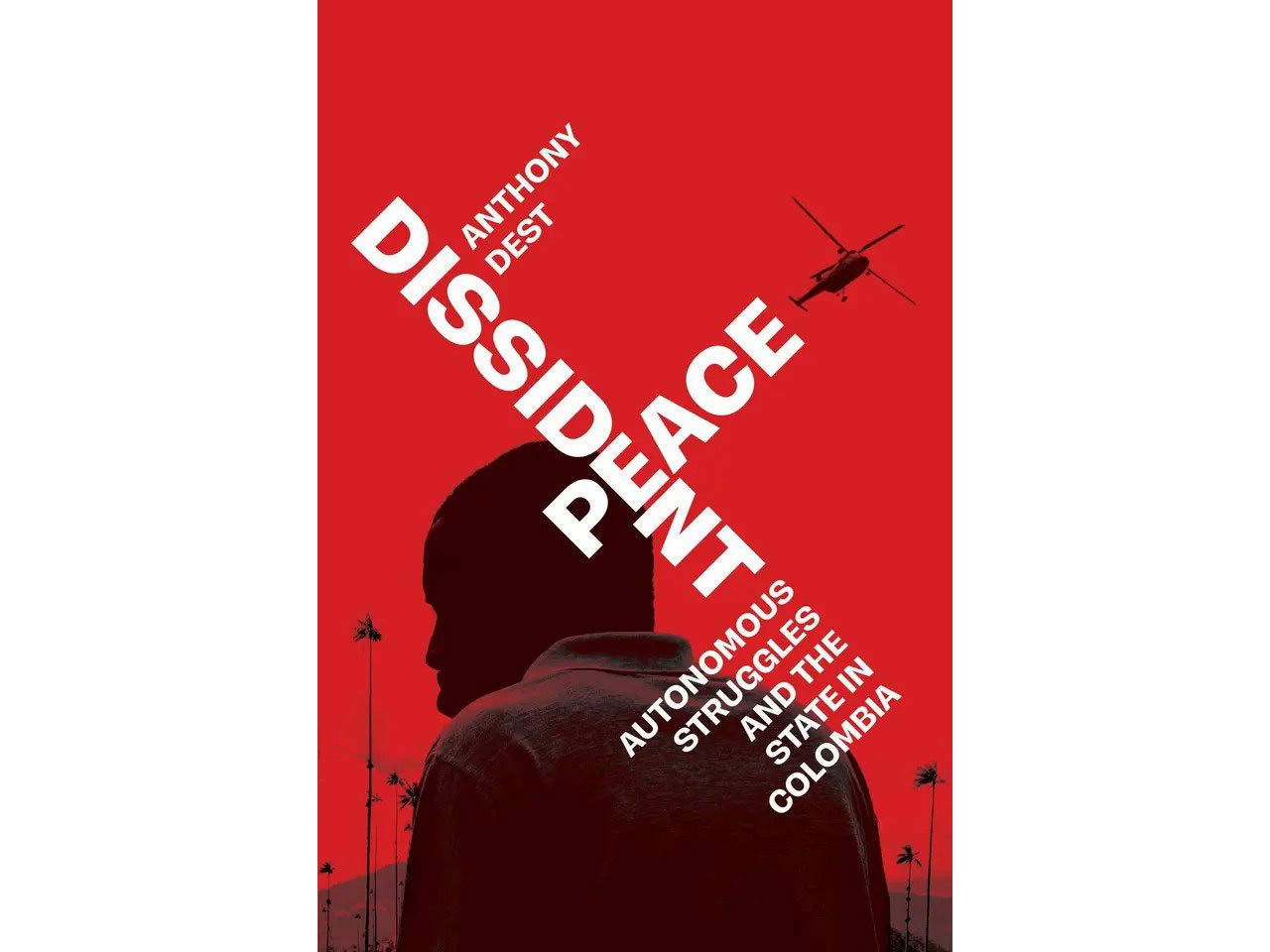
© Stanford University Press.
Shattering the discourse
This book explores how the dominant discourse of peace in Colombia is shaped by and shapes colonial capitalism. By establishing the consolidation of the state’s sovereignty as the antidote to violence, it takes for granted how state-centric peace consists of a totalizing form of settlement dependent on genocide and the elimination of alternatives to it. Peace, like war, imposes a framework for thinking and acting politically that shapes social relations. This process of subjugation, however, is always incomplete.
Another one of the survivors of the El Tandil Massacre described his efforts to achieve justice through the legal system as “swimming against the river.” This frustration has emerged at nearly every meeting, march, or mobilization that I have attended.
From survivors of the El Tandil Massacre to Afro-Colombian community councils on the Pacific coast to resistance points in the city of Cali, people share stories about how violence, capitalism, and the state impede their ability to live freely as they struggle for a better future. In theory, the state should be there to protect them, but instead it mostly manifests in the form of a hostile police officer or a useless bureaucrat. Dissident forms of peace emerge from their rejection of the status quo and the potential of their struggles for autonomy from it.