

Migrant suffrage under fire in Chile
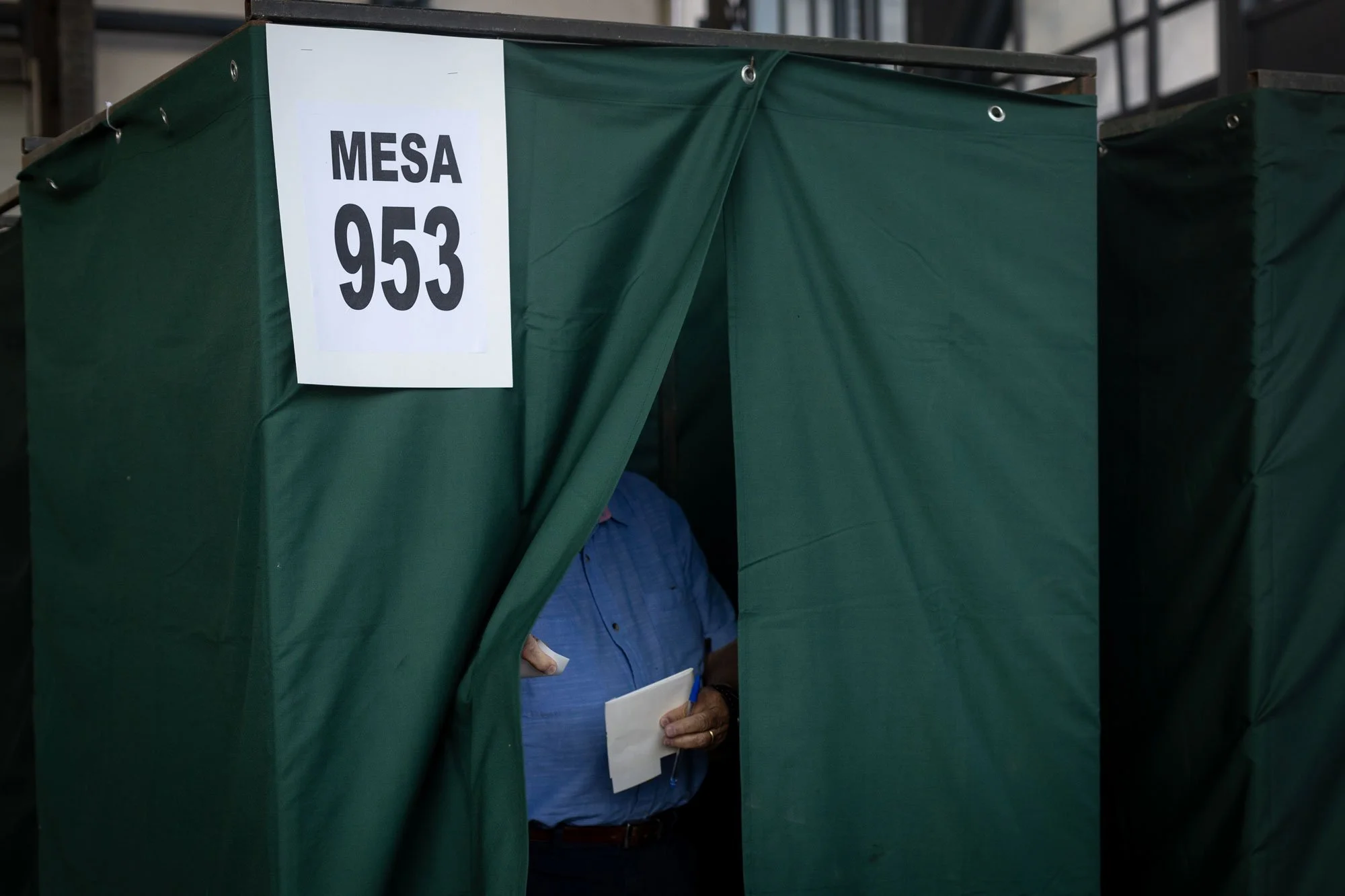
A man leaves the booth after voting during the presidential election at a polling station in Estación Mapocho, Santiago, Chile, on November 16, 2025 © Sofia Yanjari.
Reportage • Yasna Mussa • November 27, 2025 • Leer en castellano
On Sunday, November 16, Sonia Teppa—a 68-year-old Venezuelan biology teacher with a PhD in Education Sciences—woke up in a good mood and headed out to vote in Independencia, the district where she lives in the Chilean capital.
That day’s presidential and parliamentary elections ended in a tight, two-way race between Jeannette Jara, the ruling party's candidate, and far-right candidate José Antonio Kast. Both will be on the ballot in runoff elections on December 14; the winner will govern Chile for the next four years.
“It's such a lovely opportunity to have a say in choosing a good candidate for this country that has given so much to immigrants, especially Venezuelans,” Teppa said in an interview with Ojalá. “How could I not go out and vote? Doing so is an honor.”
Teppa, a retiree, had no plans to settle in these southern climes. She arrived in 2019 to visit her children. But the COVID-19 pandemic completely altered the course of her life.
Now, having resided in Chile for more than five consecutive years, she has the right to vote for the first time. She was one of 886,190 immigrants who were eligible to cast their vote this election cycle.
Throughout the campaign, the right of immigrants to vote in elections was the focus of debates and opinion polls. Today, that right—which turned 100 this year—is in jeopardy.
A recent bill that proposes to restrict the voting rights of migrants was followed by a slew of campaign promises calling for measures like the total closure of borders and the mass expulsion of undocumented people.
“The rhetoric is focused on controlling the border, which is seen as a vulnerable place where transnational organized crime can enter,” said María Fernanda Stang, a researcher at the Research Center for Social Science and Youth at Silva Henríquez Catholic University in Santiago.
She explained that in a period of just a few years, migration has become a crucial issue in election campaigns, and the discourse of “criminal migrants” has taken hold in more explicit ways.
“It’s extremely dangerous,” Stang told Ojalá in an interview. “None of the political parties consider, in their public positions, integration policies, which is what one would hope for from a government perspective.”

A group of people vote for president in booths at a polling station in the Ñuñoa district in Santiago, Chile, on November 16, 2025 © Sofia Yanjari.
Fear and disinformation
During the last radio debate before the elections, Evelyn Matthei, one of the right-wing presidential candidates, claimed Chile encourages “irregular” migration by allegedly prioritizing foreign children for admission to state-run kindergartens.
Not only did she criminalize migrant children by referring to them as “illegal,” but she also spread false information, because available data disproves her claims.
Countering this type of disinformation about migration with data and background facts is part of the work carried out by Alexis Torreblanca at Infomigra, an initiative run by a multidisciplinary team that creates content and shares information.
Infomigra’s “Migrants for Democracy” campaign noted that this year marks the hundred-year anniversary of immigrants being granted the right to vote in Chile. That will change with the implementation of a constitutional reform passed last September that upped the requirements for immigrants to participate in presidential and parliamentary elections.
“It's a setback in terms of what’s possible in terms of the inclusion and integration of immigrants' civil rights and citizenship,” said Torreblanca. He’s critical of the fact that this position has been adopted across the political spectrum in the national debate.
“We have witnessed the rise of populism in a way we didn’t see two or three elections ago,” said Torreblanca. “Now, we observe that more than half of the speeches and media stories revolve around and focus on migration, pushing other issues aside.”
Fear comes hand in hand with disinformation. The constant association being made between migrants and crime or migrants and drug trafficking has impacted public perception.
“We are justifying a discourse of criminalization through which everyone who is different from us or who we don’t know is turned into a potential criminal,” said Torreblanca.
Stang agrees that such rhetoric is reductionist, adding that when it comes to counting votes, the left tends to be prejudiced against Venezuelan immigrants—the fastest-growing migrant group in recent years—who are presumed to be right-wing voters. The assumption is that, after leaving Nicolás Maduro's regime, Venezuelan immigrants will oppose progressivism.
“As a result, the left itself tried to take voting rights away from migrants,” said Stang.
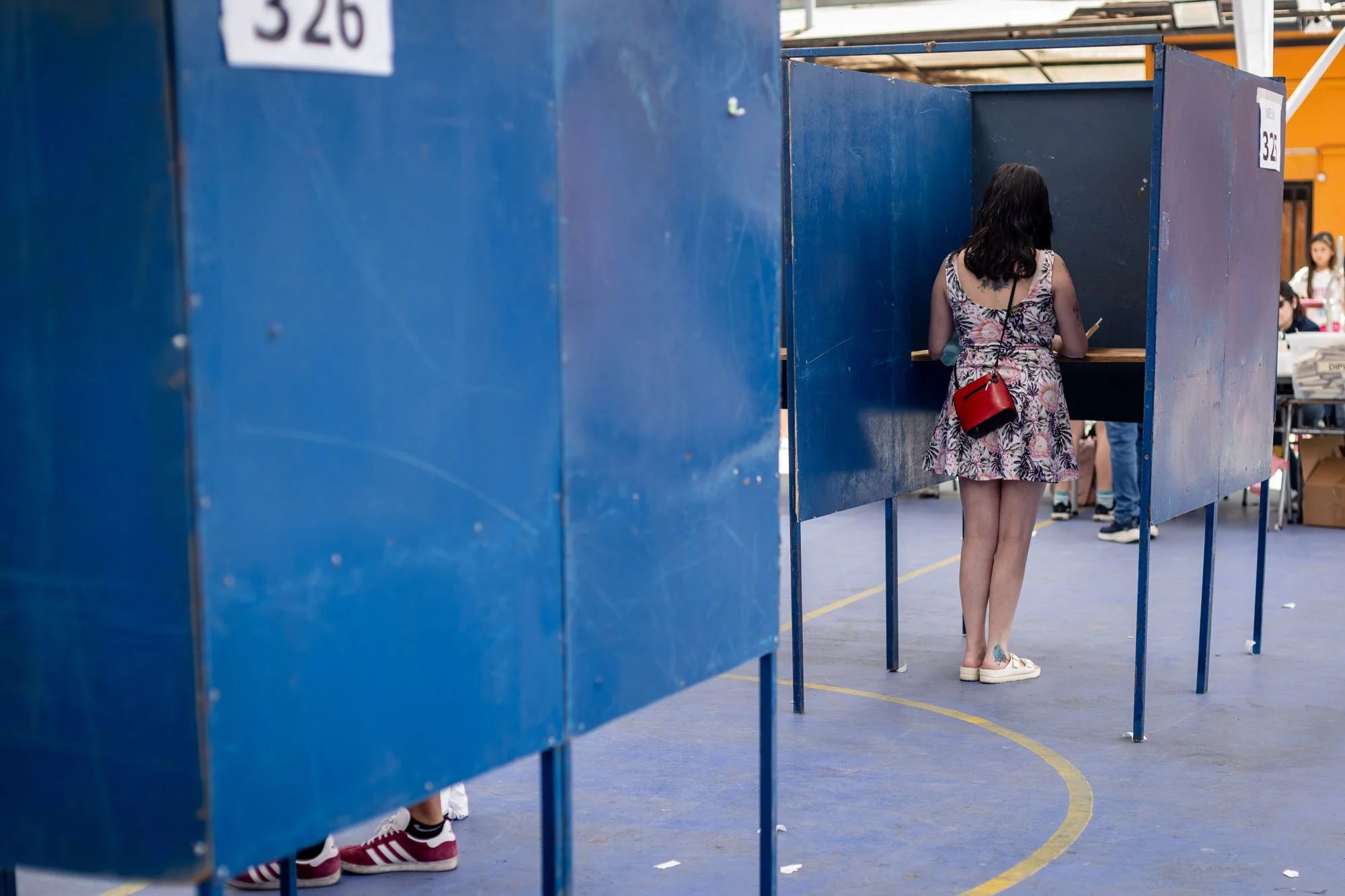
A woman decides her vote in a booth at a polling station in the Ñuñoa district during the presidential elections in Santiago, Chile, on November 16, 2025 © Sofia Yanjari.
Targeting and expulsion
On November 20, Kast, who is running for president with the far-right Republican Party, wrote on his X account: “There are 111 days left until the presidential transition. 111 days for illegal immigrants to leave the country voluntarily. If they don’t leave, we will kick them out, and they will never return. You have been warned.”
This type of messaging is not new in Chile, and is part of a rising anti-immigrant political tide worldwide. In 2019, former President Sebastián Piñera said he wanted to “shut our doors, hopefully with a machete,” referring to the entry of undocumented migrants into the country. He organized deportation flights featuring a set-up in which people boarded planes dressed in white overalls.
Catalina Bosch Carcuro, director and founder of an organization called Migrantas, says it pains her to see how migrants are used and exploited in electoral contexts. The decision on whether or not to curtail their democratic right to vote, she says, hinges on how politicians believe the majority will vote.
“The main thing should be trying to convince that electorate that you’re the best option,” says Bosch, who is also on the board of the Museum of Memory and Human Rights, vice president of Amnesty International Chile, and a member of the Chair of Racism and Migration at the University of Chile. “The way in which the migrant vote is being used and manipulated is truly macabre.”
From the perspective of Migrantas, the situation is clear: the current government coalition has reinforced this practice and has, in a way, handed the issue on a silver platter to the right and the far right.
“They take advantage of it in the worst possible way, unscrupulously, ruthlessly, with proposals that compete to determine which is the cruelest,” said Bosch.
Bosch says she had hoped that the other candidates would take a different stance, based on ethical and humanistic perspectives. They should have done so, she said, “based on unconditional respect for human rights and concern for the progress of society,” she told Ojalá in a café in Santiago.
As political discourse moves in one direction, reality, says Stang, is something else altogether: coexistence between locals and immigrants exists and has for a long time, and that’s true in many different contexts.
One example of solidarity and community is the El Progreso Neighborhood Council, in northern Santiago. Housing committees and soup kitchens are organized there by and for the neighborhood's residents, regardless of their origin or nationality. The council values diversity and has defended the participation of migrants in building community.
“A social bond is being forged there that is crucial for what we are going to do in the future,” said Stang, the researcher. “It is also crucial for the foundation of Chile’s democracy, which is being called into question in the context of the wave of neoconservatism sweeping across the world.”
Sonia Teppa is excited to vote again in December, when she will be part of choosing the country’s next President.
But with a conservative, anti-immigrantmajority in Congress and the possibility of a far-right government in the near future, the question of who will be allowed to vote in the next election cycle remains unclear.
