

Feminist struggle & counterrevolution
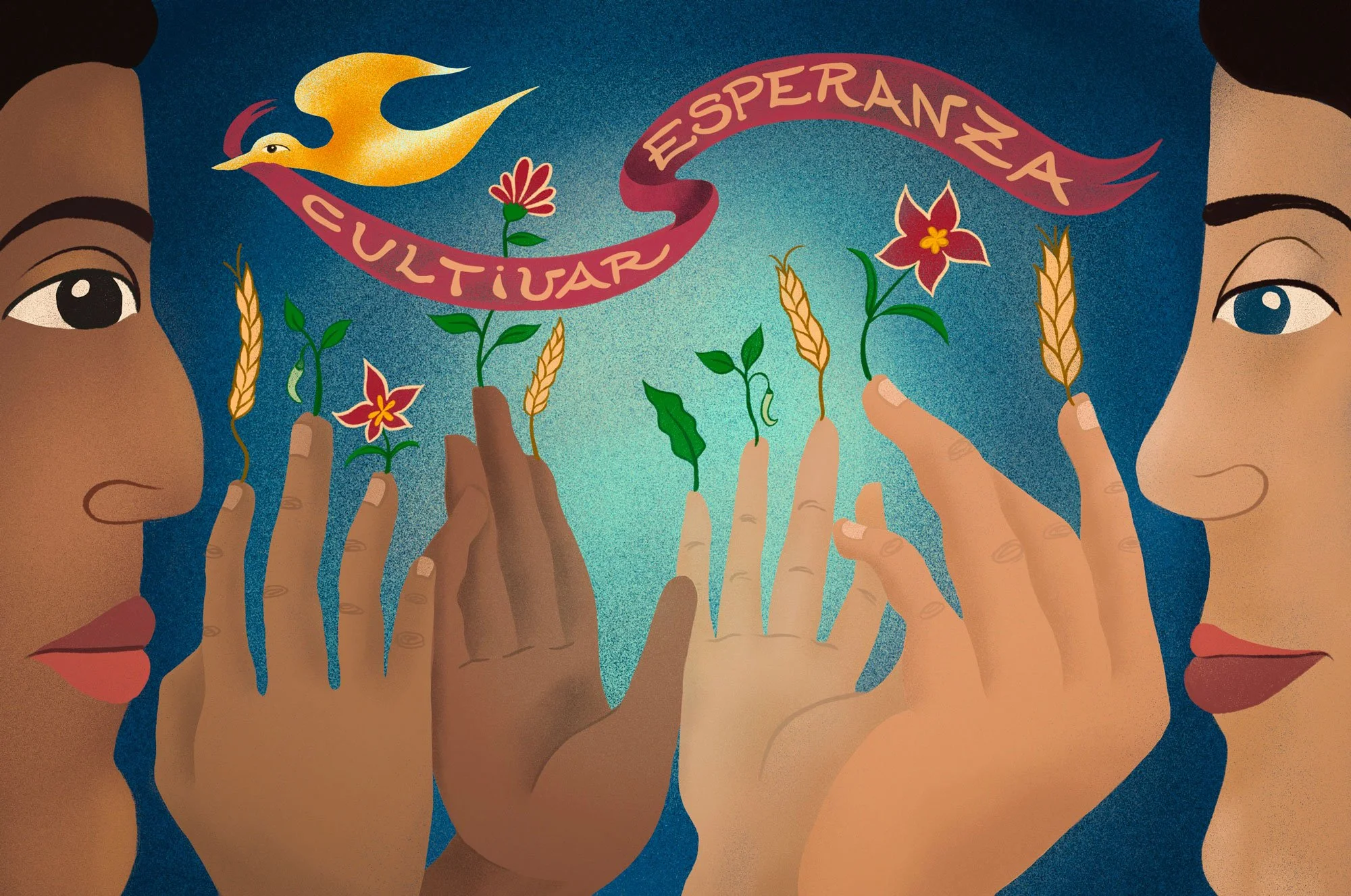
Digital art by @Pazconadie for Ojalá.
Opinion • Laboratoria EuroSur • December 5, 2025 • Leer en castellano
This article is the last in a series of eight pieces we’ve published as part of a series of Transfeminist Debates. The first piece, written by Verónica Gago, can be read here; the most recent here. A compilation of Ojalá’s Transfeminist Debates will be released in the new year—Eds.
Our contribution to the debate on transfeminisms, organized around Verónica Gago's piece “The reinvention of the strike: 10 years of feminist uprising in Argentina” comes from southern Europe and seeks to build in dialogue with our compañeres at Ojalá.
Using Gago’s analysis of 10 years of radical (trans)feminist mass movements as a starting point, compañeres from across the continent have brought their perspectives to bear on militarization and the intensification of authoritarian politics, as well as the ways in which feminism is being neutralized and attacked.
Our response, which comes out of the EuroSur node within Laboratoria, is imbued with a keen awareness of the decomposition of the European world as we know it—of its landscapes and certainties, and its forms of abundance, security, and numbing. We can already see the pirates trawling the troubled seas, always looking out for their own ends.
We are aware that, as Aimé Césaire said, fascism is a boomerang that will return the violence of colonialism back to Europe. The crumbling European welfare state has long been sustained by the exploitation of the global South.
Our thoughts are informed by the syndicalist feminist network we have been nurturing for more than five years, together with many others in Madrid and Andalusia.
We’ve been thinking along three main threads, informed by our reading of Gago's text and a strong sense of urgency: the meaning of the counterrevolution that’s underway, the importance of taking stock, and the hope we are committed to fostering.
Here we’d like to share some of our insights as part of this shared conversation.
Reading the counterrevolution
We agree on the importance of characterizing these troubled times as counterrevolutionary. This is a way of resisting a reactionary narrative that seeks to erase all traces of our struggles or make them appear ridiculous, defeated, useless, or naive.
To say that what we are experiencing today is a counterrevolution is to highlight the extent to which present developments are a response to the potential global upheaval we were able to instigate. A massive upheaval, occurring almost in shifts, spread through a translocal contagion of action and demands. An upheaval that was rich in both its tangible dimensions and its potential, and which continues to act on the present, as inspiration and as embers that can ignite and summon other futures.
Susana Draper encourages us to take the long view, and in doing so we name this upheaval the long spring of the public squares. A chain of insurrections that ran from the Arab Spring to Occupy Wall Street, from the International Feminist Strikes of 2016-2019 to Jin, Jiyan, Azadî in 2022 in Iran, from the Chilean and Ecuadorian social uprisings of 2019 to Black Lives Matter and Defund the Police from 2013 to 2020 in the United States (which our comrades at The Peoples Want have made the effort to map out).
Today’s authoritarian shift is responding to this long spring with fire and fury. But counterrevolution is never just a countermovement. It resembles a judo headlock, in that it takes the vital force, imagination, and desires embodied in uprisings and mobilizes them to reinstate and reinforce structures of domination.
In Europe, the counterrevolution wears green and white. The militaristic turn in foreign policy, clearly expressed in the ReArm Europe plan, is combined with two particularly aggressive offensives domestically.
On the one hand, there are efforts to restore the “natural family,” which go beyond a “culture war,” made up of publications, reports, and conferences. Instead, these efforts are supported by a broad network of infrastructure promoted by the most conservative branches of the three Christian churches (Catholic, Orthodox and Evangelical), by far-right governments such as Viktor Orban's in Hungary, and by international organizations such as the Conservative Political Action Conference (CPAC).
These organizations promote legislative and legal initiatives in each country as part of a coordinated strategy, directing significant resources against sexual and reproductive rights, non-heterosexual marriage, the health and identity rights of transgender people, as well as against the power of mothers to protect their children from violent fathers.
The other domestic battlefront is the arrival of the war examined by Ana María Morales in this series, to European soil. The most direct expression of this at the EU level is the European Pact on Migration and Asylum, through which Europe has abandoned any human rights framework and, in the words of the self-organized migrant and anti-racist movement RegularizacionYa, has made a pact with death.
In this context there is no “natural family” to restore: children (particularly those who migrate without their families) are treated as criminals until proven otherwise, the right to family reunification is systematically violated, and women are hired en masse in a care market that curtails their own ability to raise a family, should they so desire.
The criminalization of the mobility of racialized people results in millions of euros being injected into war technologies—many of them Israeli—used by the European Border and Coast Guard Agency (Frontex).
These two battlefronts are linked within a supremacist project that blames the crisis afflicting Europe on the “demographic winter” of white women and dares to speak of “white genocide” on the very shores of the gigantic mass grave we have made of the Mediterranean.
Taking stock
Given the vertigo and helplessness this counterrevolutionary scenario can produce, we need to take stock in a way that allows us to reconnect with the power of the struggles we have been engaged in.
Why? We must resist the defeat of our memory, the idea that nothing we did was worth it, because we have ended up in these turbulent times for which even the supposed excesses of those struggles are responsible.
This is not an exercise in romanticization or epic storytelling, but rather one that comes with taking a long view, beyond the immediacy and the pornographic sensationalism of horror.
This is about invoking the vigor and imagination that those struggles produced in the present. It is about acknowledging, as Gago does in her piece, the length and depth of their impact on today's world: in the form of concrete achievements, shifts in sensibilities, organizational gains, knowledge, institutions, and infrastructure, etc.
We must also examine the lines of fracture, particularly with regard to feminisms, and in particular, the ease with which we have incorporated polarizing debates that are of little use for our practices.
Among them are the individualizing dynamics of variations on the slogan “the personal is political," of neoliberal niche and brand captures, of the uses of the feminist or feminine signifier to promote militaristic projects (as Raquel Gutiérrez highlights in Mexico) or conservative ones (see the global phenomenon of transphobic feminism or the European forms of femonationalism explored by Sara Farris).
Our aim is not to engage in self-punishment, but rather to learn lessons and to encourage a more focused insistence in thinking through transfeminist power. Our feminisms aspired to transform everything, particularly in their approaches to politicizing, disrupting, and reinventing the structures that sustain collective life.
Cultivating hope
Towards the end of the European summer, we found some respite from the desolation of the extreme heat and rampant fires of August, which burned as we watched the genocide in Palestine deepen. Decentralized actions to boycott Israel's participation in the Spanish Vuelta cycling tour and the sailing of the Global Sumud Flotilla, an international civil initiative to break the blockade of Gaza, from the port of Barcelona offered a taste of transitioning from powerlessness to power as we organize together.
Today, as a collective euphoria in the streets seems to be temporarily subsiding, we must remember that initiatives like these don't come out of nowhere.
They are born from networks that, at any given moment, manage to mobilize and unite a myriad of groups—both those who have been working for decades for the Palestinian cause and now against genocide, and other groups with a collective vision of cooperation and transformation, who felt called to action.
We must insist on initiatives that pierce the landscape of terror with specific and widespread practices of solidarity and disobedience. This is how we break with the sense of powerlessness and open up our imaginations.
And we must also insist on making visible the fabric of our networks and the infrastructures that make them possible, not only in practical terms, but also in subjective ones. Creating spaces for collective life that address inequality, that bring different people together, that welcome pain and transmute it into organized anger, is the only antidote to the ongoing counterrevolution. This is how we can work to cultivate generosity, commitment, and defiance.
We believe this dual insistence is key to reckoning with the incompatibility Draper describes between the ability to sustain collective life and the escalation of war on all scales. As we sang in a translocal #ResistenciaFeminista performance for Palestine, and paraphrase here: against all cruelty/of war in complicity/we insist, we resist/we cultivate a dignified life/a broad collective fabric.