

War for profit in Colombia
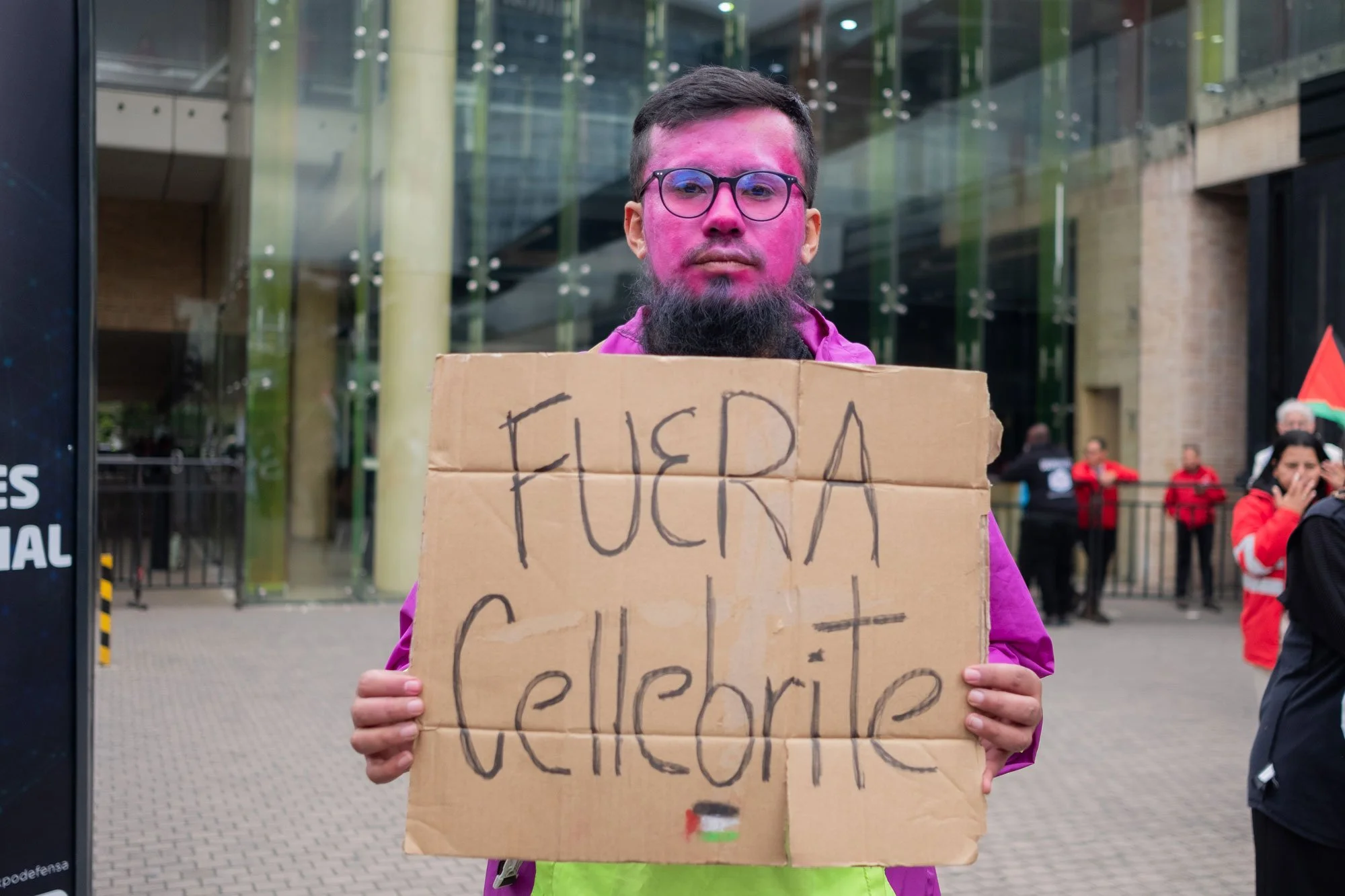
A protester calls out an Israeli company with a sign that reads “Cellebrite Out” at a protest outside ExpoDefensa in Bogotá on December 1, 2025. Photo © Mariana Mora.
Reportage • Mariana Mora • December 11, 2025 • Leer en castellano
“Cellebrite Out” read the sign held by Mateo Cruz, a member of the anti-militarist and Palestine solidarity group Tadamun Antimili during a protest at ExpoDefensa, Latin America’s largest military industry fair.
Cruz explained in an interview that a representative of the Israeli surveillance company Cellebrite was attending as a participant in the Bogotá fair—despite the Ministry of Defense restricting participation by Israeli companies in July of this year.
The week prior, the Tadamun collective documented and condemned the company's participation. ExpoDefensa removed the event from its website, but the talk by Oscar Javier Rojas, Cellebrite's commercial director for South America, went ahead regardless.
Three days later, Rojas lauded his participation with a post on LinkedIn: “Despite some adversity, it was an event where our customers showed their love and appreciation for Cellebrite, the InseyetsPro forensic tool, and Pathfinder, which is the most widely used in Colombia.” Pathfinder is a tool used for the organization of digital data collected in surveillance processes.
This year, 248 exhibitors from 30 countries participated in ExpoDefensa, which was attended by around 12,700 people, including more than 70 delegates from the armies of 30 countries. At the fair companies and armies showcase technological advances and new products, states and suppliers renew contracts and military alliances are celebrated.
Among the exhibitors are among the world's 100 largest arms manufacturers, whose revenues rose by 5.9 percent in 2024, according to research by the Stockholm International Peace Research Institute (SIPRI). This increase is due to recent wars, including, of course, the genocide being perpetrated against the Palestinian people.
On the sidewalk outside the event, around 100 people chanted demands to end the war, performing music and theater, and gathering around a communal pot. Since 2017, collectives and organizations have engaged in actions like this at every iteration of the fair. In their actions and signs, protesters connected global war and the ravaging of Palestine with what is taking place in Colombia. “The war starts here, we must stop it here” was the slogan used to convene the protest this year.
Palestinian flags waved in the crowd, young people did juggling tricks, and a microphone was passed around to amplify the voices of those who wished to speak out. Every so often, a man in a suit with a lanyard would walk by and look at the crowd before going into the fair. Some took photos, others made phone calls.
Eight young people, their faces painted red, stood at the main entrance wearing T-shirts spelling out the word “murderers.” Police and military personnel patrolled the peaceful protest from the moment it began.
Three hours after the protest started, as rapper Zafiro Lux began her performance, around 50 agents from the Dialogue and Order Maintenance Unit (UNDMO)—formerly the Mobile Anti-Riot Squad (ESMAD)—left Corferias, Colombia's largest business center that partners with ExpoDefensa, to break up the sit-in. They threw stun grenades and tear gas at youth, elderly people, children, and even pets in attendance.
Two people were seriously injured and were removed from the protest to the Corferias facilities. At the time of writing, both were in stable condition. According to the testimonies of protesters and the early warning issued by the Mateo Aldana Human Rights Platform, there was no attempt by state forces to engage in dialogue.
The Bogotá Metropolitan Police and Corferias were asked to comment on their role in the events, but neither responded. The next day, President Gustavo Petro called for an investigation and pointed a finger at Bogotá Mayor Carlos Galán
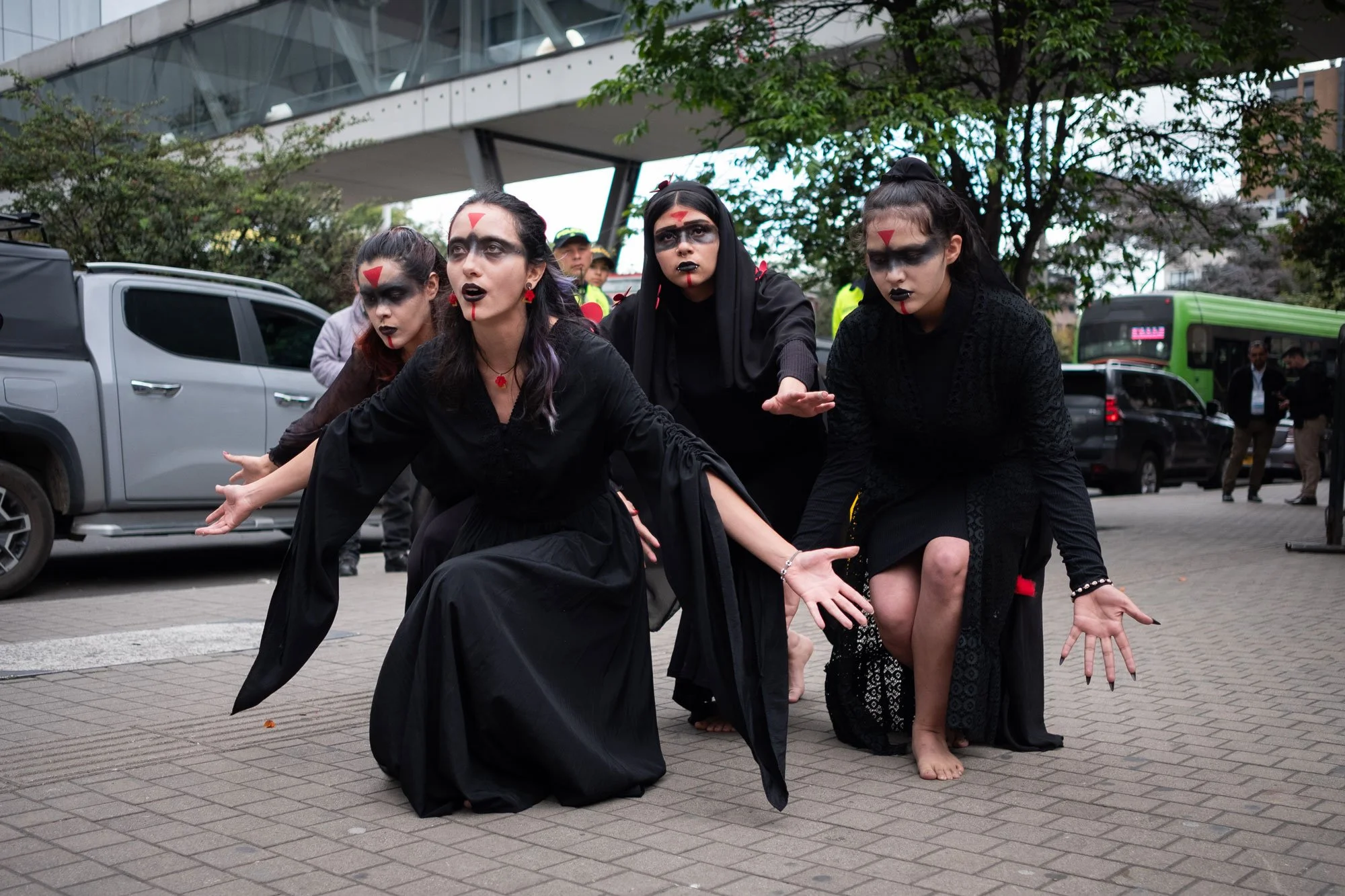
The folk theater group Quira performs a play denouncing war outside Expo Defensa in Bogotá on December 1, 2025. Photo © Mariana Mora.
Repression for sale
“Every industrial development at this fair exists to strengthen our military and police forces,” said Defense Minister Pedro Sánchez during the opening of ExpoDefensa.
But for protesters, strengthening the armed forces is synonymous with repression.
“It's a cycle in which they pillage our territories which will be resisted on a community level,” said Natalia in an interview with Ojalá. The activist requested that only her first name be used for security reasons. She is a member of the folk theater group Quira, which staged a protest piece during the demonstration. “How are they going to deal with that resistance? With weapons.”
Stun grenades and tear gas, known as “less lethal weapons,” are part of what’s on offer at ExpoDefensa. They account for 85 percent of the Colombian National Police’s acquisitions between 2019 and 2022, according to information provided by said institution to the DeJusticia organization, which is dedicated to human rights research and advocacy.
Globally, this market is growing. According to investment consulting firm Allied Market Research, by 2028 it will be worth $12.49 billion, representing a 7.4 percent increase on its value in 2020.
Colombia, in constant conflict
ExpoDefensa was first held in 2009, under the government of Álvaro Uribe, when Juan Manuel Santos was defense minister. According to its website, the aim was to “present the capabilities of the armed forces to key international actors.”
It is no coincidence that this fair is held every two years in Colombia, where, over the last 20 years, governments have allocated between eight and 13 percent of their annual budgets to military spending. In 2024, the country devoted the highest percentage of public spending to its armed forces in the Americas, higher than even the United States, according to SIPRI.
“In capitalism, war is not a failure, it is a business,” a spokesperson for the Congreso de los Pueblos (People’s Congress), one of the grassroots organizations involved in the protest, read into the microphone. “A business that needs constant conflict to survive and turns every humanitarian crisis into an emerging market, a business that transforms human suffering into investment opportunities.”
The Colombian people have experienced firsthand the cost of constant conflict. The national Truth Commission's Final Report recorded almost nine million victims of homicide, forced disappearance, kidnapping, recruitment, and forced displacement between 1985 and 2018. It also acknowledges that there is significant underreporting—the figures could be almost double, and the period covered is only half the duration of the internal armed conflict.
“We oppose the purchase of 17 aircraft from the Swedish company SAAB, supposedly for the defense of the Colombian people, instread that money should be invested in education, health, and the wellbeing of workers and the people,” said Juan de la Cruz Sánchez, a professor at the National University and member of the Workers’ and Socialist Unity Party.
The 2025 budget reflects these priorities. Funds allocated to defense and police, for example, are 65 times greater than those earmarked for the system established to guarantee truth, justice, and reparations for victims of the conflict.
Total Peace, a policy based on agreements with illegal armed groups and “the necessary territorial transformations that address the causes of the armed conflict in the country,” has been of the central tenets of Petro's government. This strategy has been criticized by the political opposition, which insists on direct confrontation.
But negotiation alone has not been enough to end the violence in the country. In the first six months of this year, the Ombudsman's Office documented the murders of 89 social leaders and 25 participants in the peace agreements. As of October of this year, the Ministry of Defense has recorded 75 massacres with a total of 263 victims.
While alarming, these figures have decreased by 22 per cent since 2022. On the other hand, homicide rates have not fallen. According to the 2025 Human Rights Watch report, “more than 121,000 people were victims of [...] forced displacement between January and July.”
Despite Petro's international rhetoric against the war on the Palestinian people and for peacebuilding in Colombia, his government has not reduced military spending. On the contrary, in August of this year it began to reinforce militarization along the border with Venezuela.
“As civil society, we must continue to demand leftist governments place a higher value on human lives,” said Expodefensa protester Mateo Cruz.
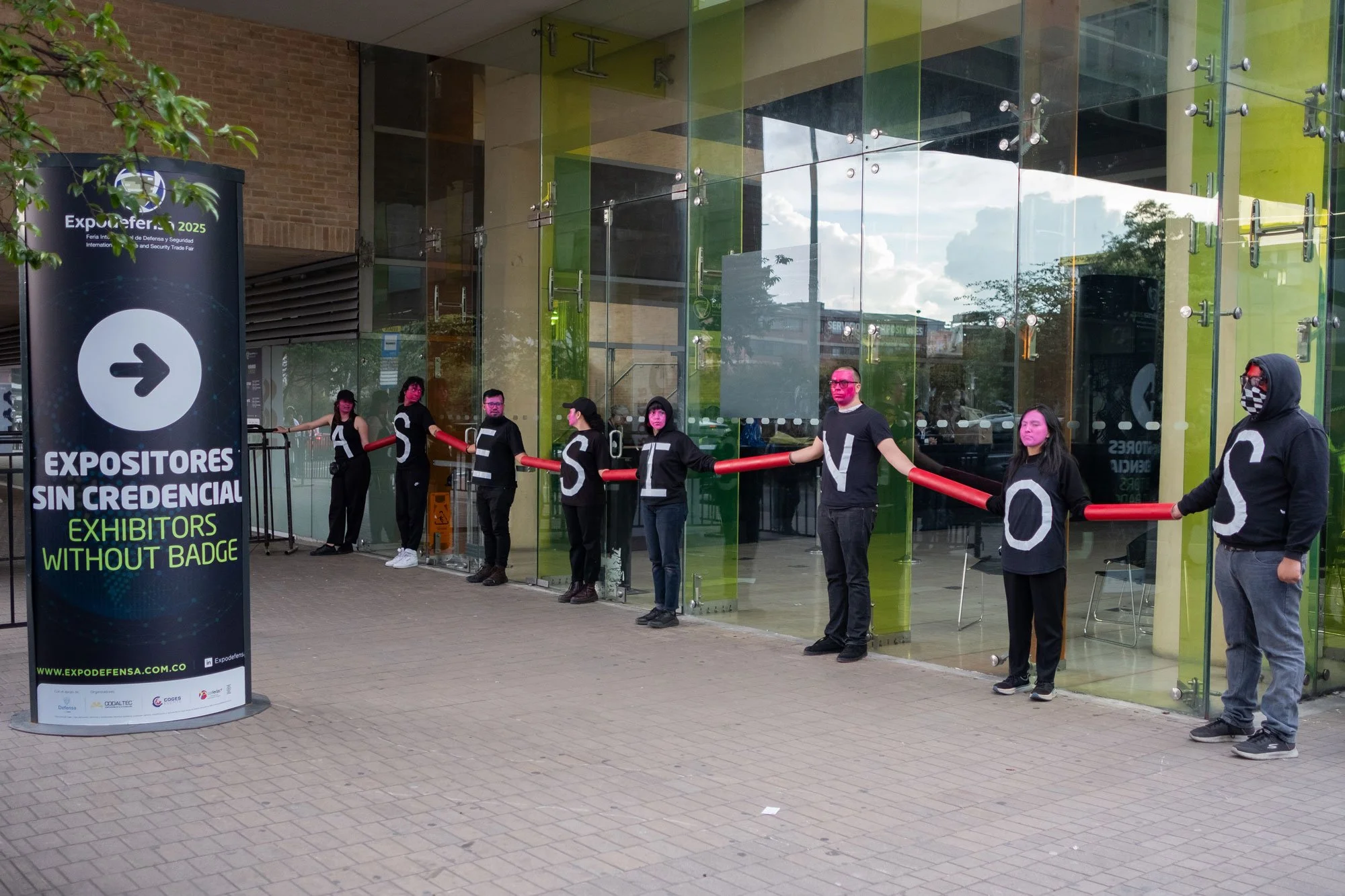
A group of protesters form the word “murderers” as they block the entrance for exhibitors at ExpoDefensa in Bogotá on December 1, 2025. Photo © Mariana Mora.
Women’s resistance
“There’s been an increase of over five percent in defense and police budgets directly related to investments in war and security forces,” said Andrea Castillo, who heads the demilitarization and peacemaking program at the International League of Women for Peace and Freedom (LIMPAL in Spanish), in an interview.
“Meanwhile, not even one percent of the national budget is invested in policies such as the prevention of femicide or gender-based violence.”
LIMPAL is one of the organizations and collectives that, since 2017, have organized protests, including the most recent demonstration at ExpoDefensa.
Castillo explained that their aim is to raise awareness about how the military industry and militarism affect women and territories—and she has faith in the collective fabric to combat this violence on a global level.
“We consistently call for recognizing paths of dialogue and the possibilities that emerge from coming together, and the initiative we organized today is an example of that,” said Castillo.