

Mapuche resistance, a beacon of hope in Chile
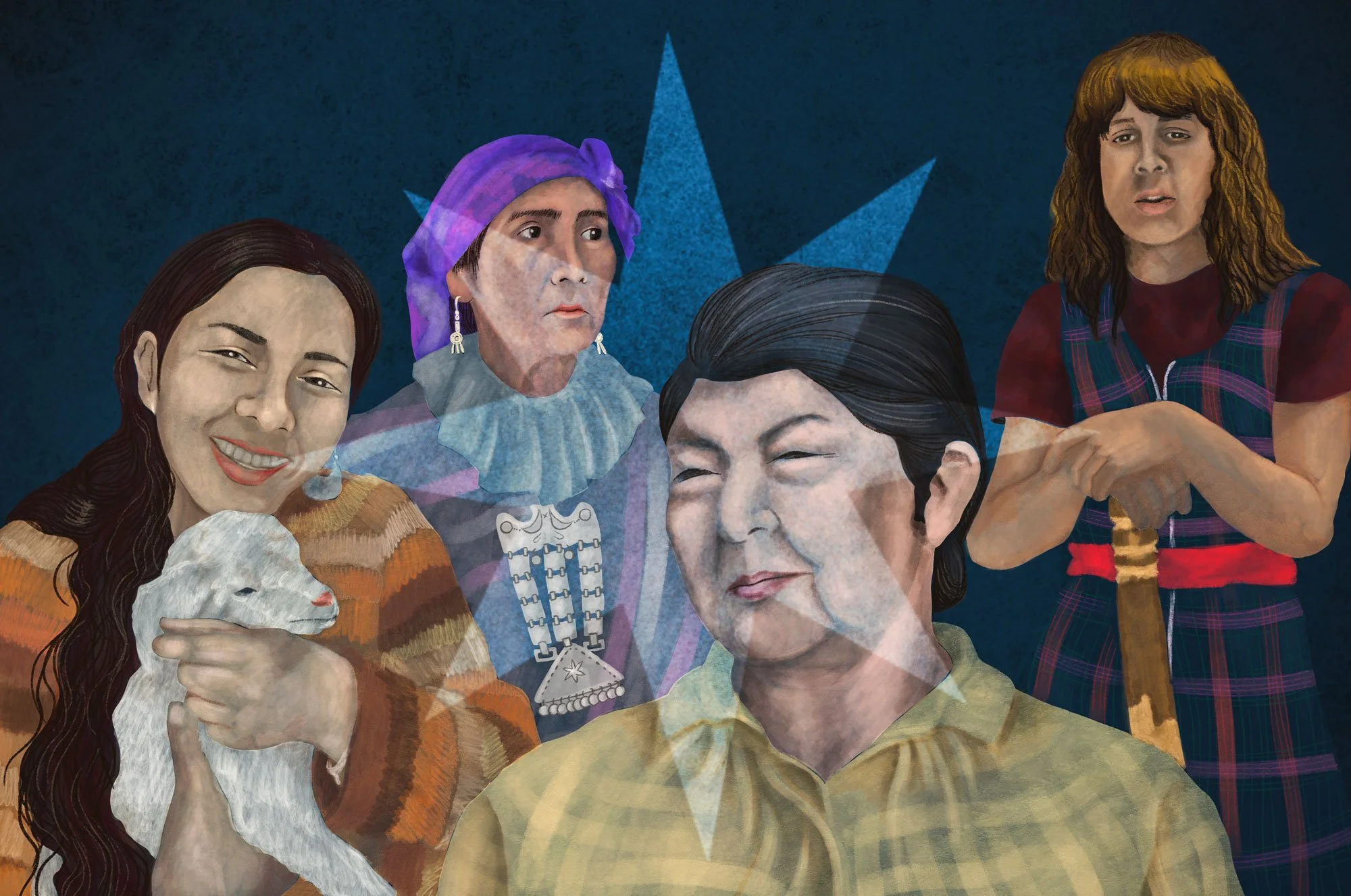
Digital art by @Pazconadie for Ojalá.
Opinion • Claudia Hernández Aliaga • December 18, 2025 • Leer en castellano
When Chile’s social uprising erupted in October 2019, we had no idea that six years later, we’d find ourselves where we are today. The December 14 presidential elections saw 7.2 million people (58 percent of voters) vote for José Antonio Kast, the favoured, far-right candidate who is now president elect.
The days of the 2019 uprising are fresh in my memory. I remember the huge Mapuche star that was installed in Dignity Plaza—as we called Plaza Italia at the time—the epicenter of the capital city of Santiago. Hundreds of thousands of us chanted afafanes (protest slogans) as Mapuche flags waved in the wind.
If there was a symbol that embodied the rebellion and resistance of the uprising, it was the Mapuche flag. Its star brought up our deepest feelings around the injustices that plague our country.
It’s true that no one can take away what we experienced during the Estallido, as the uprising is called in Chile. But the way in which our shared collective sense has been diluted weighs on me when I recall how the right began to claw back votes beginning in May 2023. Since then, the far right's ability to capitalize on exhaustion, fear, and depoliticization in a country that had just a few years earlier demanded profound changes has been on full display.
When I left Chile in late 2020, the priorities were the same as those raised in 2019 under the rallying cry “until dignity becomes the norm.” We sought decent wages, an end to the AFP pension system, free public education without university debt, universal public healthcare, decent housing, freedom for political prisoners jailed during the uprising, and the recognition of Mapuche territorial and political rights.
I returned to Chile four months ago, and today, it feels like a different country. One could be convinced that the main problems now are security, order, and immigration. Social inequality is no longer discussed, nor is the uprising, or the thousands of times the Mapuche flag was raised as an emblem of dignity.
In this context, as debates are stifled and election campaigns imposed a polarizing agenda, it’s worth paying close attention to how the ruling class has regrouped. The counteroffensive, now led by the far right, has been remarkably effective in reinstating the neoliberal order that the Estallido threw into crisis.
The 2025 election is but the latest chapter in a plan to seal shut the cracks that opened up in 2019, and to uphold a regime of colonial and extractivist violence that is especially harsh here in Wallmapu (Mapuche territory).
This violence did not end with Gabriel Boric's government; on the contrary, he reinforced it through further militarization, legal persecution, and the banalization of repression. The disappearance of Julia Chuñil is a key thread we can use to understand that continuity.
A year without Julia Chuñil
Julia Chuñil is a papay (elder), leader, and Mapuche land defender from the rural area of Máfil, in the Los Ríos region of southern Chile. She was disappeared over a year ago in lands reclaimed by her community. Her whereabouts remain unknown.
The investigation by the Public Prosecutor's Office has been marred by irregularities: the family has been kept completely in the dark, there’s been a lack of transparency, and evidence has been lost. Officials have failed to carry out critical protocols and made explicit attempts to depoliticize her role as a land defender, as well as participating in the unlawful coercion and incrimination of one of Chuñil’s daughters.
I arrived in Wallmapu on September 30, the same day Karina Riquelme, the lawyer for the Chuñil family, shared some terrible news.
That day, Riquelme condemned irregularities in the investigation and disclosed the fact that two phone calls had been intercepted from one of the main suspects—forestry tycoon Juan Carlos Morstadt Anwandter, the legal owner of the land recovered by Chuñil's community—in which he claimed that she had been burned.
The news caused an immediate outcry.
The next day, we took to the streets in cities and towns across the country to protest, demanding truth and justice for the papay. Her name is constantly on our lips, and she has been honored in marches, vigils, ceremonies, cultural events, and rallies organized by Mapuche, feminist, and environmental organizations.
Chuñil's disappearance is another in a devastating historical pattern that continues on repeat. The cases of Nicolasa Quintremán (2013), Macarena Valdés (2016), and Emilia Bau (2021), all Mapuche defenders murdered in the last two decades, demonstrate the persistence of a regime of colonial extractivist violence that targets Mapuche women who defend their territory.
Incessant militarization in Wallmapu
The presidential elections on November 16 and December 14 were not experienced the same way across the country. Not everyone voted under the same conditions.
Wallmapu has been under a state of exception since October 2021. First declared by Sebastián Piñera's government, it was extended without interruption by Gabriel Boric's administration. This enabled militarization, especially in so-called “conflict zones” where Mapuche territorial recovery efforts have gained momentum.
There’s no public, up-to-date information on the total number of police and military personnel, their bases, checkpoints, or intelligence teams operating in Wallmapu. What we do know about are the special reinforcements, like the 2,500 military personnel sent to guard polling stations in La Araucanía, and the repeated reports of police violence and abuse, especially against Mapuche children and young people.
We also know that daily life has changed, and not only in the stigmatized “conflict zones.” In cities such as Temuco, finding public transportation after nine at night is a challenge. The streets empty out, and shops and restaurants close, as if under an undeclared, de facto curfew.
Although this wave of militarization has been going on for more than four years, it’s nothing new for the Mapuche people. It also took place during Pinochet’s dictatorship (1973-1989), and if we go back a little further, just three generations earlier, in the mid-19th century, the Mapuche suffered invasion by the Chilean army, the dispossession and colonization of nearly 95 percent of their ancestral territory, and annexation. This open and persistent structural wound continues to mark the present.
This is compounded by the criminalization of the Mapuche through the creation of a political, media, and legal climate in which being Mapuche, defending the territory, being a community leader, or participating in restitution processes is considered a threat or a crime against private property, public order, and national security.
The most alarming expression of this is the fact that there are more than 100 Mapuche political prisoners in Chilean prisons, according to Radio Kurruf. That number has increased steadily since the post-dictatorship period, as well as during Boric’s administration.
In order to understand the full picture, we must also consider impunity. By this I mean not only criminal impunity, but also political and structural impunity: the slow investigations, the procedural omissions, the tacit cover-ups, and the absence of punishments for businesspeople, and employers who arm themselves and benefit from dispossession. We are deeply affected by the case of Julia Chuñil because in it, these aspects are all operating simultaneously in a way that’s fully visible to the public.
Militarization, criminalization, and impunity are not isolated or circumstantial phenomena. They’re parts of a strategy of territorial control deployed by the state to protect the interests of extractive, colonial capital. Together they produce counterinsurgency strategy based on territorial, legal, and media control, as well as militarized accumulation that seeks to neutralize the defense of the territory and the ways of life that the Mapuche people sustain and resist.
Seeing the present, beyond the elections
Having clarity about this allows us to understand that what Alondra Carrillo calls the neoliberal consensus is, in reality, inseparable from a colonial consensus: a tacit agreement that government after government, will normalize violence against Mapuche people, and enable criminalization, silencing, and impunity.
We are confronted with this uncomfortable truth in the Chuñil case. Despite the reactionary offensive and the closing of the horizons opened up by the social uprising, Mapuche resistance persists, anchored in a long memory of territorial defense against colonial projects that never fully disappear.
Faced with the advance of the far right—and the realignment of elites seeking to protect the neoliberal order—embracing Mapuche struggle as a political north star is not a symbolic gesture, but rather a guide to the present. It calls up practices that do not yield to state violence, and that weave community networks in the face of militarization and extractivism.
Today, Julia Chuñil's name challenges more than just the state. Her memory is a living force that nourishes struggles to come, in a context in which, under Kast's government, promises to become even harsher. Her name illuminates a horizon of dignity, autonomy, and territorial defense. Perhaps that—and precisely that—will become the brightest beacon as we navigate the dark times ahead.