
How Hurricane Melissa sparked solidarity within Cuba
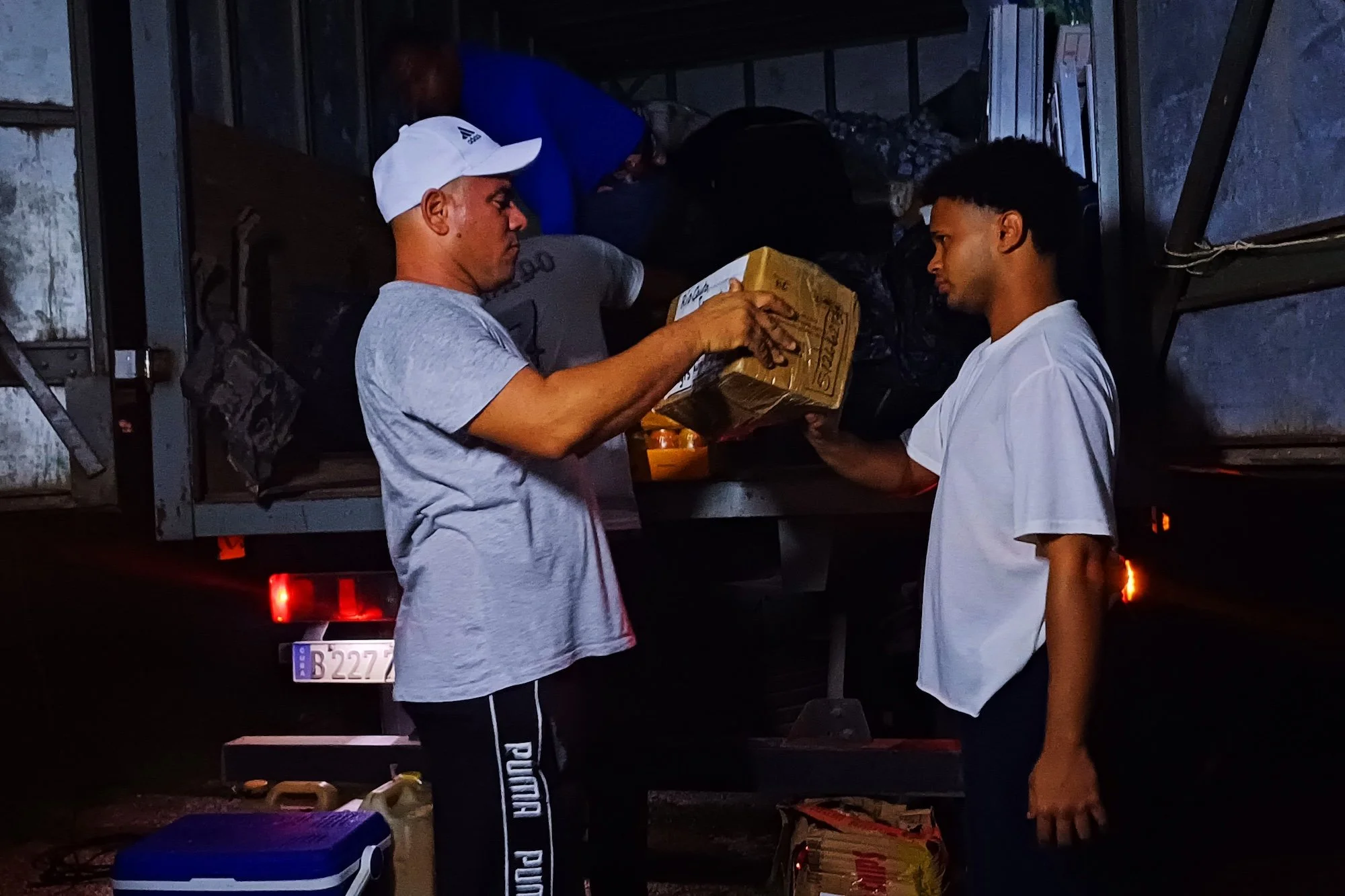
Local residents help unload donations brought by the Río Cauto en Nuestras Manos initiative on November 8, 2025, in the town of Grito de Yara, Granma province, Cuba. Photo © Eileen Sosin.
Reportage • Eileen Sosin Martínez • January 9, 2025 • Leer en castellano
Sixteen-year-old Leonardo Reyes walks barefoot along a dirt road in the rural settlement of Cauto del Paso, in Granma province, Cuba. Having finished high school, he now works cutting hay, which is used to feed horses. “I get paid monthly,” he said with some satisfaction. He stutters slightly as he recounts the dramatic events that unfolded in the early hours of October 29, 2025, when Hurricane Melissa battered the eastern part of the island.
Cauto del Paso is an area with a long tradition of agriculture and sugar production. As Melissa moved through, the Cauto River rose, and the local dam overflowed, causing floodwaters to rise throughout the area.
Two weeks after the hurricane hit, Cauto del Paso was still without electricity, and phone service was spotty. The Cauto River—which normally supplied water to local residents—was contaminated by flooding, which meant families had to wait for a truck to bring in drinking water.
As with other natural disasters, several initiatives sprang up to support the victims. Among them was the Río Cauto en Nuestras Manos (Cauto River in Our Hands) project, which brought together state and private companies with local authorities and residents, rare effort in Cuba.
Long-standing neglect
The fallout from the pandemic, increased US sanctions, the failure of economic austerity policies and dollarization have hit the Cuban people's purchasing power and public services hard.
Experts describe the situation as a polycrisis, which in Cuba's case is a combination of economic, migration, and healthcare crises. All of these elements collided when Hurricane Melissa hit the island last year. That’s why I decided to travel for almost 14 hours with a group of volunteers to Grito de Yara—and then to Cauto del Paso—to document solidarity efforts and the experiences of those affected by the storm.
The teenage Reyes told me how he was rescued along with his grandfather, Delio Reyes. A helicopter evacuated them to Bayamo, the main city in Granma province. They spent five days in an evacuation center, and then returned to face the destruction.
“That refrigerator was lying there, smashed to pieces across the floor. The television too,” said Reyes, gesturing around his home. “From one side to the other, it was a mass of mud that took a shovel to clear away. I still can’t pull the mattress out [to dry] because it weighs too much.”
Other families began to lay their belongings out in the sun, creating a kind of museum of loss: torn up, water logged clothes, furniture, and appliances laid out in the open air in a last-ditch attempt to salvage them.
These are scenes that elders in the area have seen before.
Delio Reyes remembers Hurricane Flora, which struck in October 1963, before the dam system was built. It was one of the worst natural disasters of the 20th century in the Caribbean, killing at least 7,000 people in Cuba, the Dominican Republic, Haiti, and several other Caribbean islands. Now, 62 years later, the rains from Hurricane Melissa pushed local reservoirs to their limits.
“They took a long time to let the water out (and lower the pressure) from the dam,” said Reyes of Hurricane Melissa in an interview with Ojalá. “We didn’t know that water was coming. We thought we were safe once the cyclone had passed.”
The people save the people
Leniuska Barrero is originally from Cauto del Paso, but she was in Havana when she learned hurricane Melissa was headed for her hometown. From 700 kilometers away, she began to put together the collective initiative that came to be called Cauto River in Our Hands.
“As the cyclone moved, I knew what was going to happen, and I started to organize,” Barrero says. “I was born there, I know everyone, and I know their circumstances.”
In Cuba, a permit or authorization from a political organization determines whether you are allowed to transit through a given area or whether the police will stop to inspect your cargo on the highway. Without these permits, any civil servant can call a project into question and, at worst, shut it down. But on this occasion, the Committees for the Defense of the Revolution supported the initiative, granting authorizations to carry out operations in the impacted region.
A private company called Pedrocaar provided a bus to transport the group of volunteers and donated one million Cuban pesos (more than $2,400 at the official exchange rate) to purchase food and cleaning products. Such initiatives are rare in Cuba, as decades of prohibition and stigmatization have led to a mistrust of the private sector, and institutional bureaucracy paralyzes or delays many efforts.
Amid a deep national crisis, with lengthy daily blackouts and widespread shortages, the preparations for Río Cauto en Nuestras Manos took a full week.
“While I was shopping, I said, ‘I have to take some sweets, because those children never get candy,’” recalls Barrero, who previously worked as a social worker in the area. “Before, people there may not have had money, but they had a small farm, vegetables, milk, their little pig, their chickens but now they have nothing.”
When the donation truck finally stopped in front of the village recreation center on November 9, residents immediately gathered to unload the supplies.
They placed packs of rice, beans, pasta, soap, and canned goods on the dry, cracked earth left behind by the flood inside the building. People crowded around the doorway, mothers with small children were given priority. There was not enough cooking oil, so families paired up to share a bottle.
In total, Río Cauto en Nuestras Manos distributed 527 bags of food, one per household, including to nearby settlements of Yuraguanal, Cauto Embarcadero, Tiguabo, and Los Cayos. First priority was given to those with the greatest needs, but the collective effort was not enough to alleviate other urgent problems.
"You have to go out to get water, in a guaranda [horse-drawn cart], 15 kilometers away, in Cauto Embarcadero. There were 50 or 60 people there. I've been there three times in a week,” said Yadisnel Zamora, a father of four, in an interview in November. “Drinking water is what the people here need. They need to bring water.”
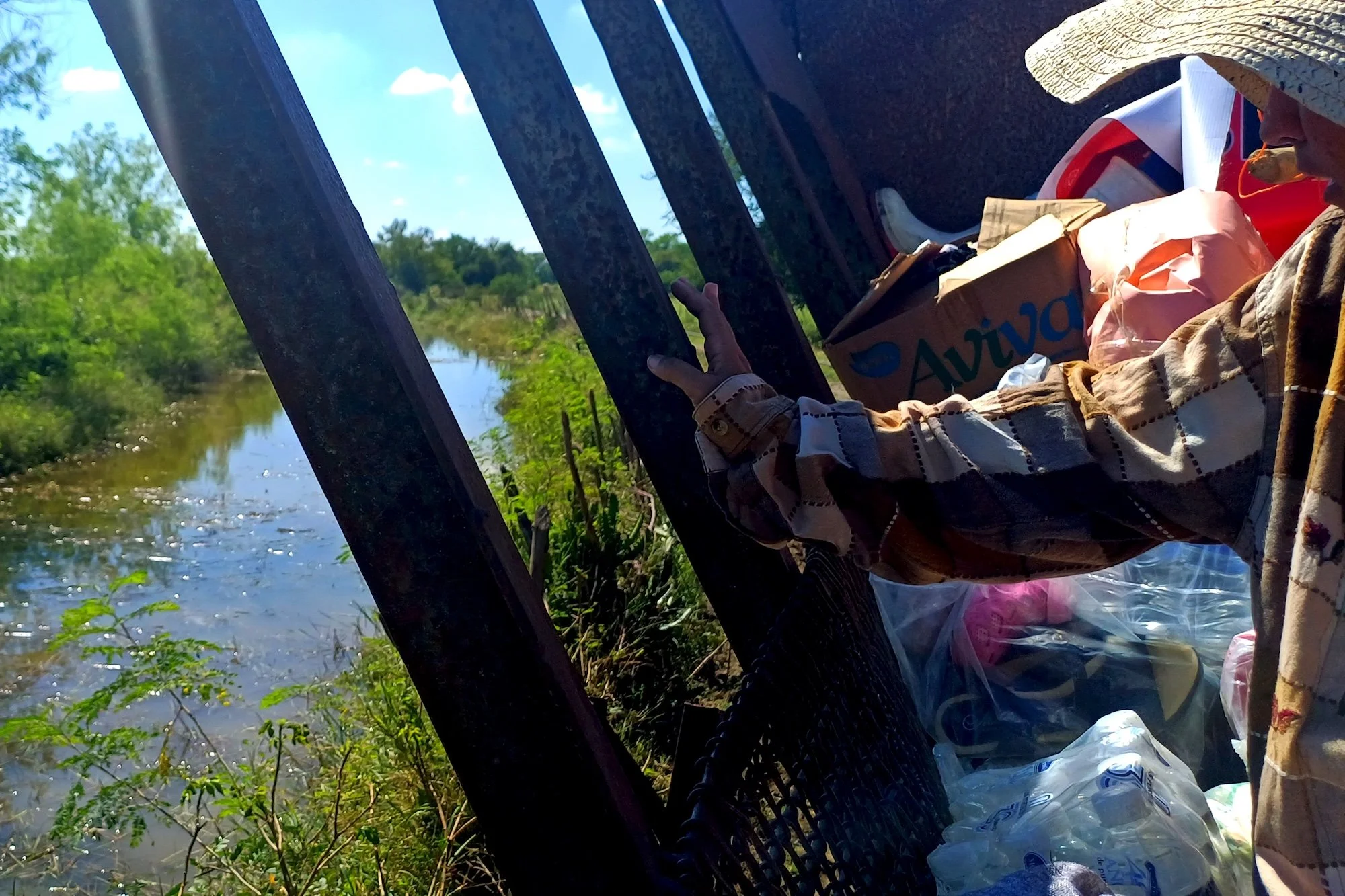
A tractor loaded with food and other essential items makes its way toward Cauto del Paso through flooded areas caused by Hurricane Melissa in the Río Cauto municipality, Granma province, Cuba. Photo © Eileen Sosin.
Struck by systemic precarity
In Grito de Yara, a town near Cauto del Paso, local residents and evacuees described what happened in almost poetic terms. They talk about a “strike of water,” which is what they call the sudden, heavy flooding caused by the dam bursting, that filled the area. But they had suffered other blows long before that.
Already existing precarity was exacerbated by the hurricane, which revealed inequalities that have historically been most acute in rural areas in eastern Cuba. The lack of transportation and accessible roads translates into a lack of opportunities for education, employment and access to healthcare.
“I think the hardest thing was realizing how insignificant a human being is in the face of other people's problems,” said Claudia Rafaela Ortiz Alba. “And especially when the problems are structural and you know they can't be solved with a day's worth of food.”
Ortiz Alba contacted Barrero after raising money, clothing, and medicine with several friends. She, too, had experience in coordinating relief efforts after Hurricane Oscar hit the province of Guantánamo in October 2024. She says on that occasion, authorities did not put obstacles in their way, but they didn’t facilitate the grassroots response either. “So everything was much more tortuous and exhausting,” she said.
Another difference Ortiz Alba noticed in relief efforts following Hurricane Melissa was that needs were identified based on information provided by social workers in the area. This, combined with Barrero’s own experience, enabled more effective support.
“Last year [in Guantánamo], it was extremely difficult to map the communities, we were starting from scratch,” said Ortiz Alba.
While the initiative brought a sense of satisfaction from helping others, it also took an emotional toll. “I wish they had a power plant or solar panels. I wish I could install a water turbine so they can have water,” Barrero told Ojalá.
Barrero explained that in Cauto del Paso, people go down a ravine to the river—from the height of a five-storey building—to collect water that is still dirty from runoff.
The awareness of these hardships makes her want to return home and continue working with Río Cauto en Nuestras Manos. But she also thinks that to address the magnitude of the accumulated challenges, it might need a different name.
“Maybe I could change the name of the project,” she said. “Right now it's Río Cauto, but another province could be next. I hope it can continue as an effort to help more people.”