

Torture haunts Mexico’s prisoners
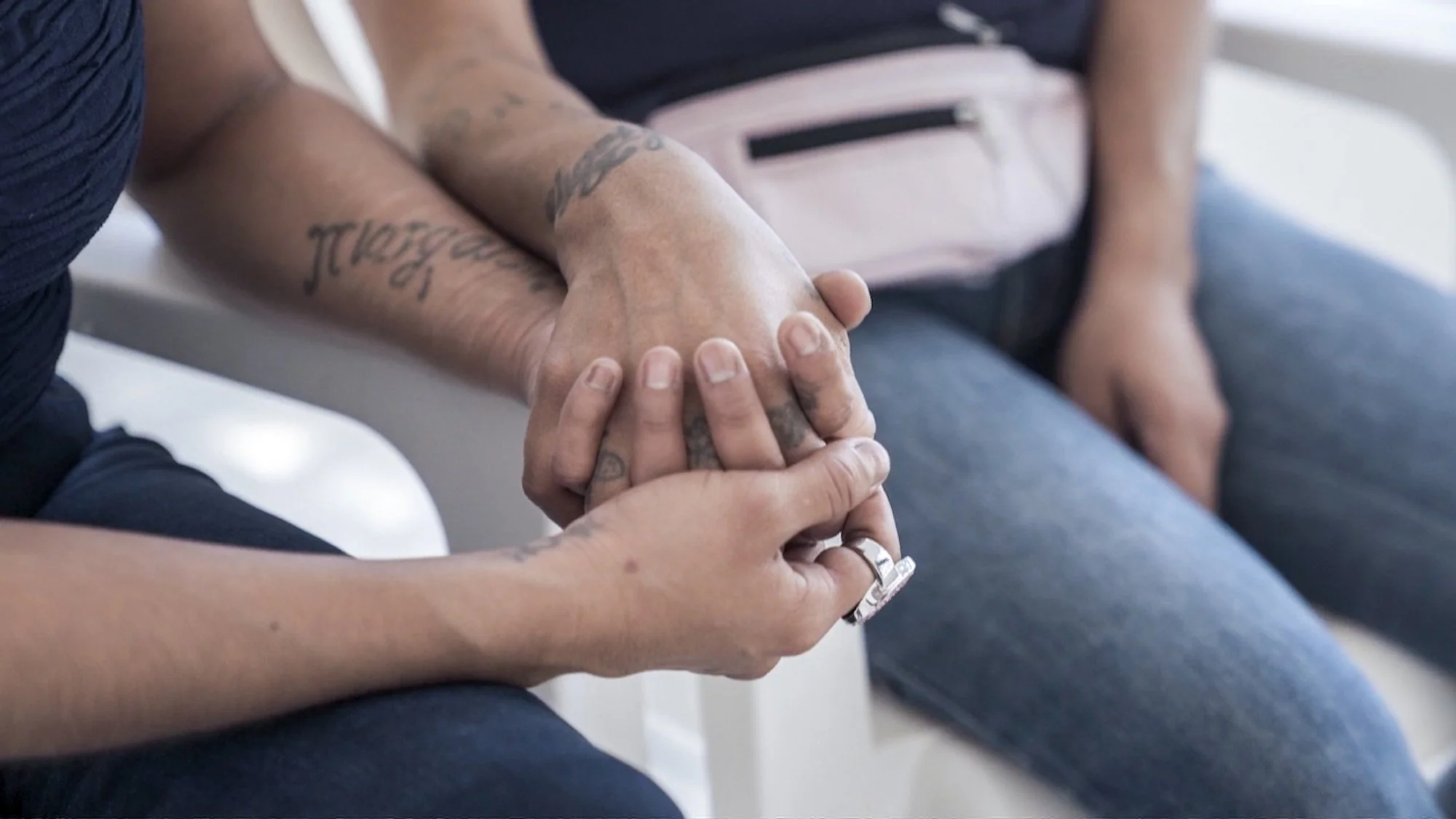
Vicki holds her girlfriend's hand during the interview. This is a still taken from a filmed interview with Vicki, Tepepan Prison in Mexico City on June 14, 2024. Image © Lexie Harrison-Cripps.
Reportage • Lexie Harrison-Cripps • January 15, 2026 • Leer en castellano
“I want people to see what is happening. The justice and the injustice,” Vicki said, looking away, her hands kneading her thighs.
She was 13 years into a 27-year sentence in Tepepan, a specialist prison for inmates with physical or mental health conditions in the south of Mexico City.
“The people in here aren’t the real criminals, because, like me, there are so many women who have suffered torture or rape,” she added in a quiet voice that was amplified by the long, empty cell. Sun streamed in through barred windows, creating a chessboard of shadows on the dirty, tiled floor.
The 33-year-old mother was dressed in the mandated colour: blue jeans, blue T-shirt, and blue headband that held back a mane of brown hair with rebellious blond and purple tips reaching her lap. A white sneaker jittered at the end of her crossed leg, undermining her calm voice.
Vicki was convicted after a “confession” obtained after days of rape and torture by Mexican Marines, leading to a 43-day hospital stay, reconstructive surgery, and a subsequent HIV diagnosis. After 16 months of correspondence with Vicki and the Mexican Government, I was finally given permission to film her testimony under the watchful eye of an unsmiling bureaucrat.*
By the end of 2025, Vicki was one of 15,893 women in prison. Her story echoes those of thousands whom authorities have tortured and unjustly detained, typically accusing them of robbery, kidnapping, drug-related, or organised crimes. This population of women has increased every year since 2017, when 9,088 women were detained.
According to the most recent government survey, by the end of 2024 almost half of female prisoners (46.3 percent) had yet to be sentenced, despite waiting behind bars for years. Many of those who have been convicted are, in fact, innocent.
A survey of female prisoners in 2022 revealed that 73 percent were subjected to violence by the detaining authorities, who then secured a conviction in a penal system that, until 2016, presumed guilt over innocence. Judges relied on written evidence—often little more than a coerced “confession”—with scant opportunity for a proper defence.
Since 2016, all states have moved to an adversarial system, in which the defense and prosecution present their arguments. The goal was to give the defendant more rights, but by then it was too late for Vicki.
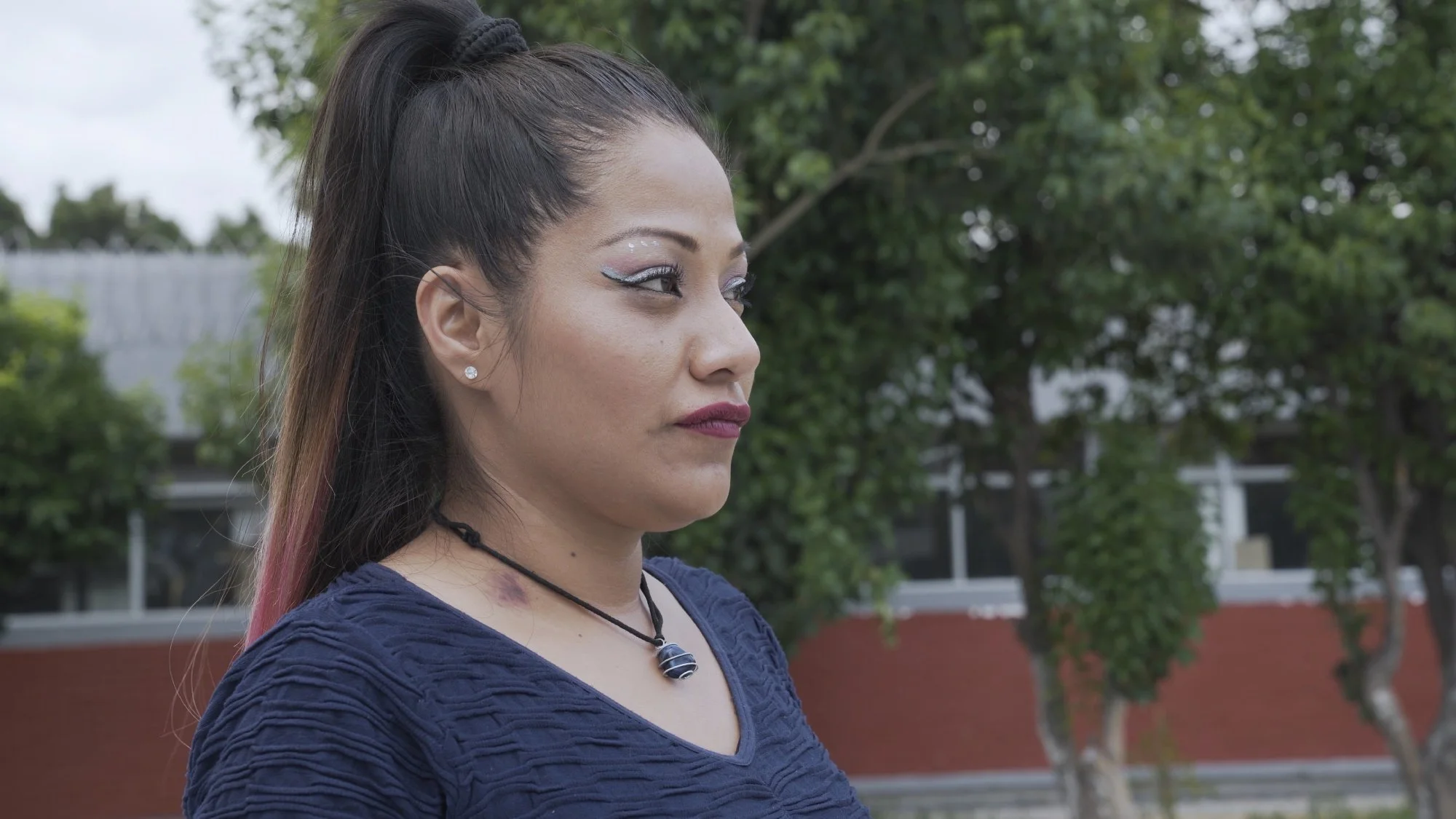
Vicki stands on the concrete court in the middle of the prison. This is a still taken from a filmed interview with Vicki, Tepepan Prison in Mexico City on June 14, 2024. Image © Lexie Harrison-Cripps.
A violent interruption
Vicki’s life was torn apart in 2011 when she agreed to help her new boyfriend move house. Her three-year-old son begged her not to leave the family home that night, where they lived with her mother and younger brother, but 19-year-old Vicki went anyway, hoping she might earn some money.
Just a few minutes after she arrived, Marines stormed the empty house, forcing her and her boyfriend to the floor. They put a bag over her head and dragged her from room to room, intermittently asking nonsensical questions and beating her before disappearing the couple to an unknown location.
Vicki remained blindfolded for the next four days as her other senses began to compensate, searing events into her memory that haunt her to this day. The sound of her captors’ voices, the smell of them on her, the echo of the empty rooms, and the screams of her boyfriend as he begged for them to be let go. She remembers the man who said he was from the National Human Rights Commission, there to end her ordeal and document her injuries. He, too, raped her.
At the time, the country was in crisis. Felipe Calderón, president from 2006 to 2012, had deployed the military to fight a war against drug cartels. But he did not win. During his term, the homicide rate tripled, and kidnappings became more prevalent. The federal police force tripled in size to around 37,000 agents, and with that growth came a corresponding increase in complaints of human rights abuses (802 in 2012, as compared to 146 in 2006 according to a report by the National Commission for Human Rights in 2013).
It’s likely that many abuses went unrecorded in a society where there was little to no trust in the police. According to Mexico’s National Institute for Statistics and Geography, only 12 percent of crimes were reported in 2013. In 2014, 70 percent of respondents said they believed the police were “ineffective or barely effective” in combating crime. At the same time, the prison population was increasing, with few of those detained ever being sentenced.
Vicki was one of 12,264 women who were sent to prison in 2011, in a year when only 1,200 were sentenced while Calderón prioritized the war on drugs over reform of the judicial system and human rights.
During his term, 95 percent of the Federal Attorney General Office’s requests for arraigo—a form of temporary “house arrest” in government buildings known colloquially as hotels where accused are held during an investigation—were approved. Penal expert Dr. Luis de la Barreda Solórzano of the National Autonomous University of Mexico argued that this “suggests that the majority of judges did not comply with their duty to protect the rights of the accused.”
Like Vicki, many of those wrongly detained remain in prison today.
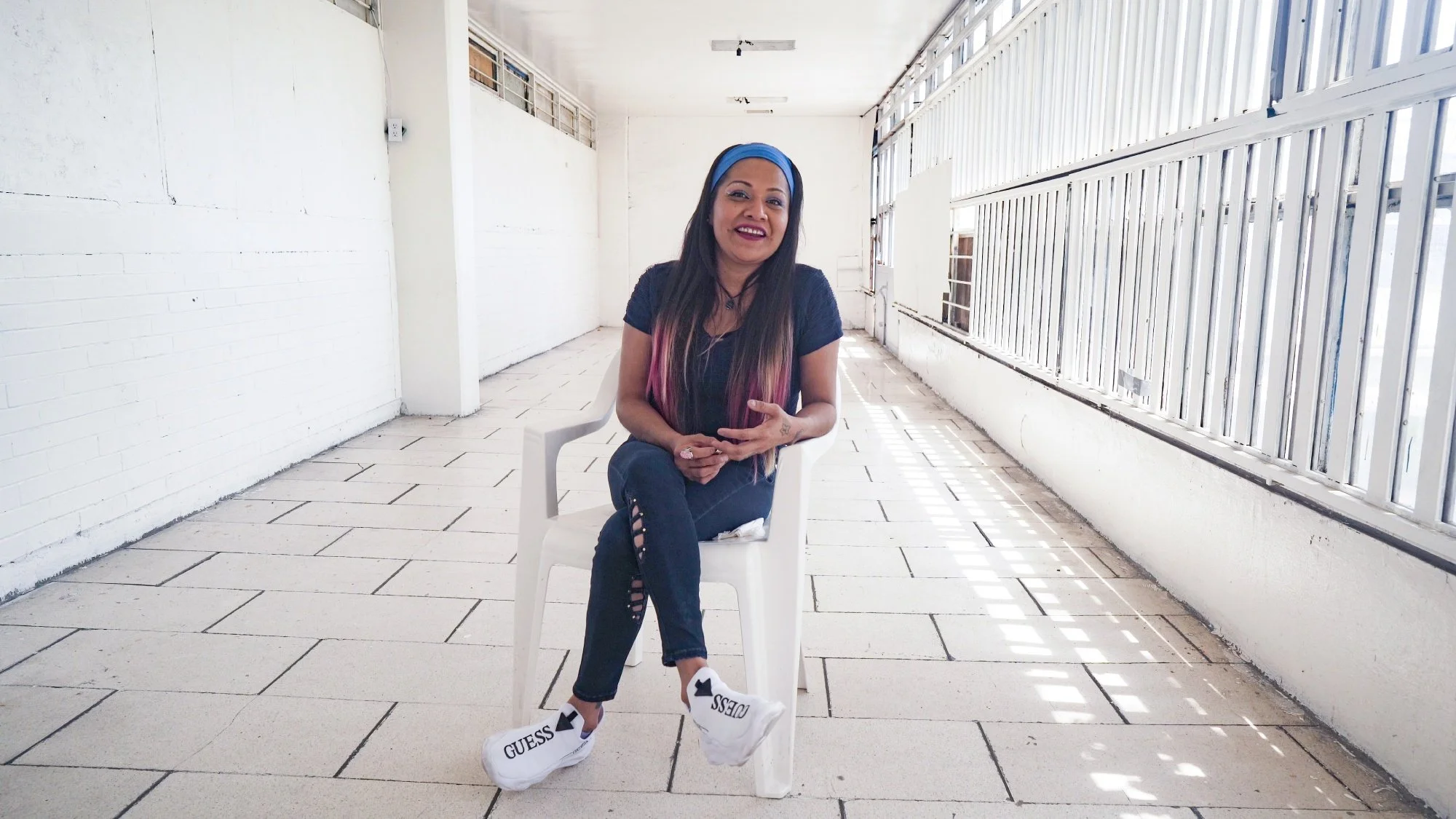
Vicki sits down for an interview. This is a still taken from a filmed interview with Vicki, Tepepan Prison in Mexico City on June 14, 2024. Image © Lexie Harrison-Cripps.
‘I’m always fighting with my anger’
Visiting Vicki is no easy feat. The Tepepan prison sits at the top of a winding road, sandwiched between stone masonry walls and poplar trees, away from public transport and hundreds of kilometers from her family in Veracruz. A blue metal fence and purple jacaranda tree divide the picturesque outside world from the incarcerated women who live according to arbitrary rules.
“You can’t wear those boots in here,” the guard snapped as his eyes scanned from my red dress to my Caterpillar boots during one of my visits. The red dress was acceptable, as prison rules require visitors to wear red or pink to distinguish themselves from inmates, but I was unaware of the ban on boots. Conveniently, the police were on hand to rent me some large men’s brogues.
Clutching Vicki’s requested rotisserie chicken, rice, and toiletries, I galumphed through a series of checkpoints—including a daunting private cubicle for an intimate search—before finally receiving a red plastic card that comes with a claustrophobic warning: “Lose this, and you can’t leave.”
An inmate showed me into the large visitors’ room filled with pink and red-clad family members surrounding picnic spreads. I looked out the window onto a sad basketball court and a broken seesaw, while she laid down a pretty blue polka-dot cloth on the table in front of us.
A tall, smiling Vicki marched across the room to clutch me in a long, friendly embrace before starting an easy conversation that was to be twice interrupted: first when the prison director summoned Vicki to her office, and second by an earthquake that sent prisoners, family members and guards running in different directions. I shuffled out—brogues on the wrong feet—into a rundown yard where a girl in blue stared at me, her eyes full of confusion.
When we resumed our conversation, Vicki was vibrating with rage. The prison had revoked her visitor rights, causing her to have, in her words, a crisis.
“I’m always fighting with my anger,” she confessed, “but I’m learning to take control.” Vicki must suppress her frustration living wrongfully convicted under unpredictable prison rules. Despite initially searching for relief in drugs and several suicide attempts, she is now fighting back.
Despite everything that has happened to her, Vicki has thrown herself into the activities offered by the prison and visiting Civil Society Organizations. She regularly participates in dances choreographed by Mujeres Unidas por la Libertad, an organization established by ex-prisoners who now return to support those left behind.
For Vicki, dance changed her life. And for a short while, so did the prison vegetable garden, which is now no more than a patch of grass. She brought the garden back to life as she described how she and her colleagues would spend endless days, bent double, coaxing food from the soil.
As part of her tour, she gestured to the doorway leading back into the prison, adding quietly that she likes to stand in the night air, looking up at the stars. “I often ask myself if it is the same air outside that I am breathing. Does it feel the same or is it different?” she said.
With the Government bureaucrat getting impatient, she ushered me out, but not before suggesting that the interview and account of the torture were too disturbing to publish.
But Vicki refused to be silenced. “There are many people in uniform out there who commit true evil, but there should be a consequence for everyone,” she insisted.
A few days later, the Government revoked my permission to film, but by then it was too late. Vicki’s story had been captured.
*Vicki consented to her name and face appearing in video and text stories, but I have since lost contact and so have not included her full name here.
An abridged version of this story won the ‘City Writes’ competition at City St George’s University in London in December 2025.