
USA, 1984
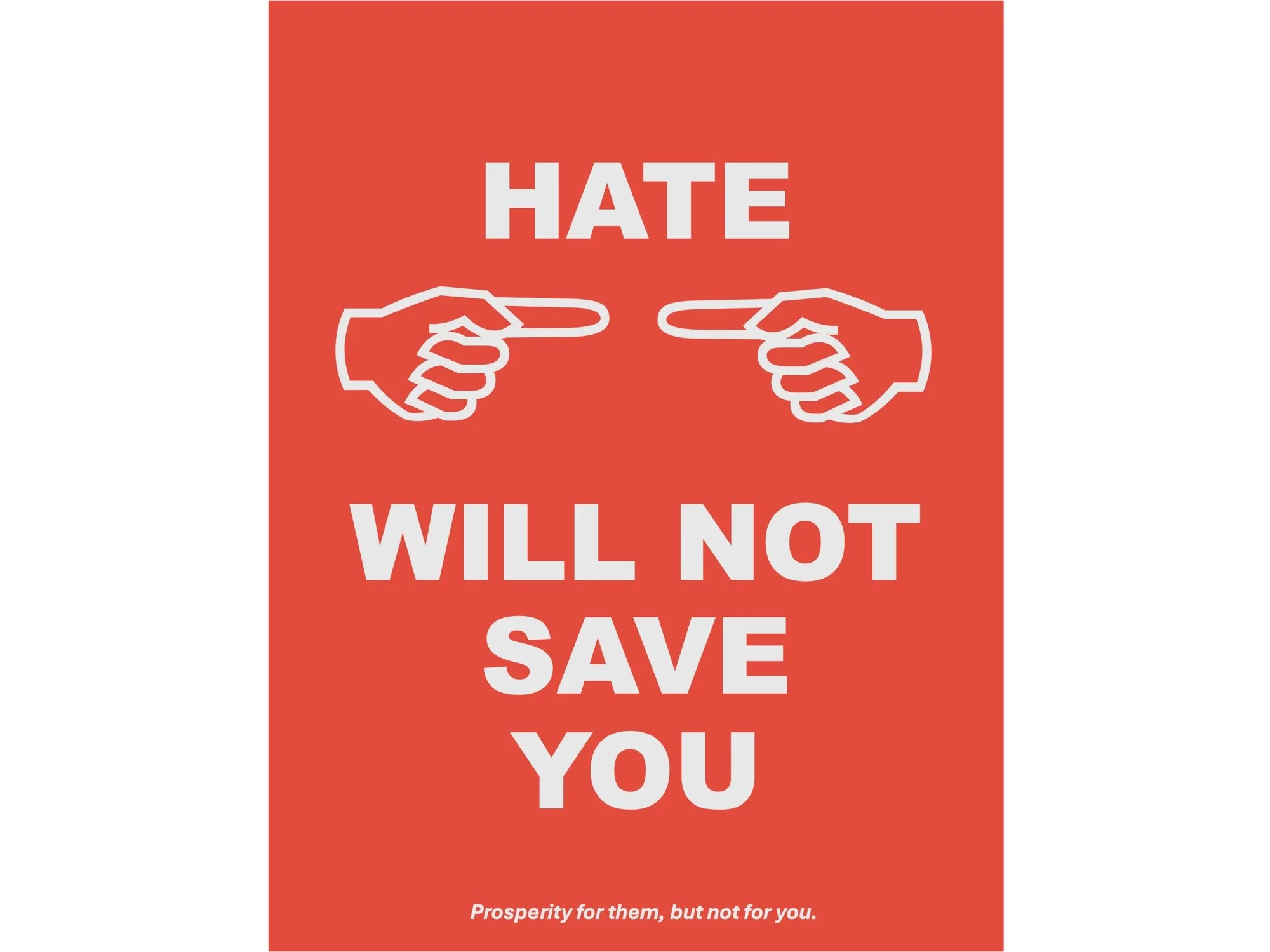
“Hate Will Not Save You” by Colejoyprints. CC BY-NC-SA 4.0.
Opinion • Kristian Williams • January 16, 2026 • Leer en castellano
Donald Trump's December 17 prime time address—coming as the United States military was escalating its campaign against boats off the north coast of South America—was, on its face, simply baffling. Many observers expected it to announce the invasion of Venezuela. Instead, we heard 18 minutes of shouting that the economy is just fine, but will definitely get better.
By almost every objective measure, the U.S. economy is worse than it was a year ago. But moreover, Trump owes his 2024 electoral victory, at least in part, to his opponent’s failure to face economic realities, allowing him to paint the Democrats as out-of-touch "let them eat cake" elitists. Now, Trump himself seems to be repeating exactly the same mistake.
He did, at least, address the practical pocketbook issues, though he did so in a way completely divorced from reality. "The price of eggs is down 82 percent since March, and everything else is falling rapidly [...] prices on drugs and pharmaceuticals by as much as 400, 500, and even 600 percent. Gasoline is now under $2.50 a gallon in much of the country. In some states, it, by the way, just hit $1.99 a gallon."
My first instinct, on hearing the address, was to wonder who it could possibly convince. People know how much eggs cost (an average of $2.86 per dozen, which is admittedly 42 percent lower than its avian flu peak). They know how much gas costs ($2.90 a gallon). And they certainly know that when you pick up a prescription, the pharmacy does not pay you. Trump's numbers are not mere fabrications, but actual absurdities. A price cannot drop by 600 percent and remain in any meaningful sense a price.
The price of smoke and mirrors
As happens more and more often, I was reminded of a scene from George Orwell’s Nineteen Eighty-Four. Winston Smith, the novel’s alienated protagonist, is in the canteen when suddenly the telescreen in front of him blares with an announcement from the Ministry of Plenty:
“Attention, comrades! We have glorious news for you. We have won the battle for production!” The eager voice goes on for several minutes, rattling off statistics to prove that “the standard of living has risen by no less than 20 per cent over the past year.”
Winston knows that the cited figures are all lies, but he is more troubled by the public’s response. "It appeared that there had even been demonstrations to thank Big Brother for raising the chocolate ration to twenty grammes a week. And only yesterday, he reflected, it had been announced that the ration was to be reduced to twenty grammes a week. Was it possible that they could swallow that, after only twenty-four hours?"
The absurdity is the point.
Trump does not care if his numbers are right, and he does not care if we believe them. It is enough that his followers accept as a matter of fealty, if not the specific statistics, then at least the general vibe.
Militarized obfuscation
There is widespread hope among Trump’s critics that the economy will be his undoing, that the undeniable harm that his policies do to his base will finally break apart the Make America Great Again movement. I share this hope, but the outcome is far from certain.
More likely, in my view, his followers will just continue to seek out scapegoats. This tendency—present from the beginning in the slogans about mass deportations and the promise to punish political opponents—has manifested most clearly in the escalating Immigration and Customs Enforcement (ICE) presence in Democrat-controlled cities and in the short-lived attempt to supplement them with actual troops.
Such deployments only served to stoke the unrest they were purportedly combating, making them self-defeating from one perspective, but self-justifying from another.
Where the public response was muted, or non-linear—most famously, with the protestors’ use of inflated animal costumes— Trump’s lackeys simply invented the necessary facts. They recycled footage from the 2020 riots without labelling it as such, or shamelessly insisted that they were facing riotous mobs as their own chosen livestreamers showed small and notably low-energy protests.
Again, the willingness to repeat the lie is more important than anyone’s ability to actually believe it.
The logic of applying racial violence to economic problems is likewise evident in the more recent Special Forces raid on Venezuela and the abduction of President Nicolás Maduro in a bid to gain control of that country's oil.
Terrorizing immigrants will not raise wages, and jailing Maduro will not lower prices. Arbitrary tariffs did nothing to renew American manufacturing. But in each case, Trump will proudly declare the opposite.
The worsening economy, when paired with the decimation of social services, will continue to hurt many of Trump’s supporters, especially workers in rural areas. But rather than shift their allegiance, the MAGA faithful may again seek out new enemies to punish while continuing to praise Trump for his imaginary successes.
They love Big Brother.