

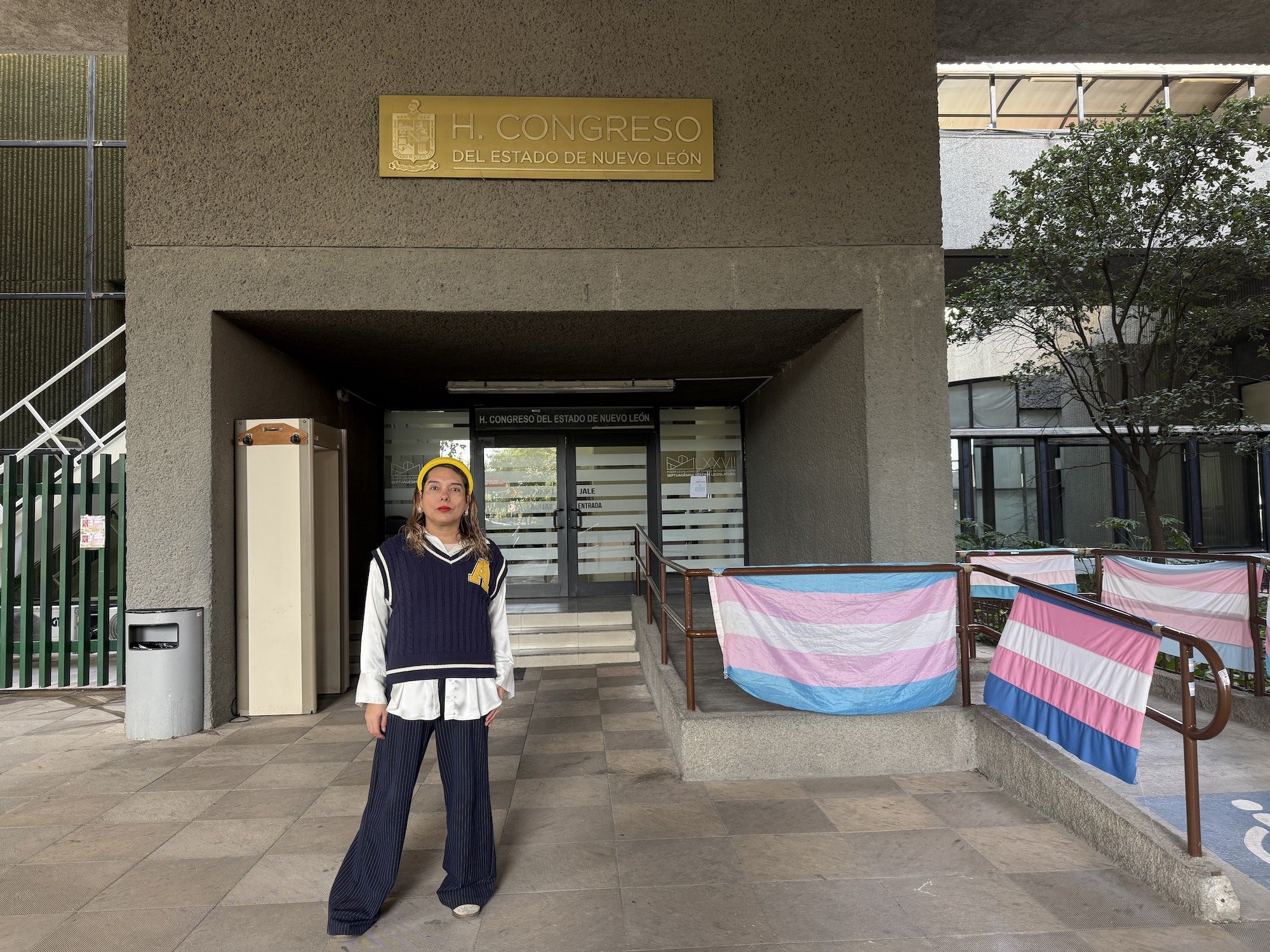
Ana Eugenia Rodríguez, a spokesperson for the trans encampment in front of the state congress in Nuevo León, in Monterrey, México. Photo © Chantal Flores.
Reportage • Chantal Flores • January 22, 2026 • Leer en castellano
Lucero Cerda Santoyo survived an attempted transfemicide—but the state of Nuevo León, where she lives in Mexico, does not recognize the crime as such. Since November, she’s been participating in a sit-in led by trans women in the state capital, Monterrey, which she says will continue until recognition becomes a reality.
Cerda Santoyo was attacked in July 2020. In the mirror of the headboard, she watched her face turn pale as she was strangled. By the grace of God, as she describes it, she managed to break free and fight off the man, who was her client. She pinned him down and bound his hands and feet until the police arrived. He was arrested, but later released.
"The police never charged him, he didn’t go before a judge; it's unbelievable. They came up with a story in which [I] hurt him more,“ said Cerda Santoyo, who is 49. “That’s how powerless you are and how much impunity the authorities have when they find out you’re transsexual.”
Recent killings of trans women in Nuevo León include that of Paola Jaqueline, a friend of Cerda Santoyo's who was murdered while doing sex work. There was Aranza Aldanelly, 23, who disappeared for three weeks and was found dead with signs of having been subject to a violent attack. A third young woman was found dead in a motel, but no further information was provided by authorities.
These three cases inspired Ana Eugenia Rodríguez, an activist and former city councilor, to join forces with the non-governmental organization Casa Trans and propose a bill to introduce transfemicide as a crime in Nuevo León's Penal Code. The goal: to recognize the murder of transgender women spurred by hate and transphobia as a specific crime.
Only six states in Mexico recognize the crime of transfemicide, which obligates authorities to respect victims' gender identity. That means honoring their name, gender, and chosen family, as well as investigating whether the attack was motivated by prejudice or transphobia.
In late 2025, Rodríguez was told the proposal had lapsed without even being discussed by lawmakers in Nuevo León.
“Nothing ever gets solved, not ever, nothing at all, and I think this is one of the most important issues we face as members of the transgender community in Monterrey, and not just Monterrey, but all of Mexico,” said Cerda Santoyo.
The activists resubmitted the initiative, and since November 20, 2025—Transgender Day of Remembrance— trans women have been holding down their protest outside Nuevo León’s state congress.
Systemic violence
“This time, we’re making more demands. We’re facing exhaustion, the fear that they will continue to kill us, and the indifference of Nuevo León’s congress and legislature, that’s why we’ve decided to stage a permanent sit-in until we get a response,” said Rodríguez.
Rodríguez, who is the spokesperson for the sit-in, says that over the past 50 days, they’ve faced police harassment, cold temperatures, and emotional exhaustion as they try to balance their jobs with the protest. At least 10 women remain on site day and night, organizing shifts so as not to suffer financially, and keep up the fight.
“Playing by the rules is not enough,” said Rodríguez. “Making formal requests and following citizen protocols to request services has not worked for us. Everything we’ve won has been because we’ve fought and made demands and we’ve stood our ground and protested."
María Romero, a lawyer specializing in gender violence, explained that in Nuevo León, a commission of 11 members is assigned to review new bills before they are submitted to the full chamber of 42 deputies for approval.
“This issue of transfemicide hasn’t even been discussed in the initial committee of 11 people,” said Romero. “There hasn’t even been a document attempting to provide an analysis of the issue; and what is worrying is that we keep seeing more deaths.”
The lack of legal mechanisms to prevent or punish transfemicide has also led to a lack of reliable and disaggregated government data. In 2024 alone, 59 murders of trans women were documented in Mexico; activists warn that the actual number is higher, as many cases go unreported or are misclassified.
Romero, who is also the technical secretary of the Commission for Gender Equality in the state, emphasizes the importance of hearing the demands of the trans activists at the sit-in. She sees raising awareness around violence as a way of addressing the crimes, and focusing on prevention. It is essential to listen to “those who are here in Nuevo León telling us about it; those who are alive,” she said.
Fighting for rights and chosen family
For years, trans women and activists in Nuevo León have demanded authorities take gender into account when they investigate cases, and that they respect victims' identities. When issuing a search warrant, for example, if there hasn't been a formal legal name and gender change, authorities still use people's deadnames, even if victims no longer use them and their communities only recognize their new identities.
“There is guidance from the Supreme Court outlining that a person’s identity and name must be respected, especially if they have expressed it in public on social media or to those close to them,” explains Romero. “This is also a matter of respect.”
Another demand within the proposed bill is to recognize guardians and chosen families. According to Rodríguez, this measure is vital, as most trans people do not live with their biological families due to the discrimination and violence they face. Misinformation and prejudice can lead families to disown or distance themselves from their trans relatives.
“We form bonds with each other that are sometimes stronger than family ties,” said Cerda Santoyo. In her role as a “mother”—a guiding and supportive figure within the trans community—she provides support to help young women continue their studies and prevent HIV and sexually transmitted infections, as well as helping them when they are victims of assault.
Cerda Santoyo and Rodríguez point out that the exclusion of chosen family complicates cases because it prevents access to key information and impacts the ability to carry out investigations. The lack of recognition also makes it impossible for the chosen family to claim the victims’ bodies and give their friends and loved ones a proper burial.
“Last year, we lost four who were buried in a mass grave. Three of them had lived with us for many years,” said Rodríguez. “We couldn’t recover their bodies and were forced to say goodbye in a painful, inhumane, and undignified manner.”
The activists plan to continue their sit-in until transfeminicide is classified as a crime in the state, no matter how long it takes. In early January, they met with the president of the Legislative Justice and Security Commission to set up working groups once Congress resumes in February.
“This is a historic struggle in Nuevo León,” said Rodríguez. “For the rights of trans people, and to stop the disproportionate and excessive violence against us, our identities, and our existence.”
