

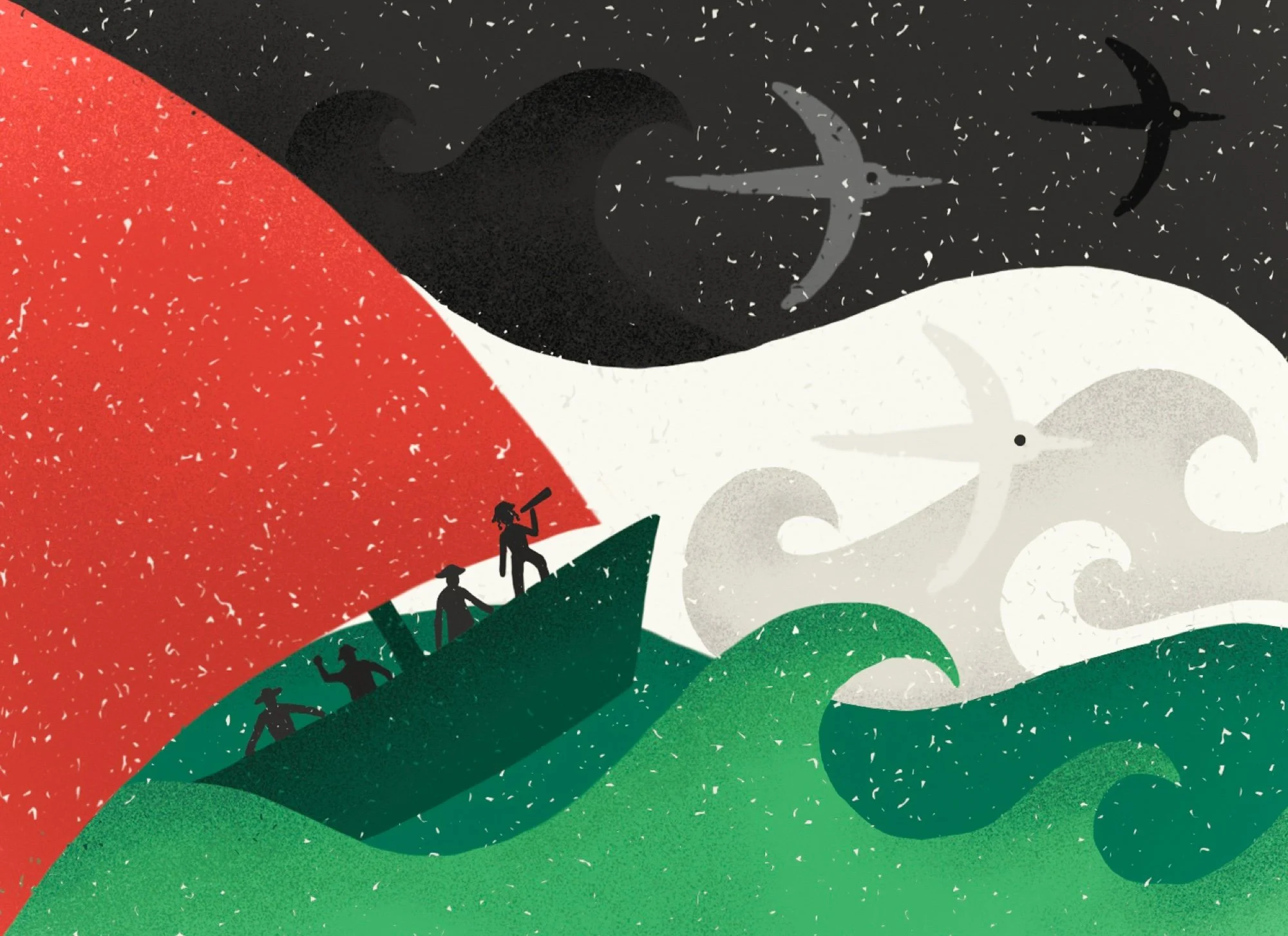
Digital art by @Pazconadie for Ojalá.
Interview • Andrea Sato • January 23, 2026 • Leer en castellano
The genocide in Palestine is a harrowing reflection of colonial brutality, and it has global repercussions. Practices of resistance and global solidarity in support of Gaza can help inform strategies of territorial defense in Abya Yala, something especially important in the wake of the US invasion of Venezuela and Donald Trump's threats against countries in the region. These strategies are beacons of hope and community learning, in which solidarity means embracing humanity and tenderness among one another.
The Global Sumud Flotilla took place within a framework of collective resistance, its ships were crewed by international volunteers seeking to break the Israeli blockade. Mexican activist Miriam ‘Mina’ Moreno Sánchez participated in this solidarity effort.
Moreno Sánchez was born in Guadalajara, Jalisco. Pursuing the love of a woman and a life by the ocean, she moved to Playa del Carmen, in the state of Quintana Roo. She arrived in the Caribbean when it was still a quiet coastline, and witnessed Playa’s transformation into a noisy city geared toward tourism.
Moreno Sánchez became a certified diver and came to understand that the sea was part of her life story, especially the cenotes, which she continues to work to protect. She is part of the organisation SOS Cenotes, which aims to preserve the Great Mayan Aquifer, and she’s been involved in protesting the construction and development of the “Mayan Train”, a railway mega-project that has led to the deforestation of vast swathes of jungle and caused irreversible damage to the region’s system of cenotes, caves, and underground rivers.
Her love for the sea and her activism led Moreno Sánchez to an unexpected destination after she joined the crew of the Shireen, a ship belonging to the Global Sumud Flotilla. The Shireen was designed as a legal and humanitarian monitoring platform to break the Israeli blockade of Gaza and deliver humanitarian aid to those who need it most. The ship was named in honor of Palestinian journalist Shireen Abu Akleh, who was killed in May 2022 while covering the Israeli occupation.
The crew consisted of lawyers, journalists, doctors, and international activists, who acted as legal and humanitarian observers. In the end, when Israel began intercepting ships, the Shireen was rerouted to Cyprus.
Moreno Sánchez shared some of her experiences aboard the Shireen at the end of the European summer of 2025 in a Zoom interview, which has been translated and lightly edited for clarity.
Andrea Sato: Tell me a little bit about how you got involved with the Global Sumud Flotilla.
Miriam Moreno Sánchez: It happened through a series of connections and friendships. Two and a half years ago, we organized a caravan in southern Mexico called El Sur Resiste (The South Resists). We traveled along the coast of Chiapas to the Yucatan Peninsula, following the same route as two of the megaprojects underway in Mexico, the Interoceanic Corridor and the misnamed Mayan Train.
During the caravan, I met an Italian who connected our group to the Climate Justice Congress in Milan, Italy. That's where I met Morana; she's from Croatia and is a ship captain. I asked her to teach me how to sail in Europe that summer, and she told me a mission had come up that she couldn't refuse. It was to captain one of the ships in the flotilla.
And I asked her, “How can I help? Do you need a hand?” I was told yes, that I should go to Italy and help get the ships ready. My plan was to go on holidays once the ships set sail. It took five or six days to get the ship ready, instead of two. I was well and truly part of the team, they were even joking that I was obviously going to join the journey. I thought everything was organized and set in stone.
And Morana—my friend, the captain—said to me: “Come with us to Tunisia and help us out with things there, and then, if you want, you can decide whether to continue.” I never left that boat once we got to Tunisia, not until a month later. In the end, I went for it, but instead of doing my intensive sailing course in the Adriatic Sea, I did it in the Mediterranean, watching out for drones and other dangers.
AS: How did you feel about that decision, which you made overnight?
MMS: Well, to be honest, I had a really strong gut feeling, especially because of all the support we had in Italy. But I was worried about my mom; she's getting older. She's 77, the same age as the state of Israel. When I told her, she gave me her full support. She told me she thought something had to be done.
When I got on the boat and we were on our way, I did think about it more. I asked myself: wait, what have I decided? What have I said yes to?
Everything was fine, but when we arrived in Tunisia, there were attacks with explosives, with drones, from submarines. And that's when I realized the enormity of my decision. We thought the most dangerous area would be near Gaza. And at that moment, we realized that the entire route was a danger zone.
Under those circumstances, we worked hard to create a loving and caring team, despite our many limitations, uncertainties, and personal issues.
During the trip, we took care not to go nuts with everything that was going on around us by making delicious food and playing games. Morana suggested we pair up every day to check in with each other. Then we started checking in with the whole group. It was a practice of care that we continued up until the end of the trip.
There were times when I would sit and look out at the sea and wonder, “What have I gotten myself into?” But at the same time, I felt a sense of satisfaction at being there.
AS: As you approached Gaza and the threats became clearer, how did you feel in terms of support from the group, both on the boat you were on, and as part of the flotilla?
MMS: As we got closer, I felt the tension rise. We did our best, I guess, not to let fear get the better of us. There were many factors beyond our control: the logistics of 45 ships, the currents and winds, as well as human factors.
Also, people from the flotilla started to leave. Some had to leave to deal with medical emergencies, and others because their time was up and they had to return to their jobs and their lives. That was also very intense because you had formed a bond with people who were like family, so those emotional and energy shifts were really tough. We said goodbye over the side of the boat without knowing if we would ever see each other again.
I think something that got to us, beyond the fears and the adrenaline rushes, was the dark nights. Every night we did watch shifts, we had to be very alert. There were a lot of drones, all the time. We had to be vigilant without letting fear or anxiety get the better of us. It was exhausting to be on edge 24 hours a day.
What kept us going on those nights, though, were the sparks of solidarity.
When we arrived in Tunisia, the first port hit by the attacks, there were thousands of people. I had never seen anything like it. It was packed. People were coming down from the mountains with flags, shouting, and carrying torches. Every night, people came out to see the boats.
What we were doing was touching many people around the world. So when we had to deal with things at sea, it made everything easier.
We were aware that breaking the blockade was almost impossible. But the blockades were broken by these small acts, these gestures. By people paying attention, getting informed, maybe posting something on social media, organizing to pressure their governments, or going out and protesting.
