

A feminist perspective on Costa Rica’s upcoming vote
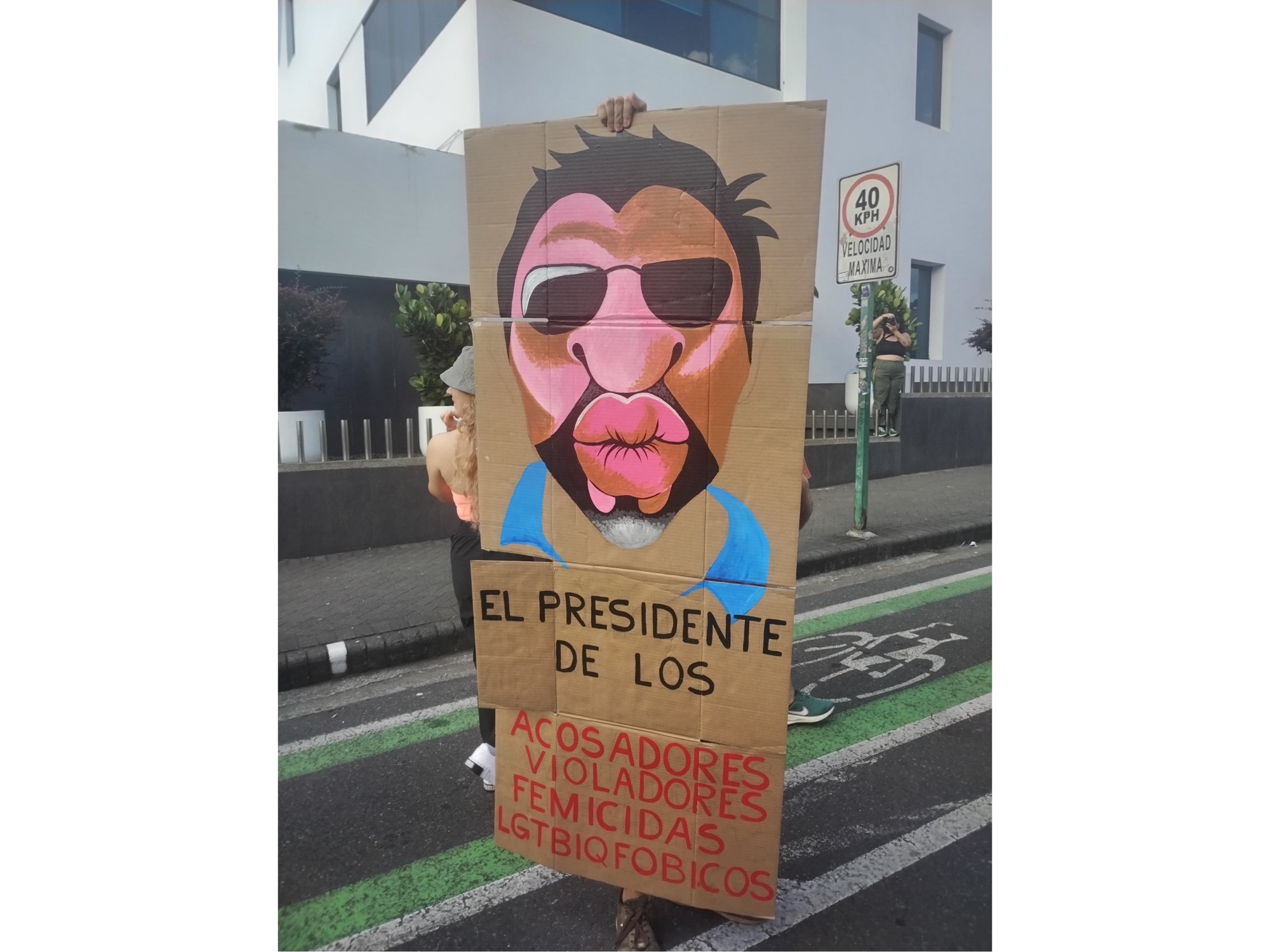
March 8, 2025 in San José, Costa Rica. The sign reads “The President of abusers, rapists, killers and queerphobics.” Photo © Laura Álvarez Garro.
Opinion • Laura Álvarez Garro, Vanessa Beltrán Conejo, María José Cascante Matamoros, and María José Guillén Araya • January 29, 2026 • Leer en castellano
On Sunday, February 1, Costa Rica will hold elections amid the most tumultuous and uncertain political climate in decades. Conservative and right-wing political forces are gaining ground transnationally, exposing the limits of Costa Rica's liberal democracy. Their rise is fueled by social unrest, deepening inequalities, and disillusionment with politics.
This phenomenon is by no means neutral with respect to gender, ethnicity, or class. The Costa Rican elections are a means to approach how and under what conditions violence against women and gender dissidents, the securitization of social life, and the questioning of public institutions have become central tenets of national political debate.
The changes in Costa Rica are taking place within a global political scene that has been in flux since Donald Trump's first election in 2016. His populist political style, which extols bad table manners as an indicator of strength and masculinity, led to the emergence of imitators such as Jair Bolsonaro, Nayib Bukele, Javier Milei, and the current president of Costa Rica, Rodrigo Chaves.
The “Me Too” movement in the United States sparked a reactionary wave from conservative sectors opposed to the allegations, who viewed it as an unjustified attack on men. And the post-pandemic era has led to higher costs of living and the hardening of fiscal austerity policies in almost every country in the world. Costa Rica is no exception.
The patriarchal onslaught
The conservative climate that prevails in our hemisphere and around the world reverberates in Costa Rica in peculiar ways, and has shaped the playing field in this election cycle.
The previous administration (2018-2022), led by Carlos Alvarado, representative of the progressive neoliberal party Acción Ciudadana (PAC), forged an alliance to pass sweeping fiscal and labor reforms. Its reforms deepened the influence of elites, most of them conservative, in the government and the legislative assembly.
These developments were part of a process that began over two decades ago with the creation and consolidation of parties that, together with far-right movements, churches, and political actors, paved the way for leaders such as current President Chaves of the conservative technocratic Social Democratic Progress Party (PPSD). Chaves was previously dismissed from the World Bank due to allegations of sexual harassment against him.
This network of actors is united in promoting fixed gender norms—and has the resources to do so. Cis women and LGBTQIA+ people are portrayed as objects to be dominated and manipulated by men who embody hegemonic masculinity. This agenda is supported by people in power, which has led to an increasingly brutal violence against feminized people becoming the norm.
In line with regional conservative backlash, the Ministry of Public Education in Costa Rica gutted plans for secular sex and relationship education. This was compounded by the undermining of institutions and programs dedicated to the prevention and treatment of gender-based violence, the criminalization of so-called “false accusations,” and the impunity of men with proven histories of assault and harassment.
Recent limitations on medical abortion by the Chaves administration, in alliance with neo-Pentecostal parties and churches, are part of this context. Laura Fernández, the ruling party's candidate, who is leading in the polls, has stated that “abortion is, quite simply, murder.”
Securitization against life
The systematic attack on sexual and reproductive rights fits into a broader regional security agenda that works in two ways. On the one hand, we see the intensified criminalization of women and gender dissidents who make decisions about their own bodies, as well as against impoverished young people exposed to poverty and the risk of premature death amid drug trafficking and organized crime, who are rounded up en masse by police forces.
On the other hand, access to justice for large sectors of the population has been weakened, and the ability to investigate and intervene in crimes committed by powerful people in the upper echelons of institutions that serve the interests of elites.
From a foreign policy standpoint, recent visits by government officials from the United States and El Salvador point to potential for economic cooperation. Costa Rica has signed on to initiatives like temporarily holding migrants deported from the US, building maximum-security prisons, and joining a common front against organized crime.
Undermining the commons
We are also seeing relentless efforts to undermine the foundations of the public sphere, from institutions to physical spaces. This is not a new phenomenon, but it has been catapulted into the spotlight in recent years thanks to decades of delegitimization, privatization, austerity, and attrition.
A clear example at the institutional level is the growth of the state's debt to the social security system, which is public, universal, and based on solidarity, ensuring healthcare access to the majority of the population
Despite lacking any technical or scientific basis, voices from the most conservative quarters have been loudly and vehemently proclaiming that the system is dead and no longer functional.
At the territorial level, public spaces like beaches and mountains are being enclosed at a rapid rate. Underpinned by lax regulations and a culture of colonial servitude—that produces socially segregated leisure and increased income flowing to real estate developers—the country's wild spaces are less and less public spaces for relaxation, and increasingly spaces to which access is restricted.
As these institutional foundations are being eroded, the state is increasingly turning to repression and punitive measures in response to increasingly complex social conflicts. Drawing on the image of Costa Rica as a country with fewer guns, there have been repeated calls to control and harshly punish social groups that threaten the exceptionalist ideal of a peaceful, whitewashed nation.
This repressive shift is reflected in alliances between local governments, police departments, and private actors that translate into criminal legal policies geared toward mass incarceration and the normalization of abuses by security forces. In two decades, Costa Rica tripled its prison population and, by 2024, it had the fifth-highest incarceration rates in Latin America.
Riding the authoritarian wave
Costa Rica still has a more or less stable foundation for the rule of law. The legacy of historically strong institutionalization—not without its racist or sexist aspects—cushions the blows dealt by the current government and other partisan actors seeking to win the presidency and legislative seats in the upcoming elections.
Of the 20 presidential hopefuls, the frontrunner is Fernández from Chaves' ruling party—renamed the Sovereign People's Party after numerous criminal and administrative complaints were levelled against its previous incarnation. Far behind in the polls are candidates from shifting traditional political forces such as the Partido Liberación Nacional (National Liberation Party), the Coalición Agenda Ciudadana (Citizens' Agenda Coalition), and the Partido Frente Amplio (Broad Front Party).
Even further down the list is a fragmented array of candidates, ranging from social democrats to evangelical right-wing conservatives. Although they are not rising in the polls, they are not necessarily unrealistic alternatives. In the week before the election, 26 percent of voters remained undecided (mostly women and young people), who will decide how to vote in the days leading up to the election or on election day itself.
In this context, undemocratic tendencies have emerged, openly promoting the concentration of power and authoritarianism. Clear indicators of this include calls by Fernández to suspend civil liberties alongside attempts by the ruling party to amend the Constitution to allow indefinite reelection.
In a society as controlled by the state as Costa Rica, this difficult situation opens us up to the possibility of imagining ways of doing politics that strategically circumvent electoral processes, by demanding what the state owes us and must guarantee. But our strategy should also push beyond demands, exposing and countering the failures produced by this electoral scenario, with the shared goal of building something different.