

Disrupting the status quo in El Salvador
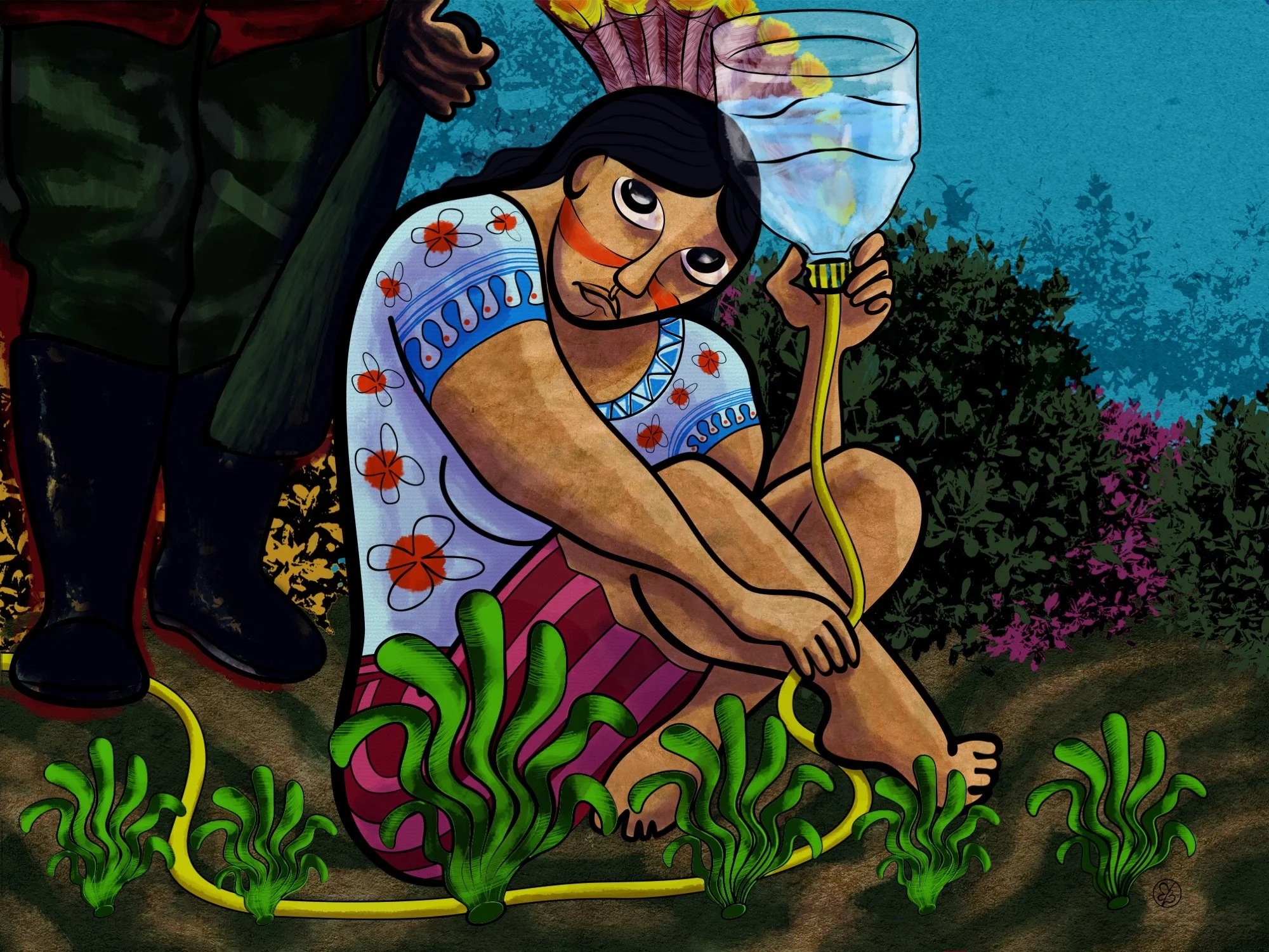
Digital art by Eusebio Linares Barthelemi (@euse_arte) for Ojalá.
Opinion • Andrés Alcalá Rodríguez • January 30, 2026 • Leer en castellano
On May 13, 2025, two environmental activists were arrested in El Salvador’s capital on charges of being “public disrupters.” The term, which is strange and almost theatrical, was used in the Public Prosecutor’s press release. For many, it was a minor incident; for others, it was a warning. Behind those words lies something deeper: what “order” were they supposedly disrupting?
The case at hand is connected to an ongoing dispute over communal lands, an agricultural cooperative, and a broader conflict indicative of the El Salvador’s deep-seated issues involving inequality, the concentration of wealth, militarization, and an economic model that has persisted for over a century.
The arrested activists were supporting the El Bosque cooperative, established as part of land reform initiatives that followed the 1992 Peace Accords signed in Chapultepec, Mexico. Their story is documented in the film Nowhere to Go, which is about how formerly landless workers were granted plots of land to farm collectively.
But the cooperative was left vulnerable due to bank debt and privatization policies. Several business groups put pressure on the cooperative to sell, arguing that the land could be better used for commercial projects.
The two people the National Civil Police arrested in May of last year were the lawyer supporting the case and the president of the cooperative. Their arrests, which were carried out without warrants, came after the community protested attempts to evict them.
On December 17, 2025, both defenders were released, but the rhetoric of public disruptors became more entrenched. Concerns of further political persecution remain, which is why their names have not been included in this article.
‘Order’ rooted in coffee, land, and elites
El Salvador’s economic structure has very specific origins with coffee barons, the so-called “14 families” who consolidated vast tracts of land between the late 19th and early 20th centuries. A coffee monoculture shaped the country, forging a system of privatized land, peasants without rights, and a state designed to protect the interests of the elite.
From 1948 to 1972, military governments ruled under a logic of protecting property and repressing any attempt at redistribution. Inequality was brutal and investment in the public sector was scarce; social mobility was almost non-existent.
As documented by Teaching Central America, this political structure was so rigid that, by the mid-20th century, social tension escalated into a civil war that ended in 1992.
In 1979, five political-military organizations formed the Farabundo Martí National Liberation Front (FMLN) and ushered in a new phase of the conflict. The state's response was brutal: the Atlácatl battalions, trained by the United States became notorious for their violence.
Thousands of families fled the country, the economy was destabilized, and inequality remained intact. The Peace Accords called for agrarian reform, which led to the creation of cooperatives such as El Bosque. For the first time, rural workers had collective access to land.
But progress was short-lived. By the mid-1990s, the privatization policies of the Nationalist Republican Alliance (ARENA) party had forced many cooperatives into foreclosure, and saw them facing lawsuits and pressure to sell their land. The documentary Cooperativa El Bosque shows us how, after decades of struggle, their land is once again at risk.
Growing inequality under Bukele
Although the arrest of the so-called “disrupters” last year may seem like an isolated event, there is a clear connection with the political context that has seen the rise of Bukele.
Since 2019, Nayib Bukele has consolidated a model that combines territorial control, a discourse of efficiency, and a state of emergency that appears to be permanent. The government promotes security measures by constructing a narrative of economic growth grounded in the imposition of security.
According to the Organization for Economic Cooperation and Development, recent economic growth in El Salvador has not translated into well-being: wages have not improved, job insecurity remains high, and inequality is still rampant.
Data from the association Women in Informal Employment: Globalizing and Organizing (WIEGO), shows 67 percent to 69 percent of the workforcen was dedicated to informal employment between 2019 and 2021, and the majority live without job security. According to World Bank data, poverty rose from 26.8 percent in 2019 to to 30.3 percent in 2023.
In this scenario, the powerful groups that have historically dominated the economy have not disappeared, they have transformed. From among the 14 formerly powerful families, there are today eight large conglomerates that maintain influence in the financial, real estate, and agro-industrial sectors.
Although Bukele has capitalized politically by displaying antagonism toward these powerful families, and his 2019 electoral victory was a protest vote against the established parties, the current government's style of neoliberalism amounts to a presidential family project.
Several journalistic investigations have reported on the real estate boom in which the “Bukele clan”—that is, the president's family—is positioning itself as new elite landowners in El Salvador.
Against this backdrop, what exactly are environmental activists “disrupting” in El Salvador?
Following the May 15 arrests, Bukele reacted publicly in a lengthy post on X. He claimed his government was not responsible for land conflicts and suggested—as punishment—a special tax on non-governmental organizations, which, he said, would solve the problem. Bukele's message suggested that the conflict was not the result of the economic model but rather the outcome of “manipulation” by foreign organizations.
The international community, academia, and human rights organizations like Amnesty International and the Inter-American Commission on Human Rights have found the opposite. What is at stake is the continuation of a historical pattern of dispossession and displacement.
This is why the category of “disrupter” is revealing. It does not describe a crime, but rather a political stance: one taken by those who interfere with a machine geared toward capital accumulation, who challenge land use, and who question the very idea of progress based on privatization and speculative land grabs.
What the ‘disrupters’ teach us
The notion of “public order” cited by the prosecution in its indictment of the defenders is not a neutral concept. In El Salvador, it has historically meant protecting a system that concentrates wealth and limits attempts at redistribution.
Today, under a regime that has expanded arrest powers, extended the state of emergency a total of 46 times as of January 2026, and restricted protest, “order” functions as the criterion for defining who is a legitimate citizen and who is a “disruptive element.” Public order, we could say, is synonymous with Bukele’s rule
According to this narrative, those who defend common goods—water, land, forests, community life—are portrayed as imminent threats. And the state, in the name of Bukelism, responds with force.
The arrest of environmental defenders, then, is not just an instance of criminalization. It is also a mirror.
It reflects a country where structural inequality is intact, in which the oligarchic past lives on in new leaders, where ordinary citizens pay the price for decisions made 100 years ago, and where security is used to silence dissenting voices.
And, above all, it shows that real disorder does not come from those who protest, but from a system that turns the defense of the commons into a crime.
Because the crime of these defenders—as so often happens in the region—was not one of action, but rather of speaking out. They were arrested for saying what many prefer to keep quiet: that “order” in El Salvador has been, for generations, based on deep inequality.