

Buenos Aires 8M weaves dignity and unity
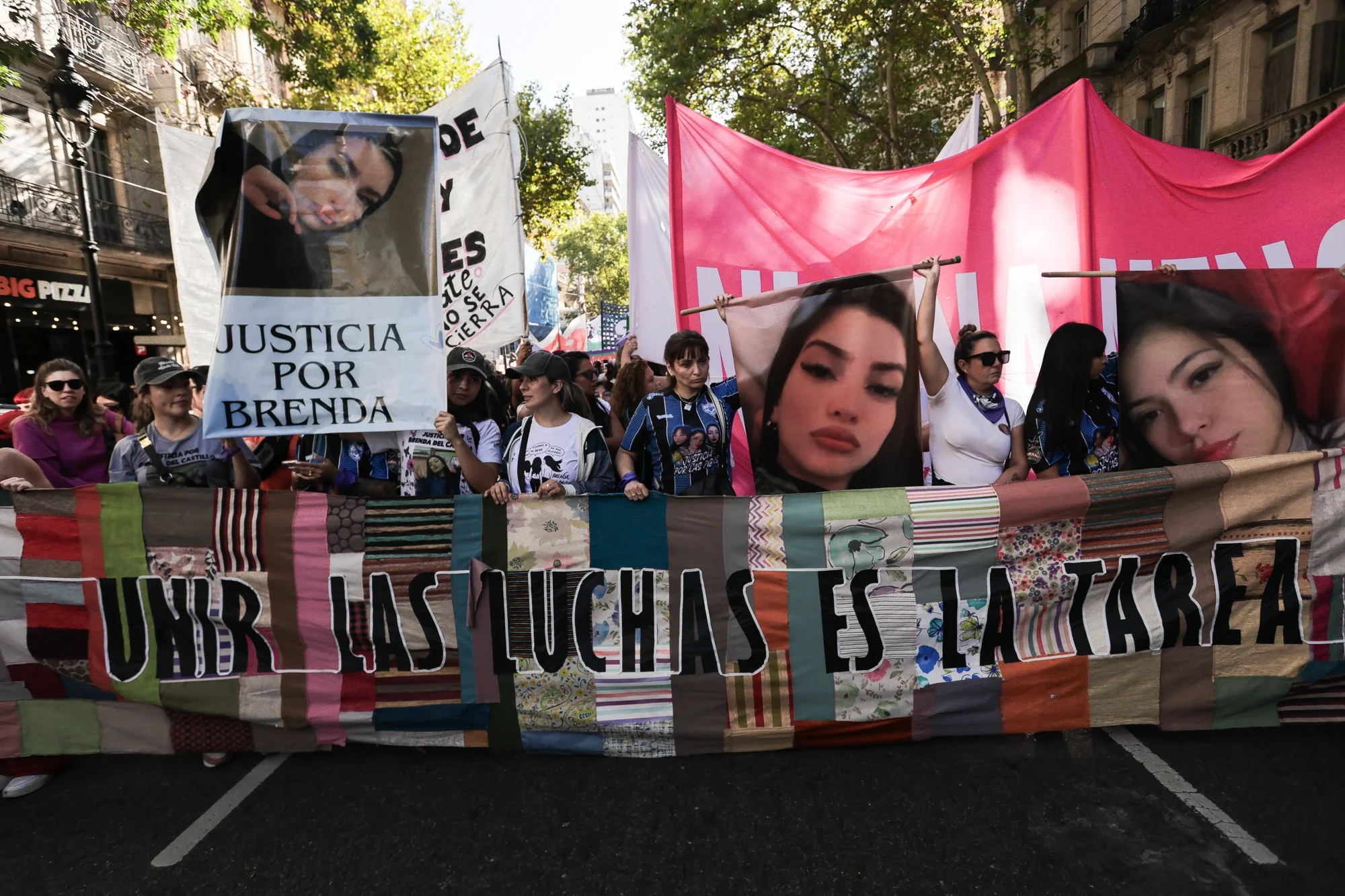
The procession leading the 8M march sets off, led by representatives of the transfeminist movement and relatives of victims of femicide. They hold a banner that reads “We must work to unite our struggles.” March 9, 2026, Buenos Aires, Argentina. Photo © Susi Maresca.
Opinion • Susi Maresca • March 13, 2026 • Leer en castellano
The transfeminist movement in Argentina draws on a centuries-long legacy of fighting for our rights in the streets. We want to live and work without killing ourselves in the process. This is the commitment that we have fought for and upheld from generation to generation.
This history of activism is reflected in the fight of Indigenous women, of suffragists, of the Mothers of Plaza de Mayo, and in the Plurinational Encounters, the Ni Una Menos movement, the demands of the LGBTIQNB+ community, and the green wave for comprehensive sex education and legal, safe, and free abortion.
This year, International Women's Day found us exhausted and drained. These are difficult times, marked by financial and repressive despotism on the part of Javier Milei's government. This government is pushing ahead with economic, political, and ideological measures that affect the population in general, and especially workers in the formal and informal sectors.
It was in this context of crisis that the decision to move the main event from Sunday, March 8, to Monday, March 9, was made to allow for a general strike with greater participation and visibility of the demands on the government.
A broad range of issues gave rise to the central slogan for International Women's Day this year: “uniting our struggles to defeat the exploitative reforms of Milei, the International Monetary Fund, and their accomplices.”
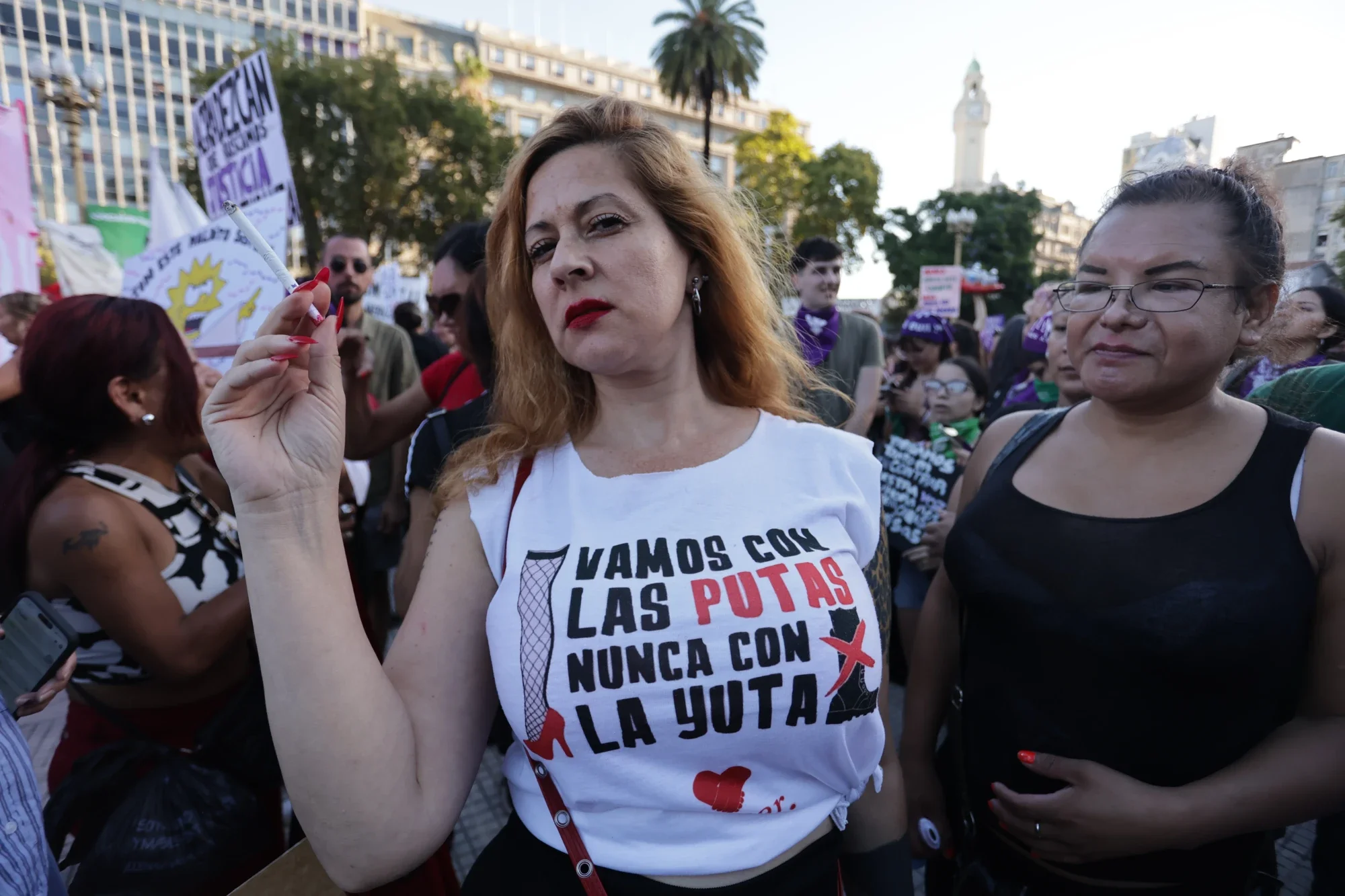
A woman in Plaza de Mayo wears a T-shirt that says “We stand with sex workers, never with the cops” during the International Women’s Day strike. March 9, 2026, Buenos Aires, Argentina. Photo © Susi Maresca.
Uplifting food sovereignty
On the morning of March 9, the Mujeres de la Tierra Cooperative began the day of protest with a verdurazo, a solidarity action carried out by small agricultural producers, who handed out tons of vegetables to raise awareness of their cause.
“People sometimes think that producing a crate of lettuce is magic, but it takes a month or two of work, depending on the time of year,” said Carolina Rodríguez, who is the mother of six children. Rodríguez is a producer in the agricultural belt of La Plata, in the province of Buenos Aires, and a leading figure in the co-op.
Boiled corn was handed out to those waiting in a long line for food at the verdurazo in Plaza Constitución, in the south of the Autonomous City of Buenos Aires. For many, it might have been their only meal that day. Eggplant, zucchini, chard, tomatoes, spinach, and lettuce were handed out in agroecological bags, free of charge, to anyone who wanted one.
“We think it’s very important for people to understand who we are as producers and the conditions in which we are working today,” said Rodríguez. “Many compañeras who used to be able to rent land are now employed by landowners, who are exploiting them more and more.”
Due to rising costs and the expansion of real estate companies seeking to build gated communities in the horticultural belt, she explains that many farm workers have had to leave their farms to become workers for the new landowners.
“Through the co-op, we are supporting many rural women who suffer economic violence, and together with Ni Una Menos, we are coordinating to sell agroecological products to help them,” Rodríguez said.
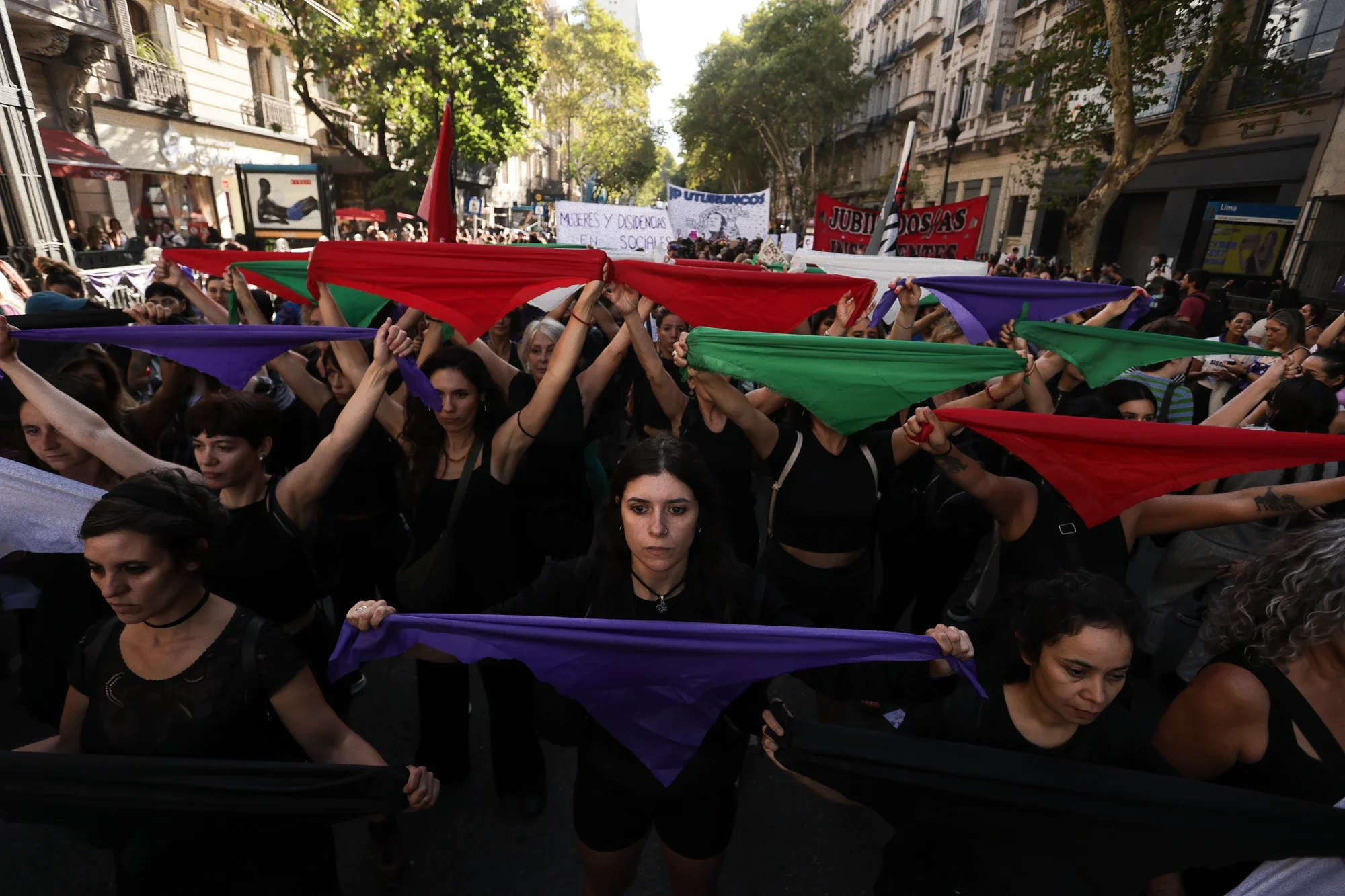
Performance by the collective Fin de Un Mundo on Avenida de Mayo during the International Women’s Day strike. March 9, 2026, Buenos Aires, Argentina. Photo © Susi Maresca.
Joining forces, building strength
At 4pm, a crowd began to gather at the National Congress for the main march. As always, there was a group of committed retirees present in body and soul and carrying signs.
A banner covered with the names of murdered women was draped over the railings around the plaza where mothers and family members gathered to condemn femicides.
“Every one of these families is missing someone,” said Eva Domínguez, a relative of Vanesa Soledad Celma, who was lit on fire by her partner in 2010. Domínguez traveled from Rosario to stand alongside dozens of other bereaved family members. “This femicide reached the Inter-American Court, and today Vanesa's children are recognized as orphans due to femicide, but this is not what happens after most murders.”
Kantuta Killa, spiritual guide and healer of the Quechua People, walked down Avenida de Mayo carrying a Wiphala. She was joined by many others from different Indigenous communities, who took part in the march to defend their bodies and territories.
“We women are Pachamama, and our territory is being plundered and violated by the colonial and patriarchal powers that continue to oppress our culture,” said Killa. “We are here to remind the government of our strength.”
A little girl held a sign that read, “Neither the earth nor women are territory to be conquered.” Elena, 10, was with her grandmother and mother. She asked me to take her photograph, as proof of the moment’s eternal significance. There were many children at the march.
Crowds of people arrived by the hundreds. According to organizers, nearly one million people turned out across the country.
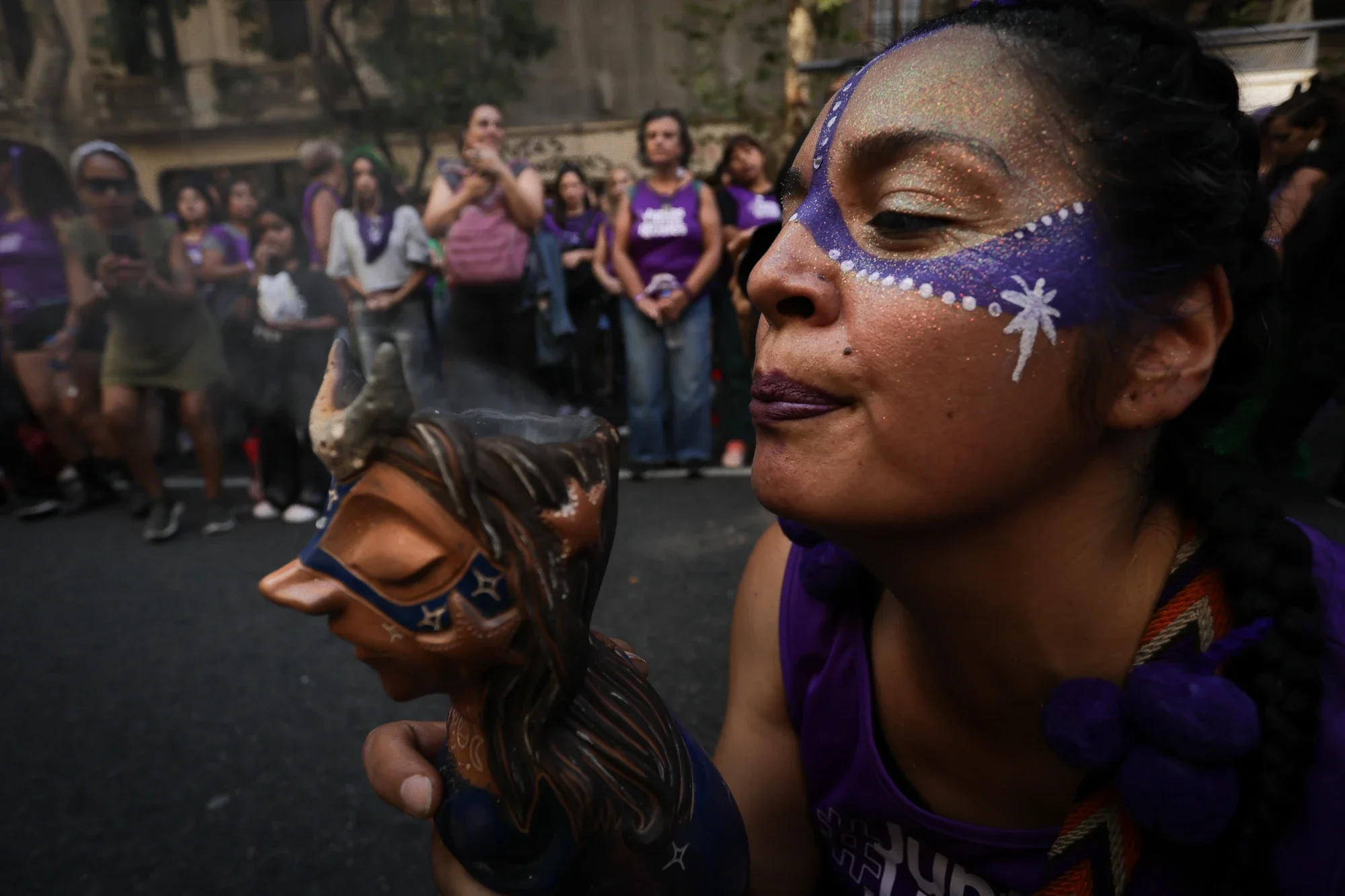
A member of the Guardianas Floreceremos collective blows on incense as the drums begin to beat during the 8M strike on Avenida de Mayo. March 9, 2026, Buenos Aires, Argentina. Photo © Susi Maresca.
Repression and fatigue
Maricela Escalante was at the head of the march as it made its way down Avenida de Mayo. She works at the Gustavo Cortiñas community kitchen in Villa 31—also known as Barrio Padre Mujica—a historic informal settlement of around 40,000 inhabitants located in the heart of Buenos Aires.
“We make 250 meals a day, which we deliver to neighborhood folks who ask for a plate of food in this increasingly critical economic situation,” Escalante said in an interview with Ojalá. “We are aware of the state’s neglect and indifference. It should recognize that we work longer than eight hours, because we also work triple shifts—at home, at our paid jobs, and in the community—and no one recognizes that. The state only exists to repress the poorest families.”
“We got here through our mobilizations, but there’s an ongoing economic crisis that’s keeping many compañeras who were closely involved in transfeminist organizing from participating politically,” said Luci Cavallero, a feminist sociologist and member of the Ni Una Menos collective. “This has to do with the need to juggle multiple jobs, debt, and the impossibility of finding time for participation and reflection.”
According to Cavallero, this is part of a systematic government goal to drive people away from activism and organizing. On March 8, the president's office released a video on social media that directly transfeminism in yet another example of its history of discrediting and defunding policies to combat gender-based violence.
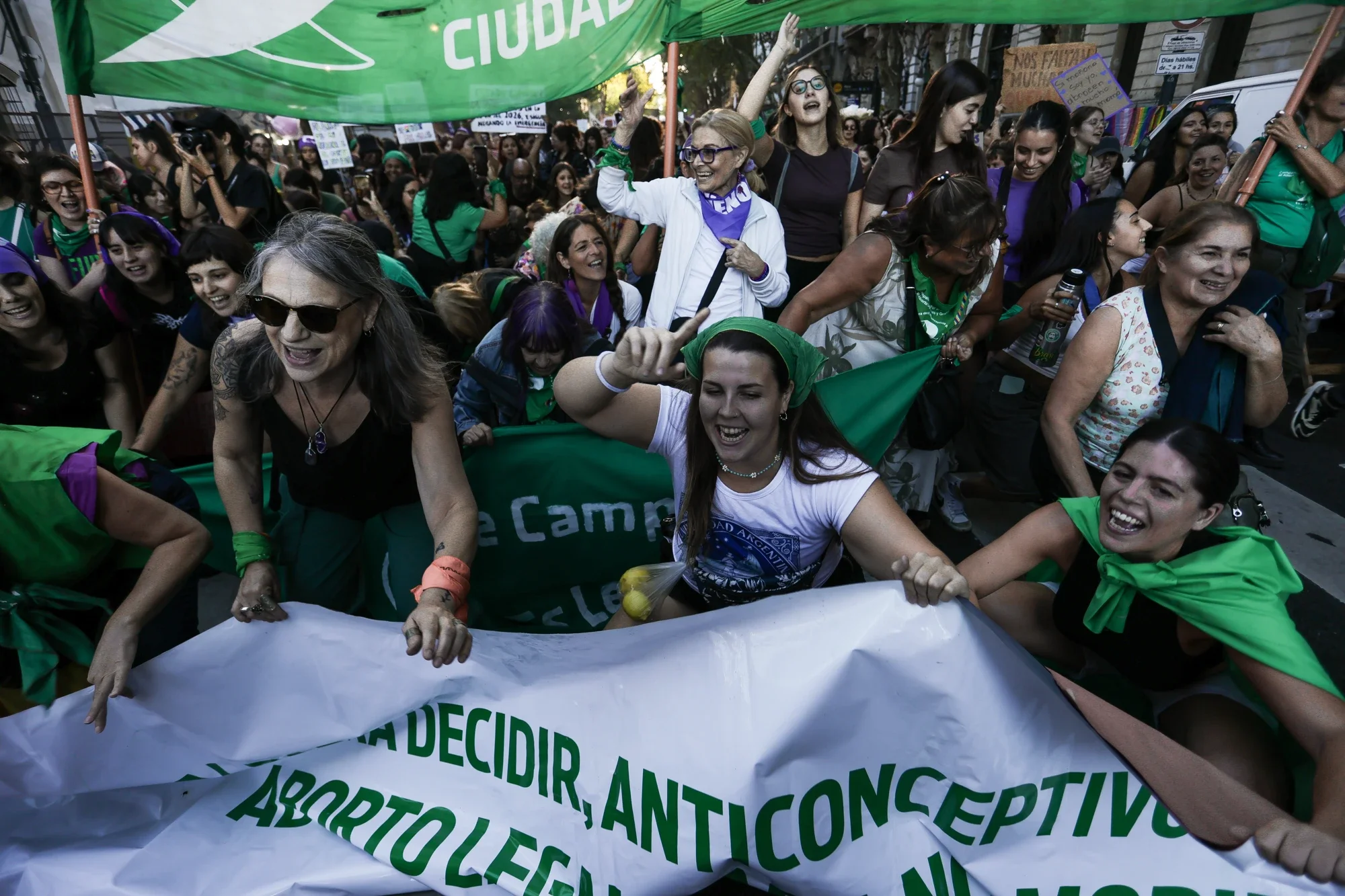
Members of the Campaign for Legal, Safe, and Free Abortion sing at the 8M strike. Their banner reads “Sex education to decide, contraceptives to avoid abortion, legal abortion to avoid death.” March 9, 2026, Buenos Aires, Argentina. Photo © Susi Maresca.
Among recent measures questioned by the feminist movement are the highly controversial labor reform and the new Juvenile Criminal Regime (Law 27.801), that lowers the age of criminal responsibility from 16 to 14. In coming weeks, a public hearing about moves to loosen protections upheld by the Glacier Law—which would impact freshwater sources nationwide—is also scheduled.
All of this is compounded by the expansion of the powers of the State Intelligence Secretariat, the persecution of migrants through Decree 366/2025, and the implementation of the Incentive Regime for Large Investments, which paves the way for extractive industries at the expense of communities.
Facing hatred with organizing
Micaela Josefina Pérez, a travesti activist, held up a banner demanding historical reparations for the travesti-trans community
“We hold this banner as a legacy for those who have been murdered and those who are no longer with us. We demand the travesti-trans employment quota be fully respected,” she said. “And we say no to exclusion. Exclusion is not a way of life for this community; it’s a strategy of the state that we must dismantle as a democratic country.”
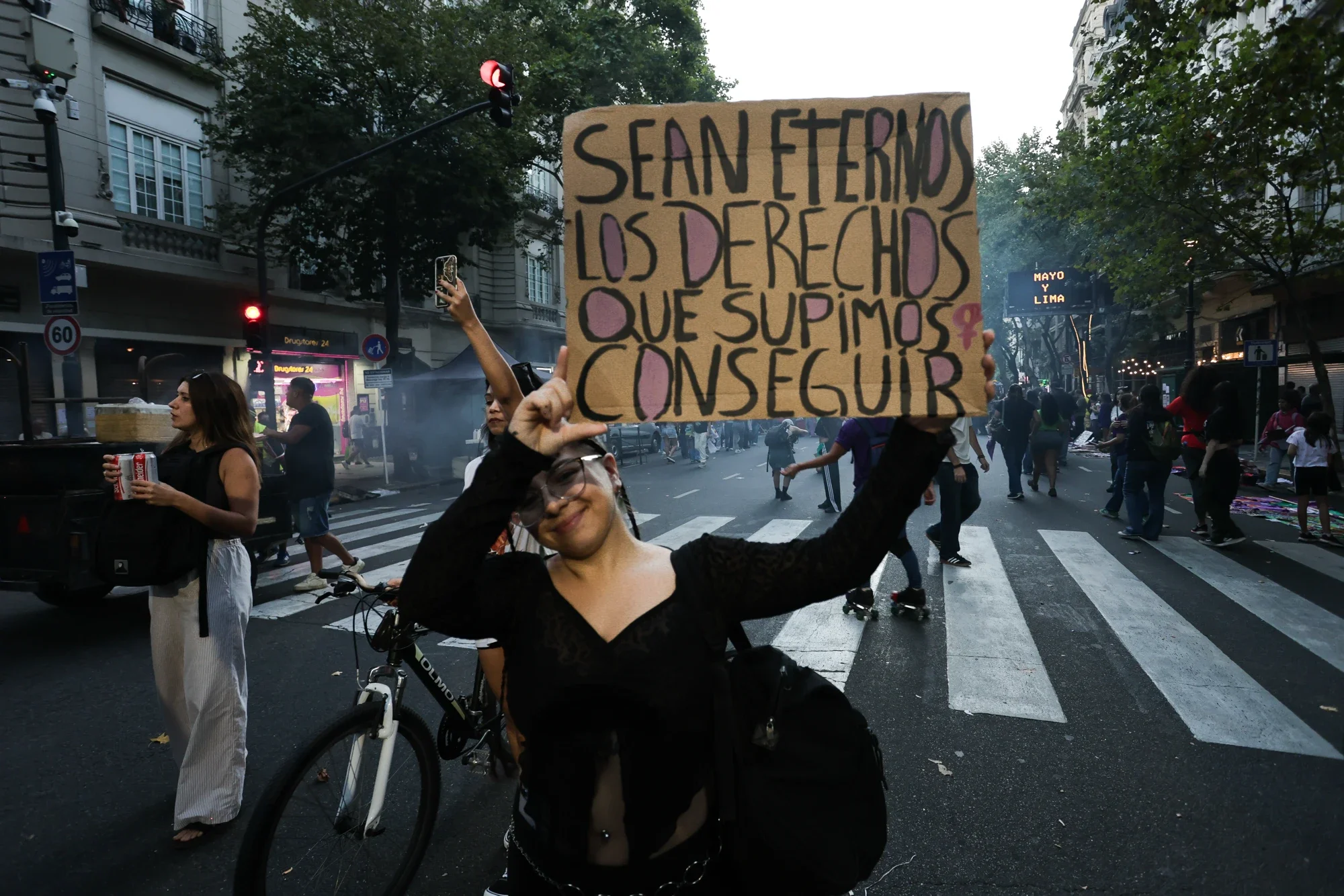
A young person carries a sign that reads “May the rights we have achieved be eternal” at the March 8 strike, a play on Argentina’s national anthem. March 9, 2026, Buenos Aires, Argentina. Photo © Susi Maresca.
As crowds arrived to the Plaza de Mayo, they listened as a 21-page document, signed by more than 700 organizations, was read aloud. “In the face of hatred, more organization; in the face of looting, more solidarity; in the face of cruelty, more community,” it read. “We are the ones who sustain life and also the ones who can transform it. Until dignity becomes the norm, we will continue to take to the streets.”
When we take to the streets to engage in politics, we make those in power uncomfortable by diverting our power from serving the capitalist system and toward the common good. Inhabiting our bodies with hugs, assemblies, discussions, and demands, and with acts of public listening, is a way to shift our sense of uncertainty.
Our sadness is shaken, and our framework is redefined. We’re reminded of something we already knew: our future lies in collective narratives, the very same ones fascists want to exterminate.
Our narrative is plurinational transfeminism, and once again, March 8th lived up to the occasion.
