

Anti-fascist pride pushes against precarity, violence in Argentina
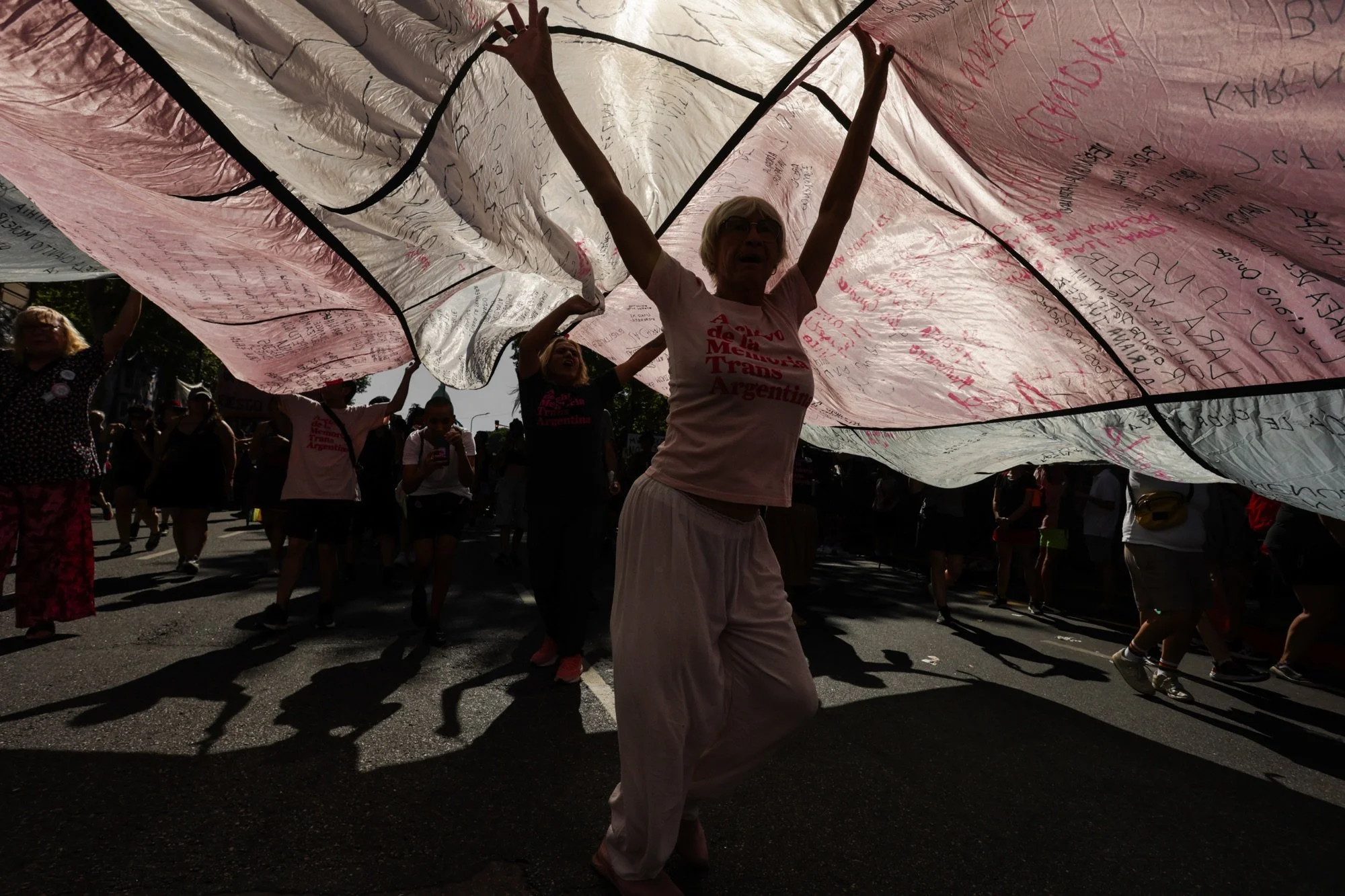
Ornella Olivia Vega (Teté) marches alongside other members of the travesti-trans community, holding up a huge flag highlighting the struggle of travesti and trans people on Avenida de Mayo during the 2nd Federal LGBTIQNB+ Anti-Fascist and Anti-Racist Pride March on February 7, 2026. Photo © Susi Maresca.
Reportage • Agustina Ramos • February 12, 2026 • Leer en castellano
The transfeminist movement in Argentina demonstrated the power that comes from uniting struggles during the second Anti-Fascist and Anti-Racist LGBTIQNB+ Pride March, which took place on February 7. The march was held days before a controversial labor reform proposed by Javier Milei was approved by the Senate this week amid further protests.
On Saturday, at least 200,000 people—including members of the LGBTIQNB+ community, people with disabilities, retirees, migrants, and informal workers—took to the streets in at least 26 locations around the country. The epicenter was downtown Buenos Aires, where a mass of protesters snaked 10 blocks from the National Congress to Plaza de Mayo under sunny skies.
“Nobody is expendable. No life is disposable,” was the rallying cry that brought participants together in Argentina’s first large-scale protest of this year. The aim was to highlight rising levels of poverty, hunger, and institutional violence against the most vulnerable in society.
“Our message addresses how retired people are being discarded as they bear the brunt of this historic austerity,” said Marta Dillon, a journalist, lesbian transfeminist activist, and member of Columna Mostri, one of the march organizers, in an interview with Ojalá. “It also addresses how people with disabilities have been targeted throughout the year, how public health is being defunded, and how these austerity measures impact our lives.”
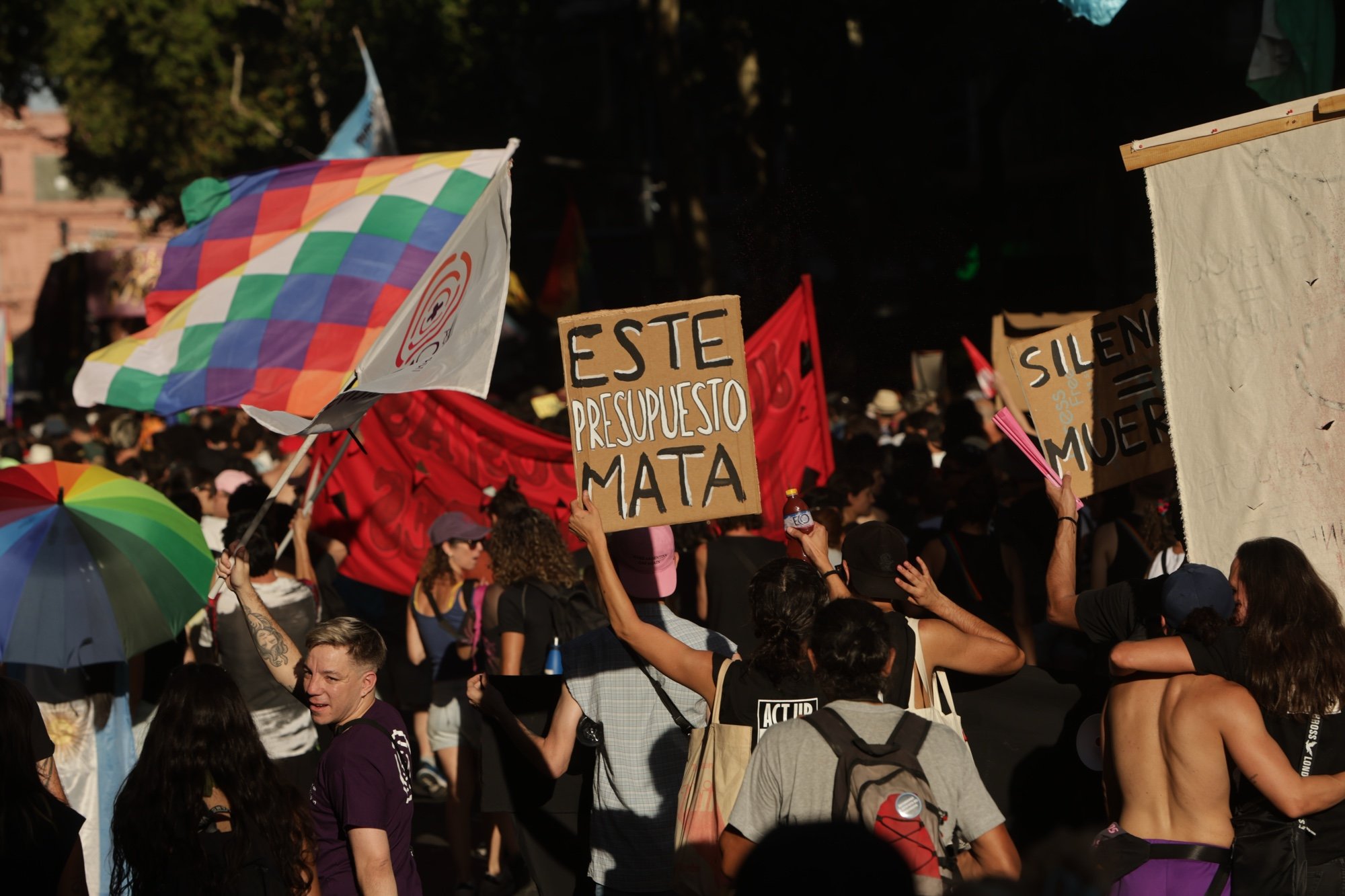
“This budget kills,” reads a sign next to a Wiphala on Avenida de Mayo during the 2nd Anti-Fascist and Anti-Racist LGBTIQNB+ Pride March. Buenos Aires, Argentina, February 7, 2026. Photo © Susi Maresca.
Return to the streets
Saturday’s march was the second iteration of a mass protest that kicked off last year in response to President Javier Milei's comments at the World Economic Forum in Davos.
In his speech on January 23, 2025, Milei targeted LGBTIQNB+ rights and feminism and compared homosexuality to pedophilia. The response was swift: on February first (1F), hundreds of thousands of people marched in Buenos Aires as well as cities inside and outside the country. It is estimated around 1.5 million people took part in the protests.
This year’s march was organized by groups who held local assemblies and virtual meetings with their supporters from around the country. There was agreement that the national government has reined in its rhetoric against diversity over the past year, but it has stepped up austerity policies and measures that curtail rights that hurt marginalized communities the most.
The protest was marked by widespread opposition to the government's proposed “Labor Modernization Law.” The Senate approved the bill on February 11, which turned into a day of resistance in which dozens were arrested in a fierce police crackdown. Over the coming days, the lower house will decide whether the bill becomes law.
The bill was harshly criticized by centrist and left-wing political sectors, who say it weakens labor protections and increases precarity. Among other things, the bill lowers severance pay, limits the right to strike, increases the workday from eight to 12 hours, and prioritizes direct contracts between employers and employees over collective bargaining agreements.
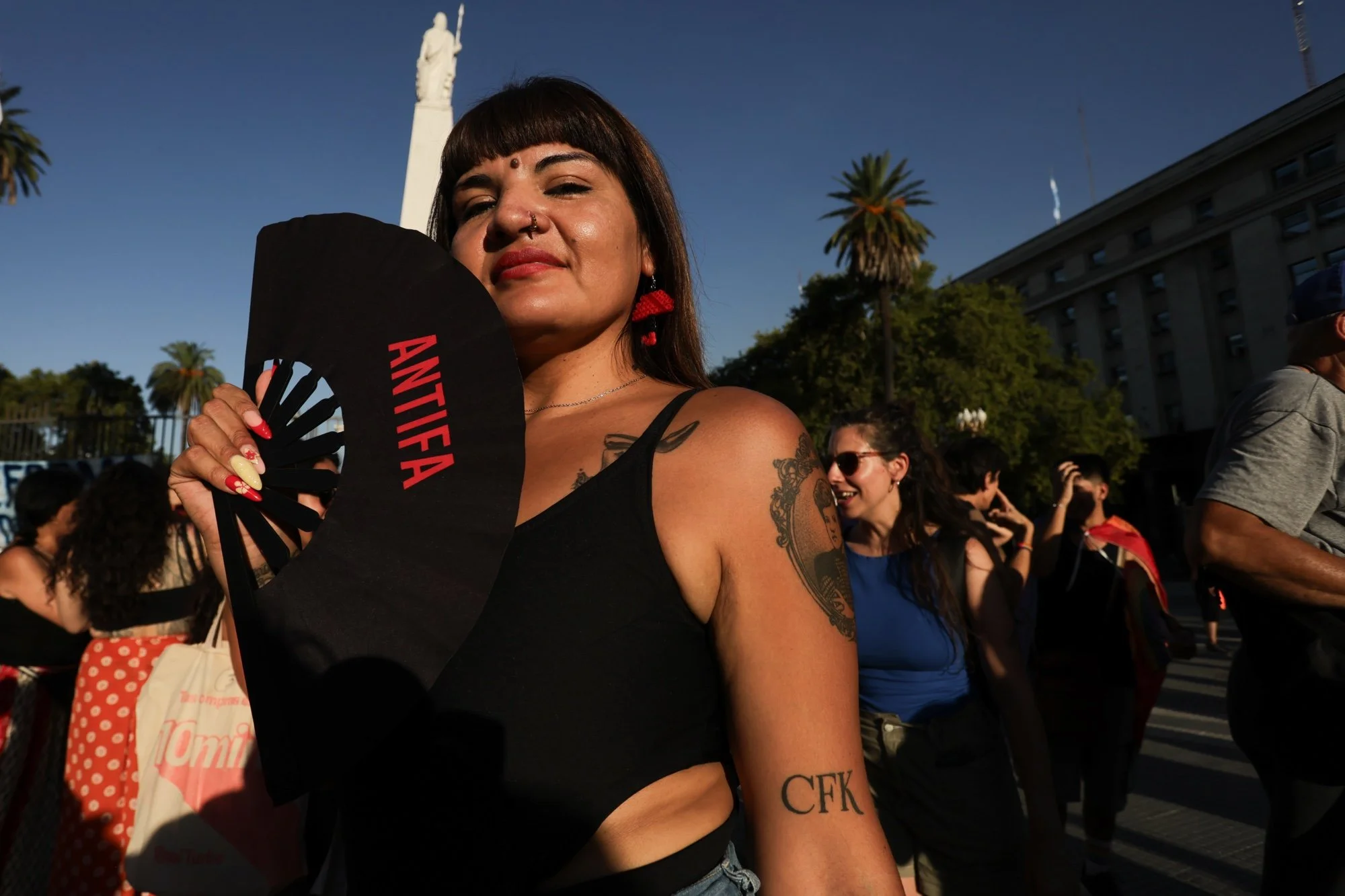
Georgina Orellano, secretary general of the Argentine Sex Workers' Union (AMMAR), holds a fan with “Antifa” written on it during the 2nd Anti-Fascist and Anti-Racist LGBTIQNB+ Pride March. Buenos Aires, Argentina, February 7, 2026. Photo © Susi Maresca.
Anti-fascism, anti-hatred
With the pink, light blue, and white trans flag draped over his shoulders, 10-year-old Martín stood on Avenida de Mayo alongside a friend of his mother's. “I wanted to come and have a good time and also to stand up for our rights. No one should get to tell us what we can and can't do,” he told Ojalá. “I'm happy with who I am.”
The travesti-trans community, particularly children and teens, has been repeatedly targeted by the current administration's policies. After last year's 1F march, Milei signed Decree 62/2025, which modified the Gender Identity Law, the first in the world to allow people to change their registered gender without pathologizing trans identities. The new decree prohibits trans youth from pursuing gender affirming care.
The national government has also failed to implement the Travesti-Trans Job Quota Law, which establishes a minimum of one percent of jobs in the national public sector for travestis, trans, and non-binary people. Instead, it went in the other direction, firing at least 150 people who had entered public administration under the law’s provisions.
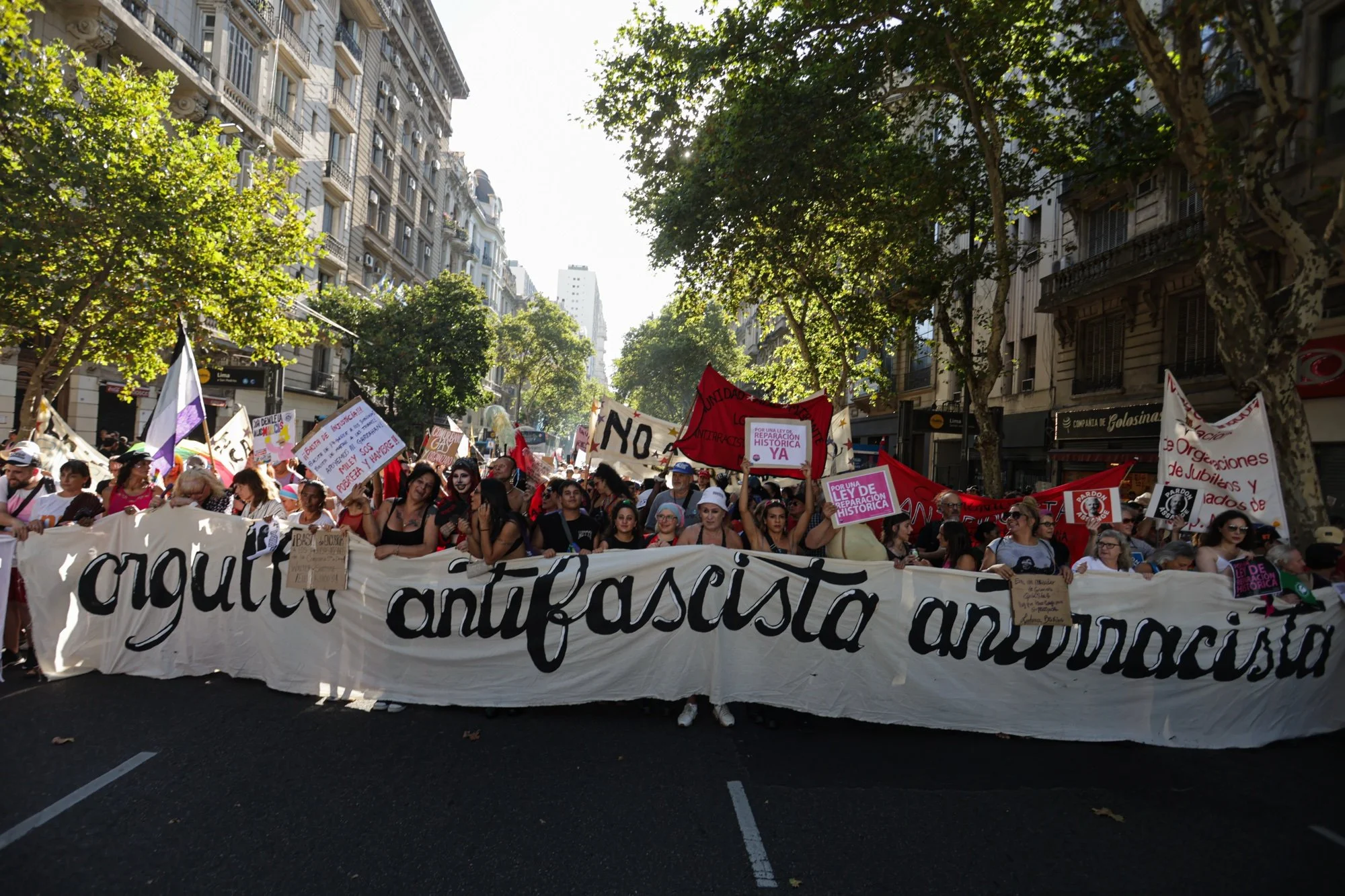
Representatives of the LGBTIQNB+ community and other groups lead the 2nd Federal LGBTIQNB+ Anti-Fascist and Anti-Racist Pride March on February 7, 2026. Photo © Susi Maresca.
Natasha Narmona was the first trans woman to join the Ministry of Economy. After experiencing repeated harassment and discrimination, she was fired in November of last year.
“I am not the only one going through this, there are many more of us,” Narmona told Ojalá. “Transgender people have no representation, and the little representation we do have—the employment quota—is being taken from us.”
Hate crimes targeting people for their sexual orientation, gender identity, or gender expression have increased since the Milei administration took office in December of 2023. According to the latest report from the National Observatory on LGBT+ Hate Crimes, there were 102 such crimes and attacks in the first half of 2025, a 70 percent increase compared to the same period last year.
“This government's policy of repression has a real-world impact in terms of the violence suffered by trans people and travestis. Hate speech is more than just talk; it has real consequences,” said Quimey Ramos, a teacher and travesti activist, in an interview with Ojalá. “The situation reflects the desperation of people who, forced into a state of daily survival, hear the government’s messages of hatred and contempt toward those who are different—against people you encounter day to day, but whose identity differs in some way from your own.”
The national government's “cultural battle” against the LGBTIQNB+ community is compounded by a policy of severe austerity and the latest attempt to change Argentina's economic and labor structure.
“The destruction of long-standing labor protections will not only affect trans people and travestis who accessed formal employment through the trans employment quota,” said Ramos. “The labor reform is against workers, and LGBTIQNB+ people are part of the working class.”
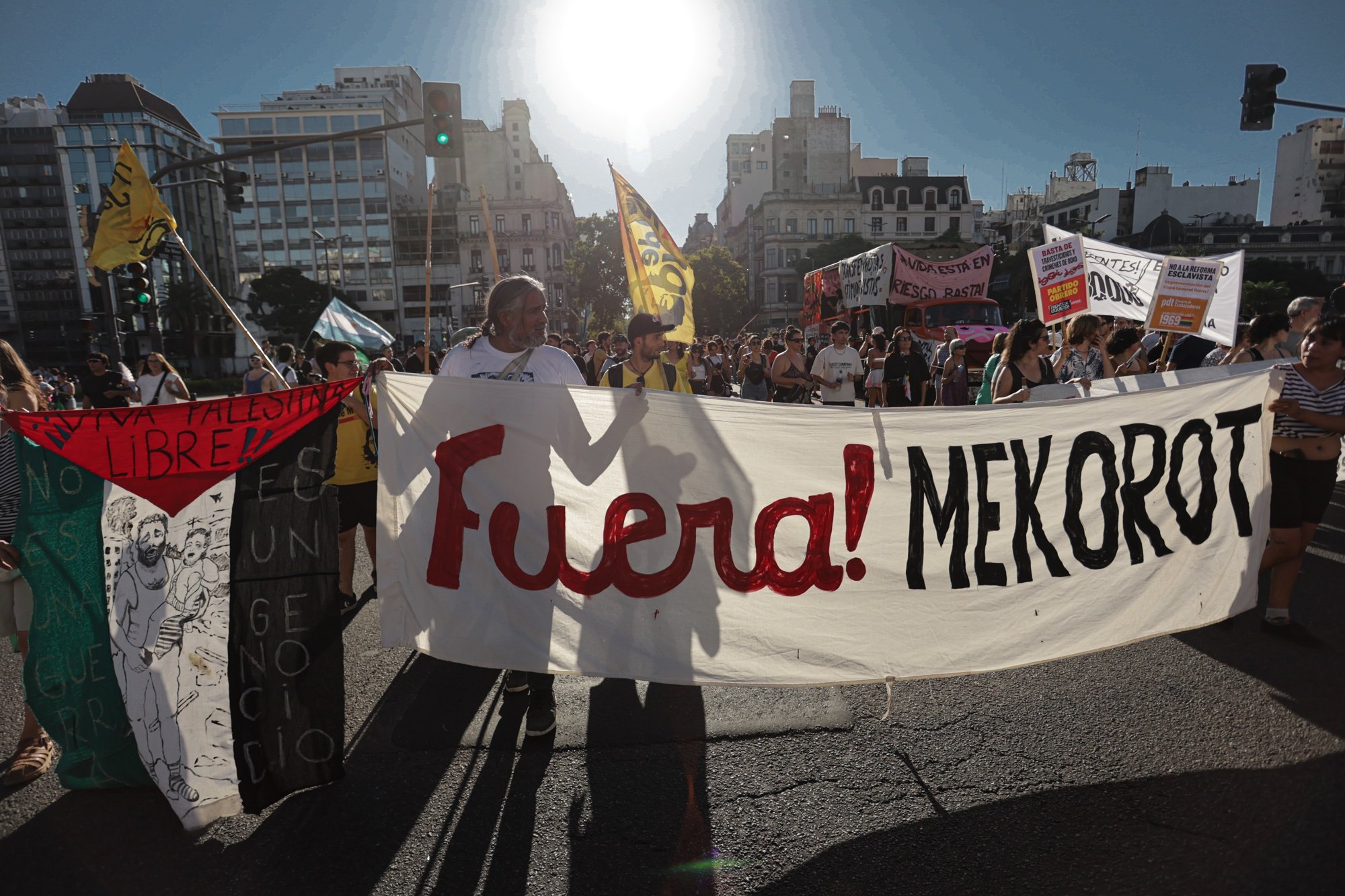
The Fuera Mekorot campaign calls for an end to the genocide in Gaza, its members participated in the the 2nd Federal LGBTIQNB+ Anti-Fascist and Anti-Racist Pride March. Buenos Aires, Argentina, February 7, 2026. Photo © Susi Maresca.
The intersectional working class
Remigia Cáceres, national secretary for disability at the Argentine Workers' Central Union, was at the head of the march in her wheelchair.
“The disability community needs to be able to come out and protest again,” said Cáceres. “This government has decided to attack the most vulnerable: the LGBT community, people with disabilities, and retirees.”
Migrant rights groups involved in the February 7 march condemned the persecution and criminalization the community has faced since Decree 366/25 modified the Migration Law.
“It's like in the United States, where they’re hunting down migrants to deport them,” said Sandra Chagas, an Afro-Uruguayan LGBT activist. “That’s this government's goal, and we won’t allow it.”
Over the past year, Argentina's Congress passed laws to improve conditions for people with disabilities, pediatric health, public universities, and pensions. They were all vetoed by the president, who claimed “there’s no money.” Later, Congress reviewed the vetoes and rejected most of them via a two-thirds majority in both houses, upholding the new legislation except for the pension increase. Legislators endorsed the presidential veto on the latter.
Zulema Palavecino is a member of Insurgent Retirees who worked for most of her life as a bilingual operator in a telephone union. Every Wednesday, she joins the retirees' rally in front of the National Congress to demand higher pensions. Many of these demonstrations are repressed by city police.
“Fascism is a consequence of capitalism,” Palavecino said in an interview with Ojalá, while holding her group's banner. “The discrimination against us stems from capitalism's need to divide us. That is why we support all struggles and seek unity."
While the world watches as rights are rolled back in Argentina, hubs of resistance are emerging in different parts of the country with distinct sets of demands, united in a shared rallying cry: “In the face of fascism, struggle and solidarity."
“We believe that this is a year in which this government and others around the world will try to radicalize cruelty,” said transmasculine activist Ese Montenegro. “We have to be interconnected enough that we can give each other the support we need to defeat the global rise of fascism and neoconservatism.”
