

Ecuador’s No vote resonates as Noboa doubles down
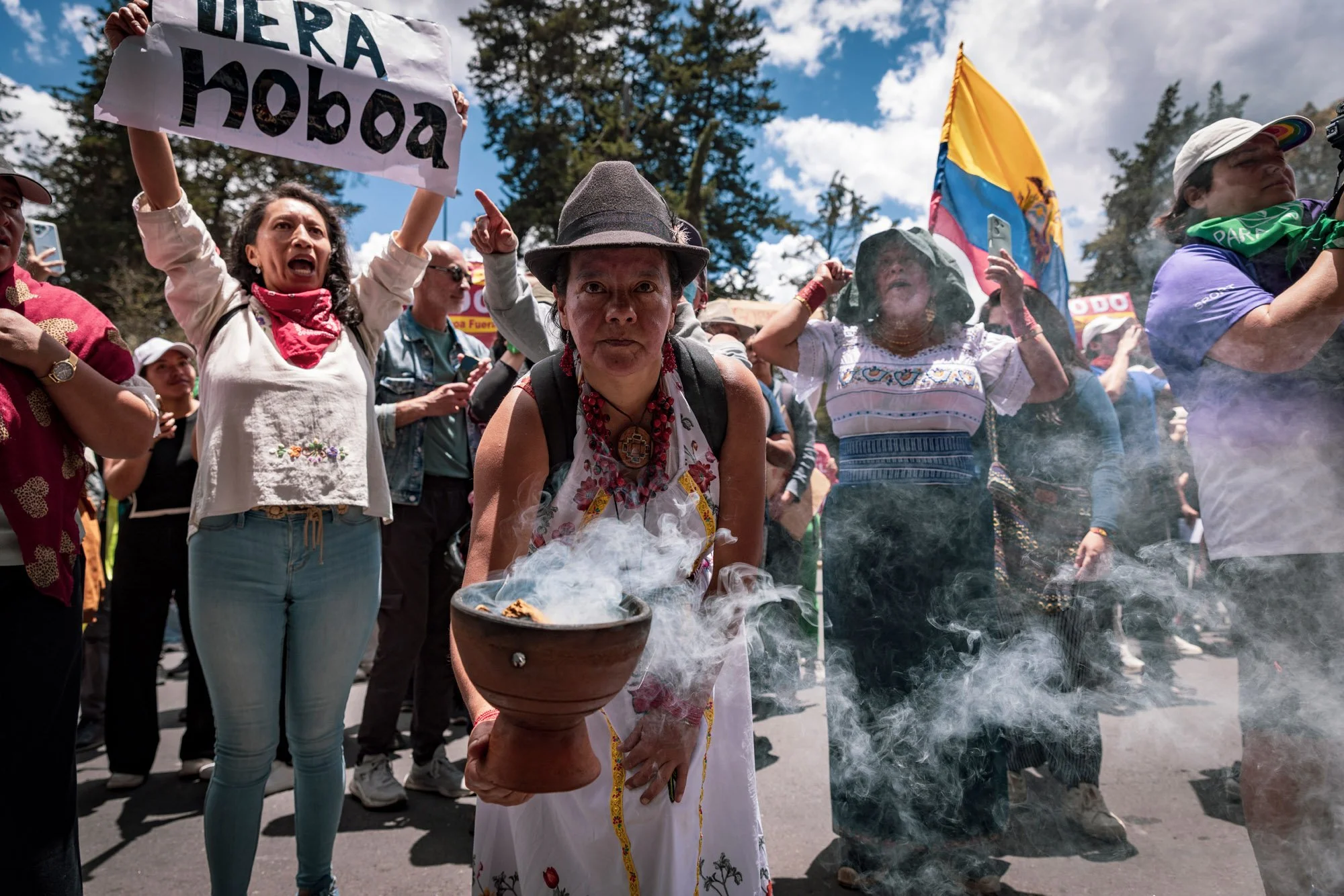
A protester holds a pot of smoldering palo santo with a sign in the background reading “Fuera Noboa” (Noboa Out), during a demonstration on Global Day of Action for Free, Safe, and Legal Abortion. Hundreds of women and social organizations mobilized as part of the National Strike on September 28, 2025, in Quito, Ecuador. Photo © Karen Toro.
Reportage • Lisbeth Moya González • February 6, 2026 • Leer en castellano
Ecuador began 2026 reeling from an intense cycle of protest in which the public expressed rejection of Daniel Noboa's neoliberal policies on the streets and at the polls.
In the last months of 2025, the country was rocked by two major processes—a national strike and a referendum—in which Ecuadorians signalled strong opposition to Noboa's government, but failed to consolidate a social force capable of challenging it.
The Confederation of Indigenous Nationalities of Ecuador (CONAIE) called a national strike from September 18 to October 22, 2025.
Students, artists, transfeminist collectives, and members of the public joined the protest to oppose Noboa's decision to eliminate diesel subsidies. The strike was marked by state repression that left at least four dead and 473 injured. It came 10 months after the army disappeared and murdered four Black boys from the Las Malvinas neighborhood near Guayaquil.
Although the protests failed to prevent cuts to the diesel subsidy, popular discontent was channeled politically through a referendum held on November 16, 2025.
The referendum launched by the Noboa administration put a series of reforms with significant political and institutional impact to a vote. They included authorizing foreign military bases on national territory, eliminating public financing of political parties, reducing the number of assembly members, and convening a constituent assembly to draft a new constitution.
Eliminating public funding for parties would deepen inequalities in electoral politics, while calling for a new constitution—in a context of crisis and high concentration of power in the executive branch—was widely perceived as a threat to civil liberties and a step toward authoritarianism.
As such, the popular rejection of the referendum proposals was interpreted not only as a vote against specific proposals but also as a political message of opposition to the government's policies and efforts to reshape the country's institutional order.
The victory of the No vote was not a spontaneous phenomenon. It was the result of various civil society initiatives, citizen groups, social organizations, and academic circles that launched creative and informational campaigns.
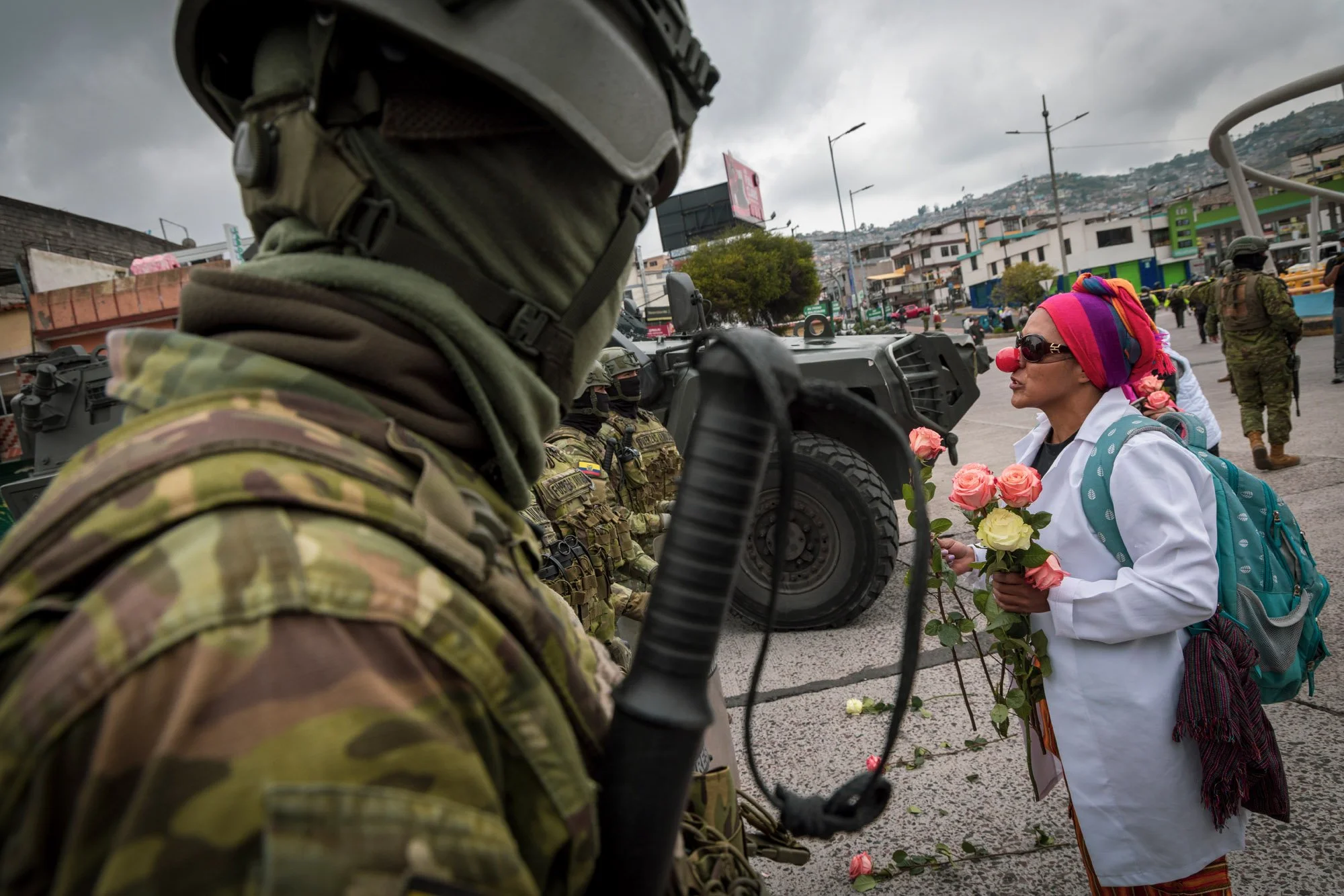
A protester dressed as a clown hands a flower to soldiers during a day of the National Strike against the Ecuadorian government's economic measures, as part of the commemoration of 533 years of Indigenous resistance, on October 12, 2025, in Quito, Ecuador. Photo © Karen Toro.
Popular reaction
“There are ongoing attempts to stay in the streets, through public assemblies, to process what’s happening in debating spaces, but it’s not enough,” said Alejandra Santillana Ortiz, a member of the Transfeminist Assembly of Women and Dissidents of Ecuador and the Yasunidos environmental collective.
In terms of how social organizations play a part in these mass movements, Santillana explains that they create a social fabric that has been active in the streets and was crucial in organizing the strike. These same social forces put their efforts into promoting a No vote during the referendum, and are now focused on rethinking and restructuring in the wake of these two intense political moments.
“It is very difficult to engage in politics when you fear for your life, and yet there is still a willingness to come together,” Santillana said in an interview with Ojalá.
Coalición Ecuador is an example of this process of popular restructurings, a key space for debate. It emerged during the referendum, and the group appears to be here to stay. Juan José Alomía, one of its founders, explains that the group is devoted to political advocacy.
“I was involved in various campaigns for the No vote, and I realized that there were many engaged citizens campaigning in Quito who were not affiliated with any political party and didn’t know each other,” Alomía said in an interview with Ojalá.
Coalición Ecuador consists of around 230 people who foster political debate through meetings, sharing content, and activities such as reading groups and community film screenings. Its goal is to strengthen collective organizing and grassroots activism beyond the divides that split the left.
Noboa, absent
The national strike and the referendum result marked a turning point in Noboa's government, weakening voter loyalty and casting uncertainty over the country's future.
An opinion poll conducted by the Center for Research and Specialized Studies (CIEES), published by several Ecuadorian media outlets, showed that in January 2026, 60 percent of the population rated Noboa's performance as poor or very poor, with only a 32 percent approval in the capital.
Santiago Pérez, an Ecuadorian political analyst and director of the research firm Clima Social, which conducted public opinion studies during the referendum campaign, says that since the referendum, the president's behavior has been to place distance between himself and power.
“Since then, Noboa has spent most of his time outside the country,” Pérez said in an interview with Ojalá. “Today, the government is more fragile than ever, and if a large-scale social mobilization occurs at this point, he could be toppled.”
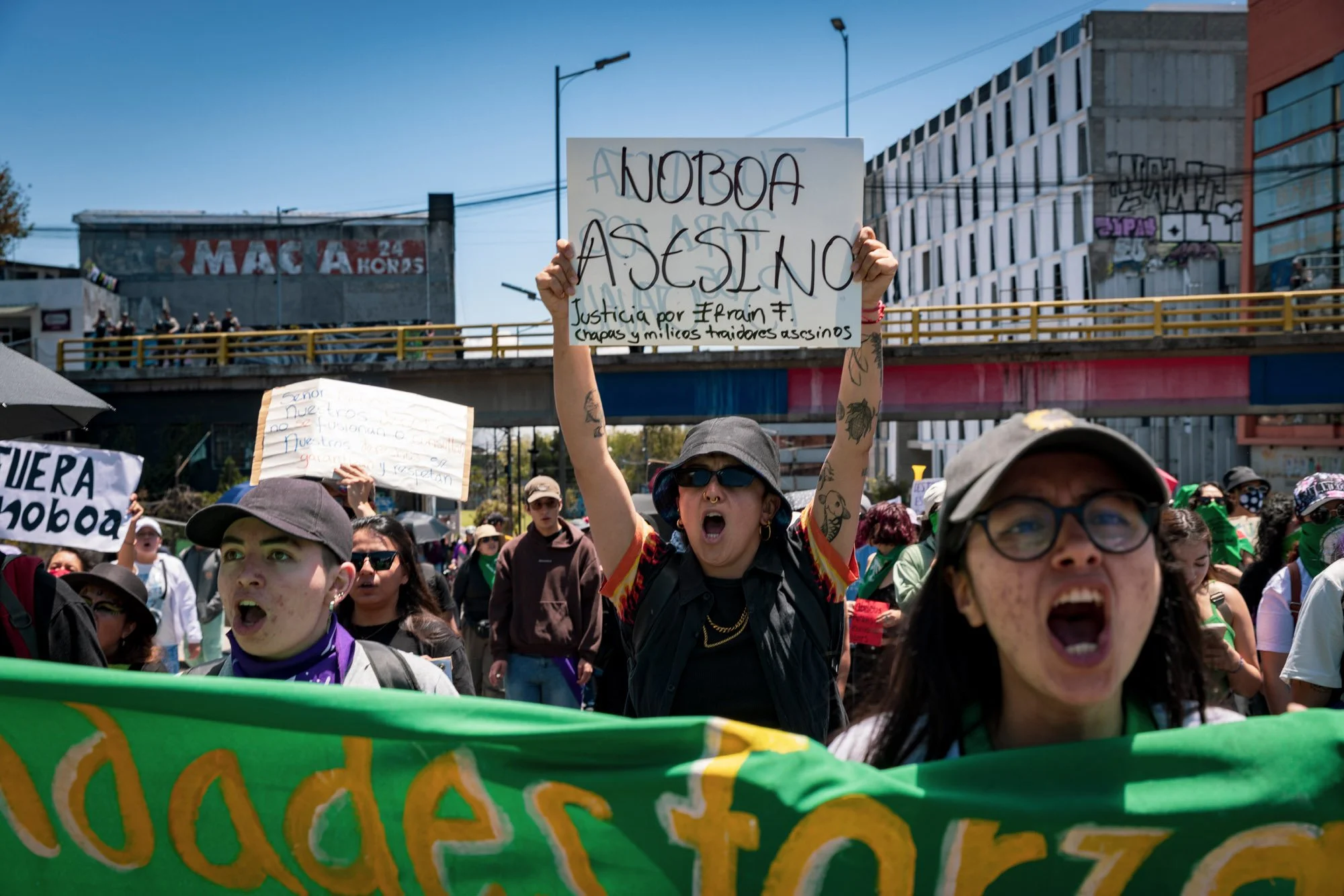
A protester holds a sign that reads "Noboa murderer. Justice for Efraín F. Chapas and murderous traitor soldiers" during a protest on the Global Day of Action for Free, Safe, and Legal Abortion. Hundreds of women and social organizations mobilized as part of the national strike on September 28, 2025, in Quito, Ecuador. Photo © Karen Toro.
After the “No”
Political logic would dictate that a president with plummeting popularity ratings and facing the wrath of the public, would take steps to reverse his fortunes. But that is not what’s taken place. The measures announced by Noboa at the start of the year are aimed at fiscal austerity, and meant to appease the International Monetary Fund and secure the United States' interests in Latin America.
Ecuador returned to the international bond market in January 2026, after almost seven years without issuing sovereign debt in those markets, repurchasing bonds nearing maturity and issuing new, longer-term securities. Those bonds are backed by public funds, which means their payment will fall on the public purse and, ultimately, on the population.
In addition, on January 28, Noboa sent the an urgent economic bill that requires local governments to earmark up to 70 percent of funds they receive from the state for investment in public works, to be implemented progressively between 2027 and 2029, to the National Assembly. This is an unpopular measure, one that relieves the central government of its responsibility to carry out public works.
Amid the US invasion of Venezuela and following Colombian President Gustavo Petro's statements against Trump, Ecuador imposed 30 percent tariffs on Colombian products and increased tariffs on Colombian crude oil transported through Ecuadorian pipelines by more than 900 percent.
These measures were justified by Quito, citing Colombia’s lack of cooperation in the fight against drug trafficking on their shared border. Bogotá responded by imposing reciprocal tariffs, suspending electricity exports, and describing Ecuador's actions as aggressive.
Ecuador has suffered several electricity crises in recent years, which have been alleviated by buying energy from Colombia. And although Ecuadorians said no to military bases on their territory, the government allowed US troops to deploy along Ecuador's northern border and at its Pacific ports.
The country is entering a political limbo: a weakened government that rules without listening, and a society that voiced its will at the polls but has failed to consolidate its power on the streets.
Ecuador’s future will depend on whether unrest can be transformed into a robust, organized people's movement in which politics once again becomes a space for collective debate, instead of serving as enforcers of neoliberal austerity.
