
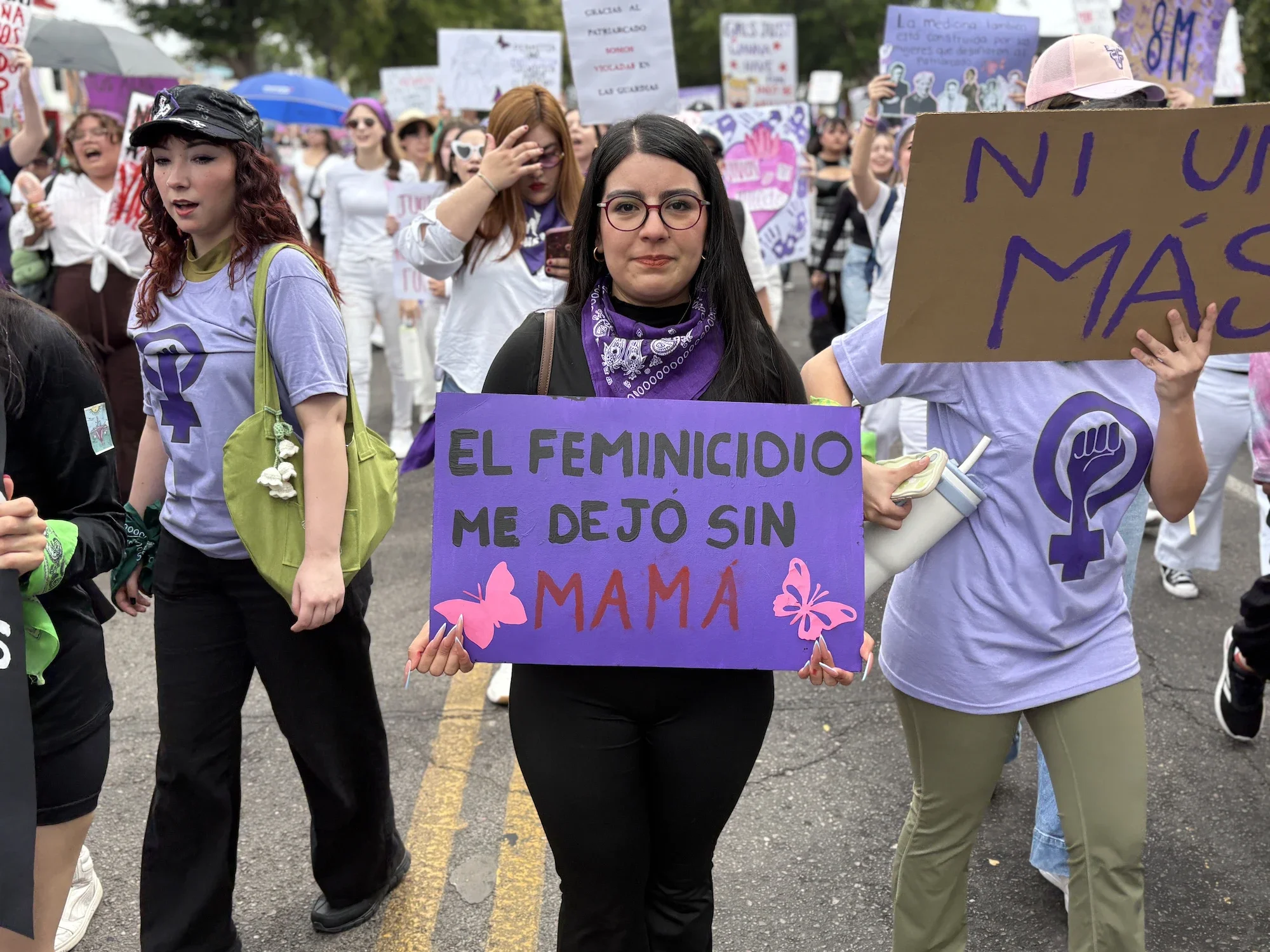
“My mom was killed on September 9, 2020, it was a femicide committed by her ex-partner,” said Nancy Lozoya. “But I still come and march for her, today is for all the women who have been killed.” Culiacán, Sinaloa, March 8, 2026 © Dawn Marie Paley.
Reportage • Dawn Marie Paley • March 12, 2026 • Leer en castellano
Over the last year and a half, Culiacán has become synonymous with some of the most intense violence in México. In this context, the March 8 demonstration for International Women’s Day has grown with each passing year.
“It used to be the same 10 people on March 8, dressed in purple and holding a sign that said ‘end violence against women,’ for many years it was like that, said América Armenta, an investigative journalist who previously helped organize the march in the city. “I think the first year we had a big demonstration was in 2020.”
The latest iteration of the war in Culiacán is known colloquially as the third Culiacanazo. It began with burning vehicles and firefights in different parts of the northern Mexican city, which is the capital of Sinaloa state, on September 9, 2024. The violence that erupted between factions of a drug trafficking organization in the wake of the application of the kingpin strategy was the most dramatic and bloody event residents had experienced for years.
It was a rejection of violence and impunity that brought thousands to the streets of Culiacán on Sunday, March 8, on International Women’s Day. The marks of conflict in the city are painful and recent, and the sting of government denial turned into rage in the streets.
Claudia Ibarra attended the march in dark glasses, holding a banner with a picture of her teenage daughter, Daily Nohemi Arredondeo Ibarra, who was disappeared from the family’s home less than one month ago. “We’re here in the march to raise our voices and ask those who disappeared her to bring her back,” said Ibarra, fighting back tears. She participated in a contingent of mothers and relatives of the disappeared that joined this year’s march.
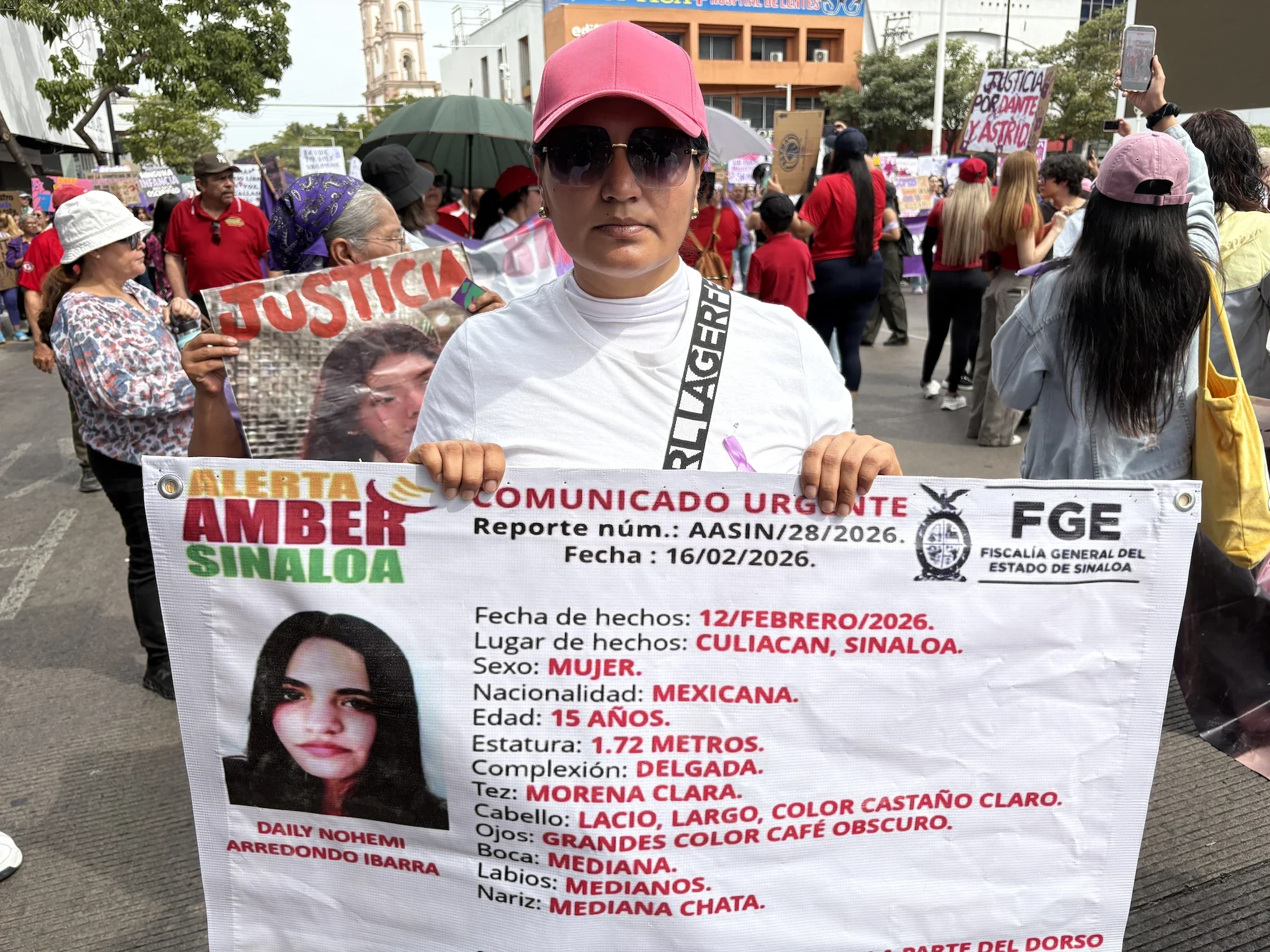
Claudia Ibarra holds a banner with information about her daughter, who was disappeared from the family’s home less than a month previous. Culiacán, Sinaloa, March 8, 2026 © Dawn Marie Paley.
There were 1,656 intentional homicides and 73 femicides in the state of Sinaloa last year, a record high. Most of the killing took place in Culiacán, the largest city in the state. At least 90 children were among those killed last year. There are over 7,000 people missing and disappeared in the state, a number that has grown by thousands since the Culiacanazo.
Rosalinda Cabanillas Guerrero’s daughter Vivian Aispuro was disappeared last March, and her body was found just over two weeks later. Cabanillas Guerrero marched on Sunday to demande justice for her daughter. “There’s been no real follow-up,” she said. She knows who is responsible for the killing, she told me, and worries the perpetrator will kill more women. “Instead of the case moving forward, it’s like it’s going backwards.”
Making violence against women visible
The weekend before International Women’s Day, President Claudia Sheinbaum visited Sinaloa state, where she gave a press conference at a military base. She was received by government workers and supporters, and leaned into the official line as the homicide rate has fallen, peace has returned to the state.
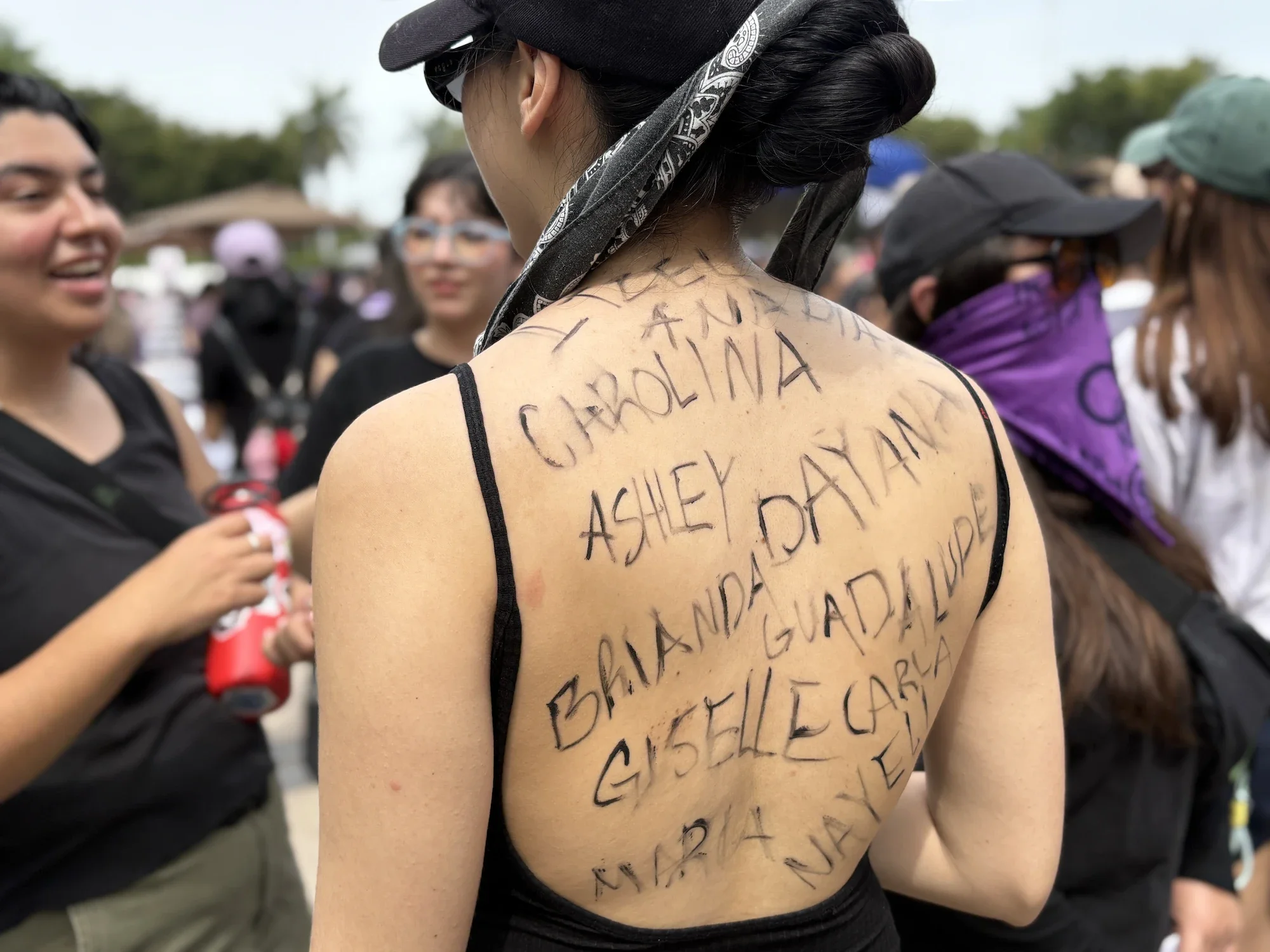
Names of victims of femicide are written on the back of a woman at the march. Culiacán, Sinaloa, March 8, 2026 © Dawn Marie Paley.
“The government tells the media and the rest of the country that Sinaloa is at peace, that things are calm in Sinaloa, but that’s not true,” said Selena, who is 27 years old and asked that I refrain from using her last name. She was seven years old when Felipe Calderón launched the drug war in December 2006, but she says older people she talks to are convinced that life in Culiacán is even scarier today. “There’s no peace in Culiacán, in Mazatlán or in Los Mochis.”
I asked Selena how the violence impacts her daily life. “The city is falling apart, businesses are closing because of the violence and so there’s less jobs, there’s fewer places where we can be outside together, and we can’t do anything because we are all cooped up,” she said. At least 30,000 jobs have been lost in Culiacán due to the violence following Culiacanazo, according research carried out at the Autonomous University of Sinaloa.
Fear and increased economic precarity were common themes among the women I talked to in the city. “A week can go by without anything happening, or things happen on the edge of the city, and then suddenly it’s right here downtown,” said Paola Shinagawa, an artist and photographer who is part of various feminist collectives in the city.

A march organizer wears a hat that says “Make Israel Palestina Again.” Culiacán, Sinaloa, March 8, 2026 © Dawn Marie Paley.
Shinagawa recently relocated to the coastal city of Mazatlan to try and get her tattoo business off the ground, because she says there’s no spare money for art in the capital.
“We’re living in a state of terror, because we don't know when something’s going to happen, and we don’t know economically either, cause, like, I have friends who had jobs and things were normal and then the business closes out of nowhere,” she said. “And the government doesn’t do anything, they just say ‘everything’s fine.’”
War is patriarchy, in Gaza or México
Images of Javier Milei, Benjamin Netanyahu and Donald Trump floated above marchers with the words “they are the patriarchy,” painted in red. Visual artist Desirée Pando created the sign to call out the men driving the planet to war.
“There are so many things happening internationally, and in some ways they are replicated here in Culiacán, in Sinaloa,” said Pando. “We see one case after another that’s a huge international scandal, and then nothing happens.”
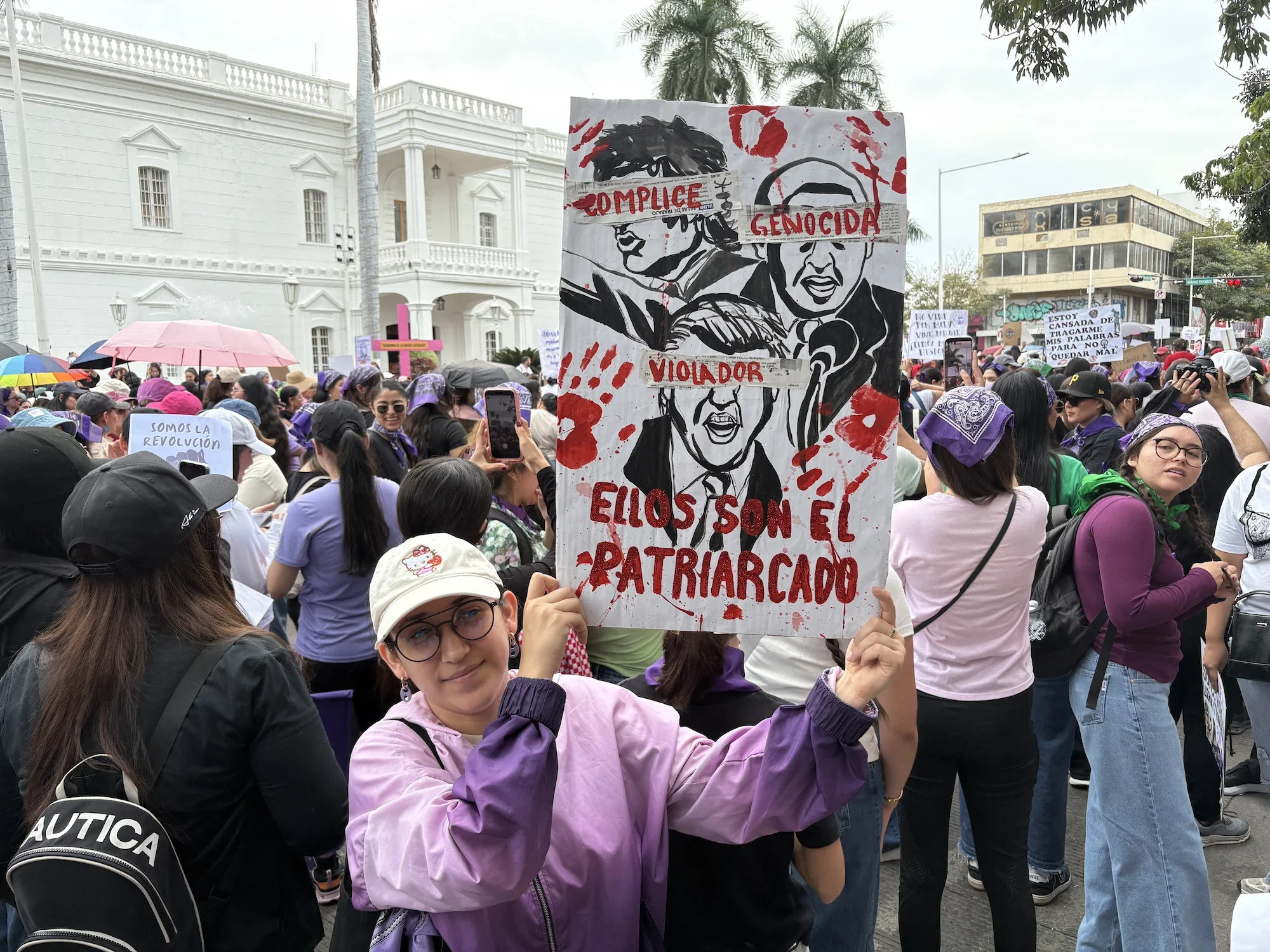
Desiree Pando holds a sign that reads “They are the patriarchy.” Culiacán, Sinaloa, March 8, 2026 © Dawn Marie Paley.
Pando, who is 24, said she was politicized while working in a feminist bookstore called Señora Dalloway’s in the city center. She drew a parallel between the impunity of world leaders who commit war crimes and that of the perpetrators of homicides and disappearances in Sinaloa. “There’s a saying that’s been echoing a lot for me recently, which is that what they did in Gaza, they can do it to you too,” she said.
Later in the march, I met Sonia Higuera Montaño, who founded Señora Dalloway’s in 2020. The bookstore is named after a 101-year-old novel written by Virginia Woolf. “In academia and in the entire culture, everything we’re taught is male-centered, and women writers have been made invisible,” said Higuera Montaño.
In addition to selling books, Señora Dalloway’s hosts feminist workshops and has become a hub for organizing. I asked her about the importance of March 8 in the city. “This march is marvellous, and it’s so necessary. We’re not where we need to be yet,” said Higuera Montaño. “In Culiacán [women] live in fear.”
In the days before the march, the feminist art group Culichis Organizadxs called for women to come together and sew letters onto a used bedsheet as part of a collectively embroidered banner that read “this bed is empty.”
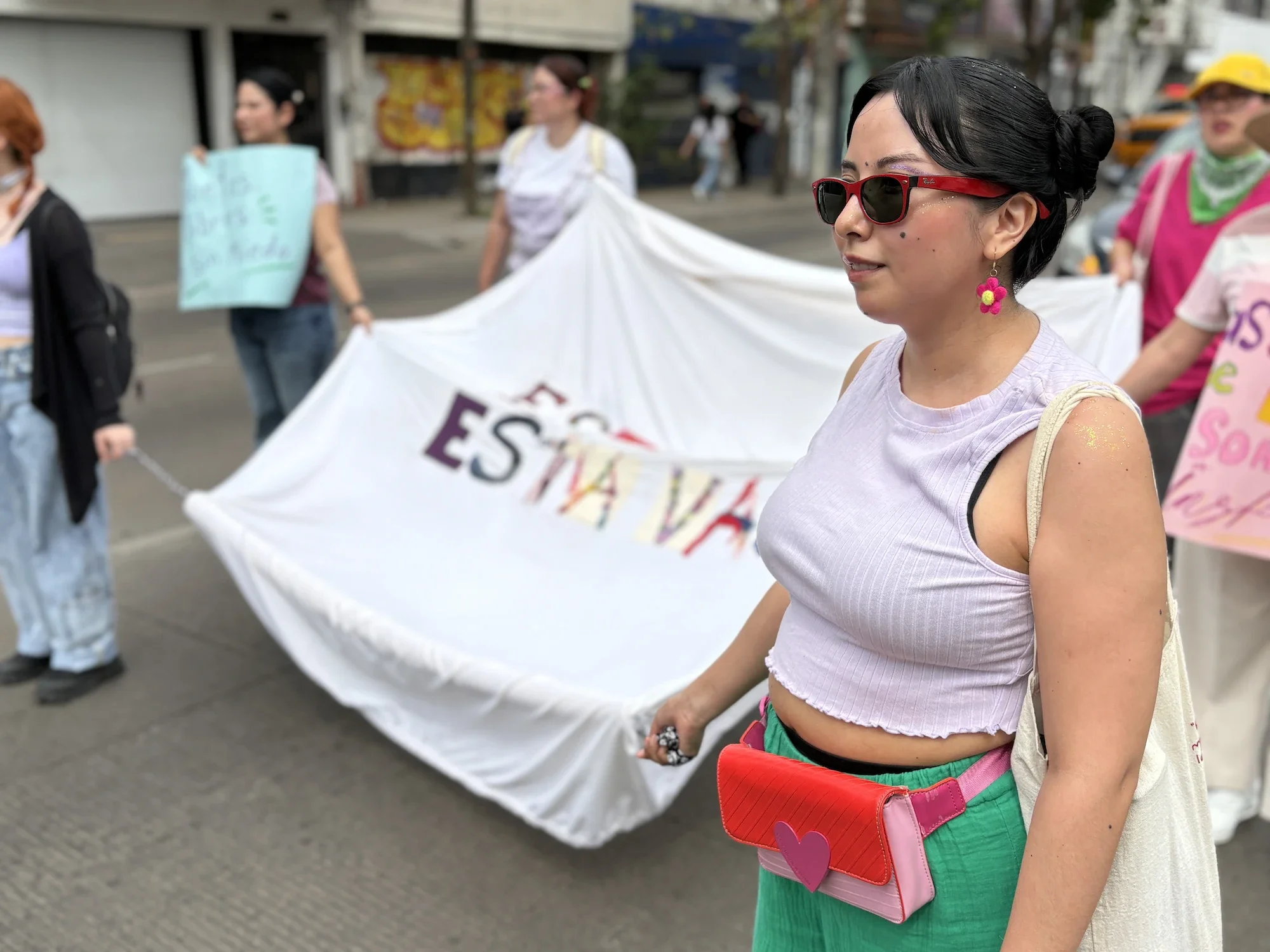
Ari Zantiago and the textile contingent carry the “This bed is empty” banner. Culiacán, Sinaloa, March 8, 2026 © Dawn Marie Paley.
“It’s a metaphor that calls up various meanings, from the victims of femicide and enforced disappearance, to women employed in care work who don’t have the luxury of rest,” said Ari Zantiago, a textile artist who coordinated the creation of the banner. The public call to create letters saw women sending their creations by mail from as far afield as Guadalajara and Mexico City.
Against stigma and state complicity
The march started at 10 am at City Hall, where a group of young activists collected pads, tampons, and other personal hygiene products to donate to women in need. “We try and donate to spaces in which women are vulnerable, women who are in prison, or communities who are in a complicated situation, like after a forced displacement,” said Andrea, who asked that I not use her last name. She’s part of the MenstruArte Collective, which seeks to support those who cannot afford period products.
The march was headed by contingents of children and people with disabilities, who were followed by family members of the disappeared and of victims of femicide. Behind them marched collectives and individuals, including trans and non-binary people.
It was an overcast Sunday, and temperatures were a little lower than usual, a boon to marchers who were ready with umbrellas and hats. The chants and calls echoed those at demonstrations throughout México and the region, and a small group of women threw red paint bombs at city hall as the march departed.
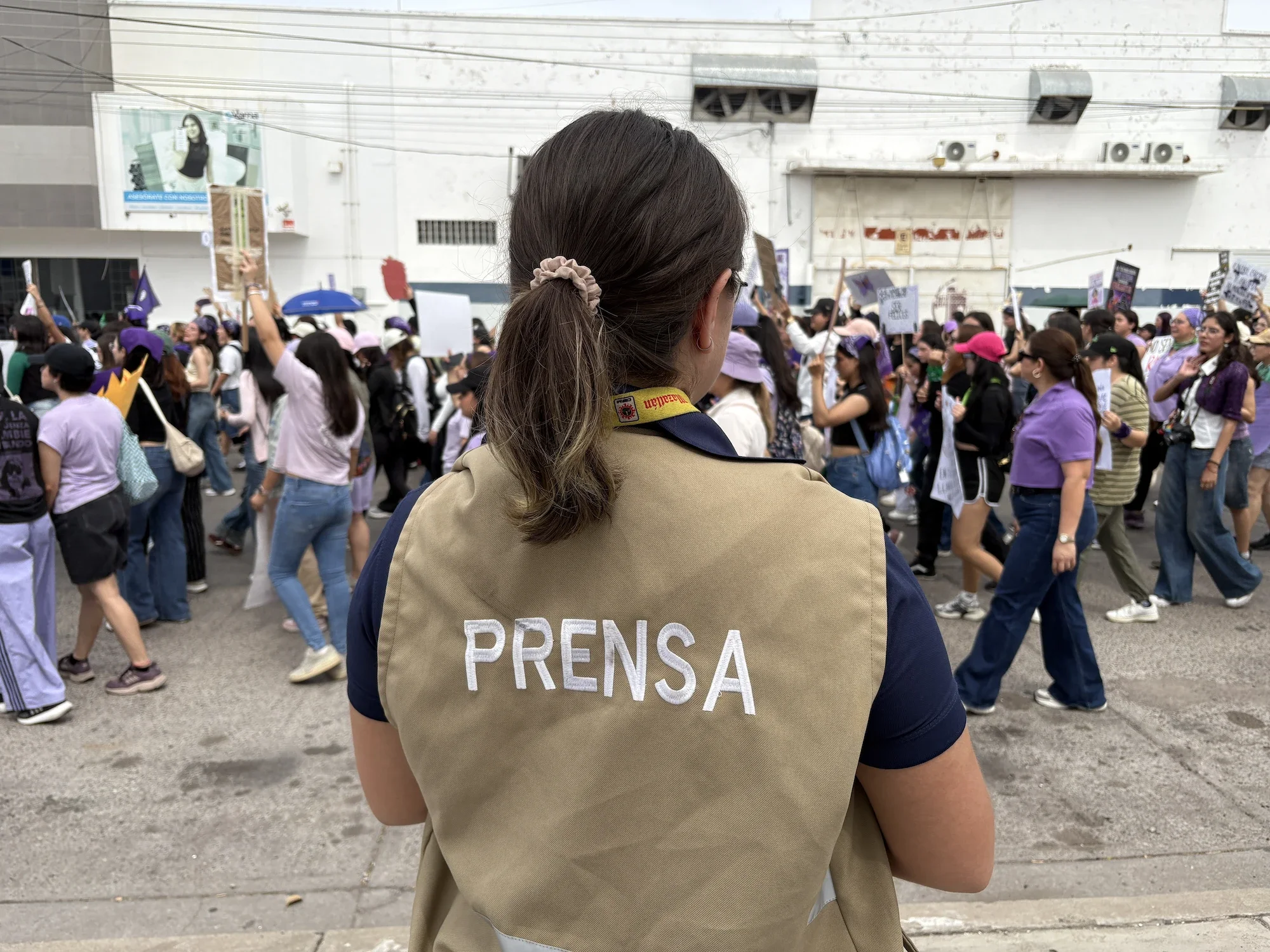
Journalist Mariam Bon covered the IWD march. Culiacán, Sinaloa, March 8, 2026 © Dawn Marie Paley.
At least 3,000 people participated, making March 8 one of the largest marches in the city. Mariam Bon, a journalist with El Sol de Culiacán, was doing livestreams from the March. I asked her if there were other demonstrations of this size in the city, and she described similar marches that take place following certain killings, especially of children.
“There’s been a lot, it’s like, we’re fed up, we’re tired,” said Bon. She told me marches against violence are especially important because of the stigma that exists around Sinaloa. “There’s always this idea that Culichis [people from Culiacán] did a march for el Chapo, but what we see here is that it isn’t all of us.”
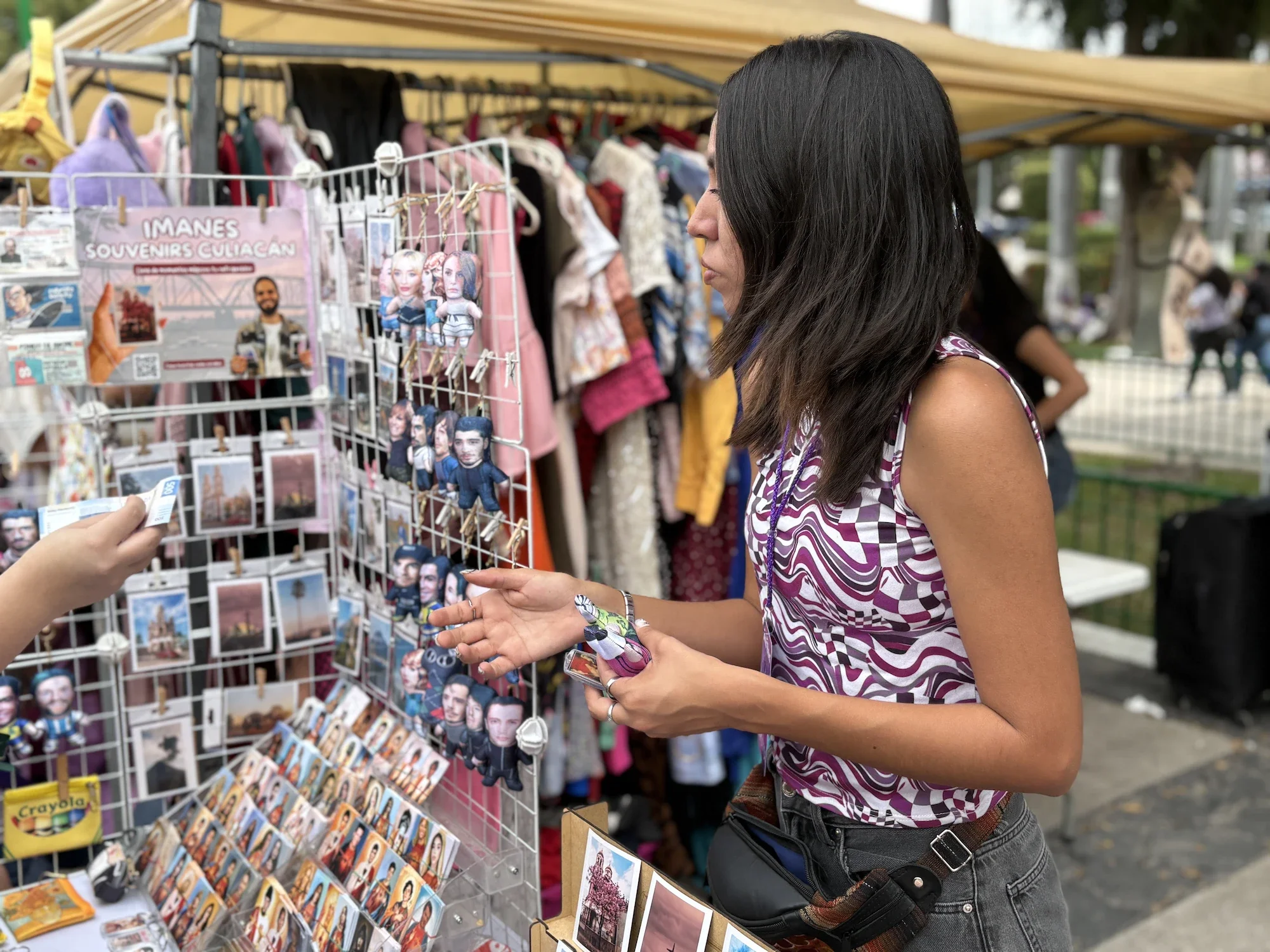
Photographer and activist Gaby Bunda sells her wares in the plaza following the march. Culiacán, Sinaloa, March 8, 2026 © Dawn Marie Paley.
The March 8 action ended at the plaza in front of Sinaloa’s government palace. Some women spoke from a makeshift stage, reading a list of women and girls killed in the city over the past years. Others entered the atrium, calling for justice. Notably, there was little property damage during the march and government buildings were not walled off or protected as in other parts of the country.
Stands where women could sell stickers and merch and food surrounded the plaza. “This is about supporting women artists from Sinaloa, from here in Culiacán,” said Gaby Bunda, who was selling her photographs and other creations. “It’s a way Culichi artists to showcase their work.”
Some of the women burned their signs in a barrel in the plaza, others set up a purple coffin against a massive flagpole with the words “the state doesn’t look after me” spray-painted in the same color at its base. As the afternoon went on, women began to drift away, savoring a rare feeling of safety and visibility in a city at war.