
Indie radios stream in solidarity with Venezuela
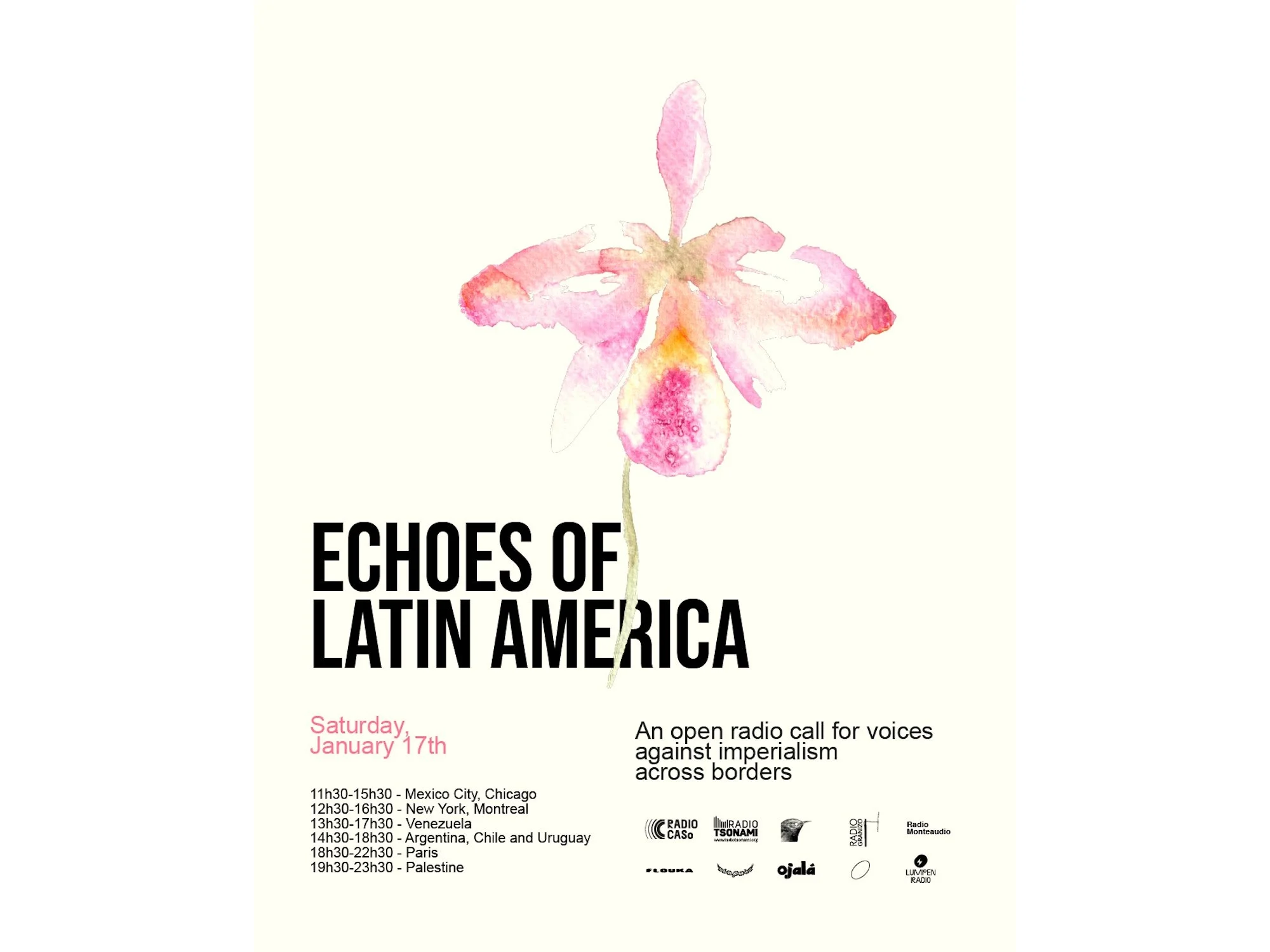
Cattleya mossiae, Venezuela’s national flower. Illustration: @veraprimavera. Design: Diego Aguirre.
Opinion • Dawn Marie Paley • February 26, 2026 • Leer en castellano
On January 17, a dozen independent online radio stations from Latin America, France and Palestine streamed a five-hour transmission against the US invasion of Venezuela.
The stream, which is titled “Ecos de Latinoamérica,” mixes Venezuelan music, voices from around Latin America, contemporary compositions, sound art, and poetry into a living, aural archive that encourages us to take a breath and sit, for a moment, with what’s taking place around us.
“This broadcast in both the organization and content was focused on expressing this, a grassroots initiative of radio programmers, cultural workers and activists working across borders and also national scope to respond critically in opposition to U.S. imperialism, in opposition to the violence of the U.S. military attack on Venezuela,” said Stefan Christoff, a co-organizer of the broadcast who is active with CKUT radio in Montréal and who helped co-organize the broadcast. “It also served to create a process to make a broadcast that featured many voices, not just repeating generalized talking points of people in positions of power, but to lift up grassroots creative voices from across the Americas.”
In one of the audio segments, Venezuelan-Mexican photographer Cavo Valecillo describes receiving text messages early in the morning on January 3, and reaching out to his family in Caracas. Their reactions were split, he said, and that polarization created the impression of the US bombing of Caracas as being a kind of struggle between two sports teams.
Later in the stream, visual and sound artist Daniel Bargach Mitre shares a piece called “Ser venezolano no es fácil,” which too, seeks to avoid the disciplining imposed on speech from both the left and the right. And Paola Valentina shares her conversations with her aunt in the city of Maturín, highlighting the centrality of social reproduction and care work in times of crisis.
Throughout the broadcast, listeners are encouraged to think through what took place in Venezuela on January 3 in tandem with events in Palestine. “Yankees out of Latin America, Zionists out of Palestine” is a resounding call that can be heard in one chant recorded in a march in Mexico City prior to the invasion.
“We understand the importance of taking care of our voice, as a kind of document or an anti-document made up of voices that have been silenced during one of the most fascist moments in history, it’s a moment in which it feels like anything is possible, but the escape valve is limited and silenced without us even realizing it,” said Diego Aguirre Fernández, the director and founder of Radio Nopal in Mexico City. “Our objective isn’t and has never been to reach massive audiences: we understand the potential of secrets, of physical encounters, of conversing on walks.”