

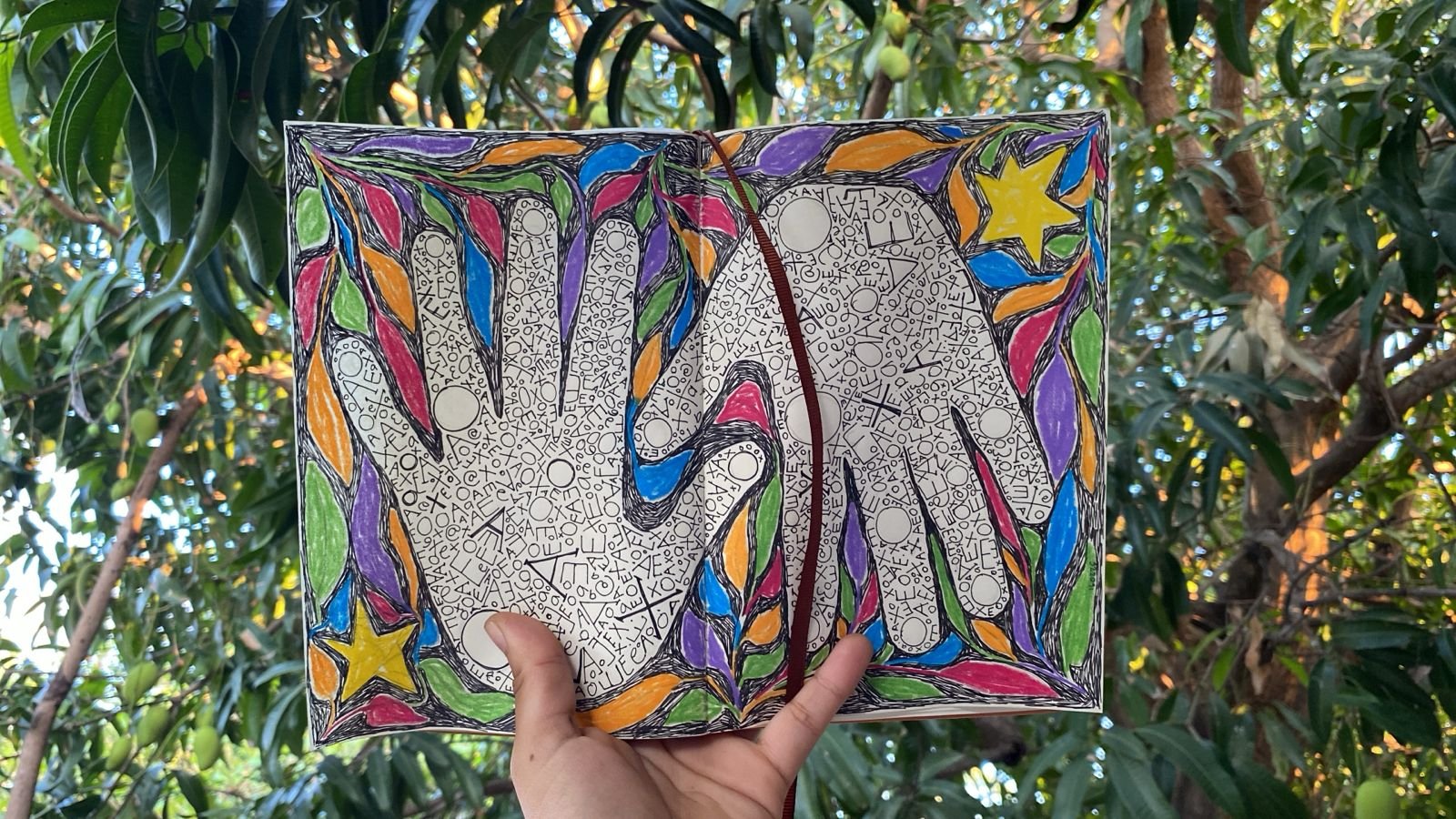
“Untitled," wax crayons and pen on cotton paper. Original art for Ojalá © Bhiany Guzmán (@verteselva).
Opinion • Kevin H. Martínez • February 27, 2026 • Leer en castellano
Spanish is a famously gendered language, and if you read the Spanish versions of Ojalá’s articles, you’ll often find words ending in -x or -e. Those letters, called morphemes, provide a glimpse into ongoing discussions within our editorial collective and throughout Abya Yala.
Our articles are published in inclusive language, also known in Spanish as gender-neutral or non-sexist language. Among other things, it seeks to challenge the rigidity of the gender binary that many speakers perceive in Spanish linguistic norms.
Our decision to do so is rooted in both practical and ethical considerations. Since Ojalá was founded three years ago, we have set out to trace the struggles of women, gender dissidents, and feminists and their ties to the broader struggles for land defense, local organization and communal resistance. Recent cycles of social mobilization have highlighted the central role of women, gender-fluid, and non-binary people in reproductive work and in sustaining and organizing the struggle.
Last year, we published an article in which Mexican artist Lorena Wolffer emphasized the importance of identifying as a transfeminist in a context in which transphobia and LGBTIQ+ phobia have become one of the foundations of the conservative counteroffensive.
At Ojalá, we strive to ensure that our editorial style respects the identities of our contributors and the people we report on in our articles, especially trans people.
In English, the challenge is less complex.
But in Spanish, I’ve encountered difficulties reconciling standard linguistic norms with inclusive language, particularly the controversial use of the morphemes -x and -e.
Growing pains
Languages can seem almost sacred, on a scale too vast for us to change them at will. But languages do change, sometimes at a tectonic pace, sometimes in a seismic jolt.
Rather than fixed sets of signs that allow us to communicate within well-defined limits, languages are tools that we use and modify according to the needs that arise through our interactions with the world, needs that, obviously, also change over time.
While many people would agree with the above, some parts of languages seem less amenable to change than others. While one may have the luxury of inventing a word—especially a noun or verb—the same is less true of grammar.
One of those elements that seems resistant to change is the pronoun system, which includes the pronouns he and she, and the nominal inflection morphemes -o and -a at the end of a noun to indicate the subject’s gender: for example, un maestro or una maestra for male or female teachers, respectively.
The use of the pronoun elle (instead of él or ella) and the morphemes -x and -e breaches this system. More specifically, this use has been called non-binary language or neutral language, which in this case would look like —unx maestrx or une maestre.
This disrupts linguistic features traditionally considered fixed, and for some, the use of inclusive language can cause discomfort. Even so, these and other less-canonical ways of expression or using grammatical gender to account for gender identity exist and are increasingly used despite objections.
To date, our editorial team has not established a standardized approach to this issue. And maybe there’s no need to.
But why?
The use of non-binary or neutral language has two main objectives: first, to refer to people who identify outside the gender binary, and second, to replace the default to masculine when referring to groups of people with different gender identities.
It’s important to distinguish between these two uses. The first one is easier to explain: the pronoun elle and the morpheme -e have become a common way for people with non-binary gender identities to refer to themselves.
Using this pronoun and morpheme simply means referring to non-binary people how they refer to themselves. It matters little whether this is considered correct within the Spanish language system: these words are already used by people in the Spanish-speaking world, and we use it when an author tells us these are their pronouns. A similar example is the morpheme -oa used by trans compañeroas zapatistas.
The use of non-binary language to replace the default to masculine is more complex. Traditionally, the masculine grammatical gender has been used to refer to groups of people of more than one gender. For example: en la asamblea había menos de 20 compañeros (there were fewer than 20 comrades in the assembly). And, in this example, the gender would default to masculine even if there was just one man among those gathered. For many years now, it has been pointed out that this use of the masculine is often ambiguous, if not sexist.
There have been all kinds of proposals to remedy this, many of which have remained trapped inside the gender binary. One is splitting the terms along gender lines (naming both men and women, maestros y maestras), the use of brackets and slashes, the @ sign, the female generic (the use of the feminine grammatical gender to refer to mixed groups, whether or not they are composed mainly of women), as well as the -x and -e morphemes.
In my experience, each has its advantages and disadvantages. Personally, I like to use the letter x. I find it more transgressive, since at first glance it is unexpected to see an x between two consonants in Spanish.
The morpheme -e is also becoming increasingly associated with non-binary people, while the use of x, in my view, can have a more encompassing effect in terms of the identities it groups together. Another advantage is that its use does not require modifying other letters in the spelling of words ending in -ca, -co, -ga, and -go. So, for example: médicx vs. médique, antropólogx vs. antropólogue.
Valen Iricibar, our colleague and editor, warned me that using an x can hinder text-to-speech applications for people with visual impairments. This is a point in favor of the morpheme -e, because it is generally not ambiguous in its pronunciation
Although it can almost always be easily switched out for the generic masculine, there is one case in which I’m not fully convinced of using the -e, which is when it is identical to the generic masculine and therefore indistinguishable from it, specifically in the formation of plurals (for example: profesores, estudiantes).
But couldn’t this be considered an advantage, as these forms are more familiar to readers who may be less experienced in this communication style?
On other occasions, especially when dealing with mixed groups where women are in the majority, could we use the generic feminine? Or would that risk obscuring non-binary identities? Wouldn't a triple split be more appropriate: amigas, amigues, amigos? Or even a quadruple split: ...y amigxs?
Inclusion is not monolithic
There are style manuals (and anti-manuals) that address this issue seriously and critically, all of which agree a plurality of strategies is necessary. There is no such thing as a singular inclusive language. I agree that it’s hard to find a single solution or a strict style guide that can be applied down to the letter: instead, some things have to be decided on a case-by-case basis.
Rather than seeking a definitive solution that could ultimately become a limitation, it seems more appropriate to acknowledge the plurality of gender and the challenges it poses in writing, editing, and publishing.
In Inclusive Language and Class Exclusion, feminist writer Brigitte Vasallo warns of the danger of seeking inclusive language that includes everyone, which could lead to a new form of standardization that ultimately conceals identities.
Vasallo is skeptical of the need for someone to sanction which uses of inclusive language are correct or not. In doing so, she says, there’s a risk of replicating a relationship of subordination and alienation that separates language from its speakers.
As a Spanish speaker who finds existing forms insufficient to appropriately name those who exist in this world, I assert the power to change them and use different strategies as appropriate, and in accordance with the wishes of the people we’re working with.
