
Paz government vs. land defenders in Bolivia
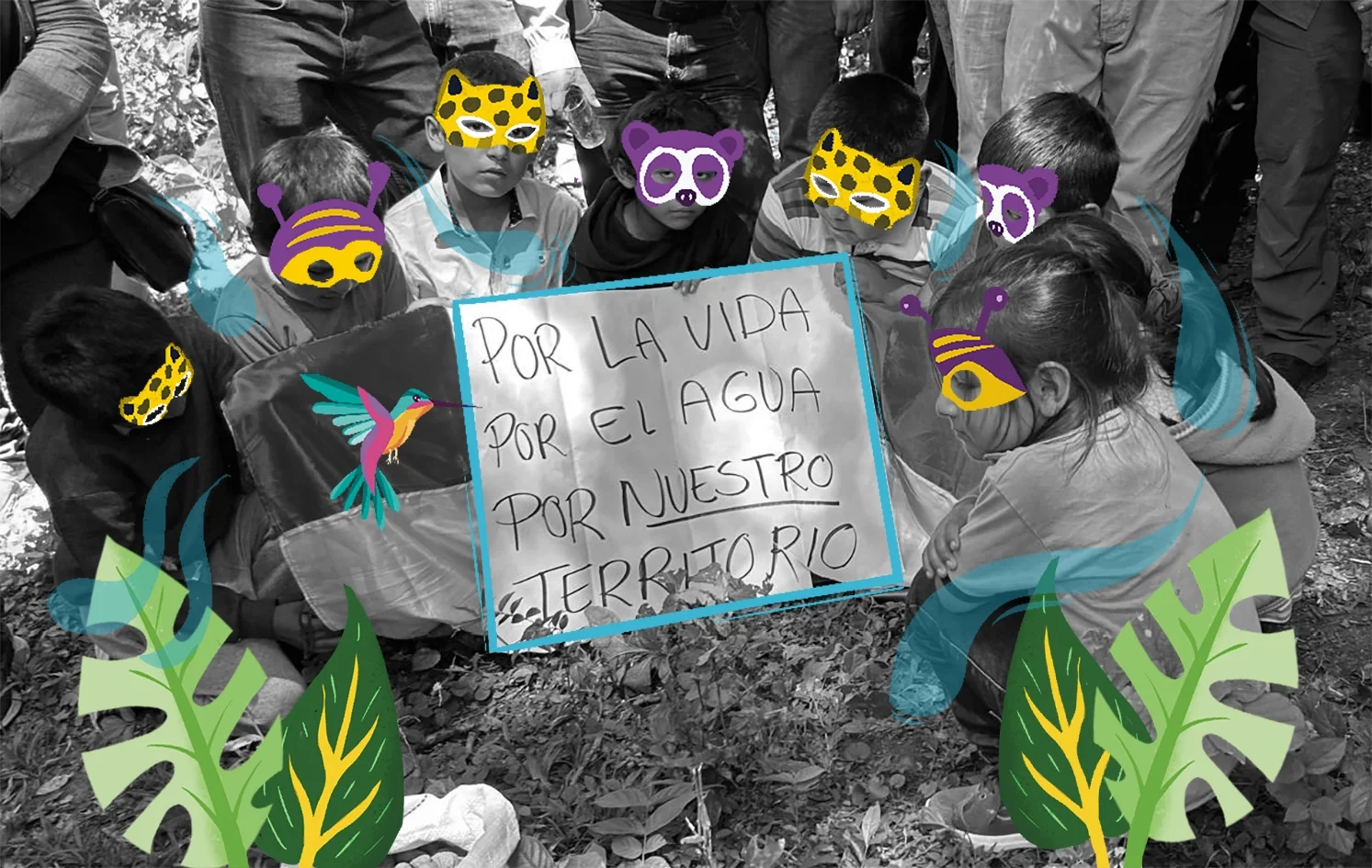
A Saican community assembly. January 13, 2026. Photo © Claudia López with digital intervention by @merlina_anunnaki.
Opinion • Claudia López Pardo • March 5, 2026 • Leer en castellano
At the same time every morning, Elvidio Mercado saddles his horse and heads to his cattle ranch in the community of Pampa Redonda, in the department of Tarija, in southern Bolivia.
“We’re all farmers here. The countryside is beautiful, and everything grows well,” said Mercado. The people in Pampa Redonda make a living by growing peanuts and corn, raising cattle, and producing honey. But those livelihoods are being threatened by the arrival of oil companies, which Mercado has vowed to fight.
“I do it for my grandchildren, I have a large family. I’ll get old and pass away, but I have to leave something for them,” said Mercado, about his determination to fight for his land when we spoke in Chiquiacá, in the Tariquía Flora and Fauna Reserve.
In 2015, a helicopter landed in the same pasture. “‘Get going, who gave you permission to be here?’” Mercado told them. Ever since, he and his family have kept a close eye on the movements of oil companies in the area.
In January, police violently repressed a peaceful blockade organized by the Chiquiacá Canton Committee in Quebrada Las Vacas. Charges were laid against 17 people who were present. Shortly thereafter, Petrobras set up camp with a police escort in the community of Saican, where the Domo Oso X3 exploration project is set to begin.
The criminal charges are the same as in a previous case against defenders, with conspiracy added to the list. On the 26th January, the prosecutor rejected the complaint. PETROBRAS filed an objection. This case remains in the hands of the Tarija prosecutor's office.
Even amid criminalization, the protest has not wavered: since 2018, the fight for Chiquiacá has been upheld through the Defense Committee, which brings together 10 communities that have vetoed oil exploitation.
What’s at stake?
The water from the springs, rivers, and streams of the Tariquía Reserve is known for its quality and purity. Human and non-human communities coexist and depend on each other in the valleys and rainforests of the Reserve, which has a core zone, or strictly protected area, that is home to at least 13 endangered species. But the subsoil is natural gas, a scarce resource in Bolivia today.
In the corporate mindset of successive governments, the Reserve is vacant land, primed for gas extraction. The insistence on gaining access and consolidating extraction has led to an unequal stand-off.
On one side is the state-owned company Yacimientos Petrolíferos Fiscales Bolivianos (YPFB) and its international allies. On the other, the communities that oppose the entry of oil companies into the Reserve. Today, more than half of the surface area of the Reserve is earmarked for oil and gas activities.
A series of decrees were passed in 2015, during the administration of Evo Morales. Among them is Decree 2366, which authorizes oil and gas activities in protected areas, loosens the requirements for prior consultation, and modifies environmental regulations. Over the following years, YPFB-Chaco and Petróleo Brasileiro S.A. (PETROBRAS) signed contracts for exploration and exploitation in the San Telmo Norte, San Telmo Sur, Churumas, and Astillero blocks.
A host of irregularities cloud the management of the Reserve. In 2014, a new Environmental Management Plan was approved by the National Service for Protected Areas (SERNAP), marking a turning point in the dispute. The core zone and protected areas were redrawn, and the boundaries adjusted to allow fossil fuel exploitation.
This allowed the Movement Toward Socialism (MAS) government to grant environmental licenses to oil companies without the communities' consent. “The new management plan was approved behind our backs; no one consulted us,” Paula Gareca from the community of San José told Ojalá.
Fighting for life and water
The community is waging their fight on two fronts. Since 2016, they’ve been protesting against the occupation of their territory by oil companies with varying degrees of intensity through the Tariquía Peasant Subcentral of District 8, in the center of the Reserve, and the Chiquiacá Canton Defense Committee, whose territory borders the oil projects.
The leaders of the Tariquía Subcentral are clear that although the projects are not in their district, oil operations in the San Telmo Norte Block will affect the springs and water sources that feed the entire Reserve.
And although there have been moments of quiet, from the outset the push for oil has fragmented the community, dividing it into two, those who are in favor of the arrival of the companies, and those who are opposed.
This has torn families apart, as there are parents who no longer speak to their children and siblings who have fallen out with each other. In some places, celebrations and community festivals are no longer held. Vidal Jiménez from Pampa Redonda considers the division within the community as an open wound. “The corporation divided our communities, and we can’t live in peace,” he said in an interview in January this year.
Even so, community resistance has been unstoppable. Locals have reported violations, taken action, mobilized, and organized two referendums vetoing YPFB-PETROBRAS's entry into the Chiquiacá.
But business interests have also pressed on, and today gas is being extracted in the heart of the reserve. It is a paradoxical situation. Since 2023, the Churumas block—home to vulnerable species such as the jaguar, the Andean bear, and a variety of birds—has been used for gas extraction.
In July 2025, Luis Arce, who was then the president of Bolivia, declared the Campo Churumas field to be productive. He celebrated the daily extraction of 20 million cubic feet of gas, transported directly to the San Alberto processing plant in the Gran Chaco region of Tarija.
Criminalizing defenders
The first legal offensive against 29 land defenders was launched in 2024, during the Arce administration. The YPFB-PETROBRAS consortium took legal action through the Entre Ríos de Tarija prosecutor's office, accusing locals of obstructing public services and violating the freedom to work.
In April of last year, 12 people were charged. By June of the same year, at the sentencing hearing, the Entre Ríos court ruled that they could defend their case while remaining free.
“The first case went to trial despite a lack of solid evidence,” said Miguel Miranda, a researcher at the Bolivian Documentation and Information Center in an interview with Ojalá. As of January 5 this year, 12 defendants—eight men and four women—continued to face formal charges. They are awaiting the sentencing hearing and the trial date.
Both governments have ignored recommendations made by the Inter-American Commission on Human Rights. On March 7, 2025, the court recognized the community members of the Reserve as environmental defenders and urged the Bolivian state not to criminalize them. In 2019, Bolivia ratified the Escazú Agreement, committing to protect those who defend the territories.
Today the Paz administration and the oil companies continue their legal assault, which relies on fear. They seek to intimidate and stigmatize those who defend the Reserve.
So far, 33 people have been prosecuted. Still, their strength has not been broken. “I'm not afraid, I haven't killed anyone,” said Mercado.
There is hope
On January 16, 2026, the Agro-Environmental Court of Entre Ríos granted a request for precautionary environmental measures filed by the Ombudsman's Office that ordered the temporary suspension of exploratory work on the Domo OSO X3 project, located in the buffer zone of the Reserve.
The Ombudsman's Office prepared a detailed report on the legality of the environmental license, the validity of the public consultation, and the persecution of community defenders. The Agro-Environmental Court of Entre Ríos scheduled a judicial inspection hearing at the site of the conflict for March 16, and a public hearing for March 24. The communities eagerly await the rulings.
Since Bolivia’s gas boom ended, the Tariquía Reserve has become one of the territories most prized by the government. Although Paz promised during his term as mayor of Tarija in 2019 to protect the Reserve, communities know that politicians' promises tend to coincide with election campaigns.
The communities have led a courageous struggle and uncovered the gruesome ways in which governments operate to maintain extractivist economic models. Their struggle is borne from enormous efforts to sustain grassroots community politics through organic practices in defense of their territories, which illuminate a horizon and an interdependent way of living in which organizing that puts the defense of life at the center.