

Cuba strains as crisis deepens
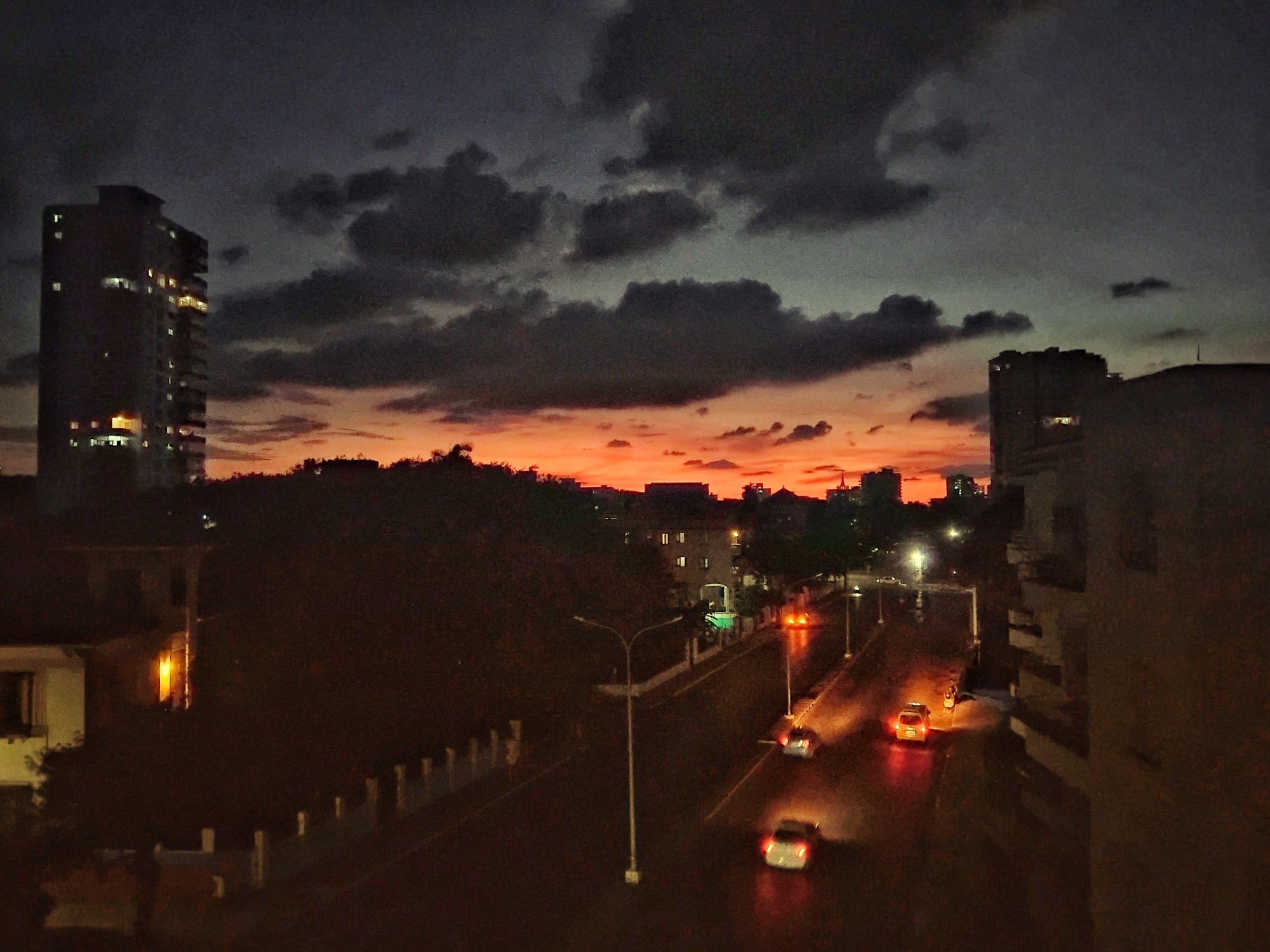
A sunset view from El Vedado, Cuba, where blackouts can last more than six to eight hours. February 5, 2026. Photo © María Lucía Expósito.
Reportage • Lisbeth Moya González • February 13, 2026 • Leer en castellano
“In a country where wages don’t cover the cost of living, surviving is a challenge,” said Leonardo Romero, a 25-year-old who lives in Old Havana. “Transportation is what affects us most in our daily lives. The streets are empty. I ride my bike everywhere.”
Cuba is facing its first month without imports of foreign oil, prompting the government to allocate fuel to essential services such as healthcare and industry, to produce electricity using domestic crude oil and renewable energy sources, to authorize the sale of solar panels to individuals and private companies, to reduce public transportation, and to control the cost of private transportation.
The island's electrical infrastructure is built on burning fossil fuels. Cuba doesn't have the technology to refine its heavy crude oil, nor does it have enough oil to meet domestic needs.
Beginning in 2024, power cuts on the island lasted from five to 48 hours, but the fuel shortage goes beyond electricity generation. The government stopped garbage collection a year ago, exacerbating the spread of diseases such as dengue, Zika, and chikungunya. Most public transportation also came to a standstill.
Another recent measure is the suspension of domestic and international flights due to the lack of jet fuel. Considering that tourism is one of the country's main sources of income, this will drastically affect the Cuban economy.
Basic education continues with flexible schedules, and universities will switch to a mix of online and in-person classes, as will many state workers. Part of the workforce will be reassigned to basic services and food production.
Agriculture will also be protected and promoted in urban areas, while cultural and sporting activities will be limited to community initiatives.
Caregiving under threat
Maydelis Borrego lives in the province of Pinar del Río. She’s a university student, writer, and mother of two. Outside Havana, power outages can last more than a day, but Borrego, like many other Cubans with family outside the island, managed to acquire a rechargeable power station or “EcoFlow,” which has helped her get through the energy crisis.
“People are visibly exhausted. Neighbors do what they can, relying on relatives who have emigrated or by finding informal jobs,” Borrego told Ojalá. “Cuban mothers have got to do what we’ve got to do, one day at a time.”
Acquiring oil is an uphill battle for the government due to US sanctions, which have historically weighed on the island. With the loss of Venezuelan oil shipments following the US invasion there, living conditions have worsened.
On January 29, Donald Trump signed a decree imposing extraordinary tariffs on countries that send goods to the island. Trump's demands include negotiating Cuba's form of government on his terms. The new sanctions have led Cuba, with its already severely deteriorated economy, to undertake “option zero,” an extreme survival strategy similar to that which was applied in the 1990s after the fall of the Soviet Union.
Mexico is stepping up its efforts to find a way to send oil to Cuba amid threats of sanctions from the US. Sheinbaum said recently she will send more than 814 tons of food as an expression of “solidarity and humanitarian aid.”
Roberto Puente is a Cuban doctor who is struggling to make ends meet with two jobs. “Medical services have been drastically reduced,” he said in an interview with Ojalá. “Everything has been affected, from being unable to do operations, properly care for many people due to a lack of supplies, or to attend consultations to follow up on their cases.”
The Cuban Ministry of Public Health announced a reduction in on-site staff in hospitals and polyclinics and the creation of municipal medical brigades to maintain healthcare services. Minister José Ángel Portal Miranda explained on Cuban television that the measure seeks to reduce staff mobility and electricity consumption in healthcare institutions without affecting essential services.
My mother visited me in Quito at the end of 2025. She brought the love and the aroma of Cuban cuisine with her, but also heartbreak and bad news.
Seeing her was painful, not just because we are two people who love each other from afar, but also because I realized how chikungunya had ravaged her. Chikungunya causes sudden high fever and intense joint pain. She told me how in Cuba, people look like zombies because the disease leaves them with serious impacts that affect their ability to walk.
She told me the dead are taken to the cemetery in horse-drawn carts or electric three-wheelers, and that people cook with coal because there’s no gas. My mother told me and everyone she knew about all this. Talking about Cuba hurts, but it is necessary.
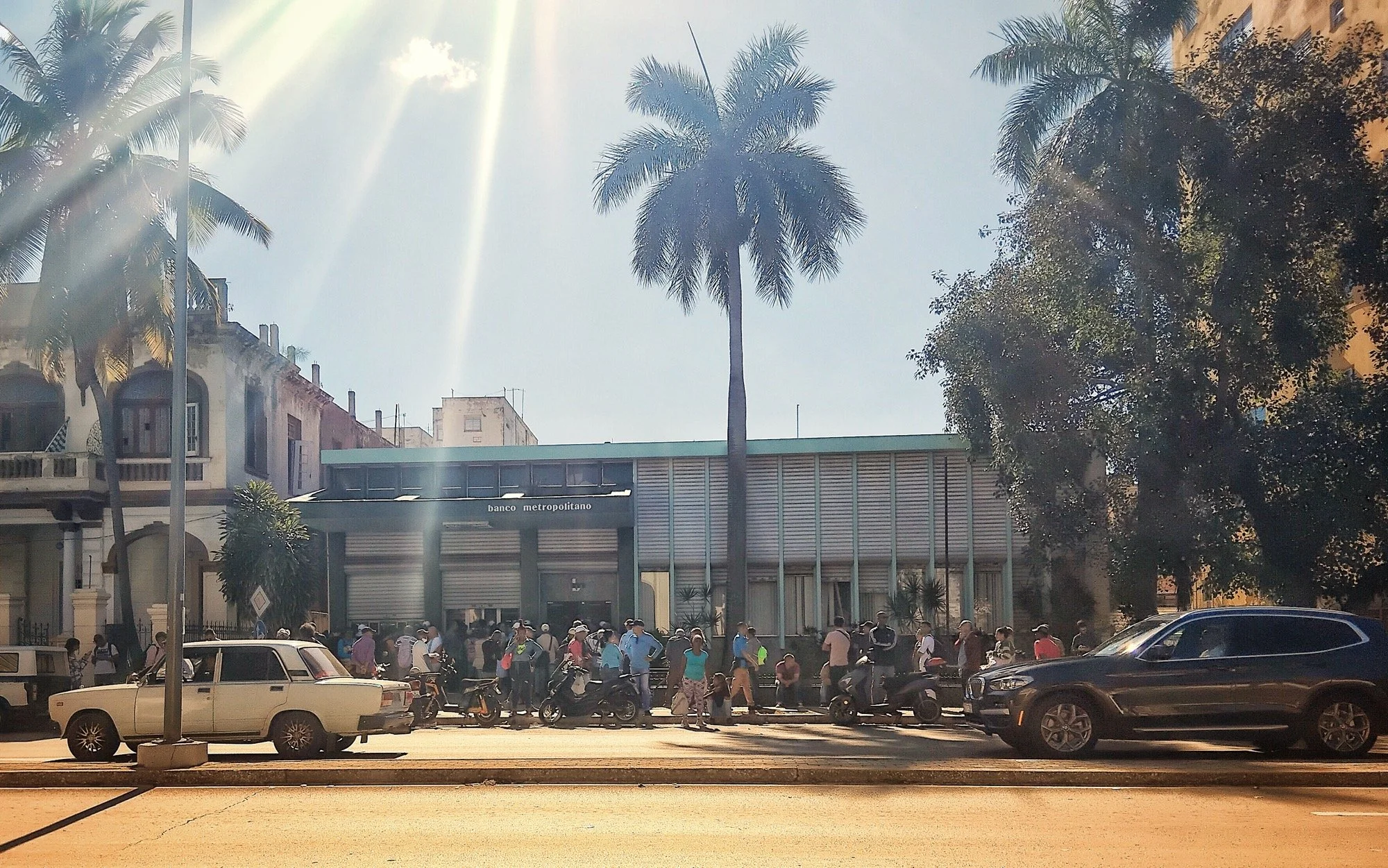
Queues at banks as people seek to withdraw cash with access to few working ATMs in Vedado, Havana, February 10, 2026. Photo © María Lucía Expósito.
Government repression continues
“A few years ago in Cuba, you could walk around without fear, but now the violence is palpable,” said José Julián Valiño, a young historian from Havana, in an interview with Ojalá. ”It’s a lot of psychological pressure: the city’s full of trash, falling apart, and you see children begging for money in the streets. I’m worried because the government doesn’t seem to want to engage in dialogue with civil society.”
The Cuban Human Rights Observatory reported that during there were at least 390 instances of government repression directed at Cuban citizens in January. Notable among these cases is the detention of the founders of 4atico—an audiovisual social media site critical of the Cuban authorities—who remain behind bars with no public sentencing.
Amid political aggression from the US, the Cuban government has opted to continue to neutralize opposition on the island. The violence in Cuba has many faces, and political persecution is one of them.
But today, Cuba is suffering a greater aggression: US sanctions. The most vulnerable sectors of society, including racialized people, those living in marginalized neighborhoods or rural areas, and the elderly, are the ones who suffer the most from the consequences.
Solidarity in the dark
I got a call from Ramón Silverio, the cultural promoter and founder of “El Mejunje,” a cultural and community center in the city of Santa Clara. Since the 1990s, El Mejunje has sought to create a safe space for independent artists and diversity. Silverio sounds optimistic when discussing Cuba. “We’ve been fighting our whole lives,” he said. “This time is no exception.”
El Mejunje is calling for an artistic campaign to help the most vulnerable in society. It is inviting artists, intellectuals, and Cubans at home and abroad to join or contribute financially to the “Teresita Fernández” brigade, which aims to bring art and solidarity to the most impoverished sectors of society. “Even if we only manage to bring them a little soup, it makes a difference,” said Silverio.
From Havana, journalist and LGBTIQ+ activist Maikel Gonzalez Vivero is also looking to help. He wants to organize solidarity breakfasts for the elderly and was working out the math when he spoke with Ojalá.
“With five dollars, you can give a glass of milk to more than 30 elderly people or children. A cup of coffee with milk, bread with egg, and a cookie,” he said. “That costs about 50 cents per person. In other words, with $50, you could provide 100 breakfasts.”
All of the people I spoke with know that life goes on for Cubans, who continue to seek solutions. We must avoid romanticizing pain while also acknowledging what deeply compassionate people are capable of doing to build a future for their own.
Amid the blackouts, sanctions, and domestic and foreign policy, there are also networks, intimacies, and people who resist.
So what can we do for Cuba right now?
We can care for life in places beyond the reach of the state, and defend dignity, even though we’re exhausted. This is not hollow optimism: it’s a certainty. As long as there is solidarity, the Cuban people will not be completely in the dark.
