
Building anti-militarist strategies for a feminist future
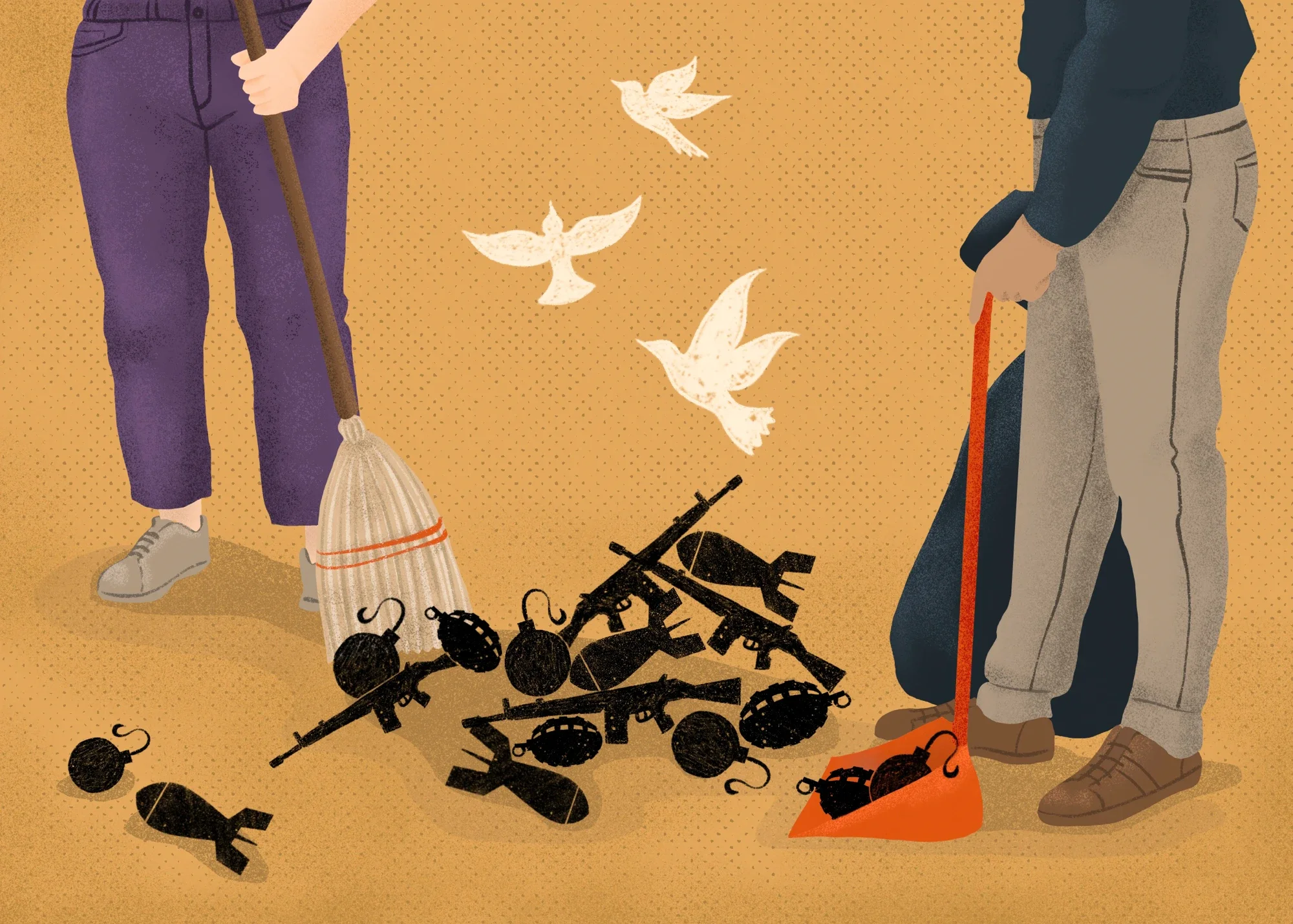
Original drawing for Ojalá by @pazconadie.
Opinion • July 23, 2026 • Dawn Marie Paley • Leer en castellano
Militarism’s long trajectory is bound up with the earliest iterations of some of the foundational elements of the world we live in today, from conquest, settlement, state formation, and citizenship to the establishment, growth and expansion of capitalism.
Throughout the 21st Century, and with renewed vigor since the beginning of the second Trump administration, militarism is on the march. Today, much of the world is at war.
Since February, the US Department of War has carried out repeated strikes in Iran, including one that killed at least 165 schoolgirls in March. Israel continues to terrorize the people of Palestine and Lebanon with the full support of Washington and its allies, and in full view of the entire world. Military and paramilitary campaigns in Congo and Sudan, backed by resource-hungry corporations and nations, have caused unbearable suffering. And Vladimir Putin’s campaign of armed conquest in Ukraine continues.
In Abya Yala, the escalation is taking the form of an amped up “war on drugs,” now branded a war on “narcoterrorism,” which promises to be exponentially worse than the already horrific violence of the past decades.
The US bombings of small boats in the Caribbean and Pacific have already killed over 200 people at sea, taking a tragic toll on coastal families in Ecuador, Colombia and Venezuela. Officials in Washington claim the strikes are making people in the US safer.
The high seas have become another space through which the Trump administration seeks to make extrajudicial killings of civilians by the US military into something routine. We must consider the meaning and impacts of these bombings in the context of a maritime space that has, at different periods in history, been used by migrants fleeing Caribbean nations by boat.
At Ojalá, we consider militarism—and the paramilitarism it can produce—to be among the most pressing threats to social reproduction and popular, communitarian and Indigenous movements. There are many ways to define militarism, but we’ll keep it simple: the deployment of centralized state forces with military training, be it in order to secure armed control over territory, in public works and administration, or in a policing role.
That’s why Ojalá is calling on writers and activists from diverse geographies to participate in helping us register the ways militarism is impacting their communities and how people are fighting back.
Exporting state terror
Washington and the Pentagon organize and export state terror around the world. Today, the US is a key site for the production of extreme wealth for very few, at the expense of the world’s majorities. It has the world’s largest military and the world’s largest weapons and war machines manufacturing sector, which now includes much of the tech sector.
Trump has brought new militarist pressures to bear, using differing tactics in different parts of the world. We would be remiss not to note that domestic militarization is ramping up, especially along the US southern border and through the Department of Homeland Security’s hyperviolent migration policing regime. The deployment of active duty military forces within the US is being justified by invoking a national security frame that casts migrants as potential terrorists.
Erstwhile US allies in NATO countries are being pushed to increase military spending to five percent of their gross domestic product under threat of tariffs. In December, German politicians voted to require all 18-year-old males to opt in or opt out of military service in a bid to increase troop numbers. And Canada announced a “defense industrial strategy” and billions of dollars in public funding for companies that profit from war.
The view from the south
In Latin America, a coalition of states sometimes called the “Shield of the Americas” was formed in March. The 17 signatory countries signaled their willingness to accept further US involvement in militarizing domestic policing under the pretext of controlling northward flows of narcotics and migrants.
Colombia, a country wracked by violence that has long been the hemisphere’s largest recipient of US military backing, didn’t sign on to the Shield of the Americas under President Gustavo Petro. But it is likely to do so once the far-right President-Elect Abelardo de la Espriella takes office on August 8th in a ceremony he insists take place on a military base.
Ecuador has become the testing ground for what are euphemistically called “joint operations” between US forces and local troops. The gaping asymmetry between US and domestic forces makes clear these are not, in fact, joint operations. In the case of Ecuador, they are better understood as an abnegation of sovereignty by an unpopular ruler who doesn’t even pretend to seek the support of voters. Instead, plantation heir Daniel Noboa guarantees his power through military force and proximity to Washington.
Militarism has surged in Mexico over the past eight years as successive left-wing governments have presented the increased size, reach and power of the Mexican armed forces—as well as their entry into economic affairs including transportation infrastructure, megaprojects and the management of ports and customs—as a bulwark against privatization and US expansionism. Sovereignty is invoked in discourse against US invasion threats, while US training of Mexican forces and military equipment transfers continue apace.
The expansion of military action under left governments is not unique to Mexico. Under Gabriel Boric, Chile sent troops to Wallmapu, in the country’s south, in an effort to police Mapuche communities, and to the north to police migration. This laid the groundwork for the intensification of the same under conservative rightwinger José Antonio Kast.
In Peru, the $3.5 billion purchase of 12 US F-16 fighter jets can only be understood as an attempt to cozy up to Washington. "Cooperation between U.S. and allied defense industrial bases has always been a shared source of security and economic benefit," said Mike Shoemaker, a Lockheed Martin VP, after the announcement was made. What Shoemaker calls cooperation is better be understood as coercion: the US ambassador to Peru played a pivotal role in pushing the agreement forward.
Elsewhere, militarization is taking place primarily vis-à-vis police forces, which are granted new equipment and training, often to combat the so-called war on drugs. This is the case in Costa Rica, as well as in Uruguay.
The tragic twin earthquakes that shook Venezuela in June are an open wound that is being exploited to encourage militarization. The quakes came less than six months after US special forces brazenly bombed Caracas and kidnapped President Nicolás Maduro and his partner Cilia Flores. The January 3 attack was a serious escalation of direct US intervention in the region.
In July, US Southern Command head Francis J. Donovan met with US troops on the USS Fort Lauderdale, an amphibious transport dock ship, off the coast of La Guaira, the region most impacted by the quakes. That meeting came after the arrival of US combat forces to the country. Reports of interference by the Venezuelan military in rescue efforts are also deeply concerning.
Anti-militarist strategies for a future worth living
In this troubling regional and global scenario, we have much to learn from anti-militarist movements of the past and present. Among them are the successful mobilizations to close the US naval training range at Vieques in Puerto Rico, the ongoing, multi-sectoral struggle to prevent the renewal of military leases in Hawai’i, and the work by Ecuadorian organizers to put the question of US bases to the public via plebiscite.
What can we learn from these and other anti-war and anti-militarism strategies? What is important to understand about the present moment, and what in particular is the role of feminist organizing in anti-militarist work?
Ojalá is seeking reported stories or opinion pieces by writers and activists that explore these and other topics. Each article will be edited by our incredible team in conjunction with authors, translated into either English or Spanish as required, and accompanied by original art.
If you’re interested in pitching an article for this series, please review our pitch guidelines here, and include “Militarism pitch” in your email subject line.