

Chiapas midwives organize in defense of life
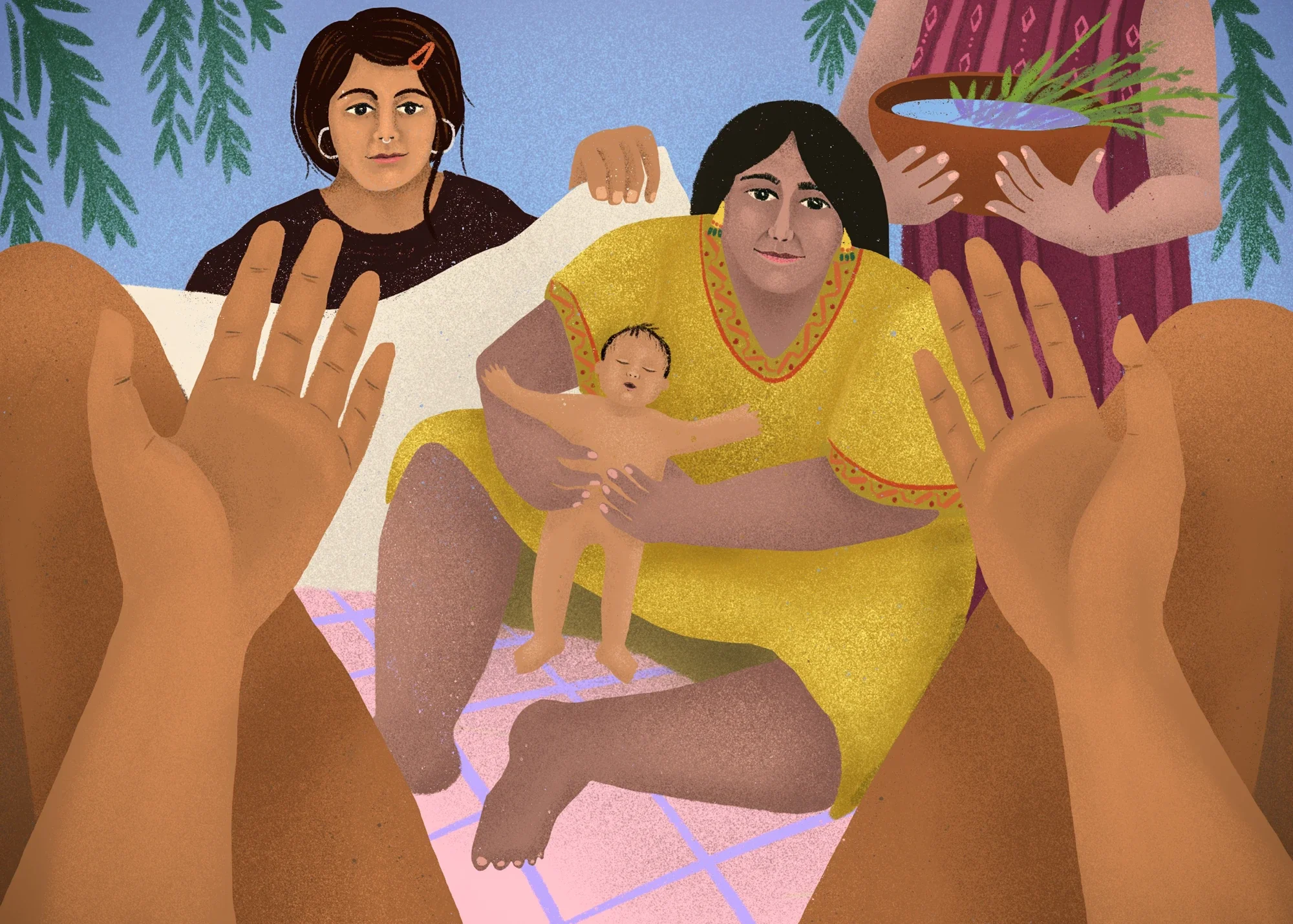
Original drawing for Ojalá by @pazconadie.
Reportage • Isàlia McIntyre • August 13, 2026 • Leer en castellano
Traditional midwives have long played a key role in Indigenous communities. In remote regions of Chiapas, Mexico, they’re a lifeline.
“We attend not only to the body, but also to the emotional side, the spiritual side, everything that our worldview embraces,” said Ofelia Pérez, a Tzotzil midwife from Chenalhó, in an interview with Ojalá.
That care exists in tension with a healthcare system that has historically dismissed, undermined, and at times prohibited traditional midwifery. In parallel, creeping institutionalization threatens to dissolve their practice via the very same channels meant to formally recognize it.
These tensions are unfolding in Chiapas, where steep inequalities shaped by geography, poverty, and racism yield among Mexico’s highest rates of maternal mortality. Discrimination compounds the risk for Indigenous people experiencing pregnancy, who are five times more likely to die in childbirth than others in the state. The erosion of traditional midwifery exacerbates their vulnerability.
In response, the Movement of Midwives of Chiapas Nich Ixim, which translates to “cornflower,” was born in 2014. Theirs is a multifaceted struggle against obstetric violence, hegemonic healthcare and the disparities driving maternal mortality. It is also a struggle to defend traditional midwifery as a bulwark of maternal health and autonomy.
Pillars of maternal health
Traditional midwives attend over 90 percent of pregnancies and childbirths in some of Chiapas’s most remote regions, usually in family homes. This happens for both logistical and cultural reasons. Many communities live hours of winding mountain roads from the nearest hospital, and travel is expensive. Chiapas is Mexico’s poorest state, and also home to one of the country’s largest Indigenous populations. Traditional midwives are often embedded in the social and spiritual lives of these communities.
Since Nich Ixim’s inception, over 600 midwives from 45 municipalities have joined this intergenerational and cross-cultural group of caregivers.
“We all come from different regions,” said Rosa Hernández, also a Nich Ixim spokeswoman and midwife of 51 years, in an interview with Ojalá.
She gestured to a group of her fellow midwives clad in intricate textiles, each unique to their origins. Others wore hoodies and graphic T-shirts. Nich Ixim had gathered in the city of San Cristóbal de las Casas, Chiapas, to march on May 5, the International Day of the Midwife.
“We come from different communities, and we are pillars of maternal health in each one of them,” said Hernández.
Their foundational role in maternal health means providing during and beyond gestation, labor and delivery. Traditional midwives help navigate fertility problems and family dynamics, which themselves can cause illness or malaise. They also treat conditions in infants like sunken fontanelle, digestive, or respiratory issues, “with the ancestral knowledge we have. We don’t study in school,” Pérez explained, referring to healing methods and herbal remedies.
Though some midwives cannot read, their literacy in plant remedies is deep, ancient, and specific to place. Keeping knowledge alive is another facet of Nich Ixim’s purpose.
“I think it’s very important that more youth follow this ancestral knowledge,” said Pérez. “We have been using medicinal plants for all of human existence, which is also traditional midwifery’s existence. Medicine came later.”
Collaboration not subordination
This does not mean Nich Ixim is hostile towards necessary obstetric interventions or medicine such as Cesarean deliveries.
“Our objective is to end maternal mortality,” said Hernández, and this entails identifying cases that do call for obstetric care. “We midwives know the limits of our ability to continue caring for women, because there are things we simply cannot handle. Both parts [midwives and medical practitioners] are necessary”.
Developing their own skills is an organizing principle of Nich Ixim, which holds formative workshops with doctors to better equip them to handle complications.
“Through the experiences we carry, we have learned many things, and through training received from doctors, we have also learned a lot,” said Hernández. For the movement, the issue is not whether traditional midwives should collaborate with the public healthcare system, but who determines the terms of that collaboration.
Nich Ixim categorically rejects schemes to medicalize their practice. Pérez described midwife certifications —state programs promoting biomedical training as criteria for formal recognition— as mechanisms “for eliminating traditional midwifery bit by bit. That’s precisely our struggle, to prevent that.”
Certification programs do not account for the social and spiritual dimension so essential to traditional midwifery. They also represent a vehicle for centralizing control, antithetical to the autonomous system Nich Ixim seeks to defend. Signs at the march echoed these sentiments: “No to the dispossession of our knowledge,” read one; “No to subordination,” read another.
Several midwives at the march pointed out that even when these programs are promoted free of charge, travel costs may render them inaccessible —especially since they often work not for money but for other forms of reciprocity.
Nich Ixim’s opposition is also a matter of cultural preservation, and a matter of principle. “We don’t depend on health institutions to reaffirm what we know how to do as traditional midwives,” said Pérez.
Threats to caregiving, old and new
Traditional midwives have not always been welcome in hospitals, and racist exclusion remains an obstacle to caregiving today. “By simply arriving [to hospitals] dressed in our way, in our traditional clothing, sometimes we are turned away, sometimes they don’t accept our accompaniment of our patients,” Hernández said.
In extreme but not uncommon cases, they face harassment and threats of imprisonment or fines, attitudes reflecting decades of demonization of traditional midwives. Of 67 midwives from 22 Mexican states, eight out of 10 described their job as dangerous.
Obstetric wards can also be sites of harm: 30 percent of all Mexicans who give birth in hospitals suffer obstetric violence —verbal harassment or physical mistreatment during childbirth— compared to three percent of those who give birth with a midwife. Studies link midwife-led care to fewer unnecessary childbirth interventions (including episiotomy, labor augmentation, and unplanned C-section), and lower rates of preterm births and post-partum depression.
Years of advocacy by groups like Nich Ixim have yielded increased legal protections for traditional midwives across Mexico, notably through 2024 reforms to Mexico’s General Health Law. Article 389 bis, for example, authorizes traditional midwives to issue birth certificates. But de facto incongruities persist.
“They don’t accept our birth record directly at the civil registry,” recounted Pérez, violating newborns’ right to identity. Similarly, midwife certification programs continue despite article 64 IV of Mexico’s General Health Law, according to which traditional midwives derive legitimacy from community recognition.
A struggle for autonomy
Nich Ixim walks a fine line, demanding institutional protections for their livelihood while staunchly resisting co-optation as a subordinate or symbolic extension of biomedical care. This is a constant challenge.
In May, the Ministry of Health established the National Midwife Committee with the stated goal of strengthening and coordinating traditional midwifery to expand culturally-informed care. It is composed primarily of representatives from government health institutions, raising fears of a top-down, centralized model that could absorb, regulate, and recast traditional midwifery on state terms rather than Indigenous ones. “The National Midwife Committee does not represent me,” read one midwife’s sign at the May 5th march.
Following public outcry, a revised committee structure included the National Indigenous Peoples Institute and the National Indigenous Peoples Council to strengthen representation. A subsequent Nich Ixim communiqué described committee members as “hegemonic, patriarchal, colonizing health institutions” totally removed from the reality of Indigenous peoples.
Controversy surrounding the Committee's creation illustrates a recurring paradox in Indigenous health policy: legal recognition can at times become another mechanism of control when it requires Indigenous knowledge to conform to the institutional architecture of the state.
While the 2024 General Health Law reforms acknowledged traditional midwives as legitimate caregivers in their own right, the Committee proposes a centralized mechanism for systematizing traditional midwifery. In their communiqué, Nich Ixim accuses the Committee of violating their rights as Indigenous peoples by “integrating our ancestral autonomous system into a Western system, devalorizing and technifying our knowledge.”
To the Nich Ixim midwives, theirs is ultimately an anticolonial struggle for both autonomy and life. Their logo—a fetus gestating in an ear of corn—reflects a worldview where humans and territory are fundamentally entangled, a relation which colonization sought to sever, treating bodies as territories of conquest themselves. Obstetric violence and reproductive control are among myriad manifestations of this.
“They feel like the owners of our body, of the bodies of all women, that’s why we’re seeing them appropriating our body, our autonomy,” said Pérez.
But while these threats are longstanding and have mutated over time, traditional midwifery is even older.
“Traditional midwives are guardians of birth, of cuerpo-territorio [body and territory as one], of the continuity of the life of our peoples,” stated the movement’s recent communiqué. They are also willing to grow, grafting medical knowledge onto ancestral practice to improve maternal health outcomes.
“We were here before the Spanish conquest,” said Hernández. “They sought to cut the branches, but they couldn’t kill the root.”