

Argentina’s scientists fight precarity
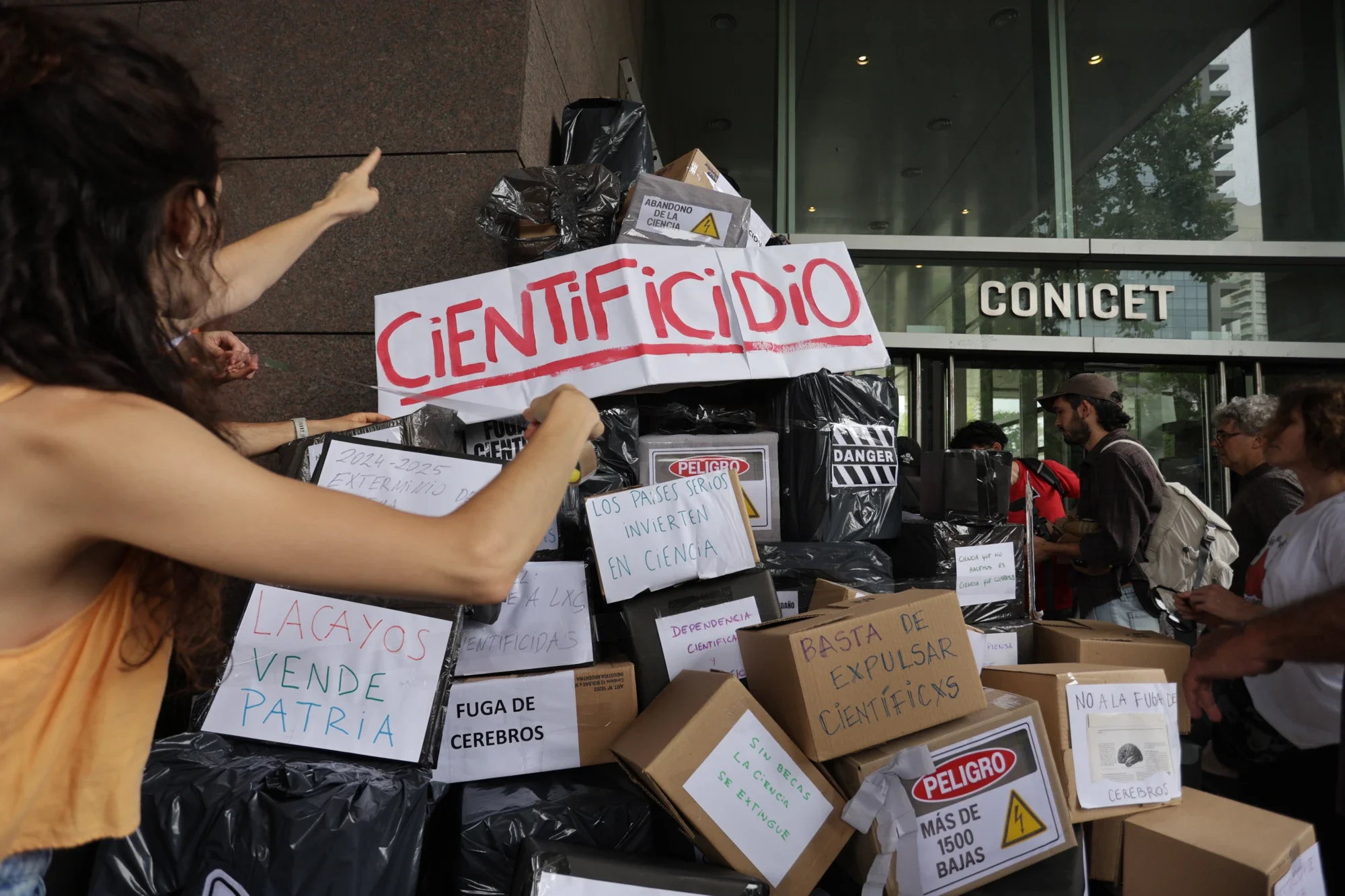
Protesters hold a “Christmas with science” rally at the Science Hub building outside CONICET headquarters in Buenos Aires. The wrapped packages bear the slogans “scienticide,” “stop expelling scientists,” and “traitors selling out the country” on December 22, 2025. Photo © Susi Maresca.
Reportage • Daniela López • August 14, 2026 • Leer en castellano
The Argentine researcher Josefina Buonocore reads a handwritten note on a box of medication out loud: “Blessings—God is love and power. Greetings from Flor, Sol, and Mirta.”
The medication inside is Letrozole, a drug prescribed by her doctor for the cancer treatment she began in mid-2025. She received it by mail in May 2026 thanks to the the support of three strangers.
“My story begins with a surgery—a double mastectomy,” said Buonocore. From the very beginning, she says, her health insurance provider—the mandatory medical coverage that government workers are required by law to receive—gave her the runaround. “They postponed my surgery I don’t know how many times,” she said. “I was so afraid that I ended up saving up money, asking my family for help, and organizing fundraisers.”
Buonocore works for the National Scientific and Technical Research Council (CONICET), the agency dedicated to advancing Argentine science that employs the largest number of scientists in the country.
Her story is set against the backdrop of a profound crisis among Argentina’s scientific community, who have experienced layoffs by the thousands, scholarship cuts, research funding shortfalls, and a 40 percent wage cut since Javier Milei took office as president in December 2023.
The situation is compounded by the lack of medical care that the state, in its capacity as an employer, is obligated to provide. As in much of Latin America, formal jobs are tied to a healthcare system in which both employers and employees are required to contribute a percentage of their wages to a health insurance provider. In Argentina, this contribution goes to the Caja de Salud, a health insurance plan that other countries call the Social Security Institute or National Health Fund.
Most national government workers are covered by Unión Personal, the health insurance managed by the Unión del Personal Civil de la Nación (UPCN) union. Over the past two years, in tandem with the government’s austerity measures targeting the public sector, the UPCN has faced a flood of complaints regarding its failure to provide adequate care to its members.
Workers have reported additional charges for medical appointments, suspended treatment for chronic illnesses, failure to cover surgical procedures, and delays in providing medications.
Some of these claims are being litigated. Buonocore has gone to court several times to demand reimbursement for her surgery, among other coverage issues. Her most extensive battle began in January 2026, when she requested three key medications—Letrozole, Leuprolide, and Ribociclib—to continue her post-radiation and chemotherapy treatment.
“I need to get that medication, but I don’t have the financial means to get it—I either get it, or I die,” she said. Buonocore’s salary—which at her junior researcher rank is around $900 a month—barely covers the cost of food.
Although Argentina has a public health system that guarantees free access to state hospitals, these facilities are plagued by a crisis stemming from high demand, a lack of supplies, and precarious working conditions for their staff. The private system is expensive, meaning that employee health insurance plans are essential to accessing timely medical care, medication, and complex treatments.
Mirta Rinaldi believes that many problems can be solved if people organize to contribute and help one another. She is 67 years old, a retiree from the administrative department of CONICET in Buenos Aires. When a researcher friend shared Buonocuore’s prescription listing the three medications she needed, Rinaldi posted a status update on Whatsapp. What followed was an outpouring of solidarity.
“I usually share these kinds of requests on my status, because there are always kind-hearted people who respond,” she said. Flor, a fellow church member, shared the request in a group chat for cancer patients and their families, which is where Sol’s message appeared.
“She told me, ‘I have a box; I’m undergoing treatment myself, but I’m going to give you one because I know she needs it.’ One box is better than nothing, so I told her yes, that I would go pick it up.”
Before taking it to the post office, Mirta wrote a heartfelt message on that box of Letrozole, which would travel the more than 1,000 kilometers that separate Buenos Aires from Tucumán, the province where Buonocuore lives.
Necessity against privacy
“A person’s medical history shouldn’t be known to everyone,” said Rolando González-José, a researcher from Puerto Madryn, a Patagonian city on Argentina’s Atlantic coast where CONICET has nine research institutes, one of which he directs.
González-José argues that publicly asking for support to address health issues leads to a level of public exposure that not all workers are willing to endure. For him, these are issues that should be handled with sensitivity and seriously, as mandated by health care protocols.
“It’s standard procedure—confidentiality clauses state that when human resources departments receive information, they can’t go around airing it out in the hallways,” he said in an interview with Ojalá. “But when someone has a more serious problem, we end up finding out sooner or later, because that person needs help.”
From a bioethical perspective, health information must remain private as part of human autonomy and dignity. A person’s physical or mental state is part of their privacy; they have the exclusive right to decide which aspects of their health to disclose, to whom they grant access, for what purpose, and for how long.
“We are seeing how behaviors that should not exist are becoming normalized,” said González-José. “We shouldn’t have to be raising money to help colleagues who are sick.”
Nelci Pascual, a union representative for the Association of State Workers and a technical specialist at the Multidisciplinary Institute of Plant Biology in the province of Córdoba, puts a name to this issue. “Having to go out and beg when you’re working for the very thing you’re demanding is violence.”
“Having a job that guarantees health care but being forced to do things while in a vulnerable situation is a step backward that undermines labour efficiency,” said Pascual. “It’s impossible to truly focus on work activities under these circumstances.”
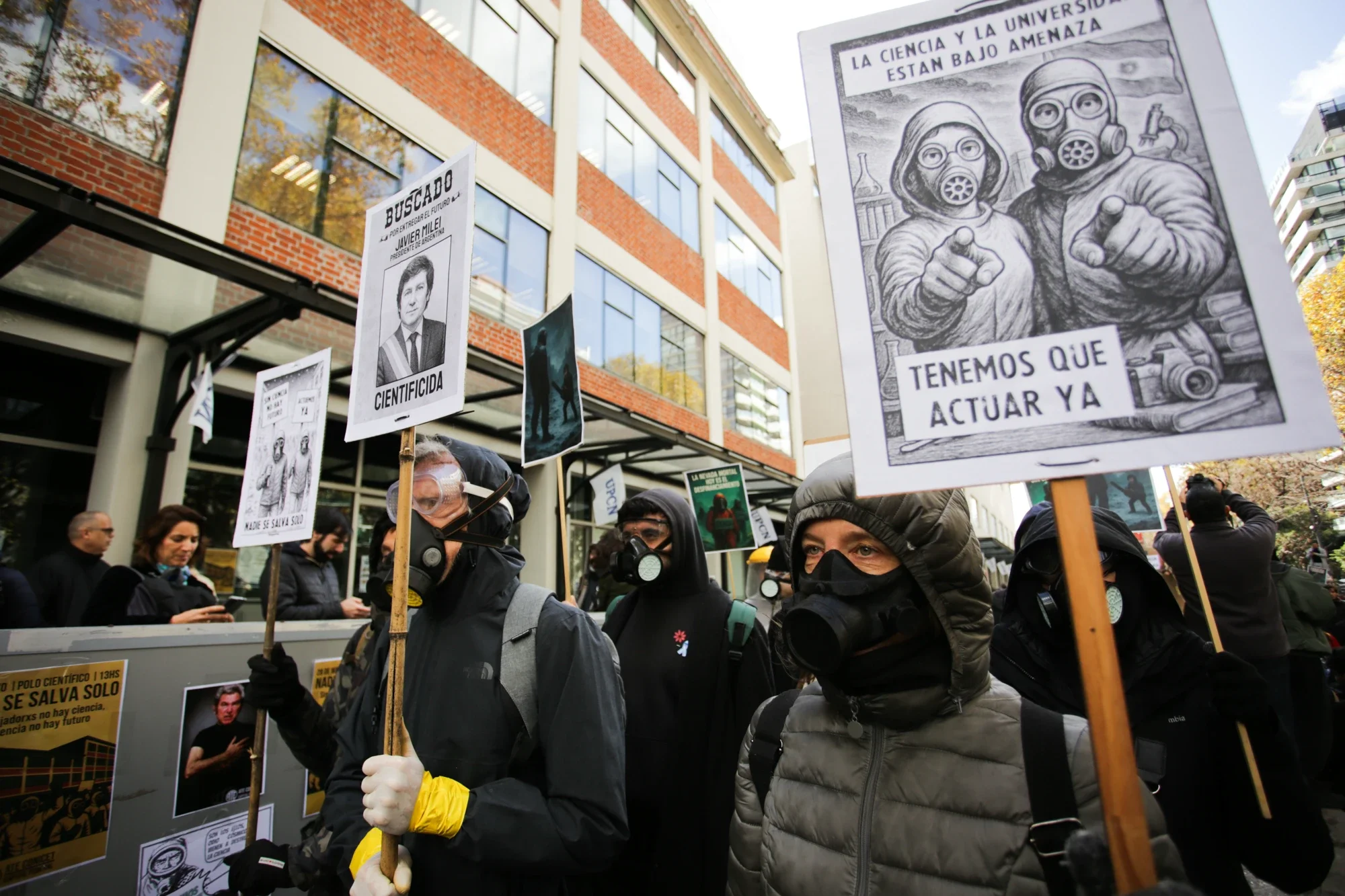
“Science and higher education are under threat,” proclaims one of the signs held by scientists dressed as eternauts (based on the comic The Eternaut) as part of a rally organized in Buenos Aires under the banner “Science in Crisis” on May 26, 2025. Photo © Susi Maresca.
Walls of silence
Neither the executives of Unión Personal nor members of the UPCN union responded to repeated interview requests sent by Ojalá. Since 2024, the health insurance company has gradually closed most of its 78 customer service offices located in various cities across the country and transitioned to “virtual assistance.”
The La Plata branch, in the capital of Buenos Aires province, closed in February 2026. That’s where Flavio Sives lives. He’s a 55-year-old technician who has worked for two decades at the La Plata Institute of Physics. His health insurance plan covers his two children, ages 18 and 20.
In recent months, Flavio says he’s witnessed a dramatic decline in access to medical care in his city, to the point where he is seriously considering switching to another health insurance provider.
“There are three of us on a single plan, and given my age, a ‘reasonable’ plan would mean spending 20 percent of my salary, which, when added to other child-rearing expenses, makes it an unfeasible option,” he said in an interview with Ojalá. To resolve pressing issues, he recalls, he had to travel to the city of Buenos Aires, about 60 kilometers away.
In addition to being ignored, union members have complained about the termination of agreements with medical providers, leading to interruptions in treatments and procedures. The option to request reimbursement was also removed from its website and apps.
The lack of response from CONICET officials is yet another obstacle scientists face.
González-José describes a two-pronged battle for scientists seeking medical care: on the one hand, the bureaucratic process at CONICET; on the other, the courts, which in some cases seem to be the only way to ensure medical care.
“Navigating this system right now is an act of resistance—resistance on behalf of the youngest members of our community and an effort to get through this as quickly as possible,” he said.
Buonocore says the outlook is bleak and it’s hard to see the light at the end of the tunnel, but she doesn’t hesitate to point out that the way forward is through struggle. “People keep fighting and defending what’s right—that gives us hope. That’s the way forward.”