

A shared meal, a collective embrace
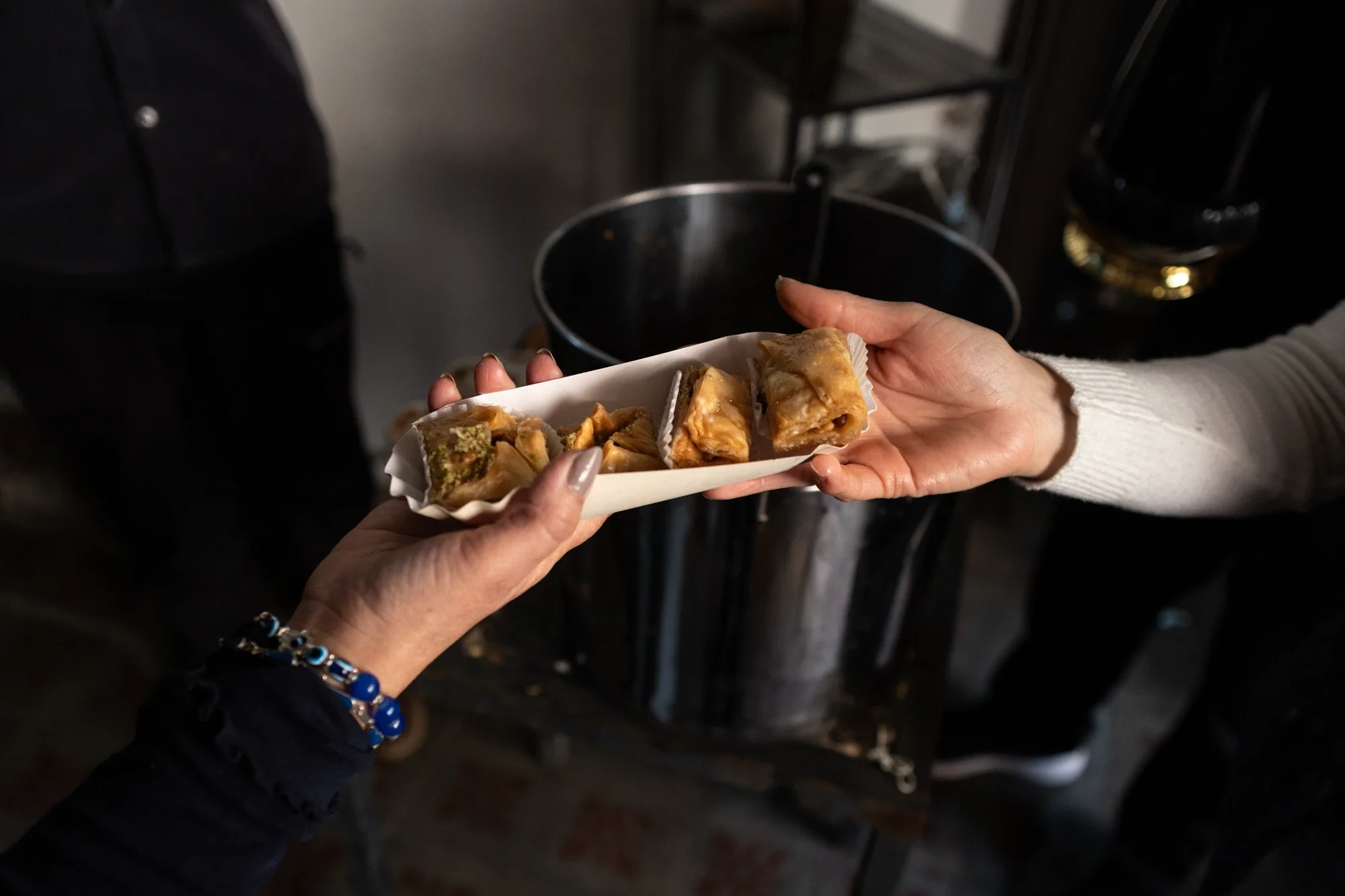
Randa Alagha serves Arabic sweets to attendees at a solidarity lunch for Palestine in Santiago, Chile, on June 27, 2026. Photo © Sofía Yanjarí.
Reportage • Yasna Mussa • August 20, 2026 • Leer en castellano
Until a few months before traveling to Chile on September 10, 2025, Randa Alagha and her family couldn’t find the country on a map. Alagha, who lived in Gaza at the time, had to Google “Chile” the first time she heard its name.
She didn’t know that Chile's official language is Spanish, that it’s in South America, or that it’s a secular state with a majority Christian population. Nor did Alagha and her husband, Mohammed Tabal have any idea Chile is home to the largest number of Palestinians outside the Arab world.
Amid the chaos wrought by Israel’s ferocious genocide in Palestine, Alagha had to learn the essentials about Chile in record time while reckoning with the fact that the distance represented an opportunity. The 11,000 kilometers separating Chile from Palestine ensure a peaceful and safe life for the couple and their four children, far from the bombs, occupation, annihilation, and dehumanization of the Palestinian people.
Breaking bread together
A few months ago, on Sunday, April 26, Chile’s capital Santiago had a warm, autumnal glow. Balloons and Palestinian flags festooned the College of Psychologists, a union association.
The main hall was taken up with a table full of guests chatting and laughing as if they were at a family celebration. From the back, in the kitchen, Tabal greeted us with a smile and a friendly gesture, without taking his eyes off the steaming pots on the stove.
All of the tables were full. The only available seats were in a small spot in one of the inner courtyards. There we settled in among strangers, not quite sure how this “Palestinian Solidarity Maklube” worked. Like many in attendance, we learned of the meal through social media.
“We invite you to be part of a unique experience: a traditional Palestinian lunch prepared by the Tabal family,” read a post on Instagram. “The main dish will be Maklube (مقلوبة), an iconic Palestinian recipe whose name means ‘to turn over’: rice, vegetables, meat, and spices, cooked with patience and tradition.” The goal was to come together to share a meal, but also to raise funds for the Alagha-Tabal family.
Little Ghaith, age eight, the third child of this Palestinian family from Gaza, approached our table. Acting as an impromptu waiter, he asked us if we’d like juice or soda. His Spanish is tentative, but he serves as the family’s interpreter. With the spontaneity that comes naturally to children, he has quickly learned the language of his new home and is the natural host, welcoming guests.
When the meal was ready, Tabal—who used to sell cars in Gaza but became a cook in exile—grabbed the pot by its handles. The guests stood, gathered around the table, and got their cell phone cameras ready to record as the chef flipped the enormous pot over and slowly lifted it away.
Magic unfolded. A huge, steaming rice cake appeared to applause as the crowd prepared to taste this traditional Palestinian dish for the first time, or to recall the familiar flavors once prepared at home.
The sharing of food allowed for exchange between cultures, and flavors served as a reminder of a dispossessed land to which many long to return.
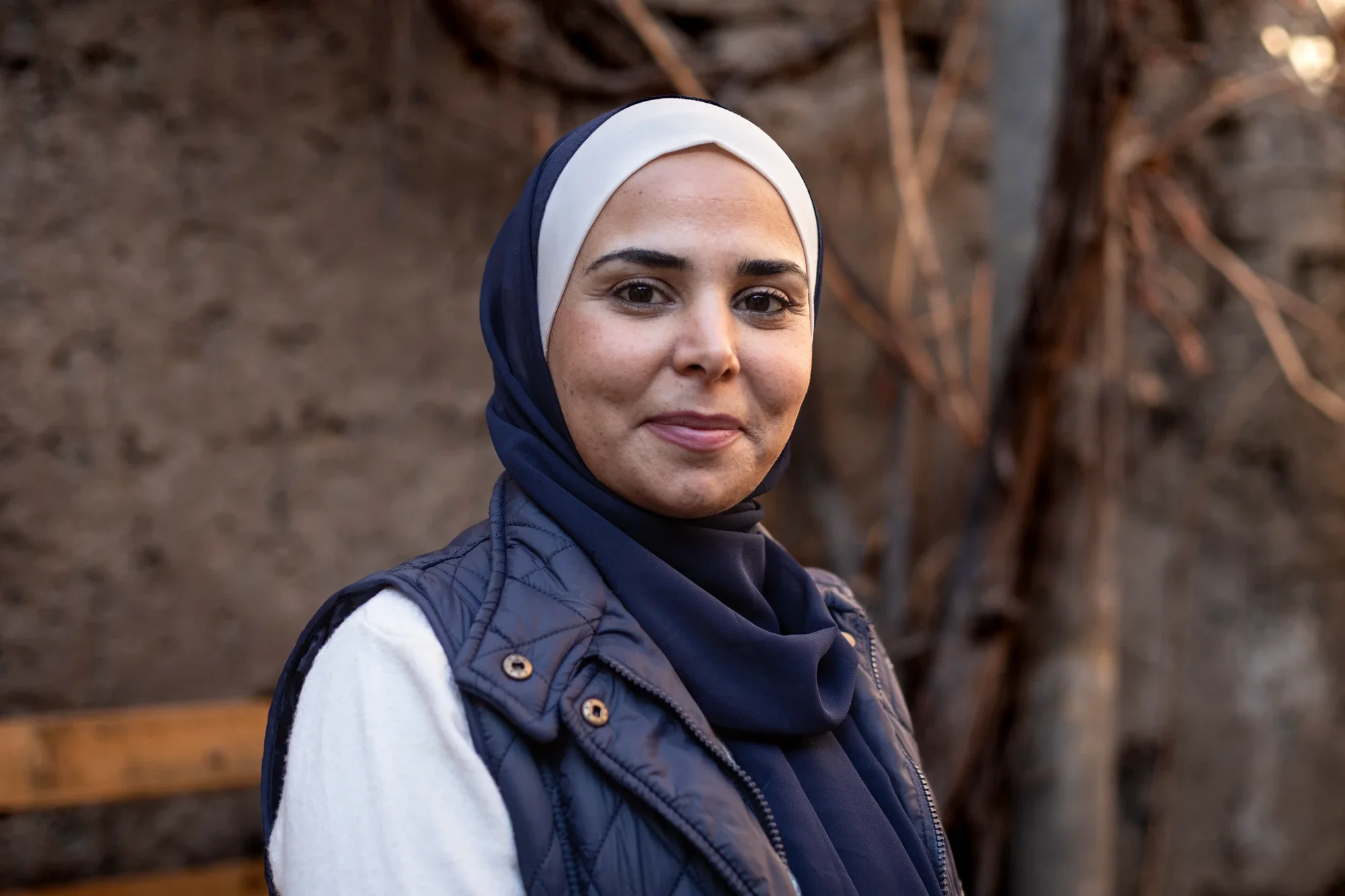
Randa Alagha, a Palestinian refugee in Chile, during a solidarity lunch for Palestine in Santiago, Chile, on June 27, 2026. Photo © Sofía Yanjarí.
Saying goodbye to Palestine
On October 7, 2023, everything changed for this family from Khan Yunis, the second-largest city in Gaza. Alagha was three months pregnant. The joy of expecting her fourth child was gradually overshadowed by fear, uncertainty, sadness, and despair.
Today, living in an apartment provided by the Chilean government—which granted them refugee status under the Gabriel Boric administration—Alagha explains in English that she is struggling to learn Spanish because her mind and heart remain in Gaza. With her family, who are still there, surviving under extreme circumstances. And with her mother, who is alone in a hospital in Egypt.
Although she boarded two buses and three planes to reach this corner of the world, the 38-year-old Arabic teacher feels as if she’s in a kind of limbo that prevents her from being close to the rest of her loved ones or settling into her new country. As we speak, when Alagha forgets a word, Yacoub, her 18-year-old eldest son, steps in to help her finish her sentences.
“It’s very hard to consider the future. I think we’re still in shock. We had plans and dreams, but now we’ve had to start our lives from scratch, so it’s hard to imagine the future,” said Yacoub when I asked her how they envision their life in the land that welcomed them.
In the middle of the austral winter, on Friday, July 17—exactly 10 months after they arrived in Santiago—I sat down with Alagha. She served up sweetened Arabic tea, fruit juices, cheese-filled pastries, and manakish, a flatbread topped with a mixture of za’atar and olive oil. Her account flitted between the horror of her final months in Gaza and the boundless gratitude she feels for Chile, for the welcome filled with solidarity and concern they’ve received over these past months.
The memories of those days in Gaza in the midst of genocide reflect the shared experience of repeated exposure to terror. Mass bombings, leaflets dropped from the sky announcing that they would be attacked, the desperation of fleeing with only the bare essentials and seeking shelter amid collective panic.
Then came the shortages. The struggle to find the essentials: a shelter, a shower, food.
With the hospitality so typical of Palestinians, Alagha insists that I eat and drink my tea before it gets cold. Out of nowhere, Yaman, the youngest of the group, meanders in front of us. His mother tells me that he’s been attending a preschool in their neighborhood for a month, while Ghaith and Kenan, his eight- and 15-year-old brothers, go to an Islamic school in another neighborhood of Santiago. Yacoub, the eldest, has just successfully taken the Tawjihi—the Palestinian high school graduation exam—remotely and hopes to study medicine.
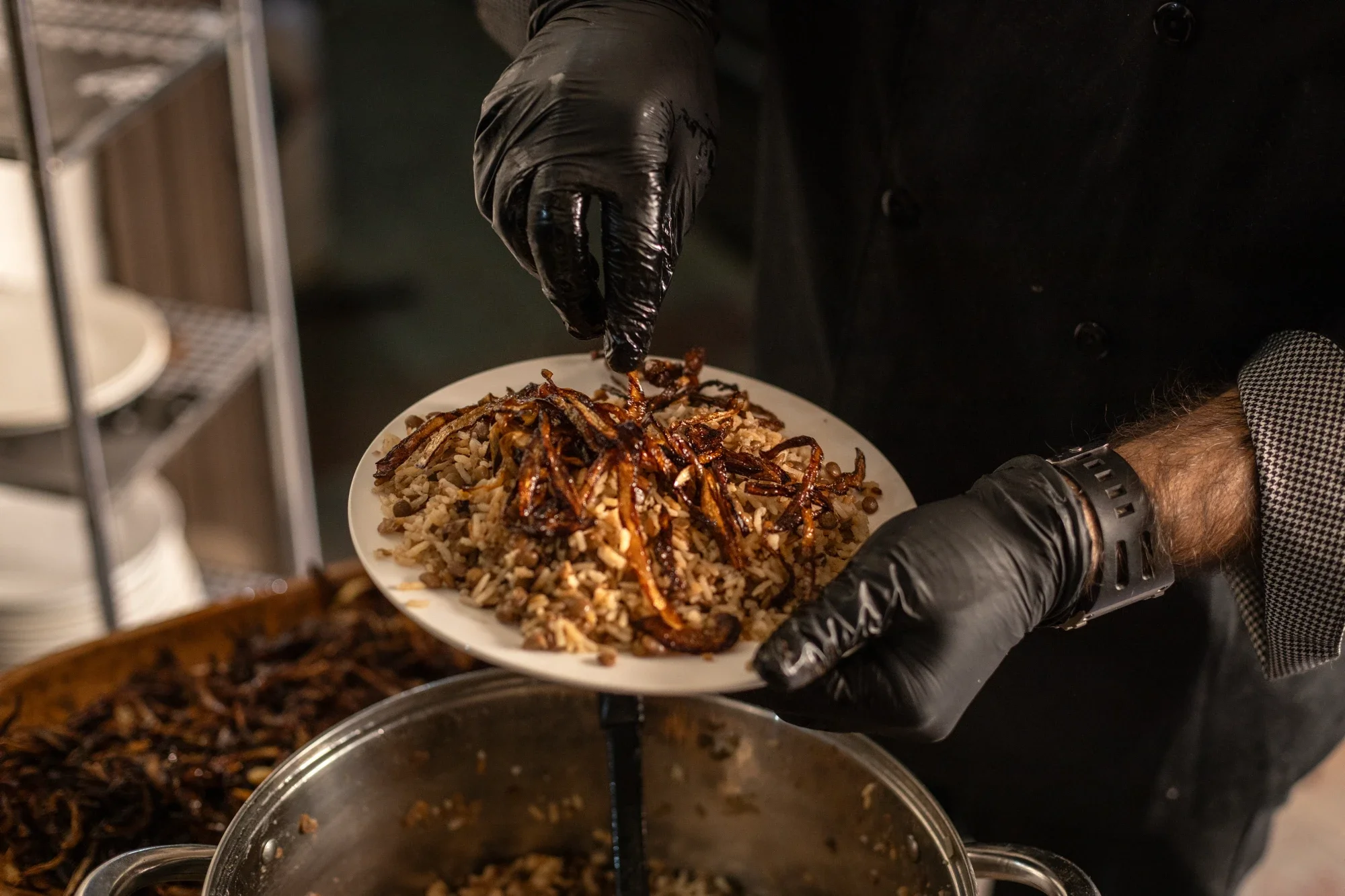
Mohammed Tabal serves food at a solidarity lunch for Palestine in Santiago, Chile, on June 27, 2026. Photo © Sofía Yanjarí.
Yaman, with the energy and curiosity with which children discover the world, bursts into the room, smiling and mischievously eager to touch everything. I ask him in Spanish how old he is, and his mother can’t believe her eyes. Her youngest son—whom she didn’t realize already understood Spanish, which the adults still don’t grasp—holds up his index and middle fingers. Two years old.
Alagha is moved. That curly-haired, cheerful, and playful boy came into the world under the most adverse circumstances imaginable. She spent most of her pregnancy fleeing death in subhuman conditions in the middle of the Levantine winter.
On the day Yaman was born, they were living in a tent, without heating and getting soaked every time it rained. Alagha underwent a C-section without basic medical supplies, like gauze or sterile drapes, or adequate hygiene. Life seemed to stretch beyond the possible. They named him Yaman, which translates from Arabic as blessed, bearer of kindness, blessings, and happiness.
Following that miracle, the Tabal-Alagha family decided to find a way out of Gaza. Through other Palestinians they met in the year and a half of displacement, moving whenever Israel decided to attack a new area of Gaza, they learned that Chile, a country then unknown to them, might be a possibility.
There was no time for goodbyes or to process what that meant. Within 10 days, they received a response and instructions: they were to leave with only the clothes on their backs. Not even a backpack, a handbag, not even diapers for Yaman, not even milk for his bottle. Their belongings in Gaza were reduced to nothing more than their identity documents inside a clear plastic bag. These were the conditions imposed by the Israeli occupation.
Few convictions are as powerful as the will to life. The Tabal-Alagha family boarded a bus to the border with the West Bank. There, they took another bus to Ramallah, where the Chilean ambassador was waiting for them. Along the way, they were given diapers and food. They continued on to the Jordanian capital. In Amman, another Chilean diplomat welcomed them, concerned not only with coordination but also with offering encouragement and ensuring that everything was in order: suitcases with new clothes, hygiene kits, basic supplies for the children, diapers, and a baby bottle.
What caught everyone’s attention most were Yaman’s reactions to his “firsts”: the first time he saw cars, the first time he saw and ate an egg, the first time he watched television.
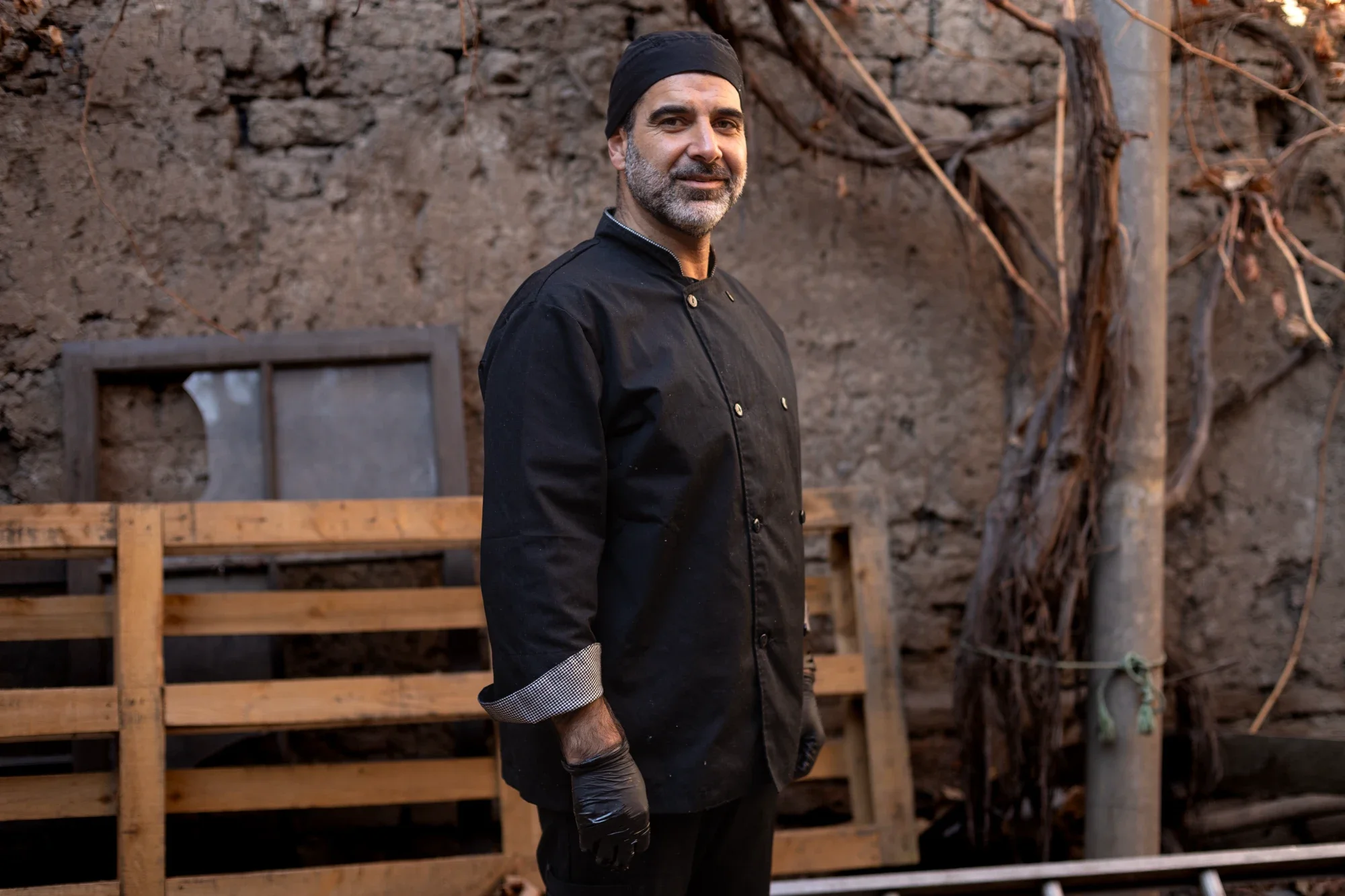
Mohammed Tabal, a Palestinian refugee in Chile, during a solidarity lunch for Palestine in Santiago, Chile, on June 27, 2026. Photo © Sofía Yanjarí.
Solidarity across the world
In the 10 months since they arrived as refugees along with more than 50 others, the family has not yet been able to see much of Chile. The exception was a trip to Viña del Mar, a coastal city about 120 kilometers from the capital.
“We loved it and were impressed. It looks a lot like Gaza before the war. Especially the avenue that runs along the coast with its buildings and palm trees,” said Alagha.
The hospitality they’ve received from officials and citizens never ceases to move them. In a gesture of reciprocity, on June 27, they organized a Solidarity Lunch for Palestine as part of a community gathering at the Casa de la Memoria.
Together with the Sumud Qum Collective—which in Arabic means “to resist and rise up”—Tabal prepared Palestinian mujaddara, a traditional dish made with lentils and rice. All proceeds went to help his relatives who continue to live amid the destruction in Gaza.
But more was shared than a popular Palestinian meal. The walls displayed a photo exhibition on resistance in Chile, including portraits of those who were forcefully disappeared during the dictatorship. There were Arab handicrafts and Palestinian pastries. Guitar music and children played among the diners.
Kenan, the family’s second son, wrapped in a keffiyeh, took the microphone and read from a piece of paper. In a nervous voice, in a language he is gradually making his own, he recited his first poem in Spanish:
My name is Palestine
Don’t whisper it
Say it as you would speak the truth—loudly and without fear
My name is Palestine,
not a slogan,
not a fashionable banner.
My name is Palestine.
I am not a number in a line,
I am not a photo tucked away after the news
I am the son of a lonely land.
My name is Palestine.
When I speak it,
questions roar,
rifles falter,
and history awakens from its false slumber.
They said: It’s over.
I said: It’s the beginning.
They said: When will you forget?
I said: When the land forgets its own name.
My name is Palestine.
If I call, the land will answer.
If it is denied, blood will prove it.
I do not borrow my identity,
I do not explain my pain,
I do not ask permission to be here.
My name is Palestine,
written in ink that never dries,
stained with the patience of mothers
and the anger of children
who grew up
before their time.
We do not die—
we are postponed.
In the end,
do not ask me who I am.
I am Palestine.
