
Fuel shortages and extractivism in Bolivia
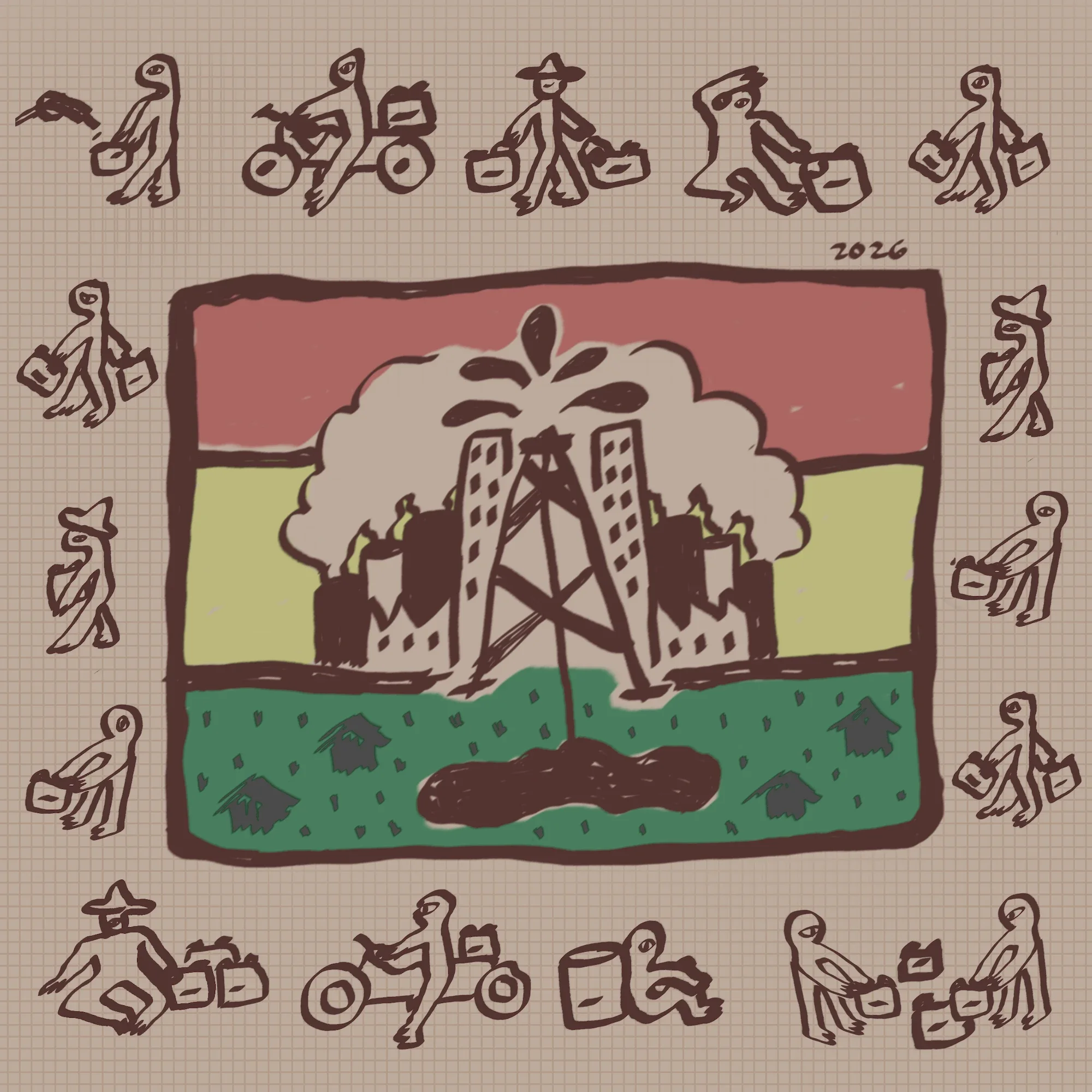
Progress. Digital illustration © verteselva.
Opinion • Claudia López Pardo • August 21, 2026 • Leer en castellano
Bolivia’s energy crisis shows no signs of abating. A shortage of fuel is driving uncertainty, as people are forced to queue at gas stations in major cities.
Lines filled with cars of all sizes, shapes, colors, and models waiting to refuel carpet cities, becoming part of the urban landscape. Rows of jerry cans hold their owners’ place in line. There are also long lines of freight trucks, with wait times ranging from one to three days to fill up with diesel. In some places, there is also a shortage of propane for household use.
The practice of lining up for fuel has quickly become the norm, and the shortages are an indicator of crisis, inflation, speculation, and the increasing precariousness of daily life.
Everyday conversations are full of questions. How will we deal with the gas shortage? Will we go back to cooking with firewood? How much more will the price of propane go up?
Another question being asked in Bolivian homes and in the media today is whether new drilling could resolve the daily problems created by fuel shortages.
The significant decline in gas reserves and production has the government of Rodrigo Paz, heir to the previous extractivist regime, sparing no effort to advance the operations of Yacimientos Petrolíferos Fiscales Bolivianos (YPFB) and Petróleo Brasileiro (PETROBRAS) in the Tariquía Flora and Fauna Reserve.
Added to the issue of shortages is the adulterated gasoline distributed by YPFB, leading to damage to vehicles. The government is meant to pay compensation to 89,651 affected individuals.
Although YPFB accepted institutional responsibility, all signs point to corruption within the state apparatus. In April, the minister of hydrocarbons Mauricio Medinaceli was fired and is currently under house arrest.
What’s clear is that there is not enough fuel to meet daily demand. The lines for propane, diesel, and gasoline are the visible, recurring manifestations of a fuel shortage that has persisted since the beginning of 2025, if not before.
This issue extends beyond the cities. Life in rural areas takes place on a more family- or community-based scale and is affected by the scarcity and difficulty of obtaining diesel to run agricultural machinery and tools.
In contrast, agro-industrial capital does not have to wait in line: the Eastern Agricultural Chamber has an agreement with YPFB guaranteeing a direct daily supply of fuel to business.
The Paz administration announced that it will keep the domestic price of propane frozen at 22.50 Bolivian pesos ($1.89 USD) per 24.2-liter cylinder, but the decline in domestic gas production is putting increasing pressure on the cost structure. This concern is related to the possibility of having to import propane at significantly higher prices.
The gas crisis may gradually spill over into households' day-to-day lives, especially if the state can no longer cover the difference between domestic prices and import costs.
In addition, price hikes for basic goods and staple foods are on the horizon, which will bring a new host of challenges to Bolivian kitchens and for social reproduction.
Terms of the dispute
There are two ways to approach what is at stake in the debate over whether Tariquía should be opened up for gas extraction or not. The difference lies in who determines the value of the land. The choice is between the Bolivian state and the communities that are fighting in defence of life.
Gas is a primary common good in Bolivia’s energy mix. It is used for generating electricity, in industry, and for residential and commercial consumption. Bolivia is a gas exporter, with Argentina and Brazil as historically dominant destinations. Thus, government revenues depend on export production levels.
Since the beginning of his administration, Paz has resorted to taking on debt to cover the shortfall. Under a program called “Smart Energy Capitalism,” he has eliminated hydrocarbon subsidies and imported and distributed large volumes of gasoline and diesel, while simultaneously attempting to open the energy sector to private capital. On August 17, he issued Decree 5676, removing the diesel subsidy for large consumers, a measure designed to reduce import costs.
The government’s “energy transition” approach aims to explore in territories with probable gas deposits, such as the Tariquía biosphere. This exploration of new areas is presented as a strategy to restore national production and revenue.
In this sense, the dispute over the Tariquía Reserve can be analyzed as a struggle between two ways of calculating value. The first involves viewing territory as a source of hydrocarbon revenue, and the second as a space for the reproduction of life.
The Tariquía Flora and Fauna Reserve is a fragile ecosystem home to 22 rural communities whose daily lives are sustained through coexistence with the non-human world. Their balanced management of this protected area has ensured the preservation of the humid, biodiverse forest.
By virtue of the ecosystem's self-sustaining capacity, the Tariquía reserve guarantees ecological processes, regulates and supplies water, conserves soil, maintains biodiversity, and regulates climate and carbon cycles. These functions guarantee the material conditions necessary to sustain life—not only for human and non-human communities in Tariquía but also for the rest of the country.
These supports to the regulation of air and climate cycles cannot be quantified and do not appear in the state’s economic accounts. In contrast, subsurface gas is a quantifiable commodity.
The communities of Tariquía have been opposing the entry of oil companies into the Reserve for more than a decade. For its part, the Paz administration has committed to reactivating the Domo Oso X3 well, the potential of which would be proven through drilling and exploration.
To date, there have been a series of controversies surrounding the new well—located as it is in the buffer zone to the watersheds’ headwaters —and regarding the validity of the consultation process for the project’s approval.
Most recently, YPFB-PETROBRAS’ attempts at approving the new environmental management plan while insisting on promoting its proposal has generated further conflict among the communities of Tariquía.
Tariquía on the chopping block
We are navigating the threshold of a time wherein the harshness of structural conditions facilitates a process of social fascistization. We saw how, during the last conflict—roadblocks that lasted more than a month in many parts of the country—the most reactionary tendencies also surfaced.
In a country with a history of struggles for the common good, we have learned that the crisis of social reproduction requires us to return to debates within our networks, neighborhoods and communities. Today, our task is to understand the fuel shortages, inflation, and rising prices of basic necessities so that we can become responsible for the social issues on which the reproduction of our collective life depends.
Politicizing the terms of our sustainability as well as Bolivia’s current dependence on oil and gas revenues places at the center the importance of the territorial defense struggles of Tariquía’s communities.
Our quality of life depends on the forest’s ecosystem and metabolic flows, as well as on the communities that, in harmony with the forest, work and sustain their lives there. We benefit more from preserving and defending Taríquia than from the capitalist plunder carried out by the Bolivian state and its transnational allies.
This debate is not just environmental, it is economic and political. The ecological benefits are incalculable compared to the profits from hydrocarbon revenues. If these benefits are preserved, the lives of future generations can be sustained. On the other hand, if the government extracts the gas, it will be depleted. Its cycle is finite.
The end of the gas cycle highlights the role of rentier policies across the span of government regimes, from openly neoliberal to progressive. The current model of accumulation has historically benefited capitalist entrepreneurs by granting them subsidies and expanding the frontiers of development through the opening of protected areas to oil and gas activity. It’s a disgrace!
If the fuel shortage affects all levels of social reproduction and life, then precariousness is not a fringe phenomenon, but the norm—and it affects us all. After all, who are the managers of this state of precariousness? Who benefits most from the extractivist accumulation model?
While we know that the Bolivian economy depends on global markets, it is not our destiny to remain eternally dependent on raw-material exports.
We need a genuine energy transition paradigm that challenges this dependence and regulates production, distribution, and consumption flows. The Paz administration’s proposal for diversification deepens dependence.
Today’s problems, created by extractivist development that strips the land and communities of their resources, leave us facing a complex and unsustainable future. The societal, energy, and environmental costs incurred when these territories are dispossessed of their resources can no longer be hidden behind sectoral or environmental narratives. Let’s get back to the debate and set the record straight to prevent the Paz administration from tearing apart the communities of Tariquía.
The energy crisis is not merely a shortage of fuel or natural resources; rather, it calls into question the very model of accumulation. Who benefits, and at whose expense?