

Cuban women again bear the marks of cooking with fire
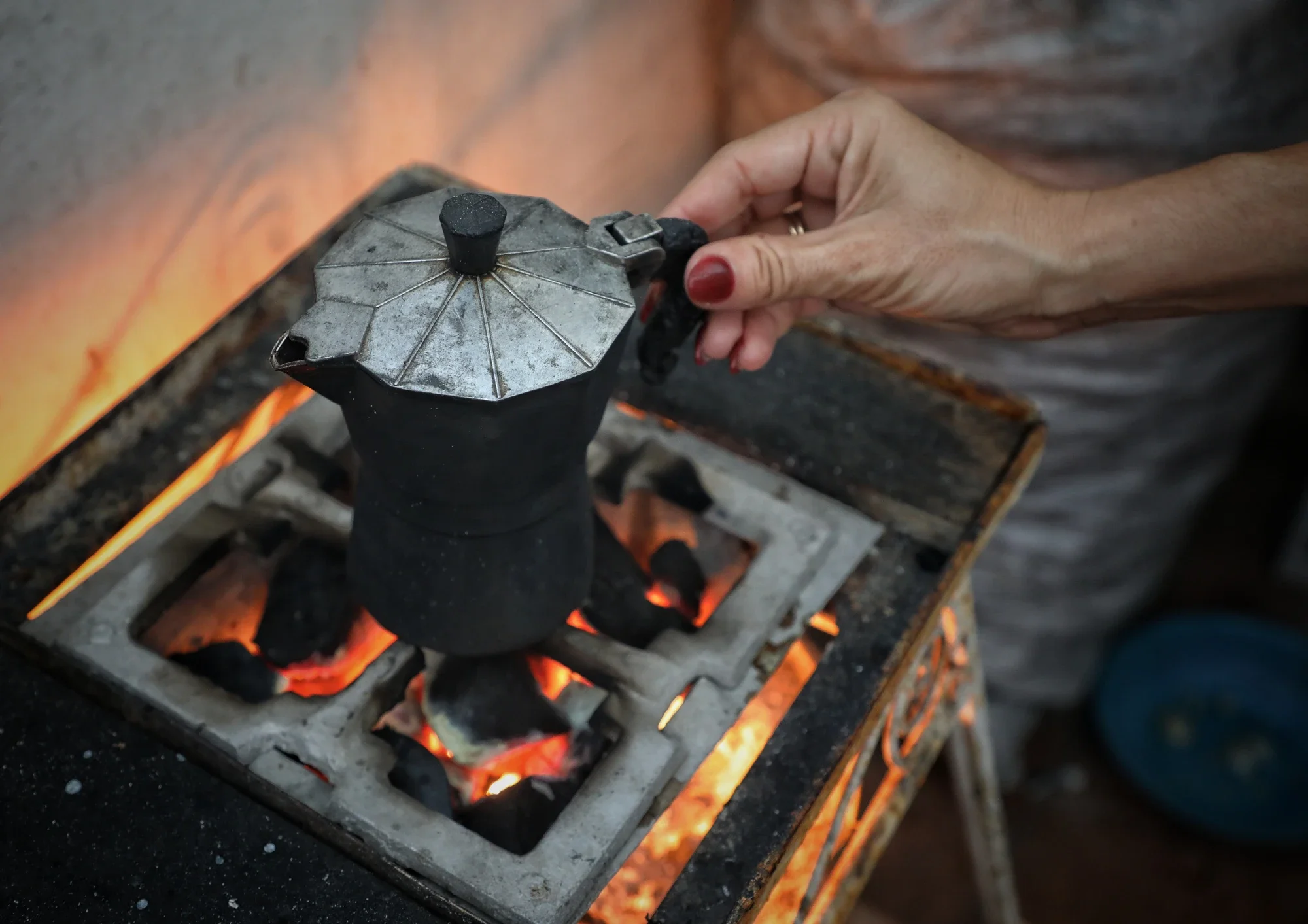
Charcoal stains coffee pots, hands, and the hopes of Cuban women in the municipality of Sancti Spíritus, Cuba, on August 19, 2026. Photo © Alien Fernández.
Reportage • Lorena Pérez Méndez • August 27, 2026 • Leer en castellano
To ensure her daughter eats lunch on time, Alicia Gómez starts burning charcoal at 10 in the morning, sometimes even earlier.
She arranges embers on the makeshift stove she set up in her backyard in Trinidad, in south-central Cuba. Gómez lights a snatch of nylon, cardboard, or any material that might stoke the flame, and begins to fan as if her life depended on it. And indeed, it does.
Her life, her 7-year-old daughter’s life, and the life of her bedridden mother depend on the charcoal catching fire, crackling, and burning long enough to cook their lunch.
“You never know if it’s going to catch fire quickly or if you’re going to be stuck fanning all day,” explained Gómez as she wiped sweat from her eyes. As she did, her soot-stained fingers left a trace of ash on her forehead: the mark of Cuban women.
There are no official statistics on how many women are lighting charcoal stoves on the island these days.
But one need only walk through Cuba’s communities and neighborhoods to notice soot everywhere. Especially in rural areas, charcoal stoves are popping up on balconies, in doorways, and in the common areas of apartment buildings.
“My mom took a bed apart during the Special Period in the 1990s for firewood to cook with,” Gómez said of that time of crisis, which came after the fall of the Soviet Union and the socialist bloc.
“Later on we had gas and electric cookers, we lived like normal people for a while. It’s really hard to have to go back to this.”
When she said “this,” she pointed to the sores on her hands, the mark of a recent burn, her fingernails stained black.
Accustomed to dealing with the legacy of patriarchy, Cuban women have long shouldered the burden of caring for household, children, the elderly, and even their own husbands, who act like visitors dropping by the house to ask what’s for dinner.
It’s one thing to bear that heavy burden, and even more overwhelming to do so without electricity, without regular access to water, without the ability to refrigerate food amid the most absolute and unequal precariousness this generation has ever experienced.
“I’ve got lunch for today,” said Gómez. “We’ll see about tomorrow.”
Mandated resilience
If there is one thing on which Cuban leaders and their critics agree, it’s that Cuba is currently facing the most critical moment in its history.
Both sides blame each other: for some, the Cuban government’s mismanagement has caused this unprecedented crisis while others point to the six-decade U.S. embargo. More recently, the sanctions imposed by the Donald Trump administration have brought the island to the brink of suffocation.
In this maelstrom, ordinary Cubans bear the brunt of it all: they suffer firsthand from power outages lasting more than 40 solid hours, inflation that wipes out wage increases, and, more recently, a rising tide of crime.
“More than the ordinary Cuban, no one suffers as much as Cuban women,” said psychologist Mayra Pérez, who has studied the phenomenon both academically and, unfortunately, through personal experience.
Pérez explained, in scientific terms—economic capital, vulnerable groups, support networks—the processes that affect her personally as a divorced mother and the sole provider for her household.
“To get to work on time, I have to get up at four in the morning, get the charcoal going, and cook whatever I have on hand, because I know that when I get home there won’t be any electricity and probably no water either,” said Pérez. “There are days when I catch myself thinking about how to solve my own problems while a patient is telling me about hers. It’s hard even for professionals like us, who have tools to manage anxiety and always recommend facing obstacles with resilience.”
That’s the term specialists use, and that’s what the government demands of Cubans: resilience. People on the street talk about “tightening their belts,” “getting by however they can,” or “having no other choice.”
In reality, there aren’t many options when electricity feels like a favor granted for just a few hours a day, and there isn’t an affordable supply of liquefied gas, petroleum, or kerosene.
All that’s left is charcoal, or its even more old-fashioned counterpart: firewood.
Precarity ignored
The devastating consequences of what some call the Cuban polycrisis on women have been rigorously documented by various media outlets.
But these “collateral” effects do not appear, at least not publicly, on the agenda of the Federation of Cuban Women (FMC), which upholds a grandiloquent discourse, comparing today’s woes to the epic struggles of centuries past.
“Heirs to the mambisas, to the brave and heroic women who shaped history,” is how the FMC head Teresa Amarelle Boué consistently refers to Cuban women.
The FMC was founded in August, 1960, a little over a year after the triumph of the Revolution. Its political influence in the early days was described by Fidel Castro as “a revolution within the Revolution,” bringing tangible advances for women in access to education, employment, and the public sphere. This period cemented a narrative of emancipation that made the FMC a pillar of the new state.
Over six decades later, the organization has lost its original momentum and become yet another cog in the state apparatus. Its dependence on the government has limited its ability to defend women’s rights, and hollowed out its ability to mobilize.
The FMC has remained silent in the face of femicide cases in recent years and has made scant reference to the precarious nature of women’s daily lives.
Its lack of autonomy was condemned by a coalition of organizations independent of the Cuban government before the United Nations Committee on the Elimination of Discrimination against Women in 2024.
Today, Cuban women no longer vent their frustrations at federation meetings but rather on social media. There are thousands of Facebook posts by exhausted mothers demanding respect for their rights in live videos, and the stories of women standing in the middle of the street with their children to denouce power outages and demand more empathy from the government, and the countless photos of teenage girls murdered by men unable to accept “no” for an answer.
In response, in an online forum, the FMC continues to insist that “for Cuban women and girls, the blockade constitutes a form of direct violence, as it limits access to essential services and affects their well-being.”
And it’s true: the U.S. blockade against Cuba is strangling the national economy, but it is by no means the only culprit.
All-consuming uncertainty
Earlier this month, Alicia Gómez spent 2,000 Cuban pesos on a sack of charcoal. That’s a significant amount in a country where the minimum wage—which was recently raised by the government—is 3,210 pesos ($83.33) a month.
“And I was happy to buy it,” she explains, “because last month I ended up paying 5,000 pesos for a sack exactly like that one.”
She doesn’t know for sure what happened—whether there was a production shortage or if the charcoal sellers and brokers simply hoarded it to artificially drive up the price. The truth is that in Cuba, people will pay whatever it takes to get a cooked meal on the table.
“Every night I’m completely exhausted, with aching legs from spending the whole day on my feet watching the stove, because if you let your guard down, it goes out and you have to start all over again,” Gómez said in an interview with Ojalá.
“But what hurts the most is the mental strain—not knowing what I’m going to cook tomorrow, whether I’ll have enough money, what time they’ll turn the power back on. That uncertainty is killing me.”
Even so, Gómez keeps going. Her soot-stained hands care for her bedridden mother, who forged her character by tearing apart a bed for firewood, and her 7-year-old daughter, the little girl for whom she’d fight tooth and nail, but whose immediate future she can’t guarantee.
“What will become of my daughter in a few years?” Gómez wondered as she held up her scalded hands. “What lies ahead for her? This?”