

Poverty and polycrisis in Cuba
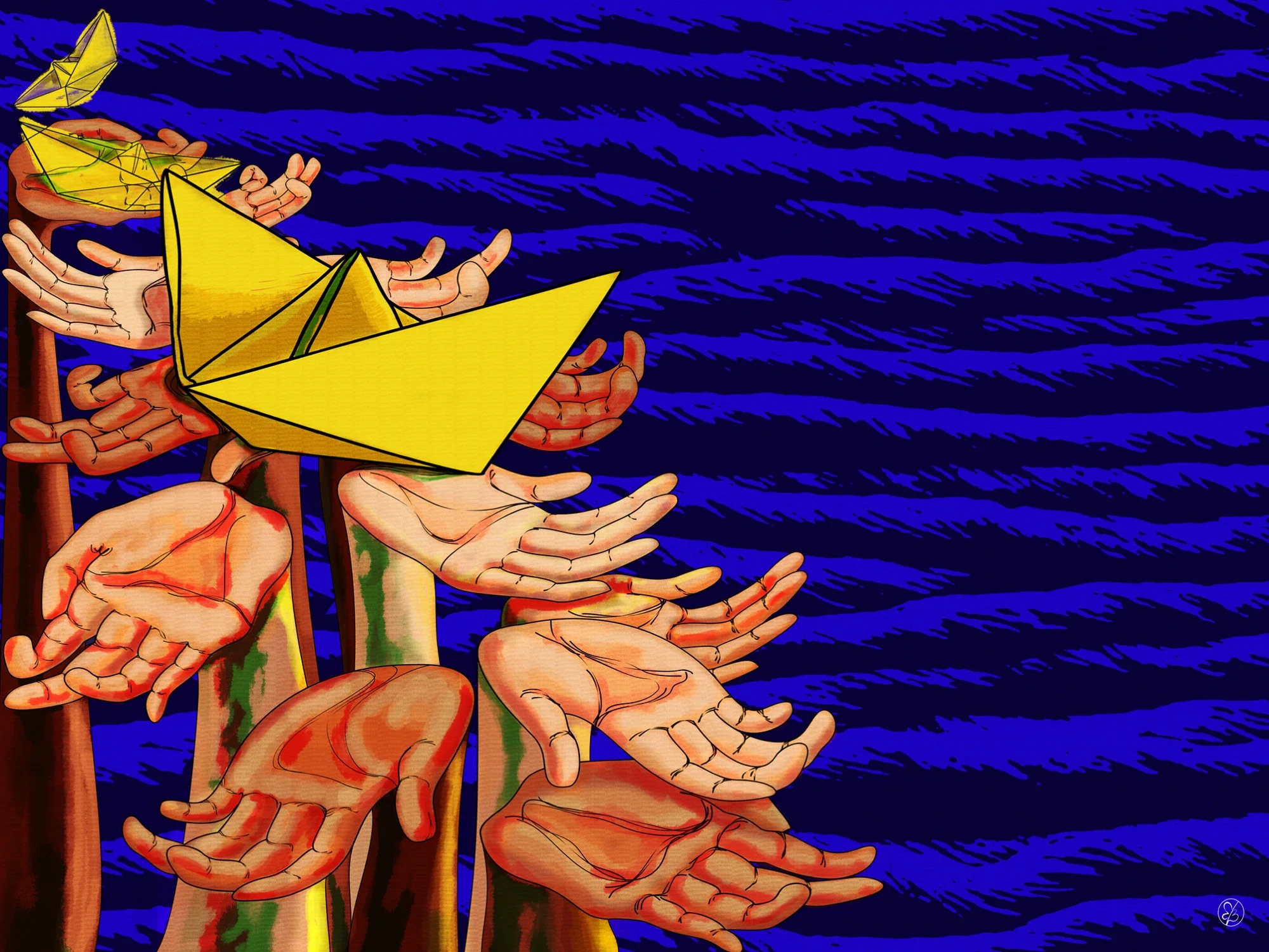
Solidarity. Digital illustration © @euse_arte.
Opinion • Eileen Sosin Martínez • April 30, 2026 • Leer en castellano
My neighbor Margarita, who is 85, has started asking for money outside a bakery on an avenue lined with small shops in west Havana. When I walk by and see her standing at the entrance, she greets me as if nothing is amiss.
Margarita is thin, chatty, and although she walks with a light step, she uses a cane to help her stay steady. We often talk about how bad the situation is, the struggle to find food amid chronic shortages, and ever-rising prices.
Official figures on poverty in Cuba are scarce and outdated. For decades, “poverty” has been a taboo term, leading authorities to use euphemisms like “vulnerability” or refer to people facing extreme hardship as “social cases.”
On January 29, U.S. President Donald Trump issued an executive order mandating tariffs on imports from countries that sell oil to Cuba. Supplies disappeared almost entirely following the U.S. attack on Venezuela, Cuba’s main supplier of crude oil for more than two decades. As the weeks pass, the US oil embargo against Cuba continues to worsen, making living conditions on the island unbearable.
But even before the Trump administration blocked fuel deliveries, the situation in Cuba was critical. What we see today has deeper, long-standing structural causes that began well over four months ago.
Denial in a polycrisis
In the past, when Cuban television or newspapers wanted to illustrate savage capitalism, they would show a picture of somebody begging outside a store window. Over the last three or four years or so, I’ve seen that exact same scene on the streets of Havana time and time again.
Every day, I come across someone—young or old—rummaging through trash bins, in broad daylight or at night. They might salvage a pair of shoes, empty cans for recycling, or any object from which they can extract the slightest benefit.
Cuba is experiencing what multiple experts call a polycrisis: one crisis on top of another, and another, in a perverse juxtaposition. The fallout from the pandemic, the tightening of US sanctions, and the misguided management of the local economy have driven the state into bankruptcy, leading to the collapse of public services.
Daily life is marked by hours-long power outages that hinder household chores, study, and work. Alongside gas shortages, many families have to cook with charcoal or firewood, even in cities. The deterioration of education, healthcare, housing, transportation, and the supply of water is immediately apparant, and a topic of everyday conversation.
Neoliberal measures—including subsidy cuts and dollarization—have led to a drastic decline in the standard of living for the Cuban people. There are frequent comparisons made between the current situation and the Special Period, the name given to the deep socioeconomic crisis that tok place after the collapse of the socialist bloc, when Cuba’s GDP fell by 35 percent.
Sociologist Mayra Espina notes that precarious conditions most impact children and the elderly, and even official media outlets have admitted that there is child labor in Cuba. These economic conditions also disproportionately impact women, racialized people, residents of Cuba’s eastern region, internal migrants, and people with disabilities.
Anyone could counter that in other parts of the world, seeing people scouring the streets for food and money is a daily occurrence that’s far from newsworthy. But in Cuba, nothing like this had been seen over the last six decades—at least not on the scale we see today.
Taking stock
Between government denial, a lack of data, and vague terminology, an in-depth analysis of the issue becomes even more difficult. Just like in the children’s story, there are those who refuse to admit the emperor has no clothes.
According to independent estimates, average spending on basic food per person is around 16,000 Cuban pesos (about $33, based on the official exchange rate) per month, not counting expenses for transportation, internet, medication, and other needs. But pensions in Cuba don’t exceed 4,000 pesos ($8) a month, while the average state salary is 6,685 pesos ($13). Simple math reveals a significant part of the workforce and retired people are at risk.
If there is anything positive to be drawn from this situation, it is that civil society has mobilized through self-managed initiatives, taking on the task of delivering medicine and food and raising funds for those most in need.
Even so, no community initiative—not even all of them combined—can be expected to do the work of the state. That’s especially true when the causes of poverty are structural.
A few months ago I spoke with a lawyer in her late 70s, and the comparison between the Special Period and what’s happening today came up once again.
Despite everything, she suggested that the outlook is slightly better today because some have the option of starting a business or travelling abroad, and we’re less disconnected from the outside world.
“The difference is that there used to be hope,” she told me. People used to have hope that the situation in Cuba would improve in the short or medium term. Not anymore.
Criminalization of poverty
Poverty and inequality go hand in hand. In Cuba. Even as most struggle to put food on the table, restaurants and bars are packed and parties are held on hotel terraces. On the very same streets that are home to US cars from the 1950s and Soviet Ladas, Teslas and Ferraris can be spotted.
The response from Cuban authorities is striking in its classist vision and criminalization of poverty.
In an article published in the newspaper Granma—the official mouthpiece of the Communist Party—Isabel Acosta, a judge on the People’s Supreme Court, acknowledged the presence of people in public places asking for money and food, which she called “practices that violate established legal norms.”
In late April 2024, the government announced new legislation aimed at improving care for “vagrants”—another euphemism—while labelling their struggle for survival as “disordered human conduct.” According to Cuban economist Pedro Monreal, this is a conservative viewpoint, which portrays the poor as victims of their own behavior rather than seeing poverty as a consequence of socially produced exclusion.
The state's oversimplified approach is apparent in the statements of Belkis Delgado, director of social prevention at the Ministry of Labor and Social Security. In her view, the primary reason people end up in the streets in Cuba “is that their family has not properly looked after them.”
From 2014 through September 2023, 3,690 people were categorized as “vagrants” in Cuba. This figure is an underestimate, however, given that it only includes the number of people treated at Social Protection Centers, of which there are nine across different provinces.
Orestes Llanes Mestre, director of oversight and control for the Havana government, insisted in remarks to state-run media outlet Cubadebate that those who rummage through trash are not “vagrants,” but rather “scavengers,” a separate category.
The dehumanization implicit in such a description—especially coming from a public official—is staggering.
This attitude became a scandal in mid-July of last year when, during a session of the National Assembly, Labor and Social Security Minister Marta Elena Feitó told lawmakers that there is no such thing as poverty in Cuba. Instead, she insisted, street-involved people are “disguised as beggars.”
Her comments unleashed indignation on social media. President Miguel Díaz-Canel underlined that public officials cannot be arrogant and out of touch with the realities we face. Even so, he failed to pronounce the word “poverty.” Hours later, an official statement was released saying Feitó had “acknowledged her mistakes” and resigned.
One would not expect that, in a country that calls itself socialist, a high-ranking official would repeat—in so many words—the stale liberal axiom that the poor are poor because they want to be.