

Mexico’s Sheinbaum reverses anti-fracking pledge
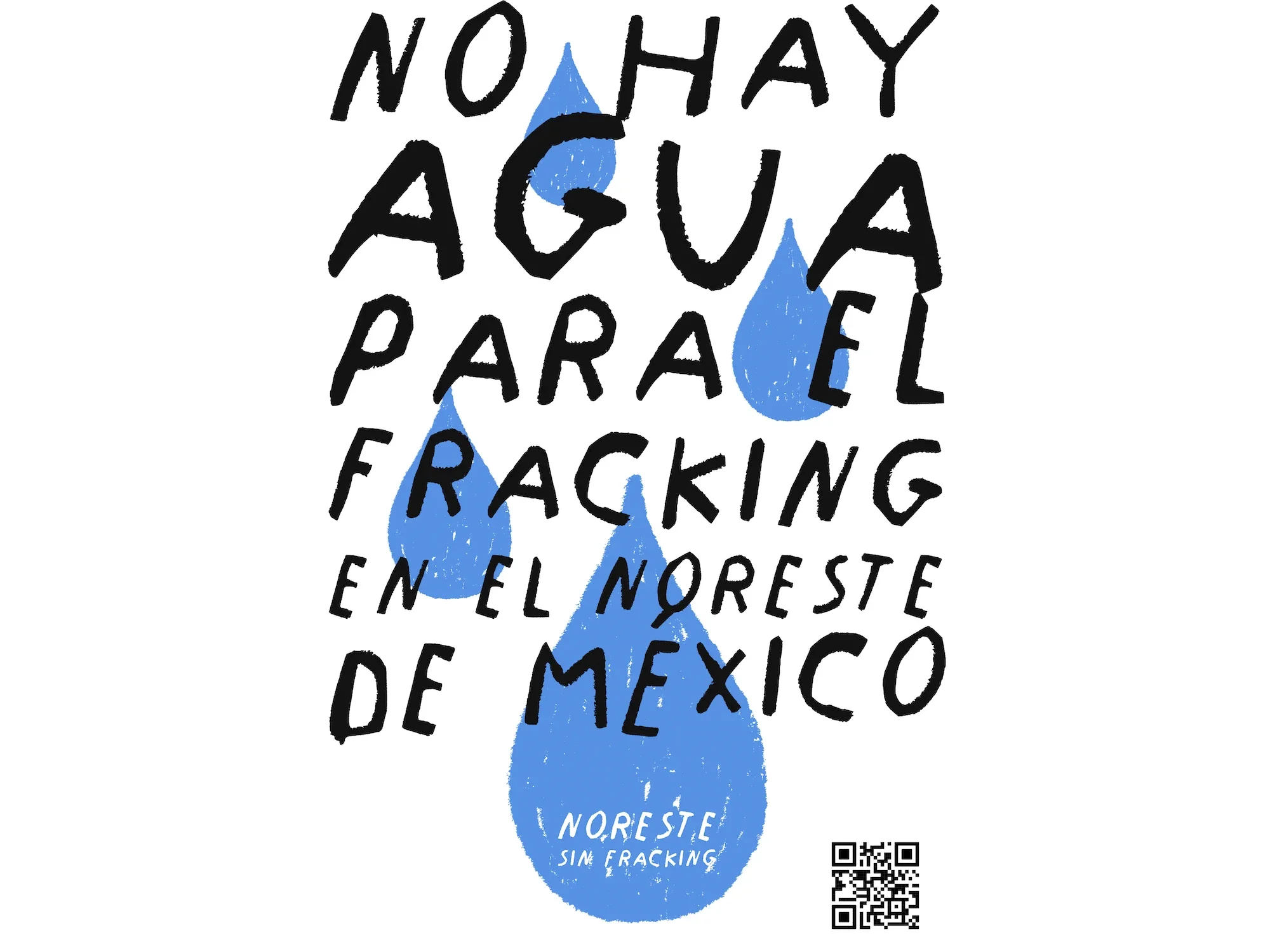
Illustration © @norestesinfracking.
Opinion • Alejandra Jiménez Ramírez • August 28, 2026 • Leer en castellano
“Fracking for gas extraction will not be permitted.”
Those were the words of Claudia Sheinbaum before thousands of people on March 1, 2024, when she launched her presidential campaign. The promise was also included in her “100 Steps for Transformation.”
But amid a global energy crisis, Mexico’s reliance on imported gas from the United States combined with the risk of an economic recession has moved the debate over hydraulic fracturing (fracking) back to center stage.
In Mexico, this discussion began more than a decade ago when then-neoliberal President Enrique Peña Nieto opened the energy sector to private investment and promoted fracking under the banner of national sovereignty as part of his energy reform.
Today, the same talking points have resurfaced under a government that defines itself as left-wing in opposition to the neoliberal model, and whose political base is explicitly against fracking.
The shift began to take shape in the 2025–2035 Strategic Plan put forward by Petróleos Méxicanos (Pemex), the state-owned oil company, in August of last year. Although the document avoids the word “fracking,” it outlines the need to exploit “complex and unconventional deposits.”
In early 2026, amid tariff pressures and conflicts over energy and security, President Sheinbaum made her stance clearer: the development of fracking in Mexico could be an alternative for achieving “energy sovereignty,” raising the possibility of exploring what she called “sustainable fracking.”
An oil-producing imaginary
Fracking in Mexico has its roots in the history of oil production, which dating back to the late 19th century, when the first oil fields were discovered in the states of Tabasco, San Luis Potosí, and northern Veracruz. These territories are home to Indigenous communities whose ways of life are centered on community organization and a deep interdependence with nature.
Following the Revolution and as a result of Lázaro Cárdenas’s oil expropriation in 1938, oil revenues financed basic infrastructure—hospitals, schools, and roads—inextricably linking national success to economic growth and constructing a national identity grounded in Pemex and fossil fuels as pillars of sovereignty.
Indigenous and rural territories provided the material resources—like as water, food, and oil—that made oil revenues and urban and industrial growth possible, while their inhabitants suffered from environmental degradation.
Under these developmentist and racist logics, the pre-existing diversity of ancestral cultures within megadiverse ecosystems was erased, and the oil state was prioritized as a symbol of progress that would lift the country out of its status as an underdeveloped nation.
This model sought to replicate the patterns of intensive capital accumulation in the fossil fuel economy, which, in recent decades, has led to the greatest challenge facing humanity: the climate crisis.
Geological decline and destruction
Mexico’s oil boom lasted from 1970 to 1990 and was driven primarily by Cantarell, an oilfield located in the deep sea off the coast of the state of Campeche—one of the world’s largest.
Today, Mexico’s oil production has fallen by more than 94 percent from its peak in 2003 and 2004. In May 2026, it stood at just 112,453 barrels per day, compared with 2.1 million barrels per day of crude oil in late 2003.
This decline cannot be attributed solely to administrative errors or neoliberal policies. It is an inescapable geological reality: fossil fuels are finite, non-renewable resources.
Mexico is running out of easily accessible, or “conventional,” oil. Faced with this scenario of scarcity and the economic system’s persistent dependence on fossil fuels, the industry has turned to complex, cutting-edge technologies to access “unconventional reservoirs,” where gas and oil are trapped in small quantities within rocks of very low permeability, known as shale.
Fracking, or hydraulic fracturing, is a technique designed to tap “unconventional” geological formations located more than 3,000 meters deep. This method involves drilling vertically until the source rock or shale is reached, then diverting the drill path horizontally, extending for kilometers.
Once the well is in position, millions of liters of water mixed with sand—which holds the fractures open—and a cocktail of toxic chemicals designed to make it easier to pump and extract the hydrocarbons are injected at extremely high pressure.
This technology was developed in the United States, a country that transformed its energy landscape and established itself as the world’s leading producer of fossil fuels by drilling more than 1.5 million fracking wells over the past two decades.
The large-scale application of this technique involves completely different operational dynamics to conventional extraction. In Texas, where fracking has been carried out on a massive scale, the impacts range from earthquakes and illnesses linked to living near fracking wells and infrastructure, to the displacement of communities and economic activities such as agriculture and livestock farming.
The intensive use of freshwater has caused serious water problems, and excess toxic flowback water from previously fracked wells—which was intended to be confined underground—is now gushing to the surface as geysers.
Top-down mandates
Following her about-face, president Sheinbaum has sought to legitimize fracking by appealing to science. In April, she appointed a Scientific Committee to evaluate the extraction of fossil gas from unconventional deposits.
The committee consisted mainly of academics and a few external consultants. The voices and knowledge of communities under threat were disregarded, as was the expertise accumulated over more than a decade by civil society groups and organizations that have documented and compiled scientific and empirical evidence on the impacts of fracking in Mexico and elsewhere.
After four months of deliberation, the committee presented its preliminary findings, which consisted of 10 conclusions, on August 6.
The report states that in the three oil basins of interest for unconventional deposits—Sabinas-Burro-Picachos, Burgos, and Tampico-Misantla. Within the Tampico-Misantla basin, “natural gas extraction activities from unconventional deposits must be prohibited.”
In other words, regions such as southern Tamaulipas, the Huastecas of Potosí and Hidalgo, and northern Veracruz and Puebla would be protected based on criteria linked to environmental and social, biodiversity, and population density. Meanwhile, fracking would continue in the north of Tamaulipas, Nuevo León and Coahuila states.
To this, we must add what was left unsaid: the political considerations that undoubtedly influenced Sheinbaum’s stance in the context of the upcoming Lower House elections in June 2027.
Another key conclusion is that freshwater should not be used under any circumstances, only saltwater. To that end, they propose conducting studies to determine how much brackish water is available in the Burgos and Sabinas-Burro-Picachos basins.
The latter holds the largest amount of prospective fossil gas reserves, putting the northern states of Coahuila, Nuevo León, and Tamaulipas which are home to nearly 1.3 million people, mostly urban dwellers, but also 1,850 rural settlements, 151 ejidos (communally owned land), and the territory of the Kikapú people, at risk.
Fracking: not here, not anywhere
The committee’s conclusions do not eliminate the threat of fracking in Mexico, they merely shift it to the northeast of the country.
In San Luis Potosí and Veracruz—home to the Tampico-Misantla Basin and the most vocal grassroots movement demanding a ban on fracking—promises alone will never be enough to feel safe. Local communities have made it abundantly clear that their resistance will continue as long as the government fails to implement a total ban on fracking.
Before Sheinbaum’s scientific committee removed their territory from the fracking map, the communities of the Huasteca Potosina and Veracruz had already done so by exercising their right to self-determination and invoking international agreements signed by Mexico, such as the Escazú Agreement.
Their demand for a total ban on fracking has been active for over a decade, during which time they have heard many promises. For them, the idea of “sustainable” fracking is merely a euphemism intended to deny the technique's inherent destructiveness.
Through community organization, assemblies, and minutes from ejidal, community, and town councils, they have shut the door on fracking in 15 municipalities. They consider the president’s recent announcement “shielding” their territory a step forward, but are not letting their guard down, instead demanding it be enshrined in a constitutional decree. Meanwhile, the defense of their land continues, and they say their solidarity with the people of the northeast is growing stronger.
Joining this defense are young people from the northeast of the country who, today more than ever, are under threat from “sustainable fracking.”
They do not see oil as a source of prosperity, but as a source of death, nor do they believe in promises of development and employment. For them, water is worth more than gas and oil, which is why they’re demanding the “Northeast free of fracking.”