Decolonizing sex-ed starts with translation
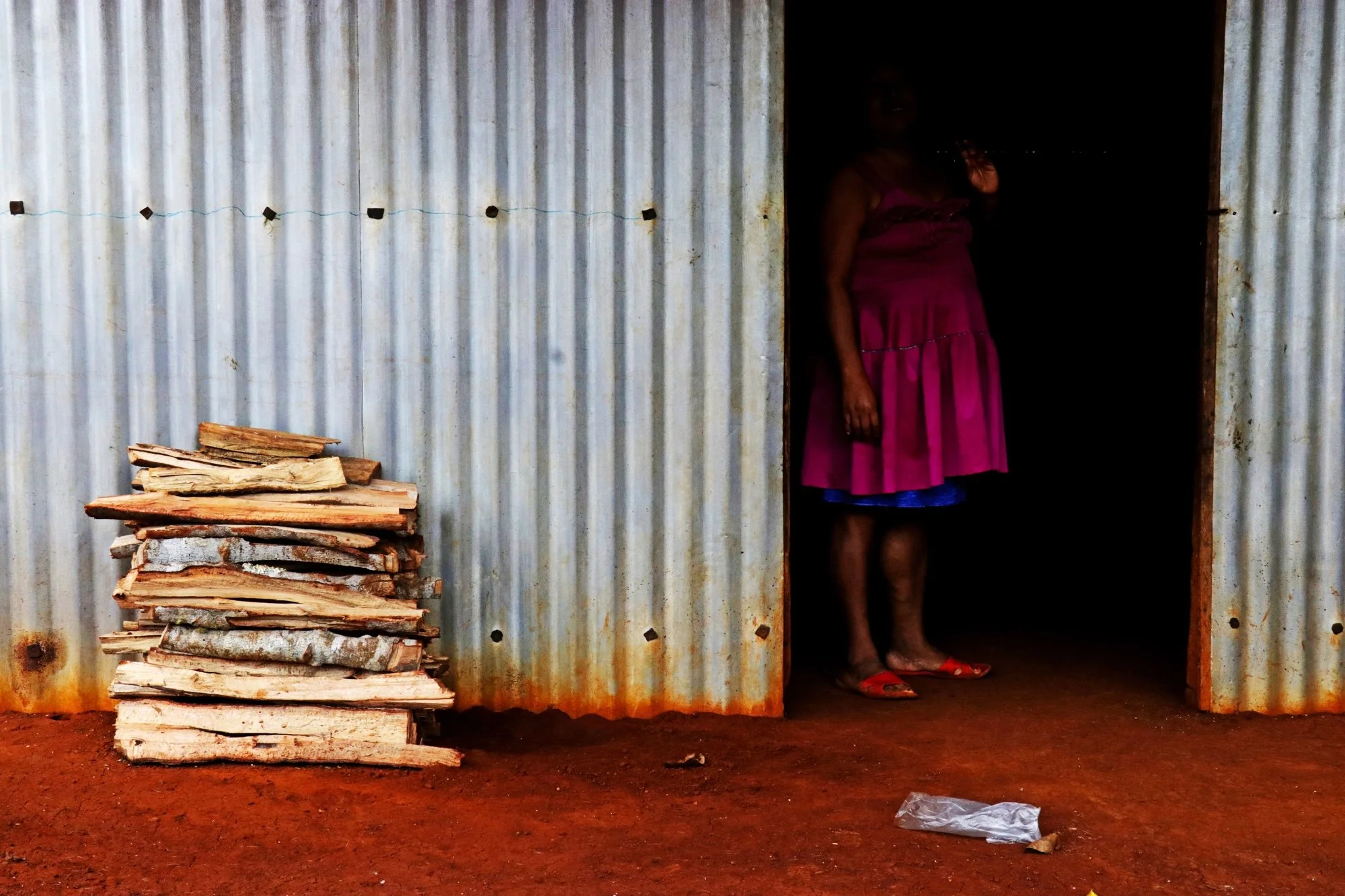
A woman from the Popoluca community in southern Veracruz looks out from inside her home, October 2019. Photo © Iván Sánchez.
Reportage · Ana Alicia Osorio · February 19, 2025 · Leer en castellano
In the Mexican state of Veracruz, over 662,000 people speak one of 14 Indigenous languages. Nationwide, that total rises to over 7,364,000 people .
Even though Indigenous languages are recognized as national languages in the Mexican Constitution, in Veracruz, official information on sexual and reproductive rights is only made available in Spanish.
That’s why collectives and community organizations in the state have built networks to provide interpreters, support campaigns, and publish information on the steps needed to access health services all in Indigenous languages.
These organizations work in regions with Indigenous populations in the north of Veracruz, where Teenek, Tepehua, Nahua de la Huasteca, and Totonac-speaking communities live, as well as the mountainous central area, home to a large Nahua-speaking community in the Sierra de Zongolica.
Language barriers as violence
“[Institutions] don't go to those places and don't address those issues because they simply don't speak the language,” said Lizbeth Santos Olmedo, a young Totonac woman who lives in Papantla, in northern Veracruz.
For the past five years, Santos Olmedo, who speaks Totonac and Spanish, has been part of Libres y Voladoras Colectiva Papanteca, a community organization that supports women experiencing violence and seeking access to sexual and reproductive rights in the region.
Information gaps stemming from language barriers show up in various social indicators. The National Institute of Statistics and Geography (INEGI) reports that only 26.6 percent of women who speak Indigenous languages used some form of contraception during their first sexual encounter, compared to 66.9 percent of their non-Indigenous counterparts.
“They are often given information in Spanish, and they pick up a word here and there that allows them to understand only part of the explanation, but nothing more,” said Elizabeth Guevara, a Nahua lawyer who has worked for years with Kalli Luz Marina, a group in central Veracruz. “That’s why teenage pregnancy and teenage marriage remain prevalent.”
According to the National Population Council, Indigenous teenagers are significantly less aware of the existence of the emergency contraceptive pill (57 percent) than non-Indigenous teenagers (83.8 percent). In 2023, 10 percent of adolescents between 15 and 19 had been pregnant at least once, but for those who spoke an Indigenous language, the percentage was 20.1 percent, almost double, according to data from the INEGI.
“[In hospitals] no one is dedicated to interpreting to Nahuatl,” Guevara said in an interview with Ojalá. “Basically, if someone shows up for any reason, there is no one to assist them.”
Nineteen years ago, the lack of medical attention cost the life of Ernestina Ascencio, a 73-year-old Nahuatl-speaking woman from the Sierra de Zongolica who was sexually assaulted by the Mexican Army. Ascencio was left without medical attention for more than 10 hours. When she was finally admitted to a hospital, there were no interpreters to assist her and her family.
The family sought justice for years, but were unsuccessful in the national courts. The case eventually went before the Inter-American Court of Human Rights, which issued a ruling requiring the hospital provide an interpreter and the creation of a national registry of interpreters for medical and legal proceedings.
But Guevara noted that the sentence did not mandate that other hospitals in the area do the same, and so far, the government has not met with the family's lawyers to establish an action plan to ensure compliance.
“If an Indigenous woman or a teenager with her family comes to request services, there is no communication between the patient and the doctor to ensure adequate care,” Guevara said.
A map of translated resistance
Kalli Luz Marina, whose members are mostly Nahua women, organized a training strategy aimed at Nahuatl-speaking women in Veracruz, who become community promoters and learned to provide support when others need it.
In the same area, Marea Verde Altas Montañas was responsible for drafting documents detailing the steps women have to take in order to access legal abortion and receive assistance in cases of gender-based violence. This procedure is outlined in Mexican Official Standard (NOM) 046, which the collective translated into Nahuatl with the help of volunteers.
“When we distributed the guide, we realized that there was a large Indigenous population and that we didn’t have the information in their language, Nahuatl,” said Luz María Reyes Huerta. “So we set out to find compañeras who would support us in the translation.”
In the northern region of Veracruz, the Marea Verde Totonacapan collective carried out a campaign to raise awareness of sexual and reproductive rights in three of the most widely spoken languages in the area: coastal Totonac, Tepehua, and Huasteca Nahuatl.
Metzeri Ávila San Martín, a member of the collective, pointed out that the region is large and said it can take people from the mountains up to six hours to reach Poza Rica, the region’s largest city.
“We have our own languages, which are completely different,” said Ávila San Martín. “These women should have the same access [to information in their language] as women living in the capital.”
This prompted the Marea Verde Totonacapan collective to translate the federal government's sexual rights booklet, which explains 14 rights, with the help of the Veracruz Intercultural University. They posted it online and, with the support of the communities themselves, made it available in schools and small businesses such as shops and tortillerias.
Bridging cross-cultural gaps
The work of these community networks goes beyond word-for-word translation—it helps explain, contextualize, and build meaning that’s understandable in Indigenous languages.
“If you only speak Spanish, you don't grasp that way of feeling and thinking, and even if someone knows the words, they may not really understand,” said Santos Olmedo of Libres y Voladoras.
According to Ávila San Martín, another challenge is knowing how to incorporate community knowledge into the work being done to bridge the gaps.
“We try to combine academic scientific knowledge with ancestral knowledge, which has also always been used and shouldn’t be dismissed,” she said. “Women and people who can get pregnant continue to use herbs and their own rituals. In communities, women who need an abortion go to a comadre who knows which tea or herb to give them.”
Flor Gómez, a young Totonac woman who found out about these collectives through social media, thinks that the outreach and support campaigns run by grassroots movements help build bridges between different cultures.
“Healthcare professionals, educators, and everyone else should put themselves in our shoes and try to understand us,” Gómez said in an interview with Ojalá. “I believe that will only happen when they learn how we think, how we speak, and above all, how we communicate.”
In light of those differences, the lack of institutional channels, as Guevara pointed out, is not an isolated issue. Rather, its one of the many forms of discrimination faced by Indigenous women. In this context, alternative community information is essential for centering rights in conversations that enable women and gender dissidents to participate, ask questions, and make decisions about their own bodies.
