

Collective action in defense of Sinaloa’s coast
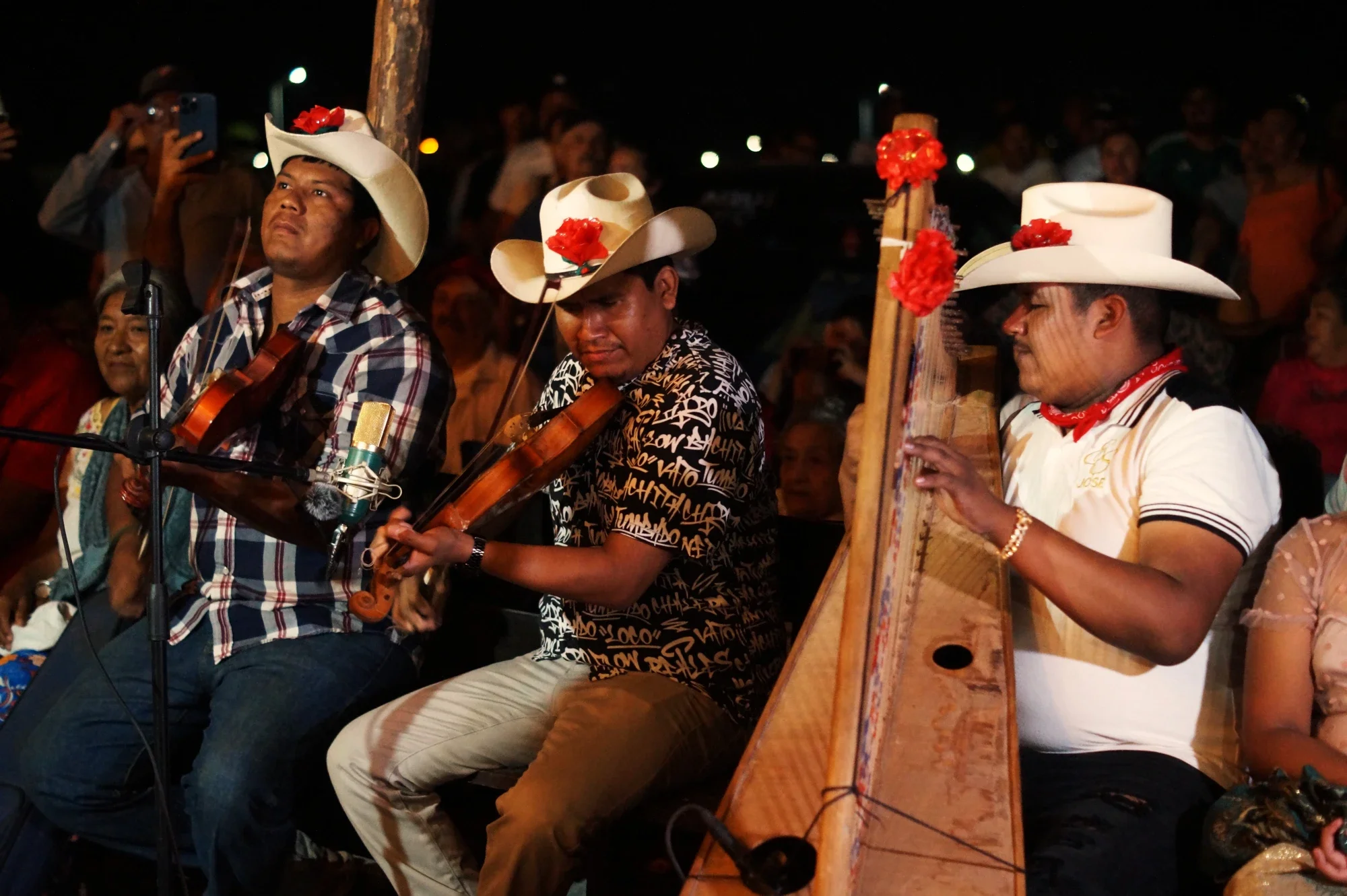
Pascola musicians accompany the dancers under the arbor, June 26, 2026, at the “Colectivo Aquí NO” sit-in in Topolobampo, Sinaloa. Photo © Itzel Arredondo.
Opinion • Itzel Arredondo • July 17, 2026 • Leer en castellano
“I’ve heard they’re calling it the Monument to Unity among Peoples,” our friend commented as we passed an enormous metal absorption tower, which is over 50 meters long and weighs nearly 400 metric tons. Its arrival to the port of Topolobampo, Sinaloa, in late May led to the establishment of a resistance encampment that’s since become permanent.
The massive cylinder has become a symbol of the movement opposing the construction of Latin America’s largest ammonia plant in a fragile coastal ecosystem in Mexico’s northwest. Opposition to its potentially devastating impact on the Bay of Ohuira has earned it many nicknames, among them, “the missile.” The combative solidarity that has flourished since its arrival is what inspired this resignification.
The arrival of this industrial instrument in Topolobampo triggered not only a permanent sit-in, but also a media boom that drew local and international attention, including among people who had previously remained on the sidelines or were unaware of the issue.
The petition against the project launched on Change.org serves as a barometer: in early May, it had around 1,000 signatures; by June 1 (two days after the cylinder’s arrival), it had around 240,000. Today, it has over one million.
The arrival
We arrived at the sit-in on June 26 as the sun was setting in a mostly clear sky painted in a gradient from orange to blue. Nearby, a thatched roof made of palm fronds was set up for that evening’s activities. A Yoreme Nation flag fluttered in the left corner, and a Mexican flag in the right.
We passed the tents where a main kitchen, a secondary kitchen, a dining hall and communal areas had already been set up. Further back, cots began to appear, some covered with mosquito netting and others left uncovered. At the very end, just outside the entrance gates to Gas y Petroquímica de Occidente (GPO), there were a couple of tents. We took advantage of the last rays of sunlight to set up in a space between two of them.
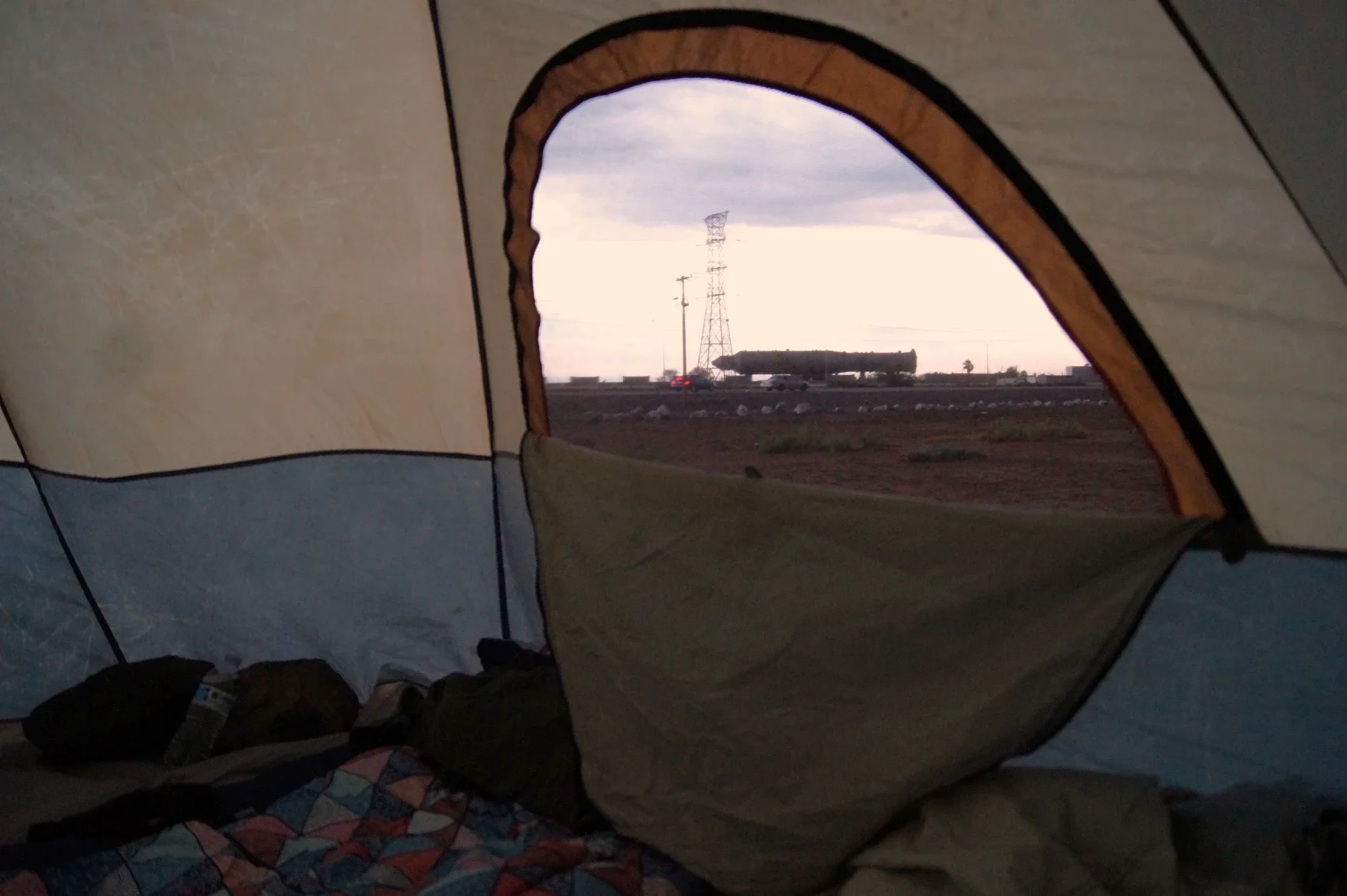
A cooling tower for the ammonia plant visible from one of the tents at the camp, June 27, 2026, at the Aquí NO Collective’s protest camp in Topolobampo, Sinaloa. Photo © Itzel Arredondo.
GPO is a subsidiary of the Swiss-German company PROMAN, which is building the plant. The project was officially announced in 2013 and is backed by financing from KfW (a German state-owned bank) and technological support from ThyssenKrupp (a German industrial engineering and steel production conglomerate that is also a supplier of weapons to Israel). It also has the Mexican government’s approval.
This project isn’t new. Nor is the organized resistance opposing it.
It is not, as some public officials seem to want to claim, that the project was allowed to move forward and now that it is “almost finished” locals want to stop it. From the very beginning, there has been criticism and opposition on the part of Yoreme Mayo communities and scholars in the region.
The Aquí NO collective has been taking legal action against the project for over a decade. Over that time, they have been the target of threats, have had to restructure and innovate, and have slowly built up public support.
Since many eyes have been on Ohuira Bay, officials have made bigger and bigger claims about the project, both in terms of the percentage of construction that’s complete (from 88 to 90 and then 95 percent) and around the benefits in terms of job creation (from 143 jobs to 3,000 to 10,000). These claims don’t match up with the reality of a plant whose entrance has been blocked for over a month.
Under a thatched roof
That night, we slept over at the camp and celebrated the Festival of San Juan.
Walking back to the common area under the thatched roof in the dark, I can tell I’m passing by where the dancers are getting ready because I hear two kinds of jingling—one dry and one metallic—accompanying their movements.

Tenábaris worn by the pascola dancers at the San Juan festival, June 26, 2026, at the Aquí NO Collective’s protest camp in Topolobampo, Sinaloa. Foto © Itzel Arredondo.
Under the warm lights hanging from the thatched roof, I could see that the dry sound came from the tenábaris—four mirrors made from butterfly chrysalises that cover the lower half of the dancer’s legs. The metallic sound was that of the coyolis, the name for the bells hanging from a calfskin belt.
There are garlands of tassels and paper cutouts in red and yellow hung throughout the space. The paper bunting produces a rustling sound with the wind, which blows from the sea toward the mainland.
Amid musicians, pascola and venado dancers, singers, guardians, and caretakers, the participants move from one spot to another, performing dance sequences featuring characters embodying dualities and rhythms that tell stories of the land on which they are performed. After several rounds, they rest. Then, they begin again. The dances will continue all night long.
The sea is the source of all life here. This incredibly rich coastline sustains 3,000 families who depend on fishing. The interdependencies extend beyond the economic realm, this region has been designated a Ramsar site, which means it is an important wetland that is protected by an international convention. It is home to dozens of species of enormous ecological and cultural importance; serving as a nesting ground for migratory birds and sea turtles, and as a habitat for the bottlenose dolphin, a species that’s emblematic for the people of Topolobampo.
This entire ecological system, which already faces a variety of aggressive anthropogenic pressures, would be seriously compromised—perhaps beyond any possibility of restoration—if GPO’s objectives are realized.
To operate, the ammonia plant would use 2,000 cubic meters of seawater per hour, which would be returned to the bay 1 to 3 degrees Celsius warmer.
This difference, which may not seem significant to humans, would be intense for many marine animals—especially in their early life stages, when they use the calm waters of the bay to feed and grow before venturing into more turbulent areas. This marine zone serves as a cornerstone of the food webs that sustain the entire ecosystem.
The plant has been favored since it was integrated as one of the 15 Economic Development Hubs for Wellbeing proposed by Claudia Sheinbaum’s administration. Ammonia is a precursor chemical in the production of fertilizers that underpin the industrialized agricultural production model that makes Sinaloa such a productive state. The president defends its construction as an essential step toward national food sovereignty.
But how sovereign is this development if it destroys ecosystems, tramples on the constitutional rights of Indigenous peoples, and sees economic profits from sales flow to countries in the global north? How sovereign is it that since local farmers are not guaranteed preferential prices, most of Sinaloa’s agricultural production is exported by large agribusinesses that seeks not sovereignty, but profit and perpetual growth?
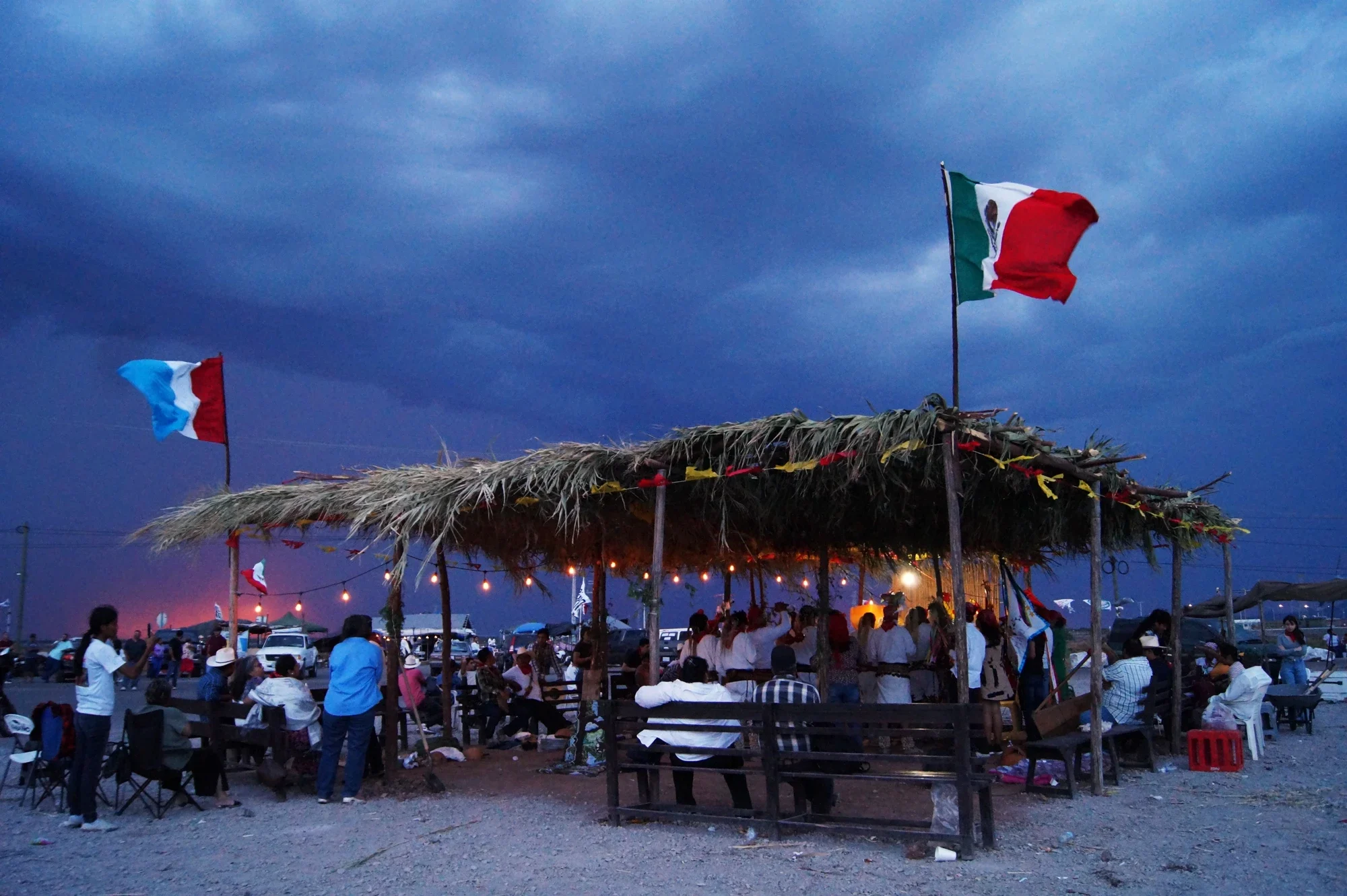
The palm roofed structure set up for the San Juan festival at the “Aquí NO” Collective’s protest camp in Topolobampo, Sinaloa on June 27, 2026. Photo © Itzel Arredondo.
A holy shower
Later that night, we went into our camp tent to lie down for a little bit and stretch our legs. The wind picked up, and the sound it made against the tents was like a surging wave. Storm clouds began to gather. In front of our tent, young people were playing the accordion and guitar, dancing and laughing.
In the early morning, around 4 a.m., and the swelling clouds broadcast a clear sign. First came a light drizzle, and around 5:30, just as a prayer rose from under the thatched roof, a downpour began to fall. The first heavy rain of the year, a true storm with gale-force winds. Some tents were flooded, mats were blown away, and people got soaked. The saint was bathed in fresh water.
“It didn’t rain on Saint John’s Day because there was no festival, but today it did,” I heard someone say as we ate guacabaqui—a traditional Yoreme dish consisting of a beef-and-bean broth—for breakfast together.
This year’s celebration of San Juan was delayed because it was held in an atypical manner. Historically, these festivals take place separately at each community’s traditional ceremonial centers, but this one was made possible by the coming together of many Yoreme Mayo communities in the region. Participation was voluntary, driven by the desire and need to continue defending territory that is under severe threat, to recognize ourselves, as humans, as part of nature and not as a separate entity that enters and leaves it at will.
The struggle for Ohuira Bay in Topolobampo is alive and well. The sit-in has been declared permanent until the project is halted, and work has already begun on building more durable structures. The Aquí NO collective invites the public to support the struggle in whatever way they can, with emphasis on the importance of physical presence.
A friend told us that when they went to gather supplies to build the shelter, their guide advised them to ask permission from the Juyya Ania (the “world of the forest” in Yoreme cosmovision) before entering and taking what they needed. While they were working, they were approached by a wildcat.
His story reminded us of how, during a demonstration at sea organized by the Collective, a group of dolphins broke the surface despite the large number of motorboats present. Roseate spoonbills flew overhead in abundance.
Dolphins emerge—unusually—amid a throng of engines; wildcats let their guard down; rain falls at the end of a prayer. The land sustains us with tenderness and strength. It speaks to that which we honor with our voices, seeking harmony.