

Social reproduction, memory and the far right
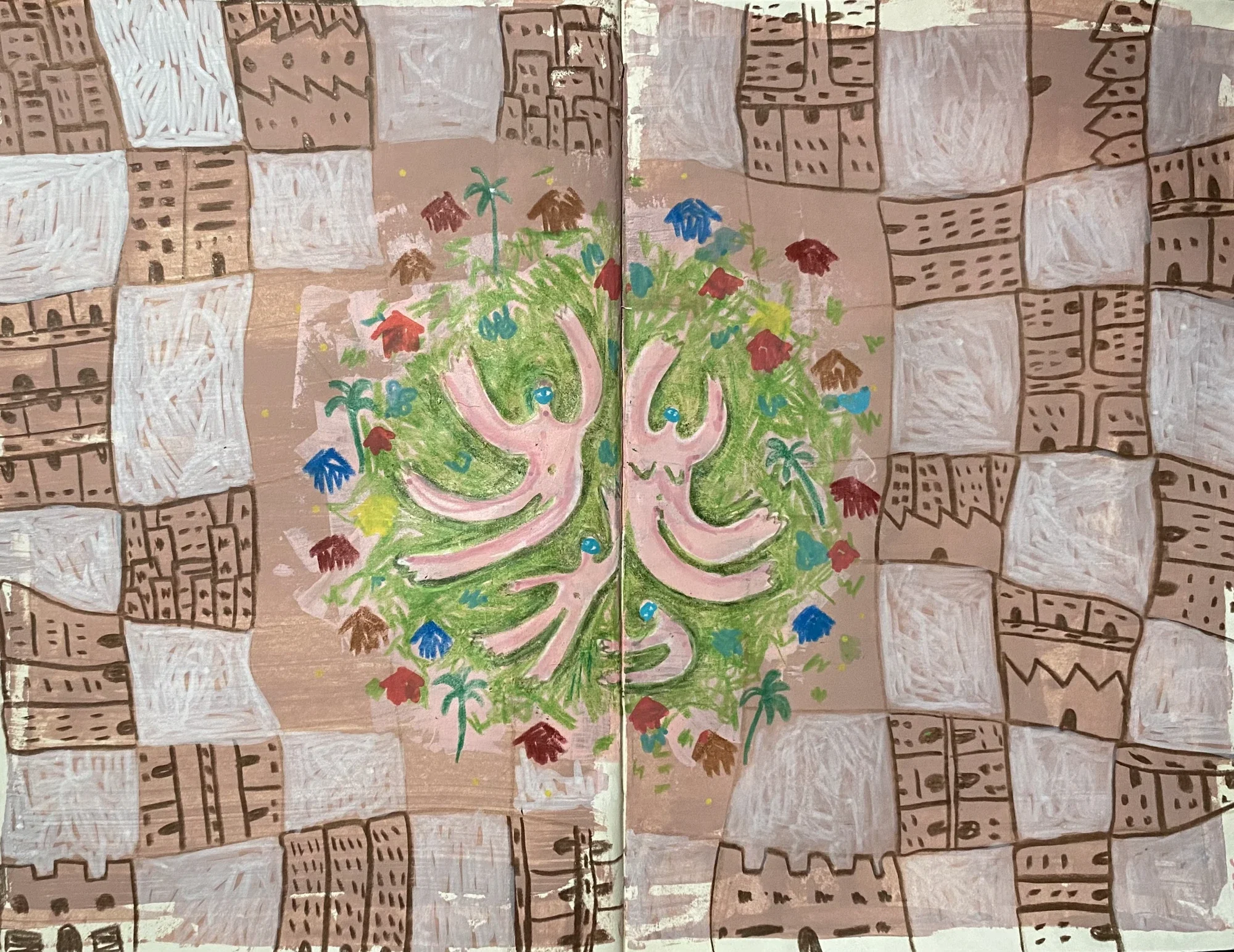
Social Reproduction, mixed media, 17 x 20 cm © verteselva.
Opinion • Claudia Hernández • May 22, 2026 • Leer en castellano
For the last 50 years, every institution in Chile’s public sector has told us over and over again that individuals succeed through their own efforts.
We’ve been told the family, “the fundamental nucleus of society,” as stated in the current Constitution—which was inherited from the dictatorship of Augusto Pinochet—must fend for itself. We’ve been told the market is responsible for providing what we need to live.
Over the last 50 years, social rights have been turned into business opportunities for private investors. Instead of guaranteeing access to these rights, like healthcare, housing, education, pensions, water, or the environment, the Chilean state had made sure that they are profitable niches for capitalist accumulation.
This neoliberal approach to reorganizing social reproduction is rooted in a long-standing colonial and patriarchal framework, which has perpetuated the idea that life must be managed privately, within the family. Historically, this has meant that the lion’s share of labor falls on women and those who are feminized.
Every time the dominant order enters into crisis, the same ideological pillars are reinforced: family, private property, order, and security (for capital). These are, we’re told, the unquestionable foundations of society.
José Antonio Kast’s far-right government is determined to continue this agenda through public policies and the restructuring of the state. His aim is to reinstate these so-called “fundamental values” of the social order through media and discourse. His style is a little more restrained than Javier Milei or Donald Trump, but just as reactionary.
Behind this discourse and policy, what is actually taking place is an intensification of precarity, an increase in repression and criminalization, and more racism and hatred.
This counteroffensive is directed squarely against community and territorial networks. Beyond the heteropatriarchal nuclear family, capitalist markets, and so-called “fundamental values,” these networks advocate for and produce alternative ways of organizing relationships with others and with the environment that surrounds them. This is the foundation from which these networks create common goods and seek to guarantee the material conditions required to sustain life.
Analyzing the struggle to organize social reproduction allows us to open a deeper political perspective on the crisis we are experiencing. What is at stake isn’t only a specific economic model, nor is it limited to a response to the growing power of the far-right. Rather, this struggle is about kinds of relationships, bonds, and ways of organizing that make it possible to sustain life itself.
The myth of self-reliance
One of the greatest ideological triumphs of neoliberalism in Chile is the institutionalization of the belief that we don’t need or depend on anyone else to get ahead. The hackneyed saying about “personal effort” has become standard rhetoric for the government and ruling elites. It suggests poverty and precariousness can be resolved through “effort,” rather than being a product of grotesque structural inequalities.
In Chile, this belief has seeped into our very being. We live in a society where it is frowned upon to depend on others. If we are unable to provide for our own needs, it’s considered a personal failure.
When this happens in social relationships, it produces even greater alienation from the land and the ecology we inhabit, as if we don’t depend on nature and are not part of it.
But the fallacy of individualism falls apart when we pay closer attention to our surroundings. Put simply, no one could survive without the care of others. We are vulnerable, and we depend on the lives of others—humans and non-humans—to sustain the material and symbolic conditions that allow existence to be reproduced.
The neoliberal, colonial, and heteropatriarchal capitalist world is built on constant denial of our vulnerability and the condition of our interdependence. This denial leads governments to speak of “self-reliance” and obscures the fact that what sustains life are collective, interdependent networks.
Authoritarian neoliberalism
Kast’s far-right administration took power just two months ago, implementing a series of measures and policies that reveal the nature of its reactionary, conservative, and authoritarian counteroffensive.
These measures are presented using the rhetoric of austerity. They say the ”state is bankrupt,” and talk about security and ”national reconstruction.” They seek to eliminate school meal programs in public schools, cut funding for public health, and roll back environmental protections. Then there’s the media campaign of fear and hatred, directed against migrants, sexual dissidents, and the poor.
This is compounded by the Kast government’s immigration policy, which aims to turn hospitals, clinics, and schools into mandatory reporting centers against undocumented individuals. Even in institutions where a minimum standard of access to care and education ought to be guaranteed, the government is attempting to instill a logic of surveillance and persecution.
The announcement of each of these measures has caused public scandal, causing some to be scaled back. Together, they reveal the continuity and modernization of a historically rooted, conservative and authoritarian project in Chile.
It's no coincidence that the Kast government has dubbed its main mega-reform proposal the “National Reconstruction and Economic and Social Development Plan, ” the exact same name used by Pinochet's civil-military dictatorship in 1973.
Although the social conditions are not the same, the political gesture is significant. By using the same language, the Chilean government is again centering the same false neoliberal promise that private investment and market expansion will ultimately benefit society as a whole.
Weakening environmental regulations, expanding extractivism, cuts to government spending, and dismantling the few social policies that remain are ways of shifting the burden of materially sustaining existence onto families. It is precisely at that juncture that we can see the political character of the struggle over social reproduction.
The civil-military dictatorship directed significant violence against unions, land-defense organizations, community spaces, and grassroots organizing. Neoliberalism sought to destroy those collective and community capacities that produce and defend the commons. But it was not entirely successful.
Our collective capacities pose a threat to the ruling elites because they can demonstrate empirically that social reproduction can be organized differently, even if only momentarily, partially and in ways that can be contradictory.
These collective and context-specific forms of care, territorial stewardship, social bonds, that create the material conditions of existence are not fully subordinated to capitalist imperatives. This is what the reactionary counteroffensive seeks to fragment, discipline, and dismantle.
Cycles of collective resistance
Kast’s counteroffensive in Chile has no qualms about flaunting its pro-Pinochet ambitions. But it's worth remembering that during those bloody decades of dictatorship (1973–1989), it was community-based, solidarity-driven economics—brought alive through soup kitchens, supply networks, solidarity funds, and collective fundraising—that made surviving hunger, poverty, and repression possible.
Then there’s the October 2019 uprising, which didn't emerge in a completely spontaneous manner. Rather, decades of neoliberalism failed to erase the memories, knowledge, and organizational capacities. That is what reemerged when millions of people took to the streets.
How else can we explain that in just a few weeks, communities created communal kitchens, care networks, health brigades, artistic ventures, and other forms of organization capable of bringing Chile to a standstill?
In Wallmapu today, there are social and economic practices—including solidarity and justice networks for missing Mapuche women defenders, land reclamations, and community farming networks—that have resisted dispossession, extractivism, and continual militarization.
These collective practices are undergirded by territory. Sustaining and defending the commons also means sustaining and defending territory.
The commons is not an empty abstraction or a simple form of coexistence. They are produced by a historical practice born out of the lived experiences of those who have organized their lives together in the face of dispossession, precariousness, and violence.
The insistence in producing, sustaining, and defending the commons is one of the most decisive political struggles in modern Chile, and it is one that continues to play out today.