
Public space in peril ahead of World Cup in Guadalajara
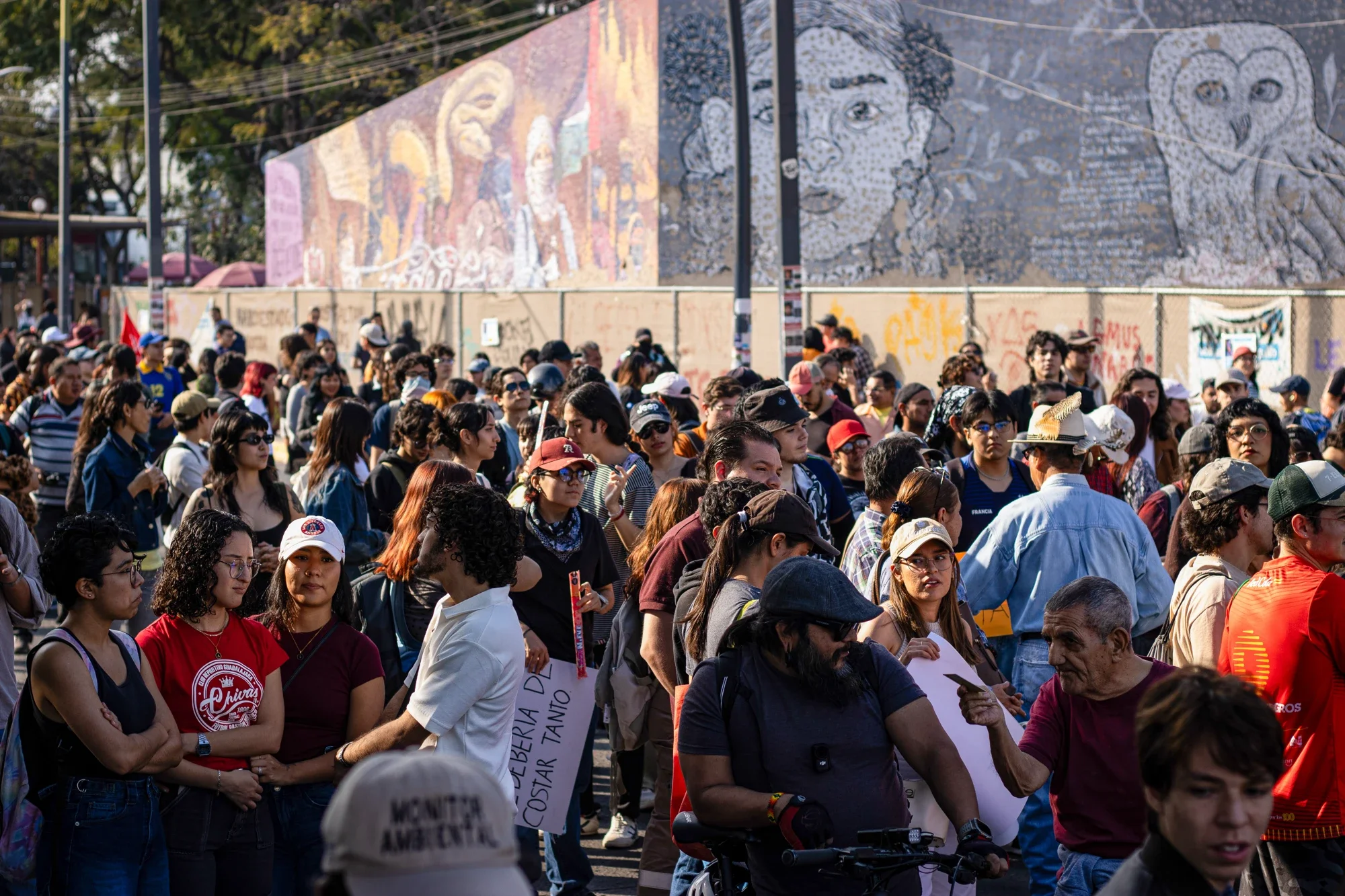
Protesters gather in the Parque Revolución to protest an increase in public transit fares on January 10, 2026 in Guadalajara, Mexico. Photo © Itzel Michel.
Interview • Dawn Marie Paley • May 20, 2026 • Leer en castellano
With less than a month to go before the start of the Mexico-United States-Canada World Cup, residents of Guadalajara are experiencing dispossession and gentrification in a context of militarization and paramilitarization.
The army’s killing of crime boss Nemesio “El Mencho” Oseguera Cervantes on February 22 in Tapalpa, just over 120 kilometers from Guadalajara, brought national and international attention to Jalisco state. A little over two weeks later, thousands of feminists marched in the city, which is the state’s capital, protesting violence and the closure of public spaces.
Among those spaces is Parque Revolución—popularly known as Parque Rojo—which is a hub for leisure activities and social and protest movements in the city.
To understand how women and gender dissidents in Guadalajara are organizing in the face of a diversity of mafias—from FIFA to local crime groups—I interviewed Lucila Sandoval, a media strategist in the city.
Sandoval works with Intrasentido, a group that supports collectives and organizations in Latin America in improving their communication skills and understanding the narrative landscape in which they operate.
She told me the World Cup is accelerating processes of displacement and privatization in the city, and discusses the multiple meanings of peace in a militarized city. I spoke with Sandoval in early May, and our interview has been translated and lightly edited for length and clarity.
Dawn Marie Paley: Could you tell me about the importance of Parque Revolución, or Parque Rojo, for queer folks, feminists, movement activists, and others in Guadalajara?
Lucila Sandoval: Over the past years, Parque Rojo has become an important cultural hub in Guadalajara. Starting in 2010 and especially since 2012, grassroots organizing in Guadalajara has undergone a significant transformation.
Although “Yo Soy 132” [protests by university students] in 2012 was a pivotal moment, there were also prior actions that fueled the momentum of the student movement.
The student movement in Guadalajara is unique in that it hasn’t been strictly student-led. This is due to the nature of our universities, and where they are located throughout the city. The [University of Guadalajara] hasn’t always had a single campus—it does now, in the north of the city—previously, its campuses were scattered around the city. So we would gather at Parque Rojo.
Certain groups began to use that space, including embroiderers who participate in Bordamos por la Paz and collectives that formed around the issue of enforced disappearances. It was radically transformed and became a politicized site where assemblies were often held.
It became commonplace for marches to set off from [Parque Rojo], which became a politically significant hub.
The main marches for [the 43 disappeared students of] Ayotzinapa in 2014 began in Parque Rojo. A lot of organizing took place there, in part because the park is in a very strategic location, at the Juárez station, which is where two subway lines converge.
A few years ago, some trans-exclusionary feminist groups created the Mercadita Feminista [that was held at the park]. Almost in parallel [in the same park], tianguis [street markets] began to emerge, run by queer youth and folks of all ages.
When Guadalajara’s City Council decided to fence off the park for renovations, the people who made a living selling goods there were immediately displaced. Groups that were more politically organized also lost access to the space.
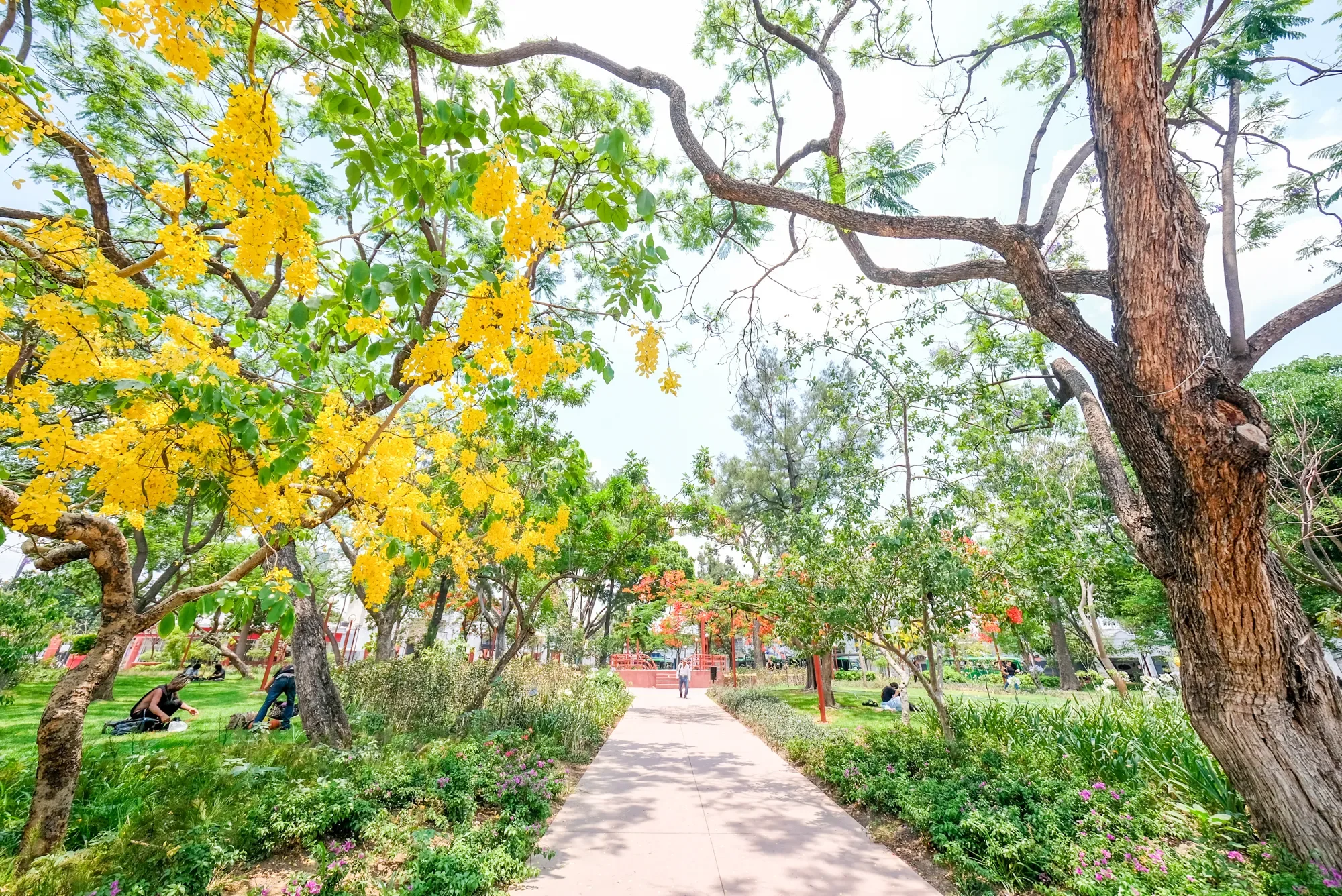
A view of Parque Revolución on in Guadalajara on May 13, 2026, following recent renovations ahead of the World Cup. Photo © Alejandra Leyva.
DMP: Can you tell me a little about the current context of privatization and gentrification in the city?
LS: With the accelerated gentrification of various parts of the city, particularly downtown, there has been a commodification of public spaces, and obvious displacement of people, especially younger residents, from them.
The “Disneyfication” of the city for the World Cup has put pressure on groups that are used to living in the city with a certain amount of freedom. This has impacted those who meet-up regularly, as well as those who organize marches and political activities.
We are currently experiencing confrontation with the state and the city governments over this. The spaces that resist have had to either make concessions to align with the government in order to remain, or they face ongoing harrassment.
DMP: Tell us about the International Women’s Day protest on March 8 of this year.
LS: This year, March 8 came less than 15 days after El Mencho’s murder, in a context one might describe as a tense calm—though in many ways it’s the new normal, a hyperviolent kind of normality.
Here in Guadalajara, there have been two [feminist] marches for several years now. The large march, organized every year by the #YoVoy8DeMarzo network is trans-inclusive, but there is also a march held by trans-exclusionary groups on the same day, which usually heads to a different part of the city. This year there was a lot of politicization; people came with very clear demands, unlike other years when they’ve been somewhat diluted.
For a few years now, the [main] march has been referred to as International Working Women’s Day. That carries a certain weight. Pro-Palestine groups participated, and this year there were a large number of contingents and organized groups.
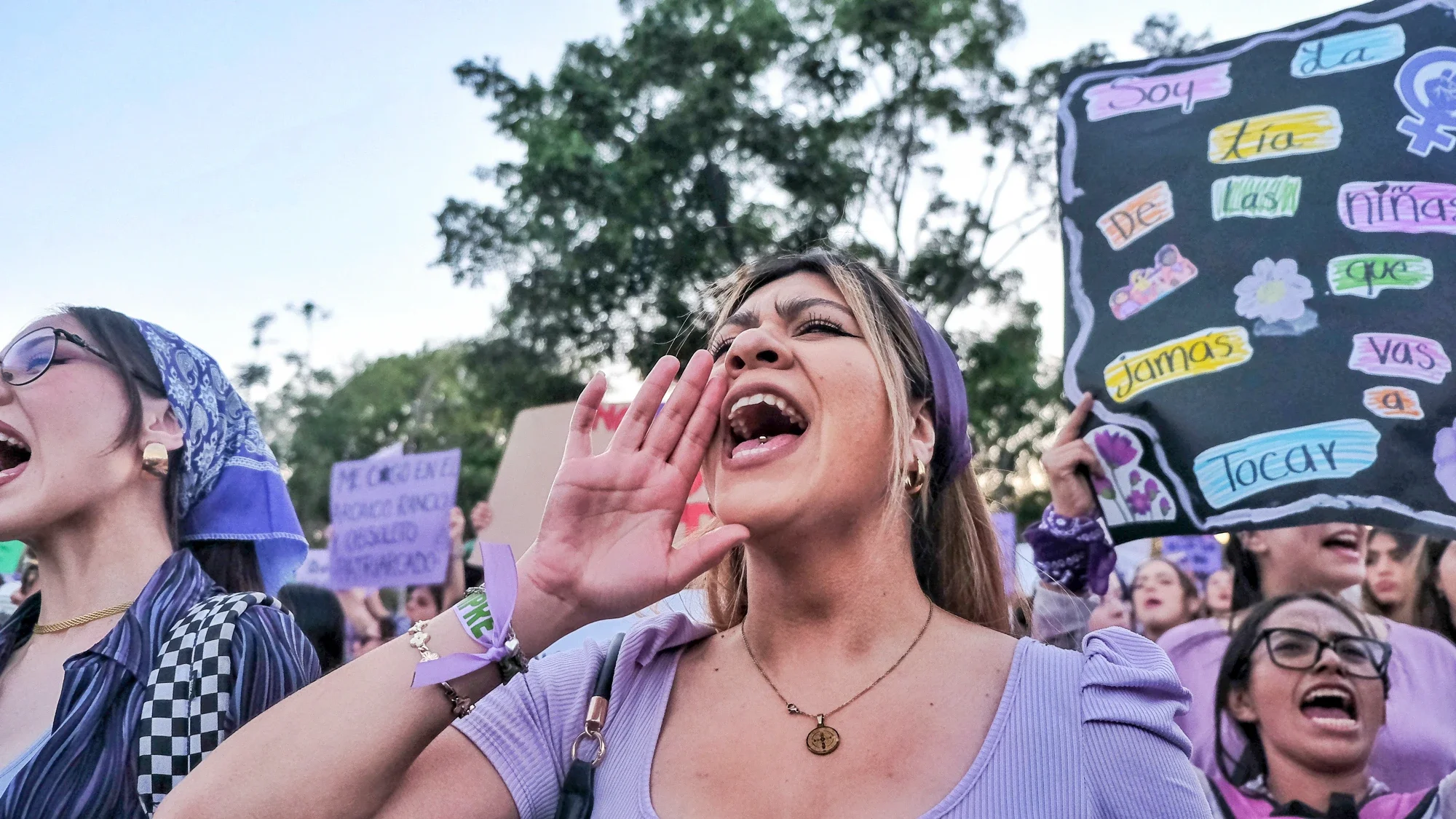
A protester takes part in the International Women’s Day march near Parque Revolución on March 8, 2025. Photo © Alejandra Leyva.
On March 8, demonstrators tore down the fences around Parque Revolución, which had been closed for about nine months. It was closed abruptly one morning and fenced off. Everyone who made a living from the weekend market was denied a place to sell. We were told [the park] was being renovated.
On March 8 when women reopened the space it became clear that there had been no renovations. After that, [the city government] began working very quickly, and it was inaugurated. There was a ridiculous police presence at that opening, so many officers that, looking at many of the photos that came out afterward, one wondered, “Where were all these police officers on the day of the blockades [when El Mencho was killed, on February 22]?”
There are a lot of commercial spaces that City Hall has begun to refer to [in a pejorative manner] as street vending. Many of these vendors were supposedly brought into compliance several years ago. It’s still unclear who exactly is being removed from downtown. There’s an obvious effort to clear out certain areas of the city, and construction has been happening at a tremendous pace in the months leading up to the World Cup.
There is a strong police presence in the city center, and a heavy military presence at all entry points to the city. The National Guard and military are deployed on the highways.
This is why, rather than an abstract notion that women are marching for peace, we ought to understand that social peace means being able to move freely through the city, that people can have places from which to sell goods, and that they are housed.
The March 8th march was particularly important not only because it was quite large and came at a time when there was a lot of fear, but also because it was much more organized than previous years. The presence of groups that organize on the day-to-day was more evident, going above and beyond the sheer numbers [of demonstrators] we’ve seen at other times.
DMP: Tell me more about how you’re reflecting on peace in a multidimensional way.
LS: This context feels so violent, like the city is being redesigned for people who don’t actually live in it.
There are two aspects to this. There is harassment by state security forces, which limit mobility, and there is also the disappearance of public spaces due to private interests and businesses, which makes it very difficult for people to simply exist in the city.
This has led to people being pushed off the streets, especially younger people, who have the least access to resources, and whose spaces—including universities—are isolated and difficult to reach.
In this city, peace means being able to feel safe in the city, to hold demonstrations, to sell things, to go to a public space and sit on a bench without having police around all the time.