

Indigenous protest forces repeal of land privatization law in Bolivia
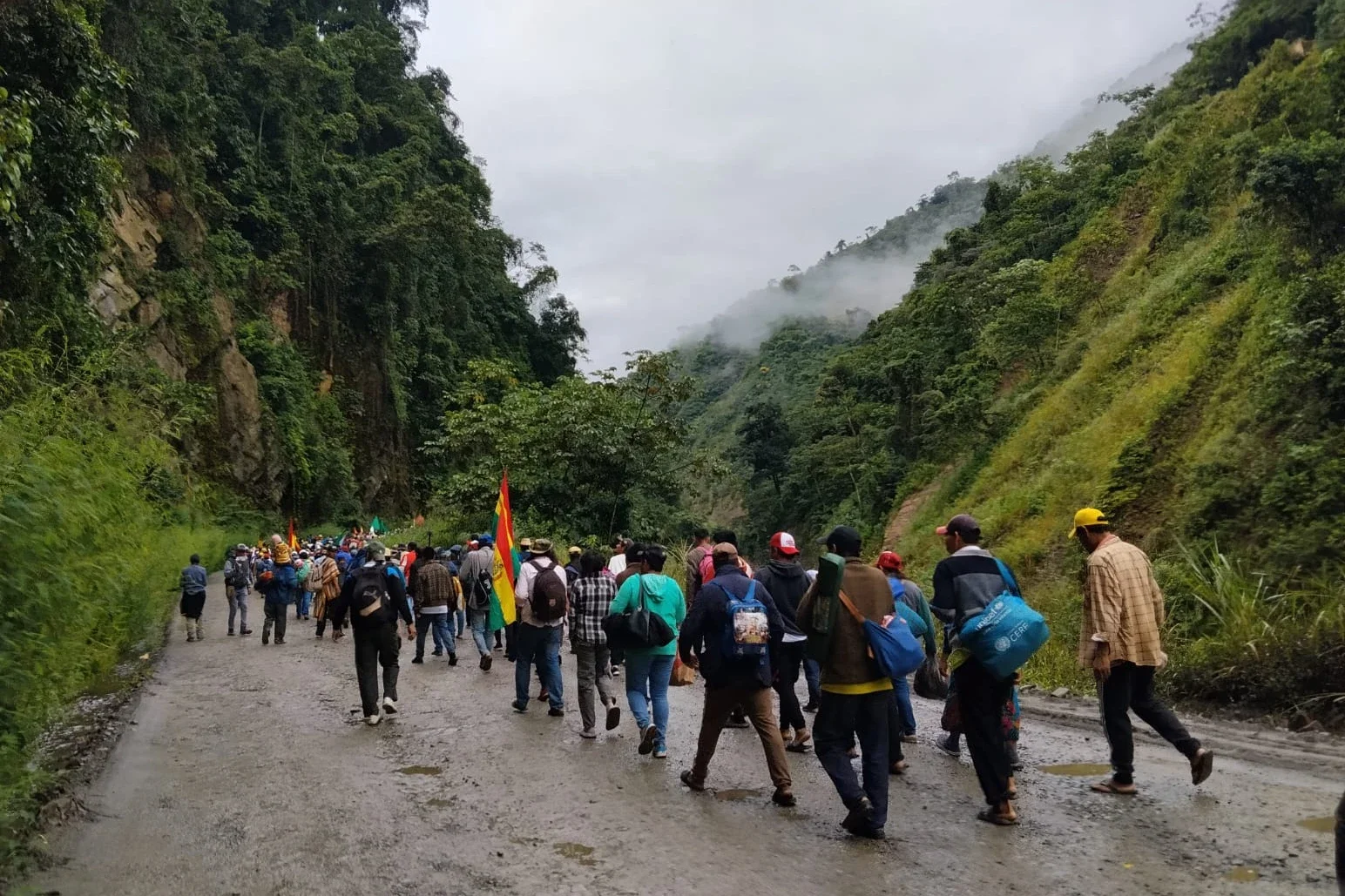
The march in defense of the Amazonian forests and the legal protection of peasant and Indigenous territories as it departed from Choro to Yolosita, Bolivia, on Thursday, April 30. Photo © Fuga Radial.
Opinion • Magali Vianca Copa Pabón • May 15, 2026 • Leer en castellano
Following a 27-day march to La Paz, Bolivia, Indigenous and rural organizations from the country’s east held a successful 10-day sit-in that forced the repeal of Law 1720.
The law threatened small-scale communal landholdings and fast-tracked a process through which they would be transformed into individually held medium-sized properties. It enabled forms of dispossession disguised as “rural credit” and that favored the agribusiness sector. The demands of the marchers, who were from Pando and Beni states, also included legal certainty with regard to land, a halt to the anti-protest law, and the right to prior consultation.
The march set out from Pando on April 8, following the enactment of the law, with approximately 300 marchers embarking on a grueling trek of about 1,000 kilometers. It continued under changing and inclement weather conditions marked by rain and cold, especially upon their arrival to the seat of government in La Paz.
By the time the marchers arrived in the city on May 4, their numbers had grown significantly, and they held a sit-in in front of the Vice President’s Office. They demanded a voice in the debate on the bill to repeal the law, which the government rushed through the legislature as protests grew.
The delegation was barred from entering the Chamber of Deputies to present their position, and the Senate amended the bill to include a legal provision requiring the drafting of a new law on the same matter. Both chambers approved the repeal of Law 1720 on May 12, which was formalized on May 13 by President Rodrigo Paz.
The president presented the repeal as the result of dialogue and announced that work would begin on a new law. But his rhetoric contradicts what happened during the protests, where demonstrators condemned the lack of meaningful dialogue and strongly rejected any legislation without prior public consultation that could jeopardize the legal security of Indigenous and peasant lands and territories.
“We cannot return home empty-handed!” said Vivian Palomeque Irina, Executive Secretary of the Vaca Diez Regional Federation of Peasant Workers in Beni, during the sit-in. She is one of the most visible figures in the historic uprising of Indigenous peoples in the lowlands.
Her words summed up the collective desire to keep fighting until their demands are met. The law was repealed, but this was not a gift from the government. Instead, it was achieved by people putting their bodies on the line.
The march and the solidarity demonstrated during the sit-in were the cornerstones of protest and pressure campaigns that gained widespread support from other peasant and Indigenous organizations, particularly at regional and municipal levels. Support also came from other social sectors across the country, including urban and rural teachers, labor unions, miners, students, transportation workers, and neighborhood organizations in the city of El Alto.
The self-organization across these sectors reinvigorated an indefinite—and ongoing—strike with roadblocks, establishing a common agenda that includes protecting natural resources, fair wages, fuel supply, and demands for Paz to resign.
The march that originated among the lowland Indigenous peasant communities against Law 1720 became the catalyst for a mobilization of historic proportions. The demand to repeal the law succeeded in articulating accumulated grievances, transforming a concrete demand into a national social agenda that challenges the plundering of natural resources, as well as the colonial and neoliberal nature of the Paz administration.
Resisting a historic rift
Small-scale agricultural landholdings in Bolivia have historically been shielded from being seized. This is a basic legal safeguard enshrined in the 1938 Constitution and consolidated through the 1953 Agrarian Reform.
Law 1720 emerged against a history in which joining small parcels was the dominant model for small-scale land tenure. The Law prioritized individual ownership over the reality of Indigenous land use, which is based on communal and community ownership grounded in redistribution, rotation, and the spatially uneven nature of the territory.
The recognition of Indigenous lands in Bolivia stems from the 1990 March for Territory and Dignity. That mobilization forced the then-government of Jaime Paz Zamora—father of the current president—to recognize Indigenous territories under a collective ownership model. That is what Law 1720 put at risk, as agribusiness sectors called for the elimination of collective land ownership as part of the cancelled law’s proposed second phase.
Land regularization and agrarian title registration—both individual and collective—are high on the agenda of judicial struggle and protest led by Bolivia's rural sector. Their efforts are marked by conflicts over boundaries and borders as well as family and community disputes, which take place in a context of historical injustices, overlaps, and reconfigurations of ancestral territory.
In the process of encroachment on Indigenous ancestral territories, historically promoted by the colonial state, Law 1720 established itself as a key legal change. It revealed a complex landscape of dispossession, decay, and disruption that is harshly imprinted on Indigenous and peasant territories, creating even more fissures in their social and territorial structure.
Another issue with Law 1720 is linked to the internal crises and the fragmentation of Bolivia’s Indigenous and rural organizations.
Over the course of the march, the Confederation of Indigenous Peoples of Bolivia and the Single Trade Union Confederation of Peasant Workers of Bolivia made deals with the government behind the backs of the mobilized organizations that held down the sit-in for the repeal of Law 1720.
This reflects the situation of co-optation and clientelism among the national leadership of the Indigenous and peasent sector in Bolivia, a trend that persisted throughout the government of the Movement Toward Socialism.
Today, hope lies with intermediary, department-level and regional organizations, such as the “Túpac Katari” Unified Departmental Federation of Peasant Workers of La Paz, one of the most vocal critics of Law 1720 and among the first to demand Paz’s resignation.
The National Confederation of Indigenous Women of Bolivia, the only national body supporting the march, organized the “Meeting for Land and Territory” and played a key role in the mobilizations.
From the polls to the streets
The march for land signaled a strong break with Paz, who was elected in August of last year. “The people put him in office, and the people will remove him; we are very angry with this government,” said one of the marchers.
Her anger reflects the rift between the popular vote that brought the Paz administration to power and the measures that have been adopted that directly hurt those very same sectors.
Following his electoral victory, Paz adopted the slogan “God, family, and country,” with a narrative that distanced itself from the broad popular base that brought him to power. The first measure passed by his government was the elimination of taxation on large fortunes. Vice President Edmand Lara, who had effectively served as the main connector to the popular vote, was also sidelined.
Dissatisfaction with the Paz government is beginning to cast doubt on whether the ballot box is truly a democratic mechanism capable of guaranteeing respect for social rights and demands. The march for land expressed a loss of confidence in institutions, political parties, and their leaders.
Thousands returned to the streets to defend their rights in the midst of the crisis. They faced a government that makes unilateral decisions and responds with measures that run counter to the interests of the electorate.
The defense of natural resources, land, and territorial rights, among others, has once again taken center stage in a social agenda with national scope and historical significance.
In its final stretch, the protest gained support from other sectors of the country via regional marches, gatherings, and manifestos. They consolidated the “Pact against betrayal” on May 5, in response to the government’s co-optation of union and Indigenous leaders outside mobilized sectors.
Among remaining broader, multisectoral demands are the approval of the Forest Law, the cancellation of a bill promoting carbon markets and the anti-protest law, the rejection of the decentralization of education and health care, the defense of natural resources, guaranteeing the fuel supply, the right to prior consultation, and the protection of rights recognized in the Constitution, among others.
These demands, as well as the specific procedures around land titling and compensation in Indigenous territories, remain unaddressed by the government and are linked to other specific demands that continue to mobilize various social sectors, who remain in a state of emergency.
The struggle against a specific law expanded to revive the memory of the cycles of mobilization, such as the Water War of 2000 in Cochabamba and the Gas War of 2003, that marked Bolivia at the beginning of the 21st century. These are the struggles that opened the horizon for the constitutional process in Bolivia.
The march against Law 1720 did not just express rejection of a law that represents a step backward and a violation of long-won land rights. The defense of small rural property and Indigenous rural territories has forged a common agenda in the face of a government experiencing an institutional crisis. It is a symbol of the broken promises of the Plurinational State and the unwavering defense of the same collective forces that made the constitutional assembly process possible all those years ago.