

Legacies of struggle in Argentina
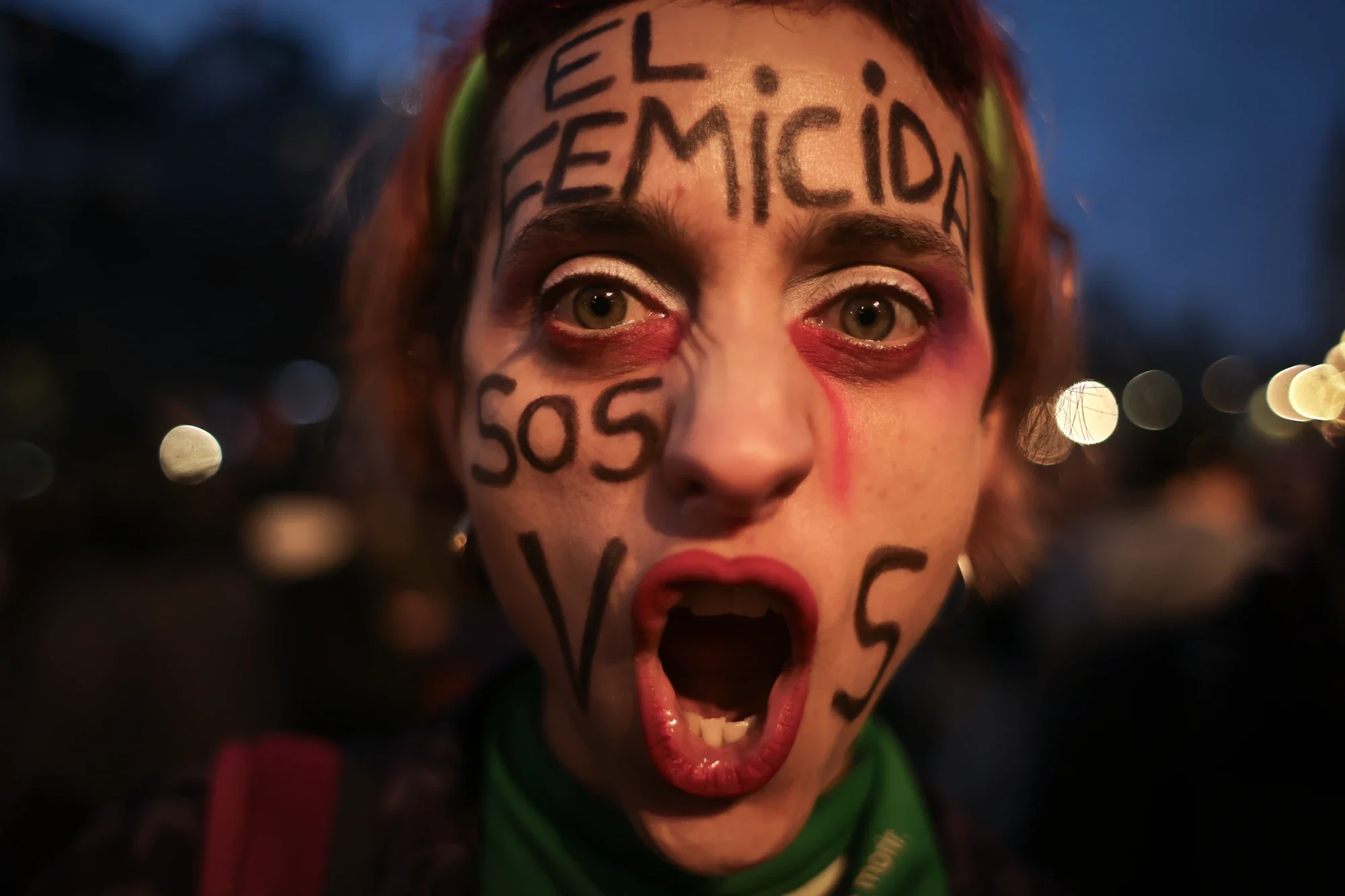
A young woman at the “Ni una Menos” rally has the words “You are the femicide” written on her face. June 3, 2026, in Buenos Aires, Argentina. Photo © Susi Maresca.
Opinion • Susi Maresca • June 17, 2026 • Leer en castellano
Throughout Argentina, Ni Una Menos is commemorated every June in a series of marches that demand an end to femicides, gender-based violence, and cruelty.
The first such march took place on June 3, 2015. It was born out of the grief that followed the femicide of Chiara Páez, who was from Rufino, Santa Fe. She was 14-years-old and pregnant when she was murdered by her partner, Manuel Mansilla, who buried her body in the backyard of her home.
The run-up to this year’s June 3 (3J) march was marked by a femicide with striking similarities. Agostina Vega was also 14-years-old when she was murdered, allegedly by a man close to her family. Her body was found dismembered on May 30, after she had been missing for a week. Vega’s killing is a fresh reminder of a deep wound that remains unhealed.
At first, Ni Una Menos did not identify as feminist, but over time it became one of the foundations—along with the Plurinational Gatherings—which gave shape to Argentina’s feminist movement.
This struggle is inspired by the Mothers of Plaza de Mayo, who passed on the meaning of their struggle to new generations.
Violence, austerity, and backsliding
This year, the 3J march drew crowds nationwide under the rallying cry “We want to be alive, liberated, and debt-free.” Marches took place in over 80 locations across the country, all against a backdrop of deep sorrow.
The focus of this year’s June 3 rally was the outcry over the femicides of Agostina Vega, Noelia Carolina Romero, and Dulce María Beatriz, which had made headlines in the media days before the march.
Vega’s case reignited a long-standing demand: “Stop killing us.”
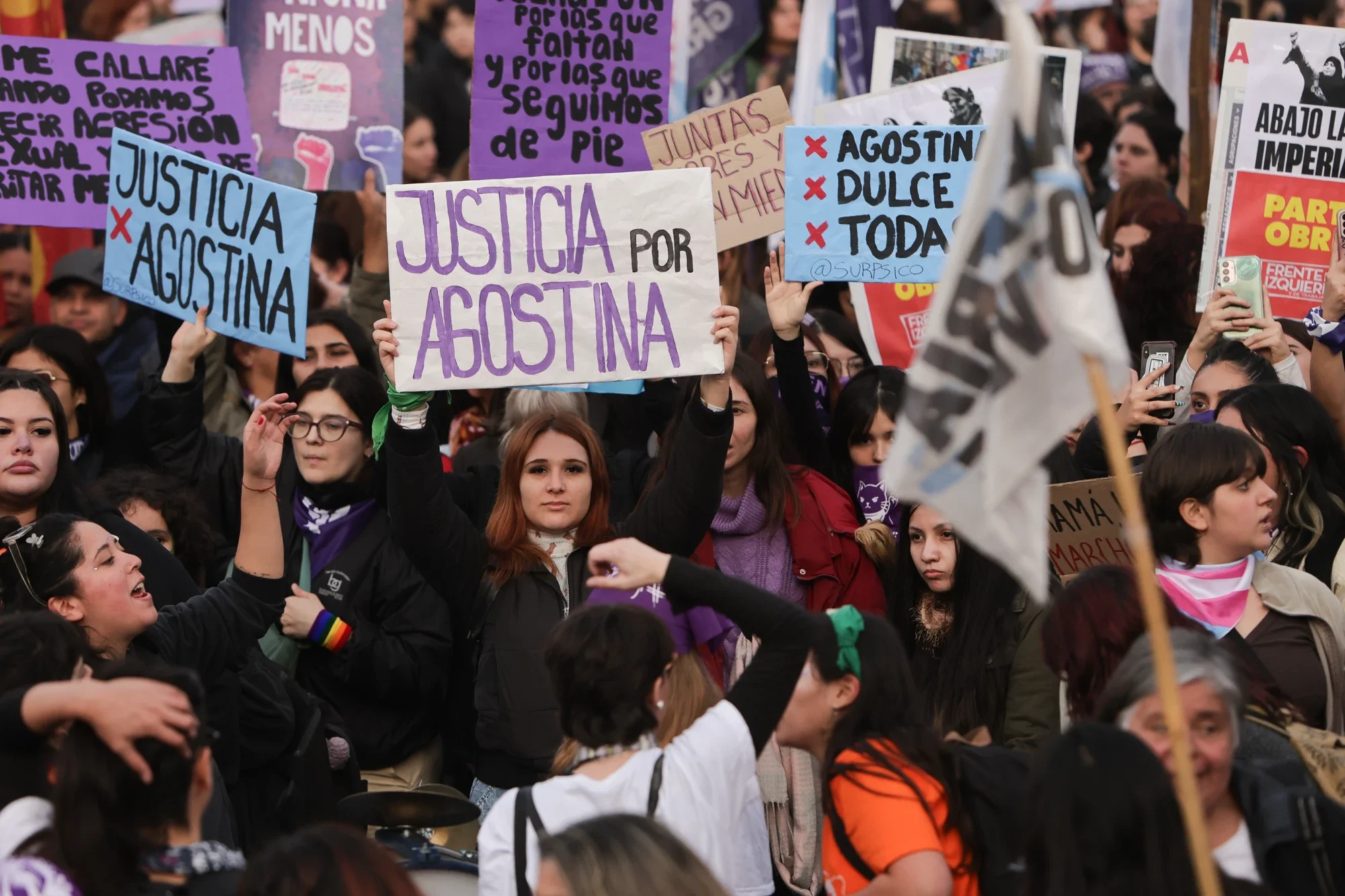
Many young women are holding signs with the names of women murdered in recent months. “Justice for Agostina” reads the sign held by one of them. June 3, 2026. Buenos Aires, Argentina. Photo © Susi Maresca.
Her family reported delays and irregularities that began the night she was disappeared, when her mother went to the authorities but received no response. The alleged perpetrator had priors for gender-based violence that the criminal legal system had ignored.
According to a recent report by Mujeres de la Matria Latinoamericana, between January 1 and May 30, 2026, 105 gender-based violent deaths were recorded in Argentina, to which these three recent cases must be added.
The document read during this year's 3J march helps us reflect on how gender-based violence is intertwined with multiple forms of violence that affect us as a society. These include forms of violence perpetrated by corporate power, orchestrated by the state, and carried out by repressive forces.
In Argentina, this manifests through the defunding of education and healthcare, violent evictions targeting historically marginalized populations—in urban and rural areas—and changes to the Glacier Law and the Land Law that pave the way for increased extractivism.
There is also a less visible but highly symbolic setback: promoting the myth of “false accusations” through bills and media campaigns, despite the lack of empirical evidence for such claims.
This strategy consists of spreading the idea that a large number of women report violence that did not occur, purely to “get revenge” or “harm” the accused, as if this were the main issue at hand.
As with other government objectives aimed at dismantling the legal framework—such as eliminating the legal classification of femicide—this does nothing to address the lack of access to justice.
Instead it seeks to discipline, sow doubt, and discourage those who already face significant obstacles to reporting abuse.
Having come so far, the official description of Vega’s killing as a “homicide” and the move to reopen the debate over whether women lie when they report abuse are forms of institutional violence.
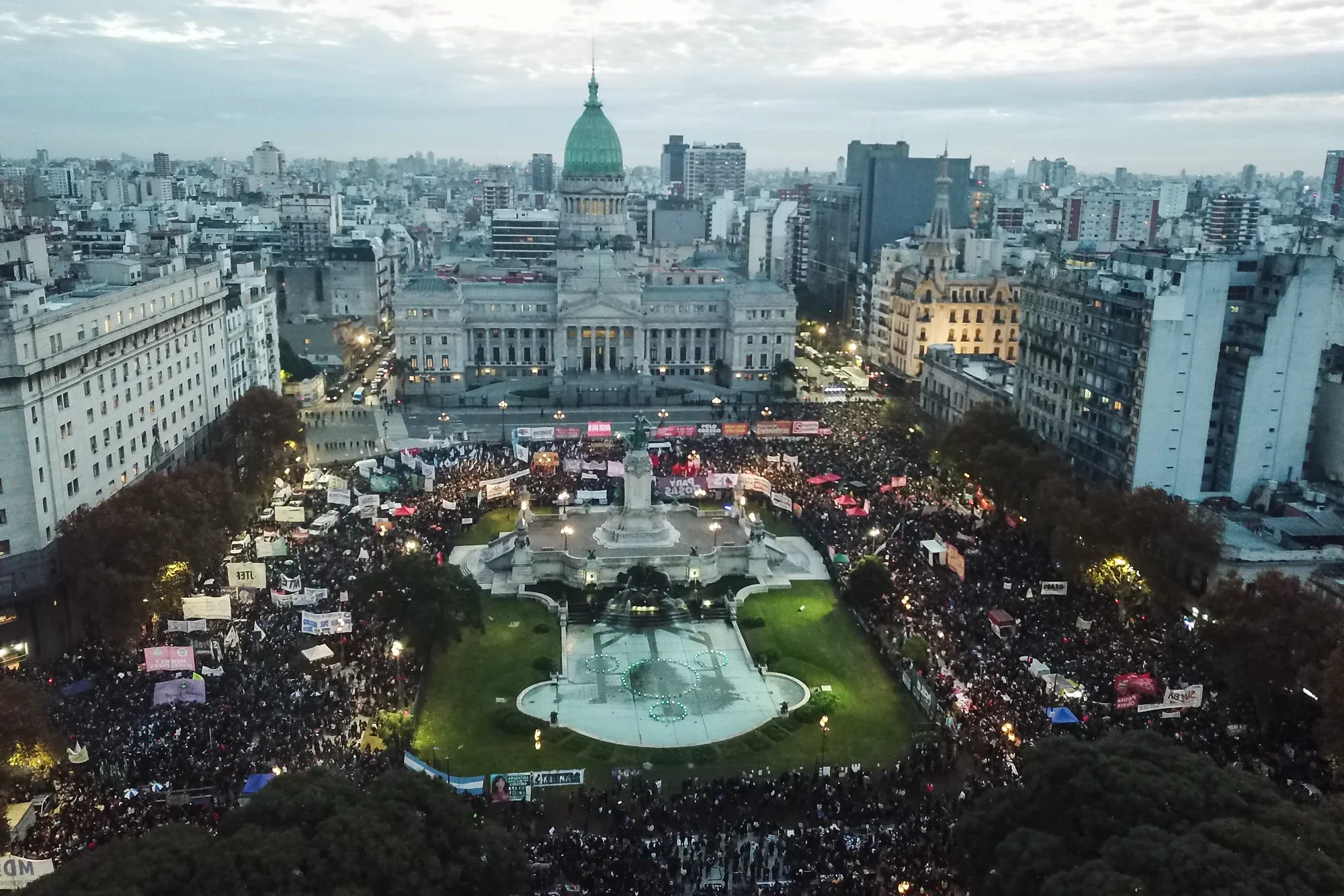
Panoramic view of the Plaza de los Dos Congresos in front of the Argentine Congress building during the June 3 demonstration. June 3, 2026. Buenos Aires, Argentina. Photo © Susi Maresca.
Threads of hate
Two and a half years into his term, Milei’s administration has gone through two phases in its offensive against the transfeminist movement.
The first was one of explicit, government-sanctioned trans and queerphobia.
Milei’s speech at the Davos Forum in January 2025, in which he likened homosexuality to child abuse and described feminism as a cancer, ignited a flame that had been burning beneath the shock of everything that was happening in Argentina.
The first Federal Anti-Fascist and Anti-Racist LGTBIQNB+ Pride March took center stage, mobilizing the feminist movement in Argentina and around the world in response to the president’s statements.
It must be emphasized that such hate speech has enabled rampant violence in society. The murder of three lesbians in Barracas is a clear example of this.
The brutal crime occurred on May 6, 2024, at a boarding house in the Barracas neighborhood of Buenos Aires. A neighbor threw a Molotov cocktail into the room where four lesbian women were living, killing three.
At that time, the LGTBIQNB+ community warned that violence was on the rise under Milei’s rule—in part due to his dehumanizing rhetoric. In the first half of 2025, hate crimes based on sexual orientation, gender identity, or gender expression increased by 70 percent. In May, the trial against the accused killer in the Barracas case began, and the Ni Una Menos collective is accompanying that process.
The rhetoric of the current government then gave way to a second phase: dismantling. The argument now is that there is no money for anything, much less for gender-related public policies. The ramping up of austerity measures, which hit marginalized communities the hardest, was the focus of the second anti-fascist pride march held earlier this year.
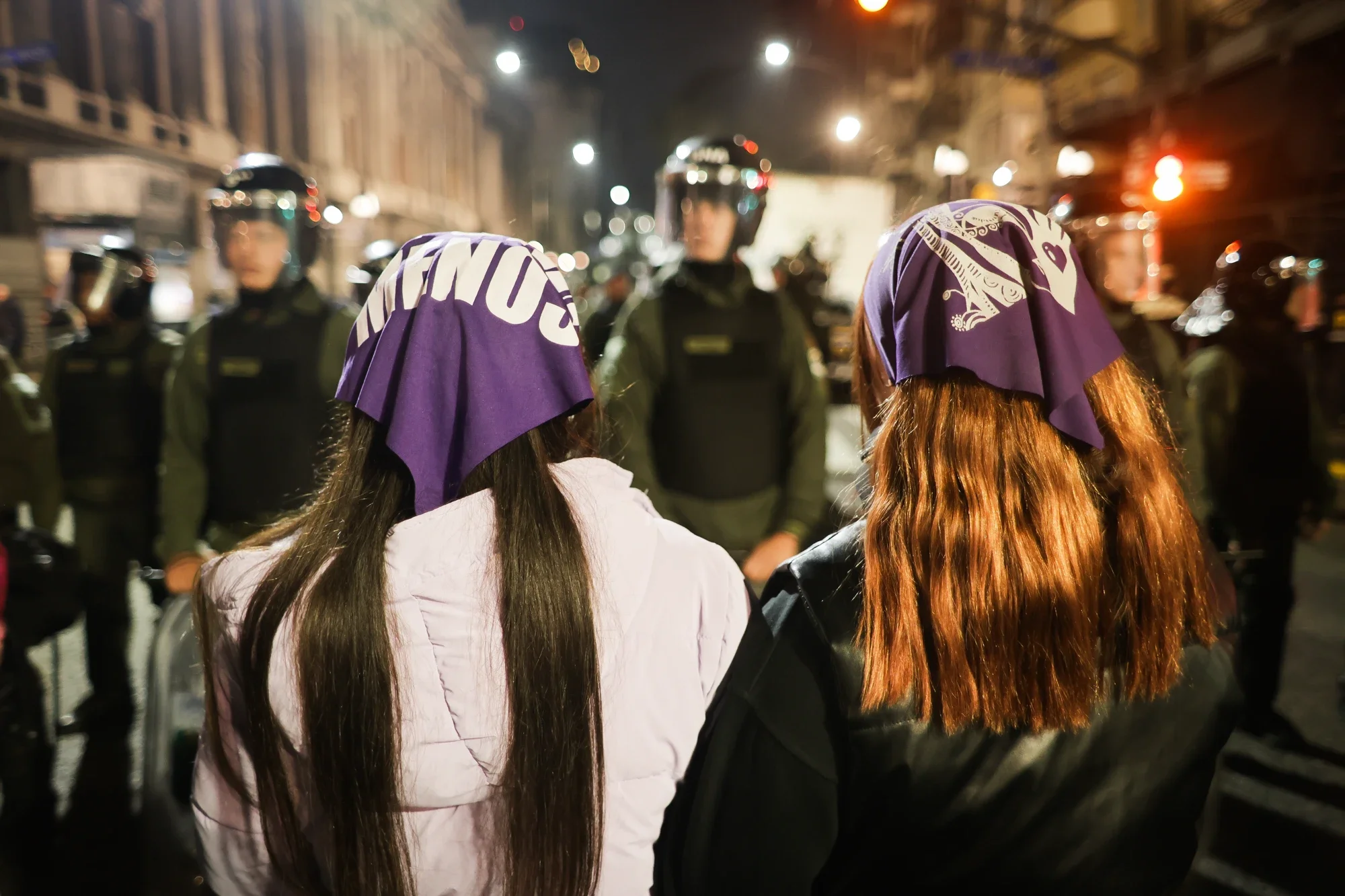
Two young people wearing purple headscarves—a symbol of “Vivas nos queremos”—face the police cordon deployed outside the Argentine National Congress. June 3, 2026. Buenos Aires, Argentina. Photo © Susi Maresca.
Living memory of struggle
When people flooded the plazas for the first Ni Una Menos in 2015, the National Campaign for Legal, Safe, and Free Abortion was celebrating its 10th anniversary. A decade later, legal abortion is the law, and green flags fly at every Ni Una Menos rally as we demand the law be respected.
June 3 unites us because it strikes an intimate and primal chord. It exposes a historical system of oppression against women and people of diverse genders that directly challenges us.
It’s impossible not to feel empathy, not to feel called to action by the rallying cry. We have all suffered patriarchal violence to a greater or lesser extent, or we have a friend, a sister, a daughter, or a partner who has. Men are not exempt either.
Sociologist María Pía López pointed out recently that many of the young people who took the lead this year on 3J were 3, 4, or 5 years old during the first Ni Una Menos marches.
Their political development has been shaped by these struggles, and they found a space for growth there.
Young people are taking to the streets, seeking answers, asking questions, and demonstrating. In this space we call transfeminism, they feel embraced by an adult world that often ignores their struggles. It’s a movement that shakes up subjectivities and weaves a fabric that endures. That’s no small thing.
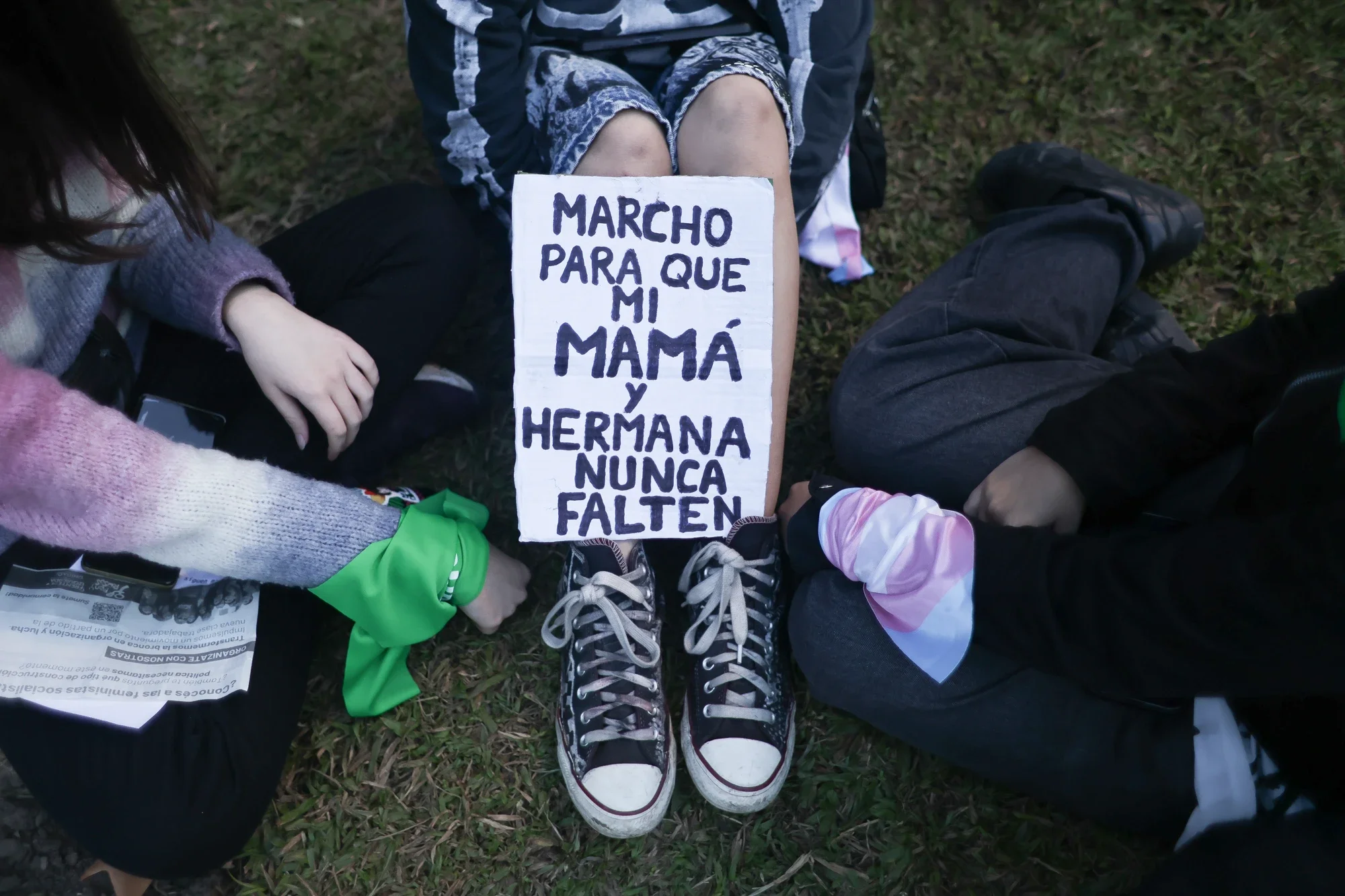
“I’m marching so my mom and sister will never be missing,” reads a sign held between the legs of a young trans person alongside their friends at the Ni Una Menos march. June 3, 2026. Buenos Aires, Argentina. Photo © Susi Maresca.
Within discussions currently taking place in the Ni Una Menos movement, there is also a growing awareness that the bodies of women and people of diverse genders cannot be separated from issues of territory and care work.
Patriarchal oppression functions as a violent and extractivist model that violates life in all its expressions. Debt is a consequence of the same exploitation.
What we are discussing today from a transfeminist perspective, as Rita Segato says, is a model of humanity: we are considering how we want to live. The backlash from the global right against our persistence is no coincidence. They regrouped because they were losing power in the face of our organization.
We are in a historic moment which reveals, like never before, the relationship between those responsible for exploitation, occupation and inequality, and those of us who sustain life so that everything else can function.
The situation is exasperating, yes. There is still much to be done, yes. Transfeminism must listen to the Indigenous communities defending their territories against extractivism. We must continue to shift the movement away from a punitive approach and broaden our focus so no one is left behind.
There is one thing that is certain: we are moving forward together, and that alone is a battle won.
