

Action for glaciers continues as Milei government dismantles legal protections
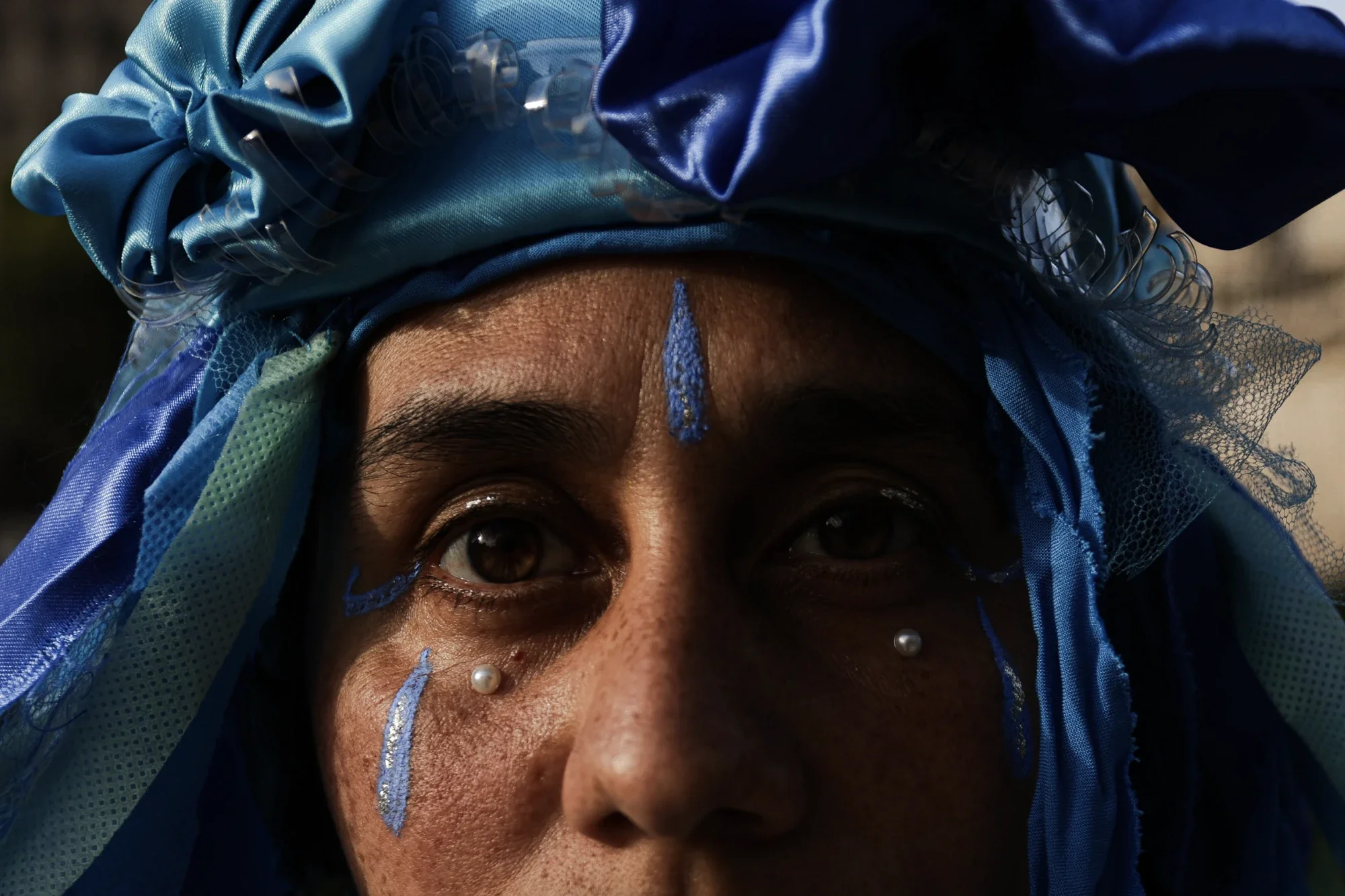
The face of a woman from the blue brigade of XR (Extinction Rebellion) at Congress on the day the Glacier Law Reform was debated in the Senate. February 26, 2026, Buenos Aires, Argentina. Photo © Susi Maresca.
Reportage • Susi Maresca • April 23, 2026 • Leer en castellano
In the early afternoon on March 25, a long line of people formed in front of the glass entrance to the Annex Building of the National Congress in Buenos Aires. But the door was cordoned off, and an employee wearing a suit, surrounded by police officers and gendarmes, checked IDs and matched them to a list on a tablet.
Shaking his head, the man indicated to those in line—many of whom travelled from other provinces and districts of Argentina—that they would not be allowed to speak at the public hearing to defend the Glacier Law against a reform bill championed by Javier Milei’s government.
In 2010, Law 26.639 on “Minimum Standards for the Environmental Protection of Glaciers and the Periglacial Environment,” known as the Glacier Law, established glaciers and the environment around them as public assets and strategic water reserves. The pioneering legislation put the brakes on resource extraction projects, safeguarding present and future water reserves.
The Glacier Law has been in the government’s crosshairs since Milei took office in December 2023. Two years later, his government introduced a bill that narrows the scope of protection to glaciers with a “verifiable hydrological function” and delegates responsibility for determining which areas to protect to the provinces.
The reform opens the possibility of mining in previously protected areas. Environmental and social groups around the country argue it violates a constitutional principle designed to prevent the rolling back of environmental protections.
Under pressure from opposition lawmakers, Milei’s government called a public hearing that drew a record turnout: 105,000 people registered to speak. But only 200 would ultimately have their say.
That’s why the closed hearing turned into a public event in the street in front of Congress on March 25, as rejected speakers sat on chairs of various sizes and colors alongside a growing group of protestors made up of entire families, youths, retirees, scientists, Indigenous communities, actors, lawyers, and activists.
“In Uspallata, we wake up gazing at the ancient water that is the glaciers. We have a spiritual and cultural connection,” said Claudia Herrera in an interview with Ojalá, from the Huarpe Guaytamari community in Mendoza—a province marked by the Andes mountain range and extractive projects—through tears. “If they die, we die.”
The open assemblies, vigils, camps, and demonstrations across the country continued in the days leading up to the amendment's approval on April 9.
The reforms will take effect later this month, and environmental organizations are already preparing a historic class-action lawsuit against it. The struggle continues, under the rallying cry: “The Glacier Law must not be touched.”
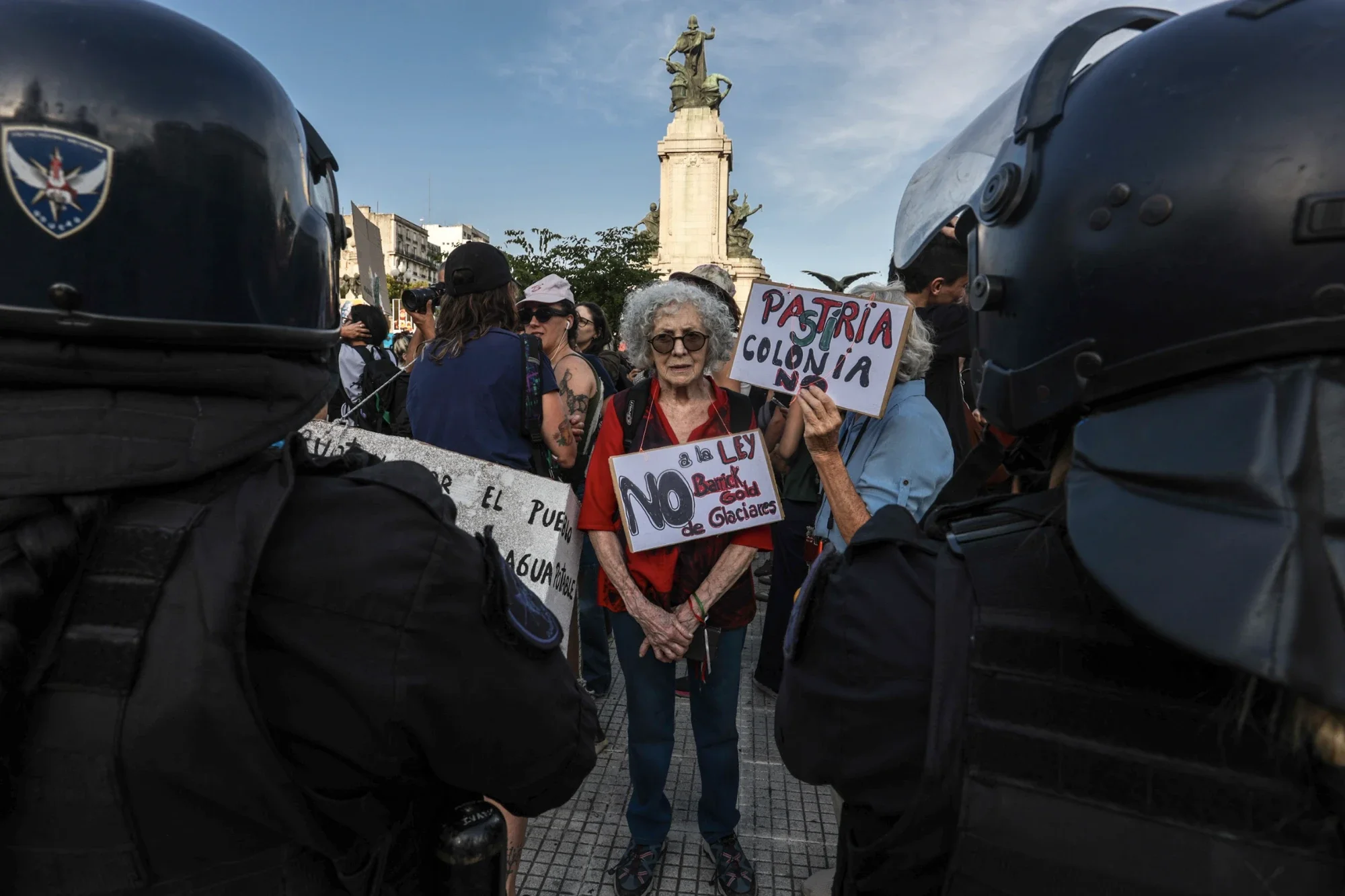
A woman in front of a police cordon holds a sign reading “No to the Barrick Gold Glacier Law” on February 26, 2026. Buenos Aires, Argentina. Photo © Susi Maresca.
The clash between freshwater and megamining
Glaciers are ancient ecosystems that provide fresh and potable water for at least seven million people and hundreds of species in Argentina.
According to the National Glacier Inventory, which was established by the Glacier Law and is compiled by the Argentine Institute of Snow Science, Glaciology, and Environmental Sciences (IANIGLA), there are 16,968 ice formations in Argentina’s Andean region. They stretch over more than 5,000 kilometers and span 12 provinces—from Jujuy in the north to Tierra del Fuego in the south.
The fight for water rights in Argentina has been ongoing for more than 25 years and is deeply linked to protecting the country’s glaciers and rivers. This struggle is often intertwined with anti-extractivist organizing against mega-mining and agribusiness, both of which pose an existential threat to water reserves.
“Our experience with mega-mining has been 90 percent negative because they told us there would be jobs, and that wasn’t the case,” said Rosa Farías, a retired teacher and member of the El Algarrobo Assembly in Andalgalá, Catamarca province. “They told us it wouldn’t pollute, and now we have the tailings dam—that massive, polluting reservoir filled with waste from mega-mining—and so many people sick with cancer.”
According to IANIGLA, over the past decade, the country’s northwestern region has seen a 17 percent reduction in ice cover.
“The Glacier Law was built from the ground up and is a pioneer in the region in protecting our water sources,” said Farías. “With this change, it’s a death sentence for the provinces along the mountain range.”
Following the approval of the Large Investment Incentive Regime (RIGI) in July of 2024, seven months after Milei’s government took office, the Glacier Law was the only obstacle protecting periglacial zones. In some provinces, extractive projects were in prospecting or exploration phases in these environments, and local communities had begun voicing their opposition.
Among major mega-mining corporations with interests in Argentina are Glencore (Swiss-British), BHP (British-Australian), Lundin (Canadian), Rio Tinto (U.S.-Australian-British, financed with Japanese capital in some projects in Argentina), and Barrick Gold (Canada). The recent reform gives provincial authorities the power to determine which areas are protected and where commercial activities will be permitted.
Resistance to the changes proposed to the Glaciar Law came not only from civil society and organizations but also from glaciologists, hydrologists, environmental scientists, and geographers, who drafted a letter warning of the bill's consequences.
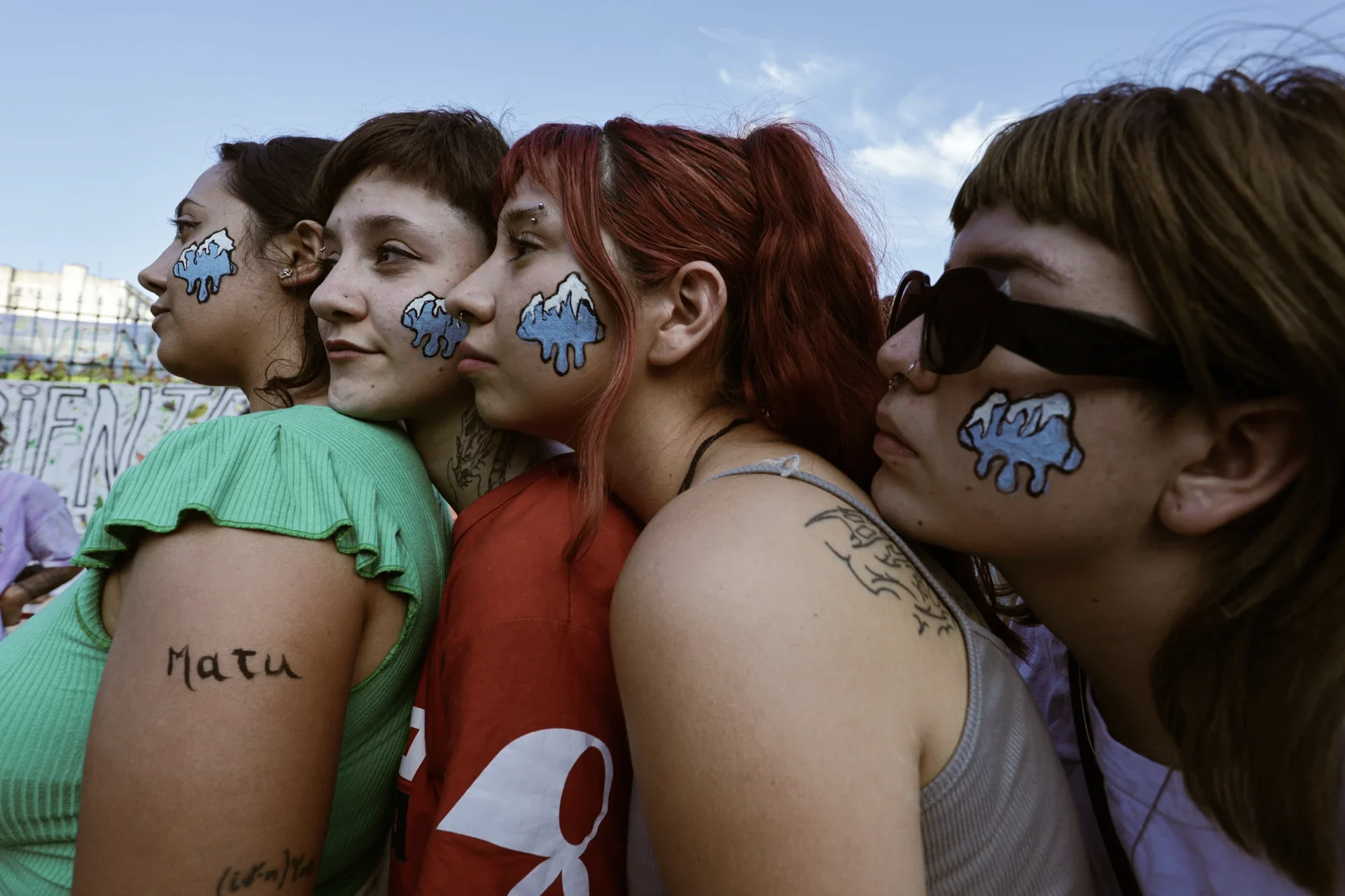
Four young people with glaciers painted on their faces at one of the protests in defense of the Glacier Law outside Congress. December 4, 2025, in Buenos Aires, Argentina. Photo © Susi Maresca.
Where time counts differently
“Water flows know no frontiers, they are the mothers that nourish us, especially Cerro Aconquija, which holds immense spiritual value for Indigenous communities,” said Lourdes Albornoz, one of the 200 speakers who spoke via Zoom on the second day of the public hearing. “It is an Apu, a sacred site that contains ancient spirits.”
Albornoz is from Indigenous Diaguita territory, which spans several Argentine provinces and parts of Chile. In conversation with Ojalá, she highlighted that glaciers are fossil waters available to us and future generations. Archaeological remains show that many of her ancestors made offerings there.
“They are a space where time converges—the most remote, unimaginable pasts with the present and times yet to come,” she said.
The amendment to the Glacier Law represents a profound blow to her people and to Tucumán province, ravaged by floods caused by soil erosion due to extractivism.
“Far from questioning the extractive model that causes these floods, governments continue to ally themselves with companies and deepen environmental damage, ecosystem imbalance, and social injustice,” said Albornoz. “That’s why our communities are rising up.”
Beatriz Mercado is a member of the Assembly for the Uspallata Valley in the province of Mendoza, where Zonda Metals GmbH (Switzerland) and Alberdi Energy (Argentina), are working with Governor Alfredo Cornejo to open a copper and gold open-pit mine known as the San Jorge Project (PSJ Copper).
Mercado emphasized that failing to protect the glaciers harms Andean communities in Mendoza, where rainfall is scarce, and they are strictly dependent on the snow that falls in winter.
“For the San Jorge Project, they would use a certain amount of water from a stream that they claim belongs to them because it lies within the project’s perimeter,” said Mercado. “The water and the land belong to the communities, to the people who live in these places, and under no circumstances are we willing to hand them over to these companies that exploit resources without any regard for the damage they cause.”
In Mendoza, security forces have repeatedly cracked down on protests against mega-mining and the PSJ Copper Project, which have taken place throughout the province. So far in 2026, dozens have been arrested and criminalized for defending water.
“Governor Cornejo has authorized the police to go out and hunt people down, even though our marches are peaceful,” said Mercado. “What is happening is very sad, but to think of a future without water is, honestly, much worse. We know that surrendering our water means surrendering our lives.”
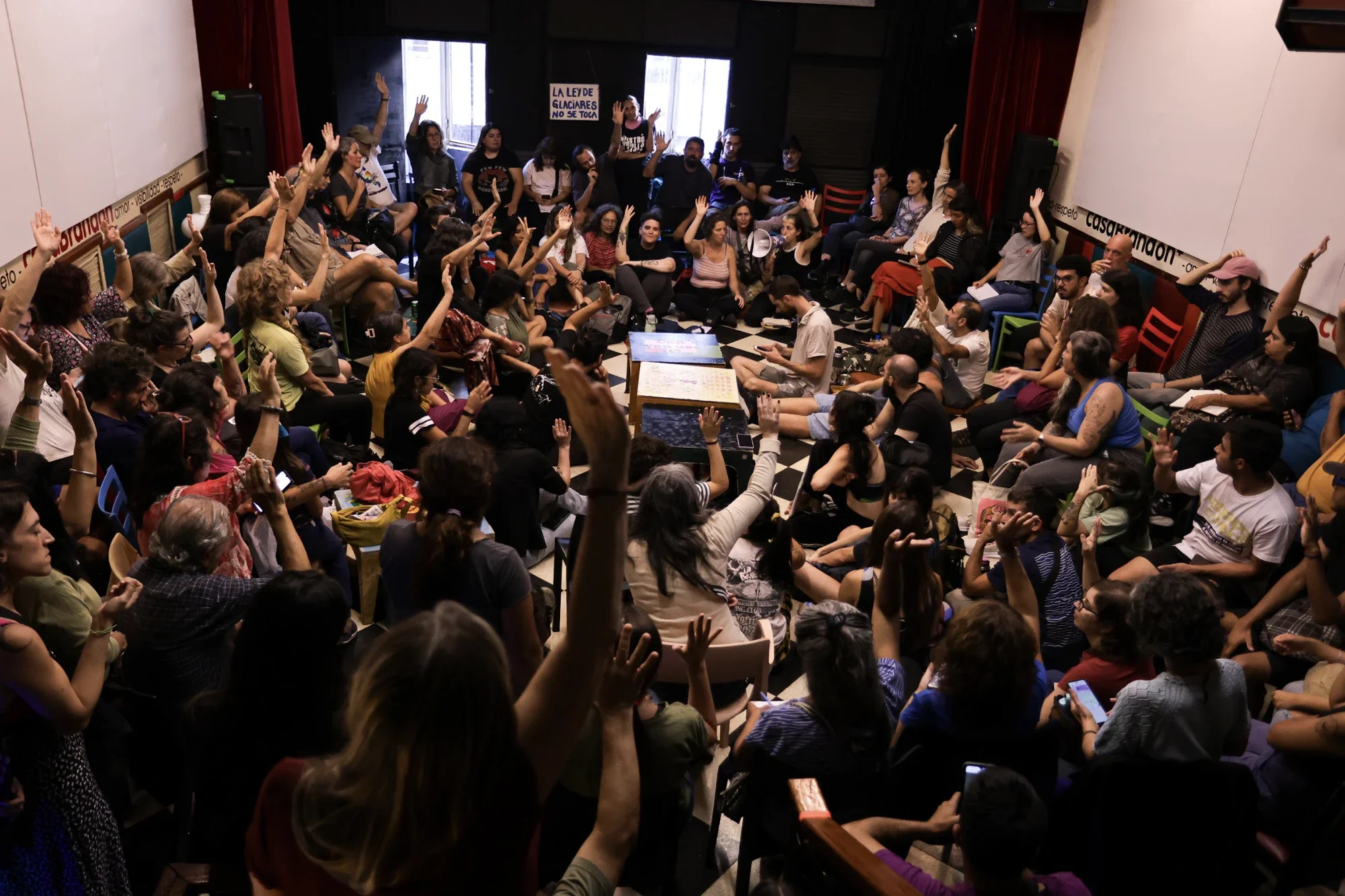
Multinational assembly to defend glaciers in the city of Buenos Aires. March 29, 2026. Buenos Aires, Argentina. Photo © Susi Maresca.
The next battlefront
Despite widespread public condemnation and significant media attention, the Lower House approved the bill reforming the Glacier Law on April 9. The controversial reform has yet to take effect: the changes have to be published in the Official Gazette first, which is expected to take place by Friday, April 24.
In the meantime, the Argentine Association of Environmental Lawyers, together with FARN and Greenpeace, has been building what is turning out to be the largest class-action lawsuit in Argentine history, with 865,000 signatures and counting. Backed by more than 40 organizations, the lawsuit highlights the unconstitutionality of the reform and the government’s disregard for the public outcry.
“This reform is absolutely unconstitutional because it allows mining in glacial and periglacial areas,” said Romina Araguas, an environmental lawyer, in an interview with Ojalá. “The lawsuit aims to unite together to ensure respect for the right to a healthy environment, enshrined in our National Constitution in Article 41, and the right to water, to keep our rivers free from mining.”
This is not the first time during Milei’s administration that the fight against the encroachment of hard-won rights has moved to the judicial arena after receiving legislative approval.
The labor reform, which was also passed despite strong public opposition, is currently stalled in the courts following a favorable injunction in a case filed by the General Confederation of Labor.
The class-action lawsuit over the Glacier Law will be filed once the reform takes effect. It demonstrates the strength of popular and community participation in defense of water.
“The momentum that was generated and the desire to participate both come through in this action,” said Araguas. “We will also demand that the government halt all mining projects currently operating in glacial and periglacial zones.”
Despite the challenges, the new attack on the Glacier Law has awakened our shared plurinational and federalist spirit, sparking rallies and campaigns across the country. Because without glaciers, there is no water, and without water, there is nothing at all.
