

Mutual aid against ICE in Texas
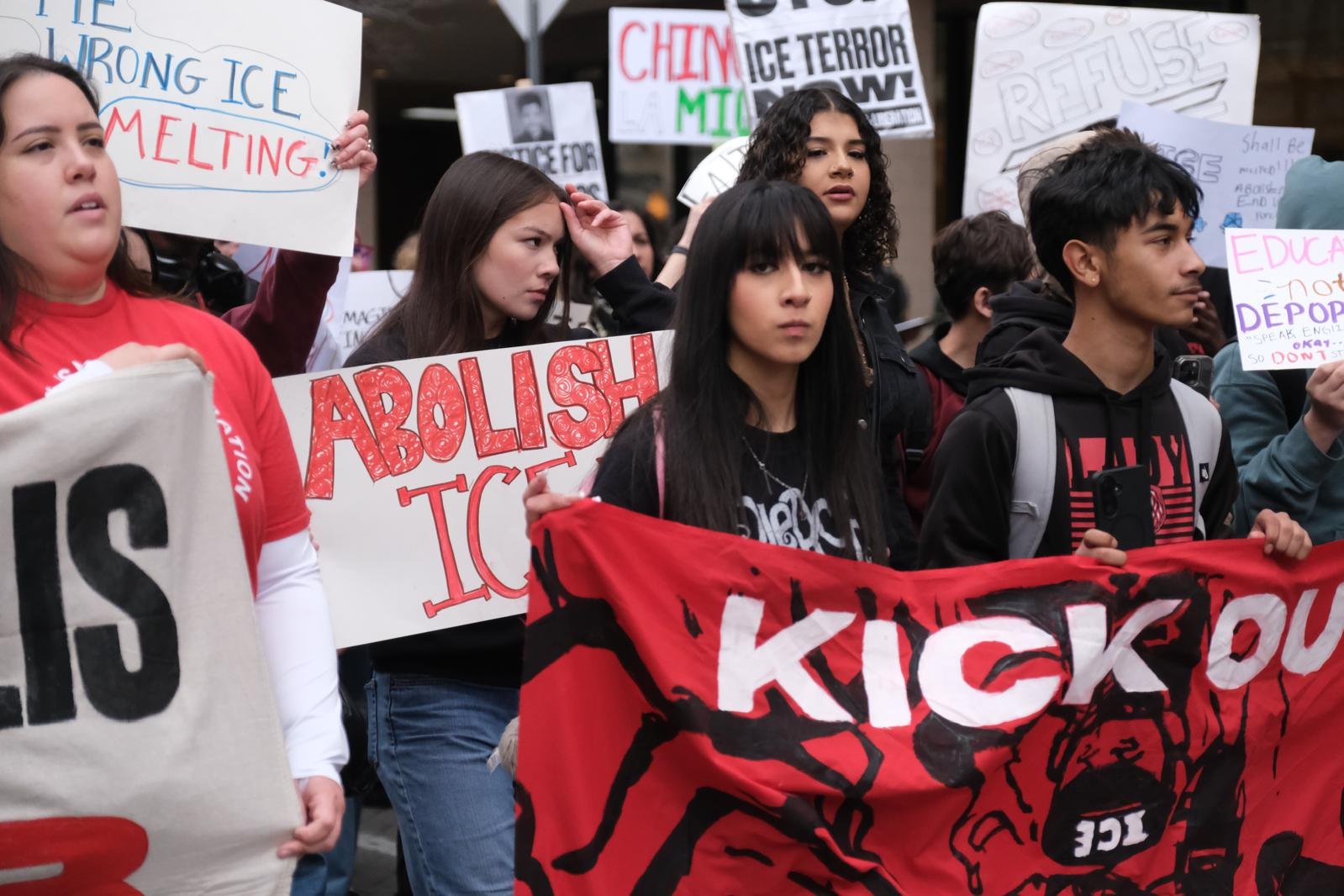
Collectives and activists rally in San Antonio, Texas, on January 30, 2026, as part of the national strike called in response to the killings of Renée Good and Alex Pretti at the hands of ICE agents. Photo © Antonio Guillén.
Reportage • Pamela Carmona • April 17, 2026 • Leer en castellano
The call came at 11 o’clock on a Thursday night. The woman on the other end of the line told Jessica Solís her husband hadn’t returned home. She’d last heard from him more than six hours earlier, when he called to say he’d been detained by police in Fredericksburg, outside of San Antonio, Texas.
Solís and the caller shared the same concern: that following his detention, her husband had been handed over to Immigration and Customs Enforcement (ICE).
The call Solis answered wasn’t to her personal number. Instead, it was to an emergency hotline set up by Venceremos—a grassroots group dedicated to supporting migrants—after Donald Trump’s administration toughened its immigration policies at the start of his second term. It was one of many calls Solís answers every day as part of her work with the organization.
In San Antonio, the story has been the same for months: people are detained for minor traffic violations, like having a broken headlight, and end up in ICE custody. From there, they’re then taken to detention centers before they can notify their families.
A network of growing urgency
Venceremos’ rapid response hotline operates 24 hours a day, seven days a week. Volunteers field reports of ICE activity in San Antonio and try to show up as quickly as possible for people in danger of being detained.
The group receives about 100 calls a month, which are handled by a network of 60 volunteers. Five of them work as dispatchers, answering calls, taking information, and alerting the rest of the team.
“We’ve seen a lot of fluctuation this year. There are days when we get just one call, but that hardly ever happens anymore,” Solís said in an interview. "We usually get five calls, but on some days we can get up to 20.”
From mid-December 2025 through March 2026, more than 5,000 ICE detentions were recorded in San Antonio, making it one of the cities with the highest number of detentions in the country. In the face of major crackdowns, mutual aid networks have sprung up around the city.
Every week, volunteers organize visits to ICE offices on Crosspoint Street. This is where migrants report periodically for their check-in appointments while their cases remain open.
On business days, a huge white bus parks outside the Crosspoint offices and the San Antonio Immigration Court on Dolorosa Street. It's become a daily occurrence to see people walking in freely to their appointments and walking out in handcuffs, loaded onto the bus, and taken to detention centers.
ICE began detaining migrants showing up for their hearings by expanding the use of so-called “expedited removal.” These cases are settled in court without a hearing and proceed directly to an accelerated deportation process, impacting people who attend the appointments mandated by the US government.
Support in a hostile environment
The practice of accompanying immigrants in San Antonio began in 2025, amid rumors of an increase in arrests at courts. Several collectives organized to bear witness to what was taking place, documenting arrests, making their presence known, and reminding authorities that the community is watching.
Alynn Jimenez is one of the volunteers who accompanies people attending their appointments alone, a role she fulfills alongside the Interfaith Welcome Coalition and Revolución Violeta, an organization she founded.
In addition to attending individual hearings, Jiménez and other groups bring food and water and provide information on the rights of migrants.
“I go from eight to 10 in the morning. We tell people, ‘Hey, there’s bread here, there are tacos—it’s totally free,’” said Jiménez. “We ask them, ‘Do you have a lawyer yet? We know this person can take cases for very low cost, even for free.’”
As detentions rise, response networks have been working around the clock. Protests have intensified and translated into an effort to pressure the local government to limit ICE operations in San Antonio.
More than 36 walkouts were organized at high schools and universities in January and February. The student protests were so numerous that the Texas Education Agency issued a formal warning that student walkouts or any form of political activism during school hours could result in punishment.
But students continue to mobilize, as do the activists and organizations defending migrants, outside detention centers, courthouses, and city hall. San Antonio’s civil society has also joined national calls to action, including the January 30 strike organized following the murders of Renée Good and Alex Pretti in Minneapolis.
As the protests continue, the arrests show no sign of stopping. Most migrants cannot wait for legislative changes or a change in government to protect them. Fear permeates their daily lives, and many families have stopped leaving their homes out of fear of being detained.
Community, a tool and a lifeline
Dianne García is the pastor at Roca de Refugio Church and founder of Nuevos Vecinos, which has organized a network of 60 people who deliver food weekly to 50 families who have stopped leaving their homes to avoid detention and deportation. It also provides shelter to unhoused people and arranges access to medication.
“The work is a bit different now because there are no more families crossing the border, and the families we’re serving in our program have been living here for four or five years,” said García. “But they’re being pushed into crisis by [this] administration.”
The Trump administration reduced the duration of work permits for migrants with Temporary Protected Status—including refugees and asylum seekers—from five years to 18 months, leaving hundreds of people without jobs. Deportations have left many households without their primary breadwinner.
For workers who were already living in difficult conditions, the situation has become even more challenging. This is especially true for domestic workers, many of whom have stopped going to work because of the presence of ICE.
“They told us directly, ‘Aracely, I’m not coming anymore because I’m scared; I’m not coming anymore because they’re stopping people while they’re driving,’” said Aracely Herrera, founder of Domésticas Unidas, a group dedicated to improving working conditions and offering workshops. “Others said, ‘No way, not when they’re boarding the buses.’ Now they’re gone, and we’ve lost contact with them.”
Faced with the possibility of being detained, Domésticas Unidas helps workers develop an emergency plan. This can include a folder with key documents, such as legal guardianship for someone to collect children from school, power of attorney to reclaim an abandoned car after an arrest, or authorizations granting another person access to bank accounts or responsibility over a house.
Previously, Herrera focused on providing training to negotiate better wages. Now, the priority is to address the consequences of being detained.
“Now, what we’re teaching is more extreme, because the situation is already extreme,” Herrera said in an interview with Ojalá. “It’s no longer a matter of not letting [ICE agents] in, now, they’re going to take you away, because they’ll grab you and take you.”
No place is safe, but even amid fear and despair, mutual support has emerged to protect an entire community.
“Building community and connection among people—especially among people who are different, from different countries, and speaking different languages—is our most important, most powerful response to the dehumanization we see from the administration,” said García, the pastor and activist.
In San Antonio, mutual support is organized through relationships and networks, which has become a lifeline in these times.
This article is based on reporting previously featured in the episode Apoyo Mutuo en Tiempos de ICE from the Autonomías Podcast, produced by the author.