
Oil sector reform spells catastrophe in Venezuela
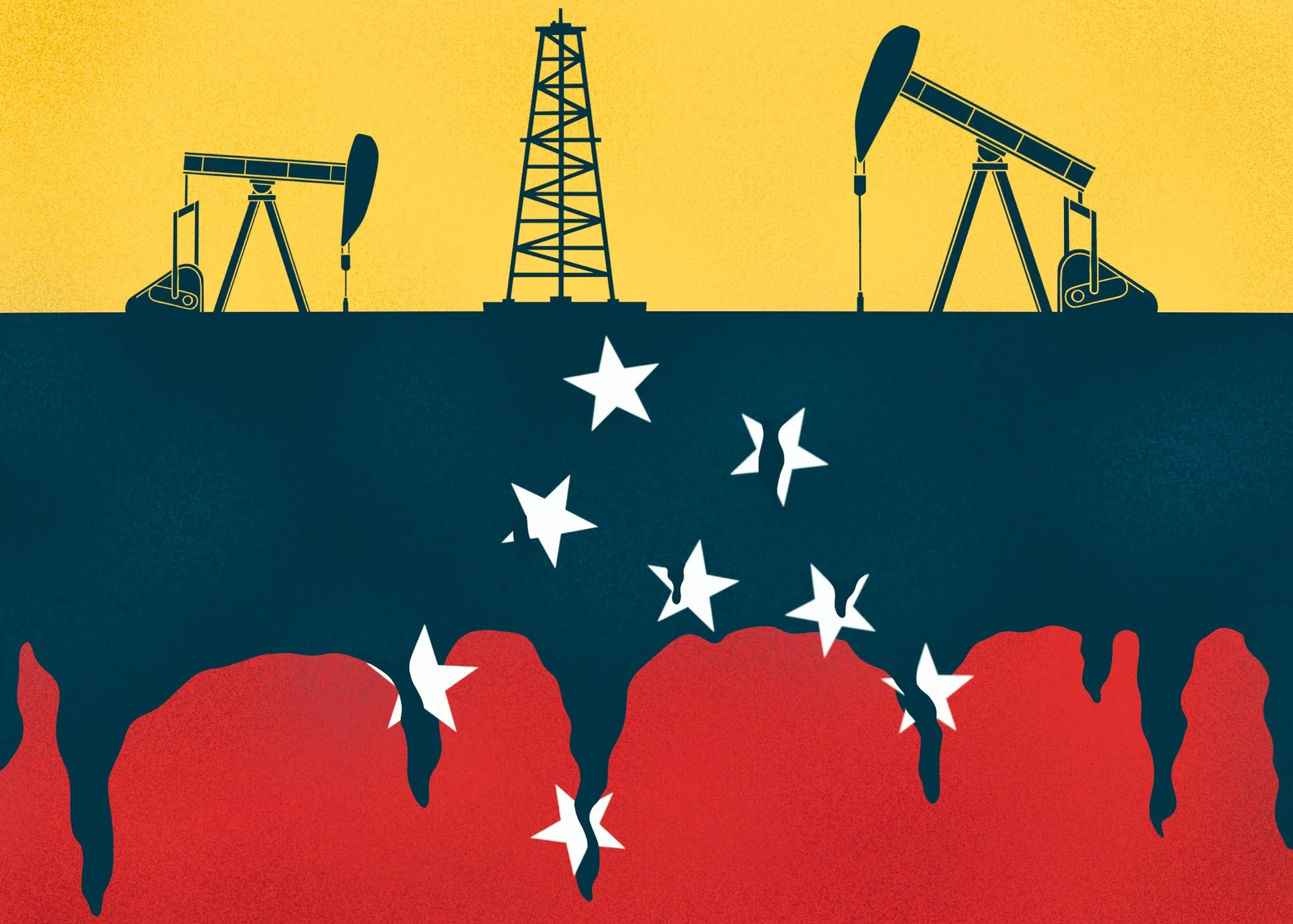
Digital drawing created for Ojalá by @Pazconnadie.
Opinion • Emiliano Teran Mantovani • June 19, 2026 • Leer en castellano
Just 26 days after the US military intervention and ouster of former president Nicolás Maduro and his wife Cilia Flores, reforms to Venezuela’s landmark Hydrocarbons Law—originally enacted in 2001 by Hugo Chávez—passed into law.
This reform is more than just a regulatory amendment. It culminates the profound economic and political transformation of the century-old Venezuelan petro-state model.
Today, the country and its sovereignty stand at a crossroads. Venezuela relies on an outdated, oil-based economic model, which is today being dismantled.
While the latest reform comes in the context of U.S. intervention, in no way can it be interpreted as a rupture from the energy nationalism of the past.
In fact, Maduro's government had been pursuing a program of economic neoliberalization for years, driven by the failure of rigid economic controls, the urgent need to raise revenue, and the impact of international sanctions.
These changes impacted the oil industry, which underwent a shift toward trade opening and market pragmatism. In 2018, an emblematic corporate income tax levied on transnational oil companies was lifted. That same year, the Economic Recovery and Prosperity Program was implemented, followed by the ‘Anti-Blockade Law’ in 2020. The latter allows the national government to hand over management of state assets to foreign capital, provides enormous incentives to foreign investors, and eliminates mechanisms for public scrutiny of measures and agreements reached. A Law on Special Economic Zones followed in 2022.
In their wake, Maduro invited oil companies to invest in Venezuela—especially US investors—and sought to ensure that conditions to do so are as favorable as possible.
A policy of handing over control of the oil sector gradually took hold, evidenced by the so-called “Productive Participation Contracts” (CPP), which granted enormous powers to the private shareholders of these joint ventures. The most important example of this approach was License LG41, issued in November 2022, which allowed Chevron to resume operations in Venezuela.
That license, which was later hailed as the “Chevron model” a business model that authorized Chevron to manage primary activities and administration, including the production and commercialization of extracted oil. It exempted Chevron from paying royalties or taxes to the state, and barred Iranian and Russian companies from acquiring contracts related to its operations.
The “Chevron model” paved the way for the 2026 reform and was the opening salvo in the destruction of energy nationalism in Venezuela. If we’re to speak of the surrender of Venezuela’s energy sovereignty, we must begin before the US invasion and recent reforms.
Why the rules were rewritten
Since 2017, an authoritarian regime has been consolidated in Venezuela, one that is characterized by centralized control across all spheres of the state, the economy, and an intense system of social repression.
This system could be said to have reached its peak following the electoral fraud of July 28, 2024. Faced with institutional destruction and political decay under the Maduro government, the regime ultimately established a neo-patrimonial system of governance, running the country as if it were a personal estate.
Within this framework, the laws of the republic and the national Constitution were reduced to meaningless formalities. Oil operations and agreements were increasingly adjusted and shaped to suit the particular interests of the government and corporations. The Chevron license was the product of direct negotiations between the US and the Maduro administration and was formalized without the approval of the National Assembly.
The main reasons for the most recent reform of the hydrocarbons law were to establish a system of guarantees, legal certainty, and stability that will allow a massive influx of transnational capital into the sector. It promotes the consolidation of a legal framework for a subordinate political regime that would continue to deepen these practices for decades to come.
More drilling, less sovereignty
Although this reform has been described as partial, the changes are substantial, opening the door to entrenched private participation and control. The state’s total or majority control over the sector has been removed, paving the way for private-sector management.
The reform recognizes the continuity of the CPPs and stipulates that private companies may undertake all primary activities, including the sale of extracted oil. It also establishes that national companies may transfer some or all of their granted rights to private companies. This marks a significant reduction in the role and influence of Petróleos de Venezuela S.A. (PDVSA).
Other provisions lower royalty rates and income tax, with the relevant ministry determining the percentage based on the project’s “economic viability.” Approval from the National Assembly is no longer required for the establishment of joint ventures or to set regulations, while international mediation and arbitration become the fora for ñ dispute settlements.
Under the reform, the republic remains the owner of the oil fields, but Venezuela has been so weakened and undermined following US intervention that it is unable to exercise effective and genuine sovereignty.
A vassal state
As long as Venezuela's oil reserves remain so vast, its other economic sectors remain so weak, and the global context sees wars fought over resources and energy, the country will likely continue to derive most of its revenue from crude oil. It will remain a petrostate where what has changed is the form of vassalage being experienced.
In line with the “Donroe Doctrine,” the US government will seek to keep the Venezuelan state as subjugated as possible. This will remain true especially if US geopolitical objectives on other continents remain unfulfilled.
If Delcy Rodríguez’s regime adapts to this model and offers the US a more advantageous relationship than its competitors, it could prolong her party’s rule.
To break free from vassalage, Venezuela would need to achieve unity among national forces capable of countering US power. It would also need to recover, insofar as possible, material capabilities in the institutional, economic, and military spheres, which would allow for the maintenance of a minimal degree of sovereignty.
Such a recovery does not seem feasible in the short term. Fragmentation has prevailed, even among Chavista blocs.
These developments pose a historic challenge to the notion of sovereignty that has been built up in Venezuela over decades, if not centuries. This challenge echoes a regional reality.
The consolidation of an enclave
The drawn-out collapse of Venezuela’s oil-based economic model and the petro-state, coupled with geopolitical subjugation, is leading to the emergence of a kind of enclave economy. The situation resembles economic structures typical of the late 19th and early 20th centuries, when territories were configured merely as suppliers of resources for the global market, with little connection to the regional or national economy.
In this scenario, Venezuela risks becoming blurred and fragmented, dominated by a patchwork of exploited territories, oil fields, and mines.
The current conjecture perpetuates oil extraction in Venezuela for the umpteenth time. Given the long history of dependency, extraction, corruption, and severe environmental damage, the possibility of alternative economic approaches are seriously hindered.
National debate after January 3—among sectors of Chavismo and the opposition—has swung between those who consider this situation an “opportunity” to boost oil and gas production, and critical grassroots voices that condemn the country's surrender to foreign interests.
The realization of Venezuela’s oil “dream” is riddled with contradictions. The destruction of the oil industry and the rehabilitation of numerous abandoned wells require enormous investment—from around $100-$180 billion—to reach some 2.5 million barrels per day 10–15 years from now.
The vast majority of the reserves that are not yet developed consist of heavy and extra-heavy crudes with high production costs. Conventional crudes are generally in decline, and costs have risen. Production could be boosted by using existing infrastructure, but new projects will be much more difficult to get off the ground.
A hollow petro-state
A decline in oil revenue and the weakening of the state's management of public assets through PDVSA would impact Venezuelan society in numerous ways, compounding the disaster created by the Chavista regime. Key social institutions are in decay, as are the essential services the state provides to society.
State fragility in the face of international powers is increasing, which favors the continuation of a neo-patrimonial regime.
Gaps in state services could end up being covered by private and transnational capitalists. This would represent a massive privatization of Venezuelan social life, and dramatically reduce the scope of the public sphere. It could also imply an increase in the presence of private security forces. All of this makes respect for human rights and democracy extremely difficult.
The dangers of ignoring climate risks
The perpetuation of a vassal oil state in Venezuela leaves the natural environment unprotected. Spills, fires, accidents, and the burning of gas in flares would continue with impunity, with “sacrifice zones” left neglected so as not to affect the profit margins of oil corporations.
Companies like Chevron—which has a track record of major environmental harm around the world—would face no oversight, to the detriment of local communities, fisheries workers, and small-scale farmers who have already suffered the impacts of the industry for years.
While the climate crisis demands a significant reduction in fossil fuel combustion, Venezuela is making it easier to ramp up oil production. This is the exact opposite path from that which ought to be taken, but at this juncture in Venezuela, there are few voices advocating for the environment and bringing up the climate crisis.