

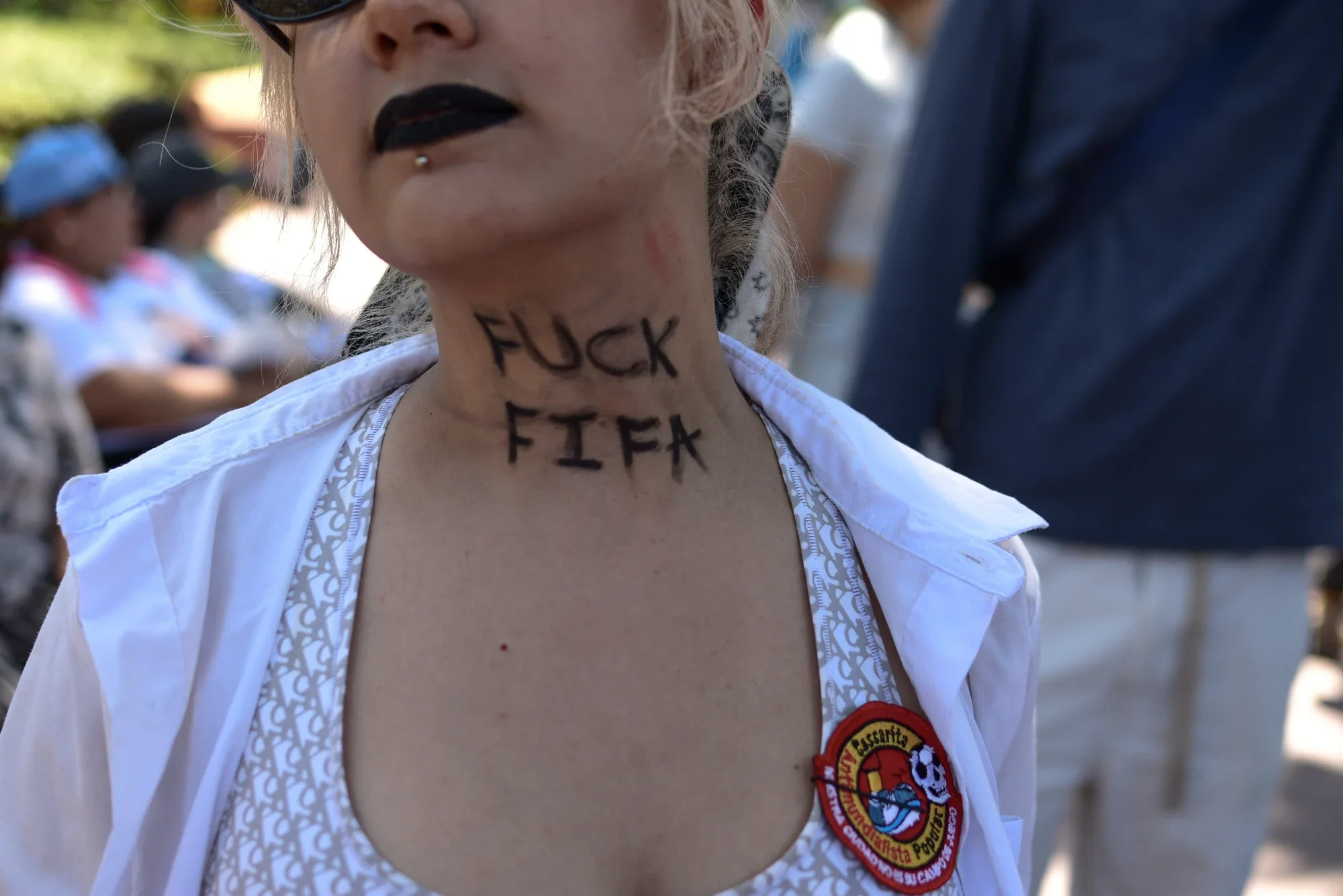
A person with “Fuck FIFA” painted on their neck during an anti-World Cup pick-up football match in Guadalajara on May 17, 2026. Photo © Leslie Zepeda.
Reportage • Mariana Mora • June 11, 2026 • Leer en castellano
When Guadalajara hosted the Pan American Games 15 years ago, former mayor Aristóteles Sandoval proposed a Human Relocation Plan to “clear the city center of unhoused people, window washers, and sex workers.” The proposal, heavily criticized, was dropped from the official discourse. But that didn’t prevent it from being carried out.
Now, the same pattern is repeating itself in the run-up to the World Cup. The tournament kicks off in the city with a game this evening, there will be three other matches in the city over the next month.
For Rocío, a member of La Otra Calle, a collective of artists, activists, and people living on the street in Guadalajara, the murder of her friend—who was around 65 years old and lived with his dog in the city’s downtown—in September of last year served as a first warning for them to leave the area.
“During the Pan American Games, this kind of violent death impacted people living on the streets,” said Rocío, who asked me to use a different name to protect her identity.
Last year, 15 unhoused people were murdered—and another 10 attacks left victims seriously injured—in the Guadalajara Metropolitan Area.
These and similar concerns dominate The Other Street’s weekly meetings, which take place at a location very close to where her friend was murdered. At every meeting since January, someone has recounted an incident of displacement involving verbal or physical violence by municipal and state police officers and the National Guard.
“[The authorities] have been telling them that if they don’t move, they’ll be taken to Tlajomulco,” Rocío said in an interview with Ojalá. Tlajomulco is a suburban municipality that’s part of Metro Guadalajara. It's difficult to reach by public transit, and home to 39 percent of the clandestine graves in Jalisco state.
Police harassment aimed at displacing people from downtown is also affecting street vendors and sex workers. Mexico City’s Elisa Martínez Street Brigade In Support of Women has received reports from women in Guadalajara of harassment by government officials, who have sought to prevent them from working “until the World Cup is over.”
Barred from working, many are unable to pay for a night’s lodging and end up sleeping on the street.
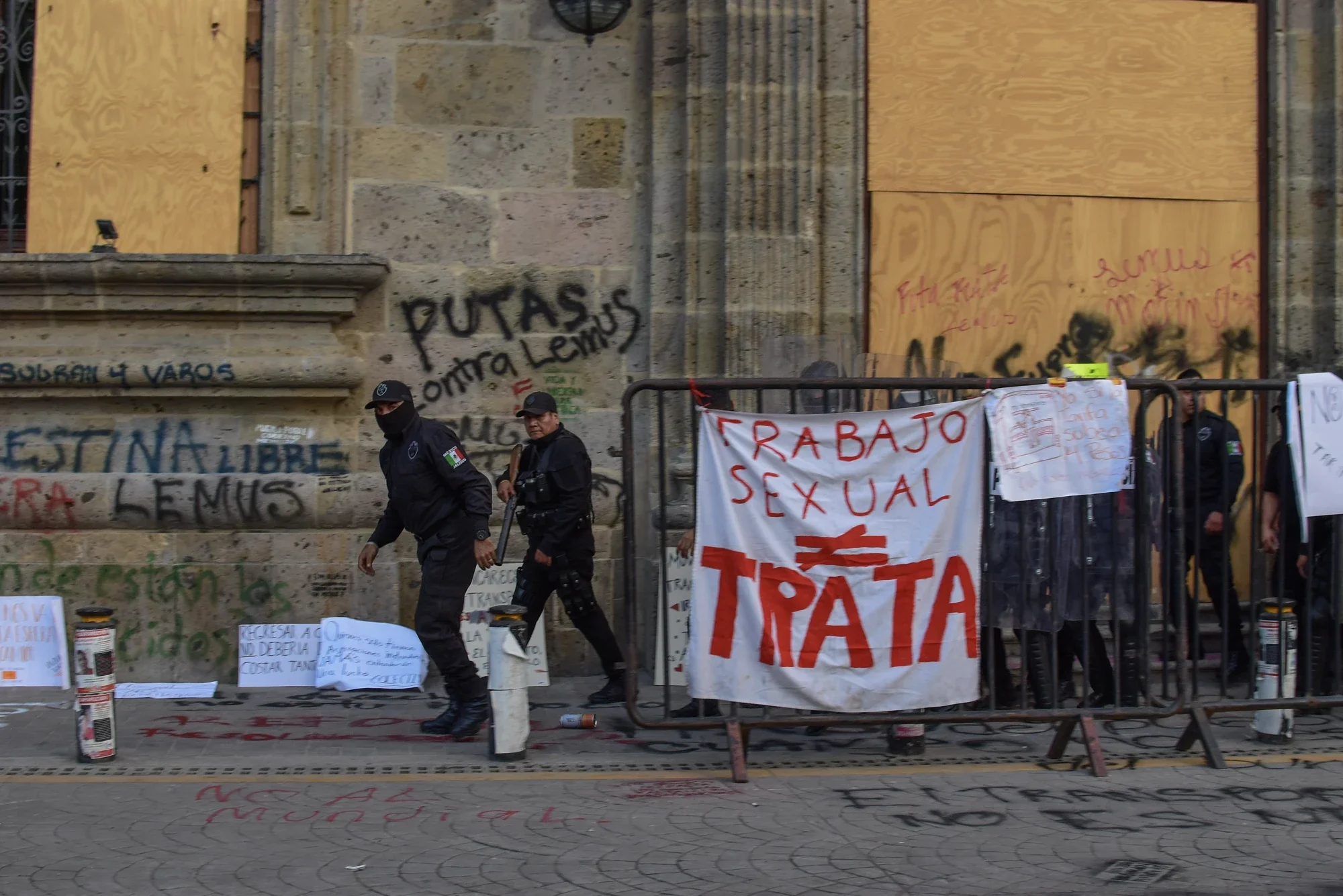
State police cracked down on the demonstration against the increase in public transportation fares in Guadalajara on January 10, 2026. Protesters hung a banner in front of the Government Palace with the message “Sex work is not the same as trafficking.” Photo © Leslie Zepeda.
Rocío’s concern grew even more when they started to notice an increased police presence near where La Otra Calle members meet every Wednesday, and where many group members live and work. This increase was linked to the installation of a World Cup related commercial fair called Mundo Jalisco.
To protect themselves, the collective joined forces with other organized groups and published a fanzine of techniques for defending against police violence. “We’ve organized walks, talks, and handed out fanzines to people and shop owners in the city’s downtown,” said Rocío. Some people aren’t interested, but there are also shop owners who give refuge to unhoused people when the police come by.
State violence on the rise
There were at least 400 protests in the state of Jalisco between January 2025 and May 2026, according to the Secretariat of the Interior. More than half took place in Guadalajara.
In March, Amnesty International published a report warning that the FIFA World Cup “is taking place amid an acute human rights crisis” due to “the divisive and repressive practices of the governments who host its flagship tournament.” A crackdown on protests during the event is one of the organization’s main concerns.
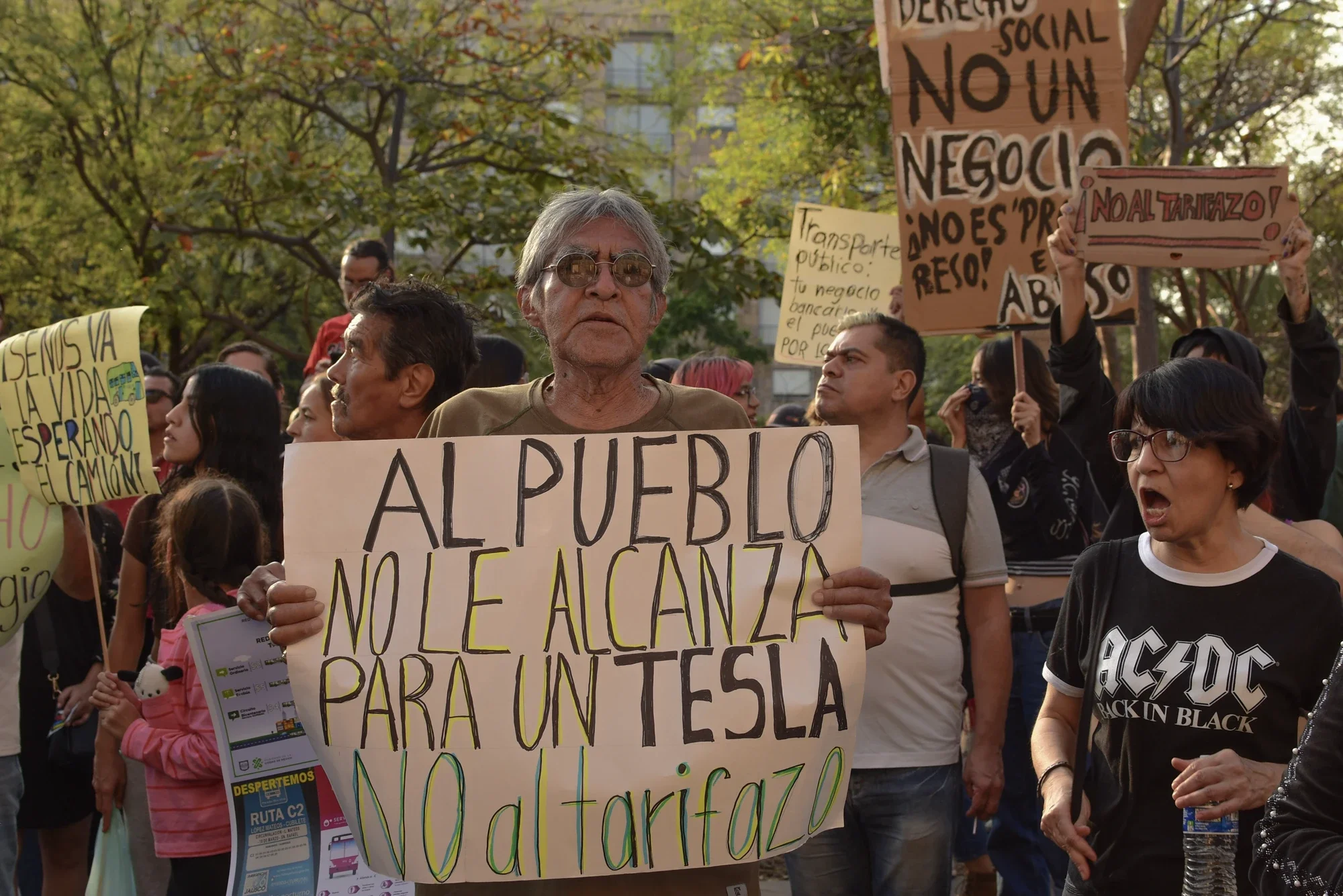
A demonstrator holds a sign reading “The people can’t afford a Tesla. No to the price hike” during a protest against rising public transportation fares in Guadalajara on January 10, 2026. Photo © Leslie Zepeda.
One of the first protests in Jalisco this year took place on January 10, when around 1,500 people demonstrated against a nearly twofold increase in bus and transit fares. As the protest concluded and participants were dispersing, four people were detained and held incommunicado for hours. The detainees were released the next day, but fellow activists reported threats and torture while they were detained.
In 2025, the World Organization Against Torture classified Mexico as having a high risk of torture and ill-treatment.
In Jalisco, the number of complaints regarding human rights violations received by the State Human Rights Commission rose from 2,976 in 2024 to 3,314 in 2025. So far this year, the Commission has received 1,099 complaints. In April alone, 281 complaints were filed, nearly half were against public security forces. Of these, there are 33 complaints related to enforced disappearance, six for bodily injury, and three for torture.
Even the Mexican Football Federation acknowledges in its human rights report on Guadalajara as a host city that “there have been cases of repression and violence against protesters in Jalisco in a wide variety of settings,” representing one of the greatest risks during the World Cup.
“With the World Cup, the atmosphere has felt very heavy,” said Gabriela, who is a member of the Red Yo Voy 8 de Marzo, which organizes the International Women’s Day demonstrations in Guadalajara, as well as the Network against Enforced Disappearance which brings together people in solidarity with the families searching for their disappeared loved ones in Jalisco. She also asked that her name be changed for fear of reprisals.
The activist, who has been an organizer for 13 years, shared an example of intensified repression at this year’s demonstrations.
For the first time in Guadalajara, police physically assaulted protesters during this year’s March 8 demonstration. Gabriela was among those who were assaulted and, along with her colleagues from the Network, she documented the cases of other people who were corralled and beaten. But thanks to collective defense tactics implemented by the protesters, like documenting police aggression and human chains, no one was detained.
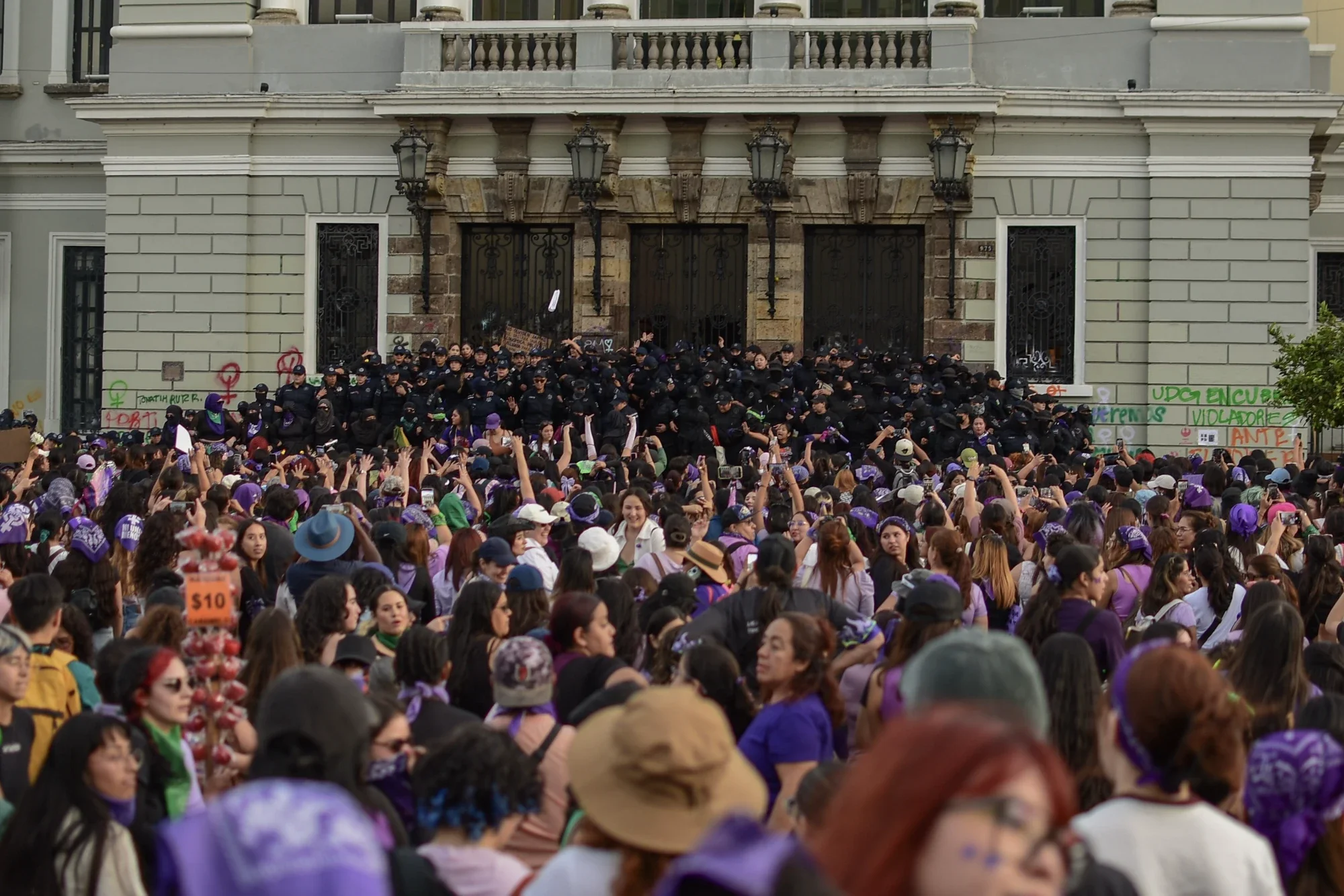
Police surround the University of Guadalajara Museum of the Arts, where demonstrators were attacked during the March 8, 2026, march in Guadalajara. Photo © Leslie Zepeda.
Freedom for FIFA, militarization for the rest
As part of their agreements with the International Association Football Federation (FIFA), municipal and state governments committed to guaranteeing security at all World Cup-related venues. This includes the stadium and its surroundings, official hotels, training sites, the airport, and the Fan Fest, which will be set up for 39 days in Plaza Liberación, a public space in central Guadalajara.
To do so, the government of Jalisco announced the deployment of more than 18,000 public security personnel from all three levels of government, including the army and the National Guard. In late April, the head of the state’s Security Secretariat reported that some police officers had been specially trained for the World Cup by the French National Police, the Spanish National Police, and the Colombian National Police—all of which have been accused of using excessive force and committing serious human rights violations—in “democratic crowd management” and “control of violent crowds.”
Although FIFA recognizes the right to protest in its Human Rights Framework, its Code of Conduct in Stadiums prohibits any form of expression that is “of a political nature.”
“We need the eyes of the world to see what is happening in our country,” said Héctor Flores, co-founder of Light of Hope search collective. His son, Daniel Flores Fernández, was disappeared in 2021.
In the lead up to the World Cup in Mexico, there have been protests against gentrification, the violation of Indigenous peoples' land rights, water shortages, and the country’s forced disappearance crisis. For the families of the disappeared, the World Cup is an opportunity to bring this humanitarian crisis to light, and there are more protests planned in Guadalajara, Mexico City and Monterrey, where the tournament will be held.
There are 134,722 people disappeared in Mexico,and Jalisco is the state with the most cases, with over 16,000. Search collectives have organized soccer matches in public spaces, where they put up missing posters to raise awareness about disappearances. Local collectives plan to continue protesting during the World Cup in the areas surrounding the events.
There is considerable uncertainty about the government’s response to these demonstrations, but there is also a strong organizing effort in defense of the right to protest.
“We know there may be repression, that they will most likely try to drive us out, but we are very clear that public space is public—it does not belong to any government,” Flores said in an interview with Ojalá.
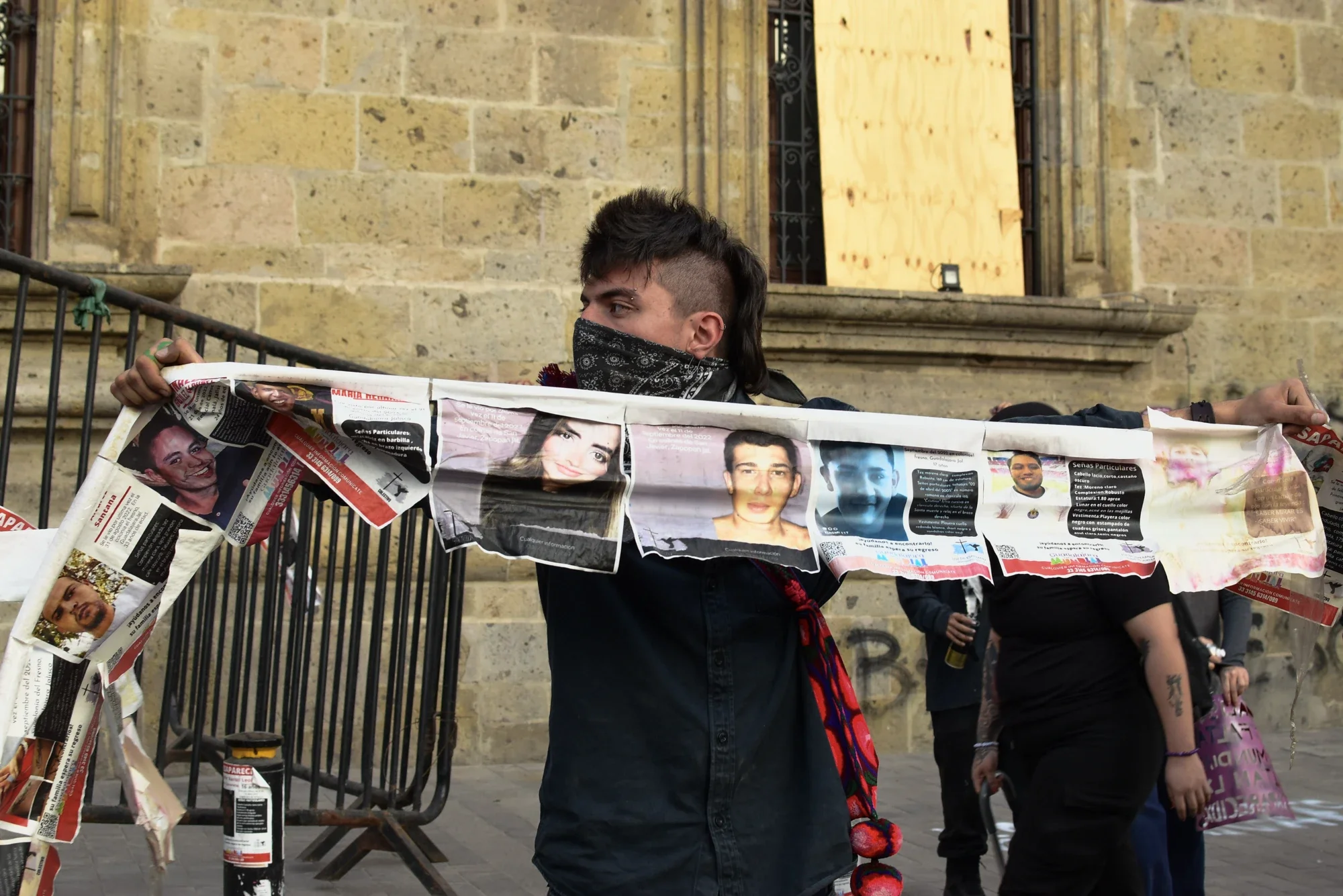
A person holds a missing persons poster for disappeared people during a protest against the rise in public transportation fares in Guadalajara on January 10, 2026. Photo © Leslie Zepeda.
In April, municipal police prevented people from putting up missing posters in Parque Rojo, a park in downtown Guadalajara that was remodeled to host the World Cup, affecting the people and groups who use that space.
“Because of the World Cup, all these groups and people began gathering and organizing,” Gabriela said, describing the strategies they implemented to counter the upsurge in state violence.
New networks formed, existing ones strengthened, physical and digital safety protocols were shared, and actions were organized among collectives from different cities.
“We remain firmly convinced that we have to keep organizing because everything is heating up.”