

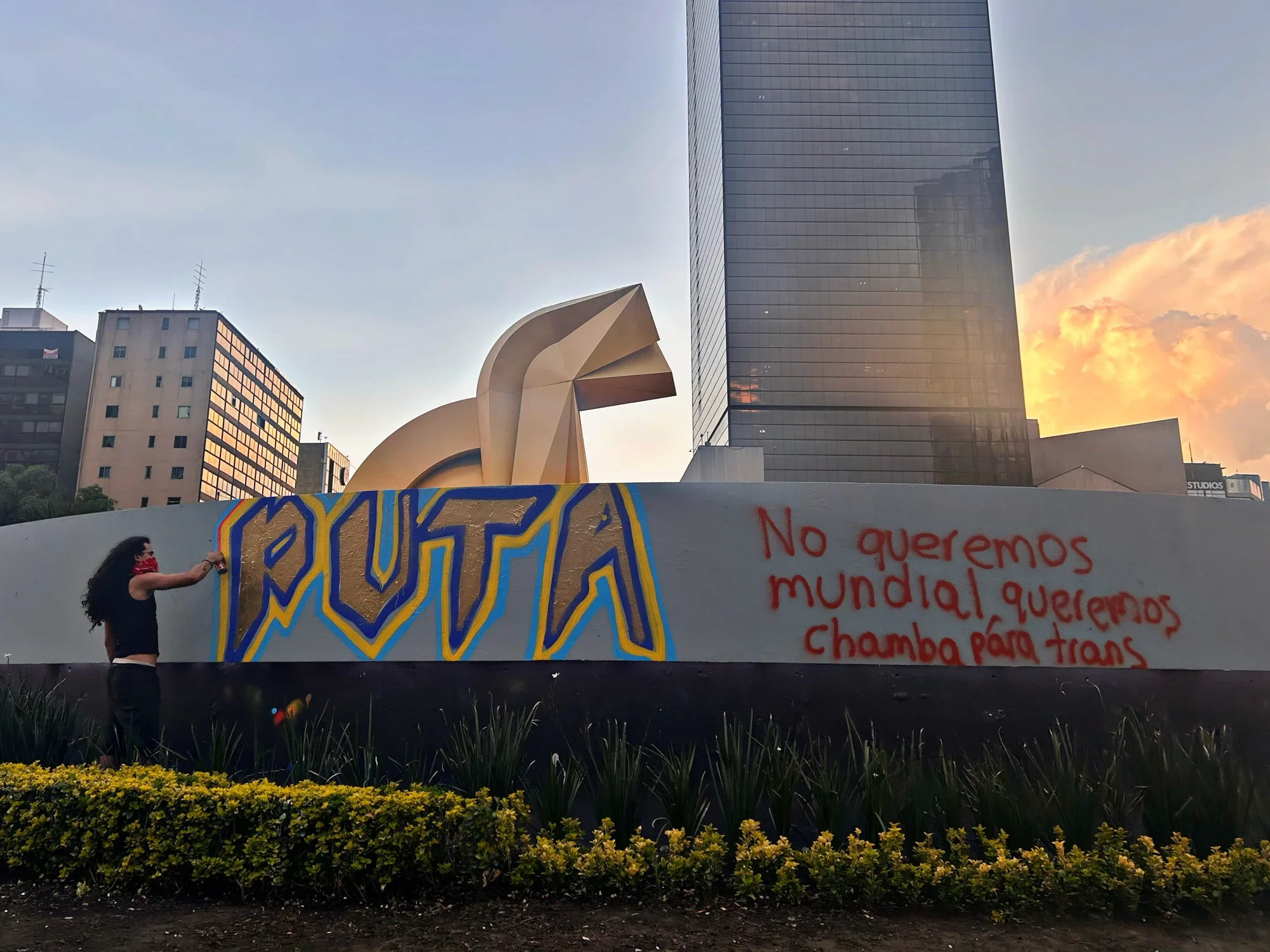
A protester writes “We don’t want the World Cup, we want work for trans [people]” in graffiti during a sex-worker led march against the World Cup in central Mexico City on June 2, 2026. Photo © Andrea Mireille.
Reportage • Andrea Mireille • June 10, 2026 • Leer en castellano
With just one day to go before the first World Cup match, Mexico City is plastered with axolotls—Mexico’s most famous endemic amphibians— and World Cup advertising. Opposition to the mega-event has been building in the city over the past months, and has intensified in recent weeks.
People living in the city's most gentrified neighborhoods and others near the stadium have protested rising rents, water shortages, transportation issues, traffic congestion, and excessive noise due to World Cup-related construction.
During the five week long event, the Anti-World Cup Assembly will hold events throughout the city.
Gentrification in Your Language, an outreach and advocacy network, has organized and actively participated in protests that use graffiti, posters, soccer matches, and marches to highlight dispossession and touristification in the city.
It has also supported collectives of families searching for disappeared relatives, who are using the international attention created by the event to raise awareness about the over 133,000 disappeared people in Mexico.
Searching mothers protested on June 3 at the Nemesio Diez Stadium, where the Mexican national team played its final warm-up match. Collectives present at the stadium announced that they will continue to mobilize throughout the World Cup.
In addition, the National Coordination of Education Workers(CNTE) has been holding a sit-in in the city’s downtown since June 1. The group is demanding President Claudia Sheinbaum deliver on her campaign promises to teachers by repealing previous reforms, raising salaries, and improving working conditions. The striking CNTE workers will continue protesting in the coming weeks.
The searching mothers, the CNTE, the National Association of Transport Workers and farmers have all called for national demonstrations starting June 9, and convened a mega-march on June 11, the day of the opening ceremony.
But over the past year, it has been sex workers in the southern part of the city who have been among the most active in protests against policies that favor tourism and the International Association Football Federation (FIFA) over the working class.
Bikewashing displacement
In the lead up to the World Cup, one of the city’s most controversial new developments was the Gran Tenochtitlán Bike Path on Tlalpan Avenue, which connects downtown with the stadium.
Clara Brugada, Mexico City's mayor,said the goal of the new bike lane is to make Tlalpan a more inclusive avenue in terms of mobility. She described cycling as “an act of resistance, one that is deeply revolutionary” and defended the creation of the bike lane as “a firm step toward a city for everyone.”
The reality lived by sex workers tells a different story. According to Elvira Madrid Romero, founder of the “Elisa Martínez” Street Brigade for in Support of Women, a civil association that works closely with sex workers, 2,500 sex workers have been displaced due to the construction of the bike lane. She says that, whether they admit it or not, city authorities “are carrying out social cleansing.”
Members of the Street Brigade and sex workers interviewed by Ojalá say that since construction of the bike path began midway through last year their incomes have dropped by up to 70 percent.
Sex workers are critical of the bike path because it encroaches on their workplaces and makes it harder for them to see clients. Local business owners have also been affected.
“They can shove their damn World Cup and their bike path up their ass. It doesn’t benefit me at all, on the contrary, it hurts me,” said Ana Gómez, a trans sex worker whose name has been changed for security reasons.
In an interview with Ojalá, Gómez explained that she has been working on Tlalpan Avenue for over 10 years. Over that time, she’s experienced an increase in institutional violence and more transphobia from society, and even from her clients.
“The World Cup doesn’t benefit those of us who work here every day,” said Gómez. “The truth is, it’s not work anymore; the street isn’t what it used to be.”
On a national scale, Mexico City has long been considered a bastion of progressivism in terms of legislation and human rights. Madrid Romero points out that sex work was recognized as a trade in the city through Constitutional Court Ruling 112/2013, which classified it is non-salaried work, through which sex workers provide services without being subject to a contract or fixed schedule. Despite this legal protection, these workers have been among the most affected by the World Cup.
Kimberly Natividad’s income has also been hurt by the new bike lane. The 42-year-old trans sex worker is currently living on the streets. She too says that between the struggle for space in Tlalpan and the bike lane, nothing is the same.
Natividad has started selling popsicles and wants to set up a candy stand. She thinks the authorities will continue to push for their displacement. She also said that they harass her clients.
“You get in the car with them, and the police pull them over to extort them, to get money out of them. Bicycles go by, and we have to wait,” she said in an interview. “It’s really tough.”
The bike route “is implicitly about social cleansing, since the design isn’t meant for cyclists, sex workers, and pedestrians to coexist,” Braulio Gabriel del Águila, a representative of Gentrification in Your Language, explained in an interview with Ojalá. “Preventing sex workers from doing their jobs is a form of violence.”
Protests, roadblocks and evasive tactics
Sex workers have refused to stay silent in the face of institutional violence, holding protests against the bike lane and against displacement.
Madrid Romero told me the Brigada Callejera has no intention of engaging in dialogue with the government. For its part, the nonprofit organization United Independent Sex Workers (TRASUIXXX) has reached out to the authorities to negotiate financial support and other agreements.
Andrea Nava, one of its representatives, told Ojalá that their demands—primarily for monetary compensation—have yet to be met.
TRASUIXXX has held demonstrations in the Zócalo and on Tlalpan Avenue. They held a protest during the inauguration of the bike path on April 19 and also on May 1, International Workers’ Day. Since the start of construction, the group has demanded that the city government allow them to keep working in the area.
On June 2, during the march to commemorate International Sex Workers’ Day, TRASUIXXX members took to the streets again. Their demands were the same: more opportunities and an end to displacement and the loss of income.
That day as they marched, they chanted, “The corner belongs to those who work it, and sex workers are the ones who work it.” What matters most to them is being respected as workers. At every protest, their goal is that people recognize that “the sweat of their buttocks is just as worthy as that of their brow.”
The ball is coming home, but at what cost?
The struggle of sex workers is part of a broader landscape of resistance to the gentrification that’s been accelerated by World Cup preparations.
For residents of Santa Úrsula Coapa, the neighborhood bordering the stadium, the arrival of the World Cup made daily life even more difficult.
Residents there have been protesting since 2022, when water shortages worsened and rents skyrocketed. They’ve been demanding that these problems be resolved ever since.
Since last year, they’ve also been protesting against the construction of Line 14 of the trolley bus, which is part of World Cup infrastructure and which, they say, will disrupt local traffic and increase insecurity in the area.
Other controversies surrounding the World Cup include the tax holiday granted to FIFA, which will not pay federal or local taxes on revenues generated by the mega event.
According to the Mexico City government, the total investment in infrastructure for the 2026 World Cup is estimated at approximately $1.3 billion dollars.
The National Chamber of Commerce, Services, and Tourism estimates a “historic” economic impact of $1.5 billion, despite the lack of an official estimate of the number of attendees.
The first World Cup ball will drop tomorrow morning in Mexico City, but the battle is already being fought off the field. It is a struggle that’s taken on many dimensions, against inadequate transportation, water shortages, high rents, forced disappearances, displacement, and rushed construction projects. And there’s one big question that’s yet to be answered: what will happen when the tournament is over?