

How Colombia’s post electoral hangover catalyzed popular organizing
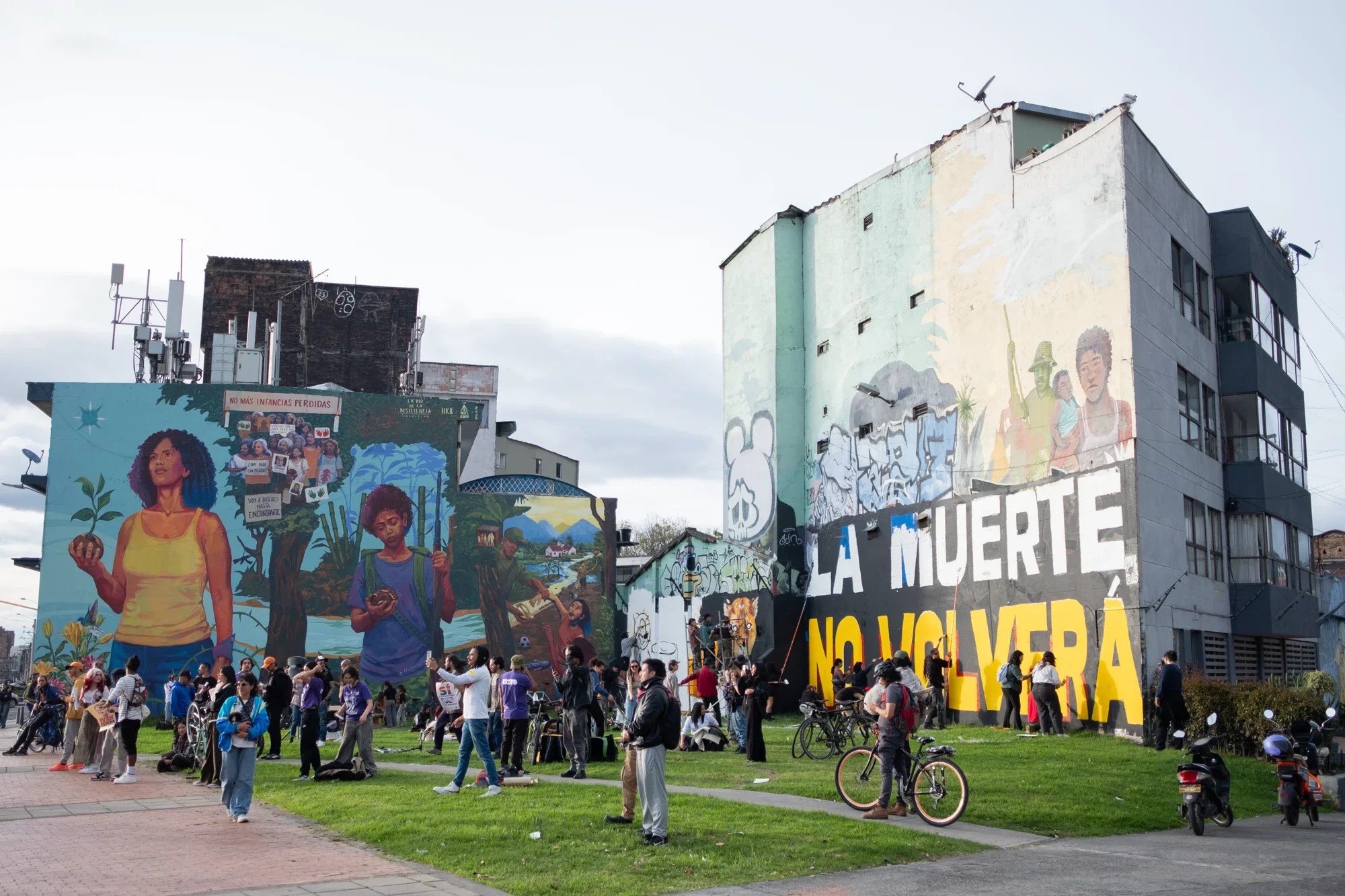
Dozens of people gathered to paint a street mural reading “Death will not return” in Bogotá on Tuesday, June 2, 2026, as a form of protest against the election results. Photo © Mariana Mora.
Opinion • Sandra Rátiva-Gaona • June 5, 2026 • Leer en castellano
On Monday, June 1, Colombians woke up with an undeniable moral hangover. We felt sad. And angry.
It was the morning after the vote in the first round of presidential elections. The Iván Cepeda-Aida Quilque ticket, representing continuity with the project of Gustavo Petro and Francia Márquez, were polling far ahead, but secured only 41 percent of the vote. And the far-right ticket of Abelardo de la Espriella and José Manuel Restrepo Abondano garnered nearly 44 percent. The runoff is scheduled for June 21.
Many of us wondered how it was possible that De la Espriella, who represents an aggressive right-wing political agenda, garnered such strong support in the first round of voting.
There is no clear answer as of yet; it’s a question that could be the subject of its own column. What the results do reveal is that Colombia is deeply polarized. But it’s not a polarization between equivalent extremes. Instead, what we see is a manufactured polarization that has been pushed rightwards.
In the primaries, voters were presented with two conservative platforms: one, led by Paloma Valencia, whose platform was aligned with the institutional right, and the other, who was much more radical, violent, and anti-institutional. It was the second that advanced to the first round, with De la Espriella at the helm.
Some say that Uribismo (the voting block that supports conservative former president Álvaro Uribe Vélez) was playing both sides of the right. I would argue instead that Uribismo is on its deathbed, and that these elections will bury the democratic center as a political force. Yet what we’re left with may be even worse.
Much of Colombian society, including part of the working class, is gripped by the fear of “becoming Venezuela,” compelling resentment and a willingness to sacrifice others’ rights in the name of individual security. Today, 44 percent of Colombian society is accepting the proposal to annihilate the other 41 percent of society. This is extremely disheartening.
The feeling in the popular and democratic camp is one of fear of the armed and deadly capabilities of paramilitary forces, and the dark hand of violence that persists in the country and that serves the far right’s political project.
Despite the moral hangover and confusion, we ought to take a closer look at how specific regions voted, going beyond the matter of the names of a few men.
Cepeda and Quilcue won the first round in the country's periphery, which is it say, in the areas most affected by war and systemic impoverishment. Wins in cities and municipalities such as Barrancabermeja, Puerto Wilches, the mining municipalities of Cesar, and various areas of Huila, Córdoba, and Sucre, convey a strong political message.
In these territories, people have said ‘No’ to fracking, land reform has taken place, and communities have directly experienced the benefits of public policies. Significant support emerged for proposals linked to a just energy transition, agrarian reform, and the popular economy, and these were victories for the political project for life.
For this reason, Petro’s stated rejection of the vote tallies was unfortunate—not because there was no fraud, but because his doing so reinforceD the patriarchal tone of presidential politics.
De la Espriella responded even more aggressively, capping off an embarrassing spectacle of pissing contests politics, organized around male egos competing to demonstrate who has more power, strength, and authority.
This kind of politics fails to meet the needs of our time.
What progressivism has achieved
The tangible achievements of the past four years under Colombia’s first left-wing government—which began when Petro and Márquez took office in August 2022—are hard to deny.
The list includes reducing multidimensional poverty to 9.9 percent, raising the legal minimum wage by 23 percent as of this year, and redistributing government revenue to historically disenfranchised groups, particularly older adults who did not qualify for a pension.
Labor rights were also restored, including extra pay for night and Sunday shifts, which ex-President Uribe Vélez had axed.
One of my favorite achievements is the titling of more than two million hectares, which involved transferring productive lands and large estates to rural organizations and victims of the armed conflict. This was not done through expropriation (contrary to what neoliberal alarmists claimed), but through the purchase of land from large landowners and the recovery of hundreds of properties from drug traffickers via asset forfeiture.
This is undoubtedly a historic achievement that goes straight to the heart of the war in Colombia: inequality in land use and ownership.
But the most profound changes are not necessarily those that show up in statistics. The main political achievement of this government is the revitalization of broad sectors of the Colombian population who, for decades, were treated at best as objects to be administered, at worst as targets of repression—and never as political subjects.
An alternative narrative has been created in Colombia. Petro did not create it alone, is it the product of his Pacto Histórico electoral movement. Rather, it is a narrative that the popular and democratic movement built over decades, against an economic model that Colombia’s neoliberal oligarchy built and imposed through bloodshed and violence.
The new national narrative is a vision for the future centered on the saying that “Colombia is a country of beauty.” This appealed to our national self-esteem (I don’t consider this nationalism; rather I see it as a way to recover from collective trauma from the war), and it articulated, through an economic project, the idea that Colombia is a country with potential in nature-based economies.
It means that our love of dancing and good food and drink are net positives. That we can build productive (and not just rentier) economies and innovations linked to conservation. That if we manage to consolidate the defense of the mountain highlands and the Amazon, we can open a window of prosperity and well-being, even in the context of climate crisis.
It would be naive to ignore the challenges. As has happened with other progressive movements in Latin America, Petro’s Change (Cambio) government ended up reproducing a deeply presidentialist logic.
President Petro’s charisma often took space that should have gone to democratic deliberation. A project that spoke of democratizing power ended up relying excessively on a single figure, embodying the “progressive macho”: transformative in discourse, centralizing in practice.
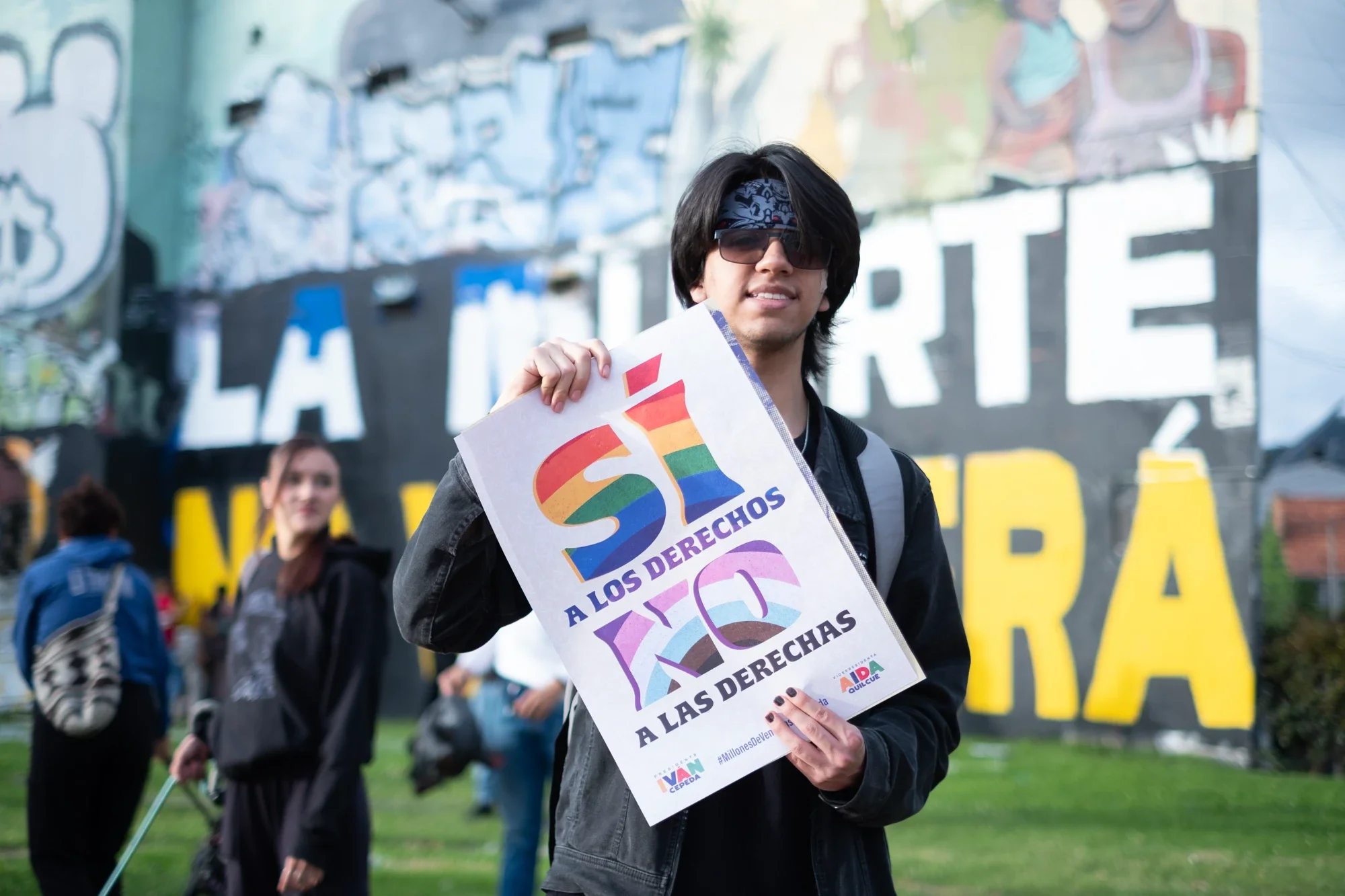
A person carries a sign reading “Yes to rights, no to the right wing” during the painting of a street mural in Bogotá on Tuesday, June 2, 2026. Photo © Mariana Mora.
A well-organized Colombian left
It must be said that Cepeda and Quilcue’s campaign was relatively insular. Various organized sectors attempted to reach out, contribute ideas, and build bridges, but encountered obstacles in doing so.
There was a tendency to close ranks, to rely on a small, trusted circle, and to use a communication style more concerned with being right than generating enthusiasm. This has felt almost like a kind of mistrust within the movement itself—a sentiment that is understandable given the disastrous scandals surrounding Petro as a result of his links with political opportunists.
Cepeda is an untarnished senator and politician, he’s an admirable figure deeply loved on the left. He has also proven to be somewhat unresponsive to sectors outside his political tradition. Culturally, he’s very Bogota-centric, even though his vice-presidential running mate is the Indigenous Nasa leader Quilcue.
Despite the fact that much of the electoral enthusiasm stemmed from the current government’s track record, and that polls fueled a certain sense of triumphalism, it is true this campaign lacked political imagination, strategic joy, and the ability to mobilize beyond core supporters.
Even so, it would be unfair to reduce the campaign to its limitations. Plazas were packed throughout the run up to the elections, as thousands of organized people from popular political traditions came together to defend a common project.
We cannot forget that this scenario is a historic achievement of popular movements—of the social and community minga (communal uprising) of 2008, of the People’s Congress and the Patriotic March in 2010, of the 2013 agricultural strike, the Ethnic, Rural and Popular Summit that brought the country to a standstill in 2016, the signing of the Peace Agreement in 2016, the youth uprising of 2019, and the social uprising of 2021.
All these moments planted the seeds of today’s mobilization and organization.
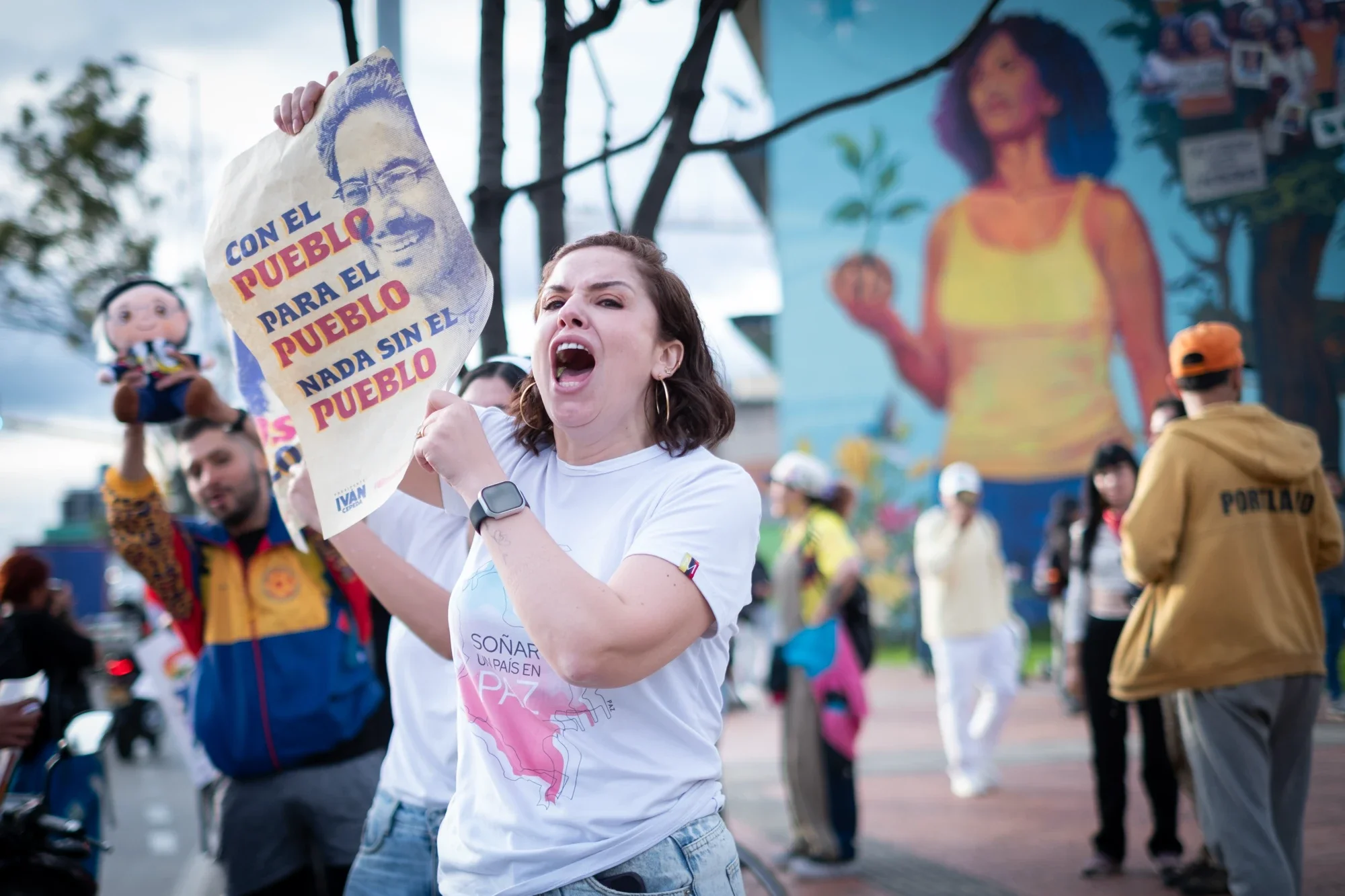
A person holds a sign reading “With the people, for the people, nothing without the people” during the painting of a street mural in Bogotá on Tuesday, June 2, 2026. Photo © Mariana Mora.
They can't take away what we've already achieved
Something extraordinary began to take place in the wake of our shared moral hangover on Monday. Impromptu assemblies, meetings, calls, and conversations were held within unions, feminist collectives, rural organizations, faith communities, friend groups, family chat groups, migrant networks, neighborhood spaces, and student circles.
Amongst the fear, sadness, and frustration being shared, we have witnessed a burst of political imagination.
This runoff will belong to those who self-organize, those who don’t ask for permission, and who will lead this political project through affection, kind words, “I love you,” and hard, hands-on work.
We have many reasons to be afraid: the Colombian right is armed, and supported by Donald Trump, by Javier Milei, by Miami. The elites have been forced to face historical grievances they refused to hear for decades. They, above all, do not want the country’s model—extractivist, capitalist, Bogotá-centric, and white—to change.
But four years are not enough. No government could, in a single term, heal the wounds accumulated over generations.
We’re aware of Petro’s mistakes and those committed by the first government that has worked for the people. Today’s campaign is not just about the presidency. It is about how the future of the country, about a future for life and a people, is organized. And no one can take away what we have already achieved.